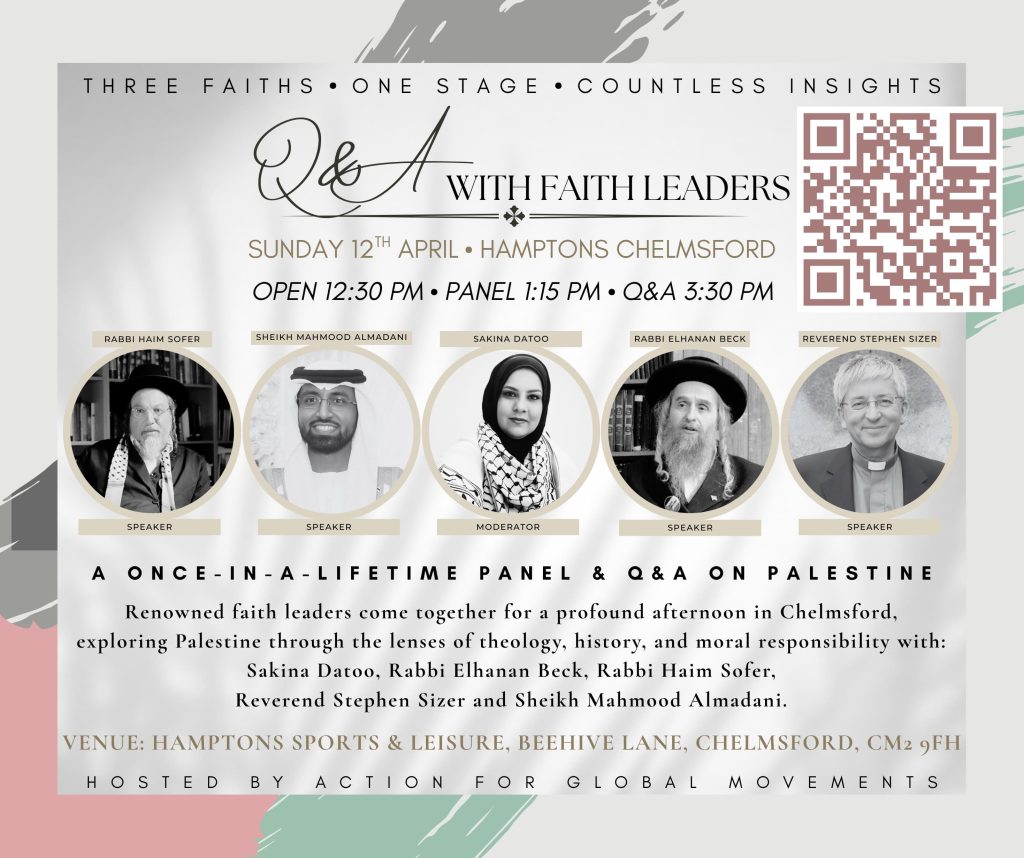
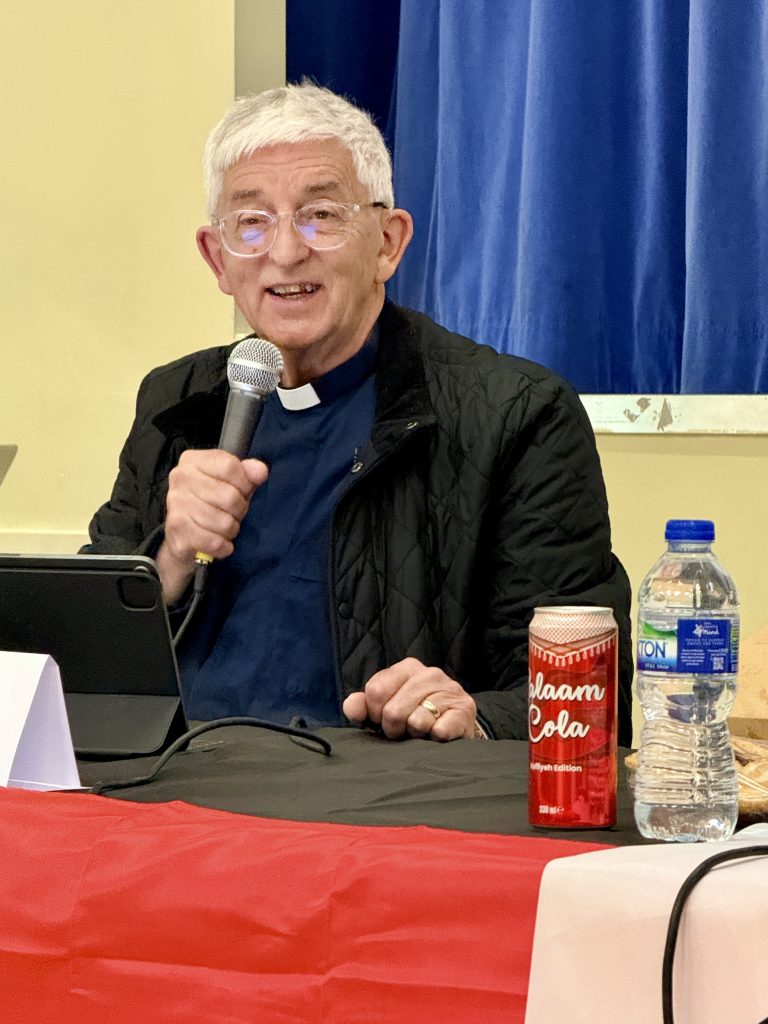
“Three Faiths. One Stage. Countless Insights.”A once in a lifetime interfaith panel discussion and Q&A on Palestine. Chelmsford Multifaith Panel
Here is a summary of my presentation:
How do colonial narratives weaponize religion as a pretext for waging war and genocide?
Colonial narratives, especially European, have often used religion as moral cover to justify conquest, exploitation, and even genocide as righteous, necessary, or divinely sanctioned. This “weaponization” works through a few recurring patterns – and I am going to focus in particular on the way Christian Zionists have weaponised religion as a pretext for waging war and genocide.
1. Moral Legitimization of Violence
Colonizers invariably present war as a ‘holy duty’ rather than a political or economic project. By claiming divine approval, violence becomes framed as obedience to God rather than human greed or emnity.
At the first of what have become monthly Christian worship services at the US Department of Defence, the personal pastor of the US defence secretary, Pete Hegseth, delivered a sermon at the Pentagon. Citing the words of Jesus from Matthew 10, Potteiger told the gathered leaders of the US military: “If our Lord is sovereign even over the sparrow’s fallings, you can be assured that he is sovereign over everything else that falls in this world, including Tomahawk and Minuteman missiles …“Jesus has the final say over all of it.”
Claiming to be a Christian, Hegseth has persisted in framing the war in Iran… as divinely sanctioned, repeatedly invoking “God’s almighty providence” and expressing certainty that God is on the side of the US military.[1]
On Holy Saturday, we held a multi-faith vigil for Palestine in the Lower Gardens in Bournemouth. We walked in solemn procession to the pier, dug a grave in the sand and buried dolls representing the 15,000+ babies killed by Israel in Gaza. I spoke briefly about the Palestinian Christian community and their resilient faith contrasted by the silent complicity and cowardice of Western church leaders unwilling to hear and respond to their cry for justice.
“Gaza today has become the moral compass of the world”,[1] insisted the Reverend Dr. Munther Isaac in his now famous 2023 Christmas sermon, entitled, “Christ in the Rubble.”[2] It is sobering to realise that for the first time in history, genocide is being recorded live on social media by the victims themselves. No one can now say they did not know.
In this short presentation, I will be reflecting on the life and teaching of Imam Ali al-Reza,[1] from a Christian perspective. This will not however, be an exhaustive or comprehensive analysis of Islamic and Christian ethical codes, but rather a comparison of some of the examples contained in the Rezavi Codes of Ethics and Selected Sayings of Imam Reza, with similar statements found in the teaching of Jesus.
Given that you will likely already be familiar with the example and teaching of Imam Reza, I will elaborate more on the teaching of Jesus to illustrate similarities and differences, recognising that Imam Reza, living many centuries after the New Testament was written, may well have been influenced by it, consciously or otherwise.
However, I am not a specialist in Islamic studies, or indeed of comparative religion. Nevertheless, I have helped organise, or have contributed to, several international conferences on Christian-Muslim dialogue, for example, with the World Islamic Call Society, Libya (2009), Fuller Theological Seminary, USA (2009); the League of Arab States in Qatar (2012) and Iraq (2013), the New Horizons conference, Iran (2014), and the Institute for Advanced Islamic Studies, Malaysia (2023).
In my own engagement with Muslims, I am deeply indebted to the Syrian Christian scholar, Chawkat Moucarry. In his life and teaching, he promotes Christian-Muslim dialogue, as well as challenges many popular stereotypes held by Christians of Muslims. In a paper entitled, “A Plea for Dialogue Between Muslims and Christians”[2], Moucarry defines dialogue in these terms:
“I take dialogue to mean a deliberate effort to engage genuinely and respectfully with each other; willingness to listen and understand; a readiness to learn and be challenged; a desire to relate to, communicate with, and be understood by one another. In Christian-Muslim dialogue, the focus is the Christian and Muslim faiths and their implications for individuals and communities in this life and the next.
For many centuries Western Christians have ignored or confronted the Muslim world. Ignoring Muslims is no longer an option in our “global village” where Muslims and Christians live next to each other. Some Christians seek to reach out to Muslims in confrontation, attacking Islam in a war of words. This approach is counterproductive as it usually inspires Muslims to become more radical in their beliefs, and often provokes an offensive reaction, too—Muslims attacking Christianity even more vehemently. A polemical engagement with Islam is also incompatible with “the gospel of peace” (Ephesians 6:15), which is about love, reconciliation, and forgiveness… Even in a heated debate the Christian apologist must refrain from polemics, personal attacks, and derisive arguments about Muslims and their religion.”
Dialogue should be understood more broadly than verbal engagement. It is a way of life: an open attitude toward others, seeking to reach out and to welcome people, including those who are different or even antagonistic.”[3]
With that objective in mind, let us now compare the example and teachings of Imam Reza and Jesus Christ.
Prepared for the Fifth Global Congress on Imam Reza, held in Mashhad, Iran, 13-14 May, 2023
[1] Rezavi Codes of Ethics: A Glance at Imam Reza’s Personal and Social Behavior (The Islamic Relations Office and Foreign Pilgrim’s Affairs of the Astan Quds Rezavi); Selected Sayings of Imam Reza by Mohammad Hakimi (Behnashr Co, Astan Quds Rezavi Publications)
Videos and photos taken at the London protest to demand an immediate #Ceasefire_In_Gaza, H.E. Dr. Husam Zomlot introduces a special guest speaker from #Palestine: the Rev. Dr. Munther Isaac. [Source]
A paper delivered at a conference organised by Astan Razavi in conjunction with the University of Tehran and Sharif University of Technology entitled, “Civilisational Thoughts of Imam Raza (peace be upon him_: Justice for all and injustice for no one.” (download a copy here)
In this short presentation I will be reflecting on the life and teaching of Imam Ali al-Raza as summarised in the Razavi Codes of Ethics,[1] comparing and contrasting them with ethical instructions taught by Jesus Christ found in the four Gospels of the New Testament. Given that those participating will likely already be familiar with the example and teaching of Imam Raza, I will elaborate more on the teaching of Jesus to illustrate similarities and differences, recognising that Imam Raza, living many centuries after the New Testament was written, may well have been influenced by it, consciously or otherwise.
This will not however, be an exhaustive or comprehensive analysis of Islamic and Christian ethical codes, but rather a comparison of some of the 13 examples contained in the Razavi Codes of Ethics with similar statements found in the teaching of Jesus.
In his first sermon Jesus announced his political agenda.
“The Spirit of the Lord is on me, because he has anointed me to proclaim good newsto the poor. He has sent me to proclaim freedom for the prisoners and recovery of sight for the blind, to set the oppressed free,to proclaim the year of the Lord’s favour.”
Then he rolled up the scroll, gave it back to the attendant and sat down. The eyes of everyone in the synagogue were fastened on him.21 He began by saying to them,“Today this scripture is fulfilledin your hearing.” (Luke 4:18-21; Isaiah 61:1-2)
The prophet Isaiah is referring to the coming of the Messiah to announce the Year of Jubilee (which occurred every 50 years). When debts were cancelled, all slaves were freed and any property sold was returned to each family. It was intended to avoid extremes of wealth and poverty, and ensure justice, liberty, and equality. Jesus insists the Jubilee had come because the Sovereign King had now arrived. Jesus political agenda therefore was to transform a deeply divided and unjust world and bring liberty, equality and fraternity, in a right relationship with the one true God and one another. Although this will ultimately only be fully realised in heaven, we get to demonstrate a foretaste by the way we treat one another.
A presentation on Christian martyrdom given at the Gulf Cultural Club, London. Watch the video here
“The early church’s theology of martyrdom was born not in synods or councils, but in sunlit, blood—drenched coliseums and catacombs, dark and still as death. The word martyr means “witness” and is used as such throughout the New Testament. However, as the Roman Empire became increasingly hostile toward Christianity, the distinctions between witnessing and suffering became blurred and finally nonexistent.” (William Bixler)[2]
John Wesley preached outdoors because the Church of England denied him a pulpit over his evangelical theology. He could have left the Anglican Church but didn’t. They didn’t want him. His theology was too evangelical. His love was too extravagant. His methods too unorthodox. So they shut him out of churches and pulpits. They could not silence Wesley. Instead he preached in the open air – in fields, markets, and cemeteries and the crowds loved him.
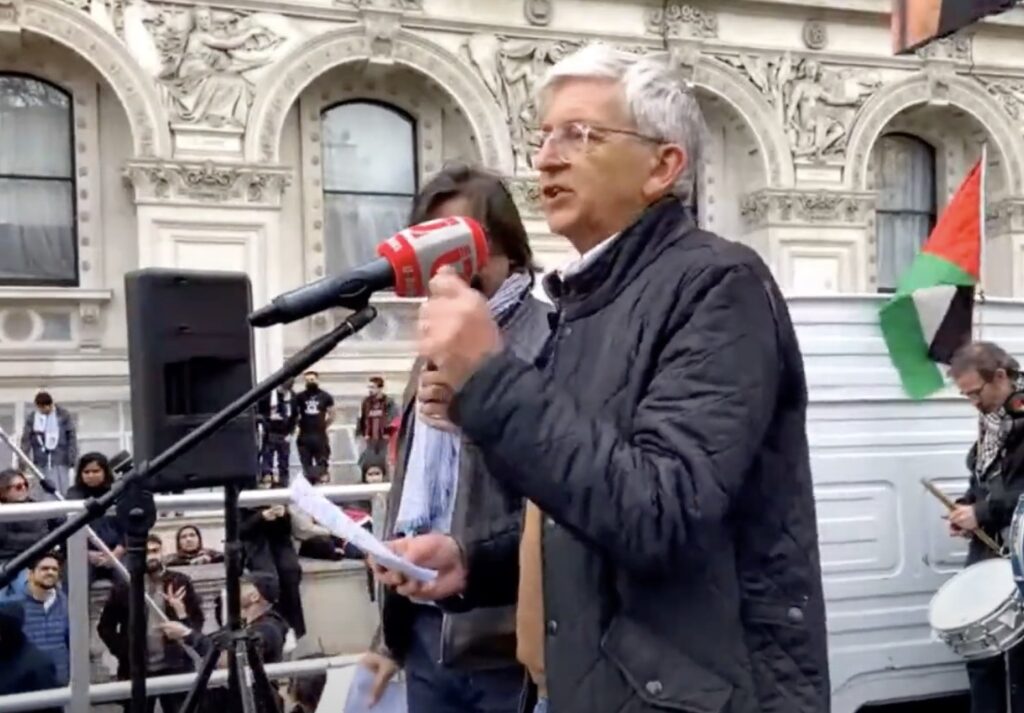
Today it was my privilege to read and expound the scriptures in the open air in Whitehall outside Downing Street before an estimated 15,000+ Jews, Muslims, Christians and those of no faith, all with police protection. It was truly one of the highlights of my ministry. (click on the photo above to watch my presentation). The text of my presentation together with photos and more short videos may be found below.
The first team of Muslim and Christian leaders have now been trained and begun to initiate peace building projects. The need is great, especially in Upper Egypt.
The plan therefore is to train five further teams in 2023. The budget for this is modest – $16,000. If you would like to support this exciting project you may do so through the Friends of the Anglican Province of Alexandria (specifying your gift is for the Peace Building Team).
You can make a donation by bank transfer in UK Sterling directly to the FAPA account: Account No: 00018311 Sort Code: 40-52-40
Peacemaker trust is delighted to promote this exciting peacemaking project and hope that you will also.
In May 2022, Archbishop Mouneer Anis, First Archbishop of the Anglican Province of Alexandria, launched the Centre for Christian Muslim Understanding and Partnership at All Saints Cathedral in Cairo. The vision is to promote peace and harmony between faith communities through more understanding of faiths, cultures and through working together for the common good. Read more here.