Category Archives: Middle East

Blessing the Children of Abraham: An Annotated Bibliography

“I am not ashamed of the gospel, because it is the power of God that brings salvation to everyone who believes: first to the Jew, then to the Gentile.” (Romans 1:16)

Various  attempts have been made in recent years to broaden the definition of anti-Semitism to both criticise those engaged in evangelism among Jewish people as well as those who question the continued Israeli occupation of Gaza, the Golan and the West Bank. Neither is necessarily true although it sometimes is.

However, articles such as  “Anti-Zionist Attacks on Church and Messianic Group” (since removed from Moriel’s website but still endorsed by them) appears on a website associated with Christian Friends of Israel. They blame my writings for attacks against Jewish people and Christians here and abroad.

Jacob Prasch states, “We additionally agree that articles citing Sizer’s anti-Zionist and anti-Christian Zionist propaganda republished in radical Islamic publications are contributing to the incitement of Moslem attacks on churches in the UK are excellently written… But now he stands publicly accused by some sources (none published by Moriel) of having his articles against Christian Zionists used to help incite attacks on churches in the UK in the same manner radical Moslems attack churches in Islamic countries.”

Besides being economical with the truth (Moriel did publish the above article – it was accessible on 10th March 2009) these allegations are unproven and defamatory. Nothing could be further from the truth. When ever I am invited to speak, especially at interfaith gatherings, I present a Christian perspective that repudiates the use of violence to resolve injustice, and instead calls for active peacmaking efforts with the purpose of achieving reconciliation.

In Zion’s Christian Soldiers, I stress that it is important to distinguish between Judaism, Israel and Zionism as well as repudiate the use of violence to bring an end to the Arab-Israeli conflict.

“Judaism is a religious system. Israel is a sovereign nation. Zionism is a political system. These three are not synonymous. I respect Judaism, repudiate anti-Semitism, encourage interfaith dialogue and defend Israel’s right to exist within borders recognised by the international community…”

In Christian Zionism, I distinguish between three strands of Christian Zionism – Messianic, Apocalyptic and Political. Messianic and Jewish Christian organisations that are primarily evangelistic, such as the Churches Ministry Among Jewish People (CMJ), Christian Witness for Israel (CWI) and Jews for Jesus (JFJ) must be distinguished from those primarily having a social or political ministry, such as Bridges for Peace (BFP), Christian Friends of Israel (CFI), Christian Friends of Israeli Communities (CFOIC) and the International Christian Embassy Jerusalem (ICEJ). I am in the process of revising the book as the emphasis of some of these agencies has evolved over time and new ones have emerged such as John Hagee’s Christians United for Israel (CUFI) and Mike Evans’ Jerusalem Prayer Team.

How big is this movement? The Pew Forum on Religion and Public Life estimates there are 20-40 million supporters in America. The Unity Coalition for Israel draws together over 200 different organizations and claims 40 million active members. John Hagee has weekly access through TV and radio to 99 million homes in 200 countries. Hagee is just one of thousands of other pastors, television evangelists, authors and politicians who identify with Christian Zionism.

Whether they welcome it is another matter, but I endorse those ministries committed to presenting the good news of Jesus Christ to Jewish people, defending the existence of a safe homeland for the Jewish people, combating anti-Semitism and enhancing the understanding of the Gentile church as to our Jewish origins.

“I ask then: Did God reject his people? By no means! I am an Israelite myself, a descendant of Abraham, from the tribe of Benjamin. God did not reject his people, whom he foreknew.” (Romans 11:1-2)

That is why I have willingly contributed to Messianic conferences in South Africa and Israel, debated with Jewish rabbis and academics, dialogued with Zionists on radio and theological colleges as well as have met with representatives of agencies such as CMJ and CWI, for example, on a regular basis.

My books have been endorsed by Jewish academics such as Dr Jeff Halper, Rabbi Professor Dan Cohn-Sherbok and Professor Norton Mezvinsky

Jeff Halper writes,”Everyone loves peace, but not everyone loves peace-makers. The work of people like Stephen Sizer is crucial to peace-making. “Peace” is not merely a goody-goody term that we use on Christmas or Passover. It has to do with hard realities like conflict, injustice and suffering, all of which require not only good will, but an analysis which identifies the causes of the conflict and offers a way out. Hardest of all, peace-making requires self-reflection, self-criticism and the ability to see the viewpoint of the Other, the “enemy,” especially when “your side” is involved. And one more thing is essential to peace-making: an ability to reach out, even to your detractors, so that a common ground of action can be established.

In all these things my fellow peace-maker Stephen excels. Over the years he has shown both courage and good-will, but most important, in my mind, he has provided us with tough analysis, primarily around issues dealing with Christian Zionism, a fundamental obstacle to a just peace in Israel and Palestine, that helps us get to the foundations of the conflict in order to resolve it. One would think Stephen’s work would be appreciated by everyone – Christian Zionists excepted, (although a sizeable number of critical Evangelicals do support his analysis). His seminal book, Christian Zionism, accompanied by films and presentations, provides an authoritative de-bunking of the spurious theology underlying that school’s seemingly “pro-Israeli” positions which make genuine peace-making so difficult.

Why Stephen is attacked and demonized by the organized Jewish community is an absolute mystery to me. After all, Christian Zionism is supremely anti-Semitic: at the End of Days those Jews who do not accept Jesus die. Indeed, the Jews are sacrificed in the battle of Armageddon; witness Pat Robertson’s outrage at Israeli Prime Minister Ehud Olmert when he ended the attack on Lebanon in 2006, an attack that, in the eyes of Robertson and other Christian Zionists, was supposed to trigger Armageddon – no matter what befalls the Jews/Israelis. Jewish demonization of Stephen, rather than of the Christian Zionists, who Jewish and Israeli leaders cynically consider our allies,” demonstrates nothing more than bad faith. It is perfectly acceptable, apparently, to be anti-Semitic if, like Robertson, you are “pro-Israel.” Simply professing a doctrine in which the Jewish people is exterminated and disappears is no crime, in their view, as long as it somehow serves short-term Israeli interests (and Stephen shows that Christian Zionism does not serve Israeli or Jewish interests in any way).

Ironically, then, it is the peace-makers – anti-anti-Semites like Stephen and even critical Israeli Jews like me – who are the enemy. If that is the case, then all the protestations of the Jewish community against anti-Semitism are hollow. What they really mean is, be anti-Semitic by all means if you combine that with a pro-Israeli position, but woe be unto those who fight such an anti-Semitic creed as Christian Zionism because by opposing Christian Zionism you are somehow opposing Israel. In attacking Stephen in his criticism of Christian Zionism, Jewish leaders have gone so far as to define “pro-Israeliness” in anti-Semitic terms.

But peace-makers are themselves tough people, willing and able to face down bigotry and bad faith. Indeed, this willingness and ability are what makes us peace-makers. To the organized Jewish community I would only say, as an Israeli Jew: remove your moral and intellectual blinders so as to be able to differentiate your true (if critical) friends from your true enemies.” Jeff Halper, Jerusalem, April 8, 2009.

My books have also received critical but constructive reviews from David Pawson and Tony Higton.

“my fellow Zionists… will be disturbed by my agreement with much of Sizer’s criticism of this position.” (p. 19). “I am grateful to Stephen Sizer for drawing attention to the legitimate criticisms of dispensational Zionism. He has rendered a service to the cause of Zionism which was needed.” (David Pawson, Defending Christian Zionism, p. 39)

“After years of sparring, Stephen Sizer and I met up and found we had wide areas of agreement. Having worked in Jewish ministry for seven years, half of them in Jerusalem, I have seen the best and worst of Christian Zionism. Insofar as it combats anti-Semitism, defends the existence of a safe homeland for Jewish people, promotes evangelism among Jewish people, and supports reconciliation in the Holy Land, it is good. However, Sizer is right to criticize the serious failings of some Christian Zionism. I agree with him in rejecting the following errors which are held by many Christian Zionists:

  • Lack of godly compassion for the Palestinians, and of concern for their human rights and about their legitimate aspirations.
  • A negative attitude toward Palestinians, and Arabs in general, to the point of racism.
  • Uncritical support for Israel (a secular, sinful state like any other), justifying all its actions against the Palestinians.
  • Neglecting or even opposing and forbidding evangelism of Israelis, sometimes believing that Jewish people can experience salvation through Judaism.
  • Being more interested in the fulfilment of prophecy than in application of kingdom principles such as justice and reconciliation.
  • Opposing the peace process.
  • Sometimes advocating the ethnic cleansing of Palestinians from the Holy Land.
  • Sometimes supporting the rebuilding of the temple regardless of the problematic theological implications and the danger of provoking extreme violence.” (Tony Higton, A Critique of Christian Zionism, p. 18)

Over the years we have also hosted events in our church for CMJ and Jews for Jesus and regularly invite a local Jewish Christian pastor to speak at our monthly men’s breakfasts. Our church family include several who are Jewish or identify with Messianic Judaism. They seem comfortable with my own views, despite attempts by at least one anonymous blogger to change their mind having gained access to our church Facebook account. Offers to meet face to face and resolve his or her concerns proved fruitless.

“Rather, we have renounced secret and shameful ways; we do not use deception, nor do we distort the word of God. On the contrary, by setting forth the truth plainly we commend ourselves to every man’s conscience in the sight of God.” (2 Corinthians 4:2)


An Annotated Bibliography

The following list is partial and subjective but these books have been helpful, at least to me, in understanding and distinguishing between Judaism, Israel and Zionism and the necessity of Christian witness among Jewish people.

Light Force Brother Andrew
Wrongly accused of being anti-Israel, Brother Andrew replies, “The best way I can help Israel is by leading her enemies to Jesus Christ.” He shows that genuine dialogue is possible based on our common humanity. Should we really be surprised, he asks, to discover that so called terrorists are human beings like you and me created in the image of God? Dr. Carl Moeller, president of Open Doors USA, summarises the importance of this unique book. “Light Force is a riveting and often provocative book. The book details Brother Andrew’s passion and compassion for the Church and bringing the Light of Jesus to one of the world’s on-going hot spots. Like God’s Smuggler, it is compelling reading. By reading the daily headlines from the Middle East, we know Light Force will be both timely and relevant.”

Israel: Land of God’s Promise: Murray Dixon
Israel is the most misunderstood nation on the planet. The Jewish people are the most consistently persecuted in all of history – ancient and modern – why? Can the Church afford to pursue its historically notorious treatment of the Jew and the nation of Israel? This book offers clarity where confusion abounds. The author compels us to examine Church history and Jewish history in the light of God’s word. Jesus is Jewish and so are the roots of the Christian faith – why is that significant? No nation, ever, has been regathered from worldwide dispersion to its ancient homeland, and speaking its ancient language – except Israel. And that, only, after man’s most hideous crime, to attempt to exterminate them – why?

Atlas of the Holocaust: Martin Gilbert
The atlas traces each phase of the Holocaust, beginning with the anti-Semitic violence of prewar Germany and leading to the German conquest of countries in which the Jews had lived for centuries. Presented in chronological order, the maps document in compelling detail, month by month and week by week, the story of the Holocaust, from the spread of the early random killings of Jews and their systematic mass expulsion from thousands of towns and villages to the establishment of ghettos and the setting up of the death camps. The atlas ends with the death marches and executions in the final days of the Allied liberation. Also shown on the maps are more than two hundred acts of resistance and revolt, as well as areas of Jewish partisan activity and other avenues of escape and rescue. Many maps tell the stories of hundreds of children deported to their deaths. Others bear witness to individuals active in revolt and tell moving sagas of their courage and defiance.

No Strange God: Gordon Jessup
An outline of Jewish life and faith. Revised edition of this classic work which helps Christians understand their Jewish neighbours.

Christian Witness to the Jewish People: Lausanne Occasional Papers
This report, is one of a series of Lausanne Occasional Papers (LOPs) emerging from the historic Consultation on World Evangelization (COWE) held in Pattaya, Thailand, in June 1980.

Judaism is Not Jewish: Baruch Maoz
People from a Jewish background face difficult choices when they trust in Jesus as the Jewish Messiah. Baruch Maoz, the leader of a Christian Church in Israel, believes that to be Jewish is a blessing from God. The strong Jewish cultural identity impacts on worship and life so how does a Jewish Christian worship with his Gentile brothers and sisters? If they join churches will they be assimilated? If they establish synagogues will their fellow Christians feel excluded? The response that some Jewish Christians have decided upon is to establish a fourth branch of Judaism called Messianic Judaism (the others are Orthodox, Conservative and Reform). Baruch accepts there are fine Christians within the movement but shows how Jewish life is not the same as synagogue life. He enables Jewish Christians to retain a cultural identity without losing fellowship with other Christians.

c

The Israel Lobby and US Foreign Policy: John Mearsheimer and Stephen Walt
How a powerful American interest group has created havoc in the Middle East, damaged Israel itself and now threatens an even more perilous future. The Israel Lobby by John J. Mearsheimer of the University of Chicago and Stephen M. Walt of Harvard’s John F. Kennedy School of Government, was one of the most controversial articles in recent memory. Originally published in the London Review of Books in March 2006, it provoked both howls of outrage and cheers of gratitude for challenging what had been a taboo issue in America: the impact of the Israel lobby on U.S. foreign policy. Now in a work of major importance, Mearsheimer and Walt deepen and expand their argument and confront recent developments in Lebanon and Iran. They describe the remarkable level of material and diplomatic support that the United States provides to Israel and argues that this support cannot be fully explained on either strategic or moral grounds. This exceptional relationship is due largely to the political influence of a loose coalition of individuals and organizations that actively work to shape U.S. foreign policy in a pro-Israel direction. Mearsheimer and Walt provocatively contend that the lobby has a far-reaching impact on America’s posture throughout the Middle East—in Iraq, Iran, Lebanon, and toward the Israeli-Palestinian conflict—and the policies it has encouraged are in neither America’s national interest nor Israel’s long-term interest. The lobby’s influence also affects America’s relationship with important allies and increases dangers that all states face from global jihadist terror. You can read the London Review of Books article that inspired the book here.

Rabbis Meet Jesus the Messiah: Messianic Good News
This book contains the moving and exciting testimonies of twenty four Rabbis, each of whom were brought to the wonderful, but startling revelation that Jesus is the Messiah through a careful and diligent study of the Scriptures. Part of the purpose of this book is to refute the view expressed by various Jewish leaders throughout the ages that only worthless, ignorant and mentally feeble Jews are likely to be believers in Christ and to accept his teachings as recorded in the New Testament. Contrary to this, the Rabbis mentioned in the book, had all received rabbinical ordination, having been thoroughly schooled in the traditions of their fathers and the teachings of Judaism. This book also corrects the misconception that when a Jew becomes a believer in Yeshua – Jesus, he becomes a traitor (meshumid) to the Jewish people and ceases to be Jewish. It must be emphasised that the turning away from sin to God, is the fulfillment of what it really means to be a Jew. These testimonies are presented as a source of inspiration and encouragement to readers and to those who are faced with the same challenge today.

Abandoned: Stan Telchin
What’s the problem with Messianic Judaism? Stan Telchin, a Messianic Jew and former pastor, explores in depth the heart and soul of Messianic Judaism. He exposes the motive behind its creation, its controversial doctrines and its ineffectiveness in Jewish evangelism. Messianic Judaism has grown significantly in fewer than four decades. While intended originally to appeal to Jewish people, unexpectedly it appeals primarily to Gentiles. Telchin, in following the teaching of the apostle Paul, sees Messianic Judaism as divisive. With a firm and loving approach, he addresses the dangers of this movement, reiterates God’s intention for His Church to serve as “one new man” and, most importantly, advocates unity among the body of believers.

Anti-Semitism: Dan Cohn-Sherbok
Dan Cohn-Sherbok traces the origins of anti-Semitism and its manifestations, from political opposition, to racial persecution and religious and philosophical justifications for some of history’s most outrageous acts. Against this background of intolerance and persecution, Cohn-Sherbok describes Jewish emancipation from the late 18th century and its gradual transformation into the parallel political and nationalistic ideal of Zionism. He explores how, in the post-war period, anti-Semitism, already triggered by 19th-century Zionism and the formation of a Jewish settlement in Palestine at the end of the 19th century, has become rampant in the Arab world. Finally, he discusses how specific strands of anti-Semitism have arisen in the United States largely as a result of conflict between African-Americans and Jews, and how in Russia and Poland anti-Semitism is as strong as ever. The book covers all historical periods up to the present day and is written for the general reader.

The Iron Wall: Israel and the Arab World: Avi Shlaim
In the 1920s, hard-line Zionists developed the doctrine of the Iron Wall: negotiations with the Arabs must always be from a position of military strength. This doctrine, argues Avi Shlaim, became central to Israeli policy; dissenters were marginalized and many opportunities lost. Drawing on a great deal of new material and interviews with many key participants, Shlaim places Israel’s political and military actions under an uncompromising lens. The result is a fresh and informed account of one of the world’s most intractable conflicts of modern times.

Not Ashamed: The Story of Jews for Jesus: Ruth Tucker
Not Ashamed tells the remarkable story of how a small band of young Jewish believers became the world’s best-known Christian ministry to the Jewish people. Historian Ruth A. Tucker affectionately describes them as a “mission with an attitude.” She pulls no punches in presenting their triumphs and flops, and their often-controversial methods for winning souls and facing down hostile opposition. You’ll find more than fascinating history in Not Ashamed. You’ll discover the underlying connections between Christianity and Judaism and the reasons for centuries of conflict between Christians and Jews. Most important of all, you’ll come to understand the passion behind Jews for Jesus as they bring the message of the Messiah to their own people.

An annotated bibliography of books on Islam will follow.

Radical Islam: How to live with it

What is an appropriate response to radical Islam? Weapons grade rhetoric that calls down fire from heaven to ignite the apocalypse or passive acquiescence that leads to dhimmitude and interfaith worship? Does it have to be one or the other? Racism or appeasement? The clash of civilisations or the Islamisation of the West?

Fareed Zakaria, writing in Newsweek suggests we must learn to live with radical Islam. Writing from an Islamic perspective he insists, “We don’t have to accept the stoning of criminals. But it’s time to stop treating all Islamists as potential terrorists.”

In what many coinsider his finest piece of writing in Newsweek, Zakaria makes a convincing case for why the West needs to adopt a more “sophisticated strategy” toward Radical Islam.

Pierre Tristam, writing for about.com summarises this important article: “The current with-us-or-against-us business won’t do, Zakaria argues, with eight years of evidence on his side. Not every radical Islamic regime is a synonym of al-Qaeda.”

Zakaria admits, “The militants are bad people and this is bad news. But the more difficult question is, what should we—the outside world—do about it? That we are utterly opposed to such people, and their ideas and practices, is obvious. But how exactly should we oppose them? In Pakistan and Afghanistan, we have done so in large measure by attacking them—directly with Western troops and Predator strikes, and indirectly in alliance with Pakistani and Afghan forces. Is the answer to pour in more of our troops, train more Afghan soldiers, ask that the Pakistani military deploy more battalions, and expand the Predator program to hit more of the bad guys? Perhaps—in some cases, emphatically yes—but I think it’s also worth stepping back and trying to understand the phenomenon of Islamic radicalism.”

There is realism in his assessment of the threat posed by Islamists: “Reports from Nigeria to Bosnia to Indonesia show that Islamic fundamentalists are finding support within their communities for their agenda, which usually involves the introduction of some form of Sharia—Islamic law—reflecting a puritanical interpretation of Islam. No music, no liquor, no smoking, no female emancipation.The groups that advocate these policies are ugly, reactionary forces that will stunt their countries and bring dishonor to their religion. But not all these Islamists advocate global jihad, host terrorists or launch operations against the outside world—in fact, most do not.”

He cites examples in Pakistan and other countries where attempts have been made to distinguish between Islamists who are violent and those who are extreme.

“Over the past eight years such distinctions have been regarded as naive. In the Bush administration’s original view, all Islamist groups were one and the same; any distinctions or nuances were regarded as a form of appeasement. If they weren’t terrorists themselves, they were probably harboring terrorists. But how to understand Afghanistan and Pakistan, where the countries “harbor” terrorists but are not themselves terrorist states?”

Zakaria also warns us not to over-estimate the influence of Al Qaeda:

“To be clear, where there are Qaeda cells and fighters, force is the only answer. But most estimates of the number of Qaeda fighters in Pakistan range well under a few thousand. Are those the only people we are bombing? Is bombing—by Americans—the best solution? The Predator strikes have convinced much of the local population that it’s under attack from America and produced a nationalist backlash. A few Qaeda operatives die, but public support for the battle against extremism drops in the vital Pashtun areas of Pakistan. Is this a good exchange?”

The danger Zakaria highlights is that believing in the existence of an “Axis of Evil” and Huntingdon’s theory  is becoming a self fulfilling prophecy.

“We have placed ourselves in armed opposition to Muslim fundamentalists stretching from North Africa to Indonesia, which has made this whole enterprise feel very much like a clash of civilizations, and a violent one at that. Certainly, many local despots would prefer to enlist the American armed forces to defeat their enemies, some of whom may be jihadists but others may not. Across the entire North African region, the United States and other Western powers are supporting secular autocrats who claim to be battling Islamist opposition forces. In return, those rulers have done little to advance genuine reform, state building or political openness. In Algeria, after the Islamists won an election in 1992, the military staged a coup, the Islamists were banned and a long civil war ensued in which 200,000 people died. The opposition has since become more militant, and where once it had no global interests, some elements are now aligned with Al Qaeda.”

Zakaria then examines the painful lessons learnt by the Bush Administration in Iraq and Afghanistan:

“We have an instant, violent reaction to anyone who sounds like an Islamic bigot. This is understandable. Many Islamists are bigots, reactionaries and extremists (others are charlatans and opportunists). But this can sometimes blind us to the ways they might prove useful in the broader struggle against Islamic terror. The Bush administration spent its first term engaged in a largely abstract, theoretical conversation about radical Islam and its evils—and conservative intellectuals still spout this kind of unyielding rhetoric. By its second term, though, the administration was grappling with the complexities of Islam on the ground. It is instructive that Bush ended up pursuing a most sophisticated and nuanced policy toward political Islam in the one country where reality was unavoidable—Iraq.”

Zakaria urges the new US Administration to break with the Bush model of doing geopolitics.

“Beyond Afghanistan, too, it is crucial that we adopt a more sophisticated strategy toward radical Islam. This should come naturally to President Obama, who spoke often on the campaign trail of the need for just such a differentiated approach toward Muslim countries. Even the Washington Institute, a think tank often associated with conservatives, appears onboard. It is issuing a report this week that recommends, among other points, that the United States use more “nuanced, noncombative rhetoric” that avoids sweeping declarations like “war on terror,” “global insurgency,” even “the Muslim world.” Anything that emphasizes the variety of groups, movements and motives within that world strengthens the case that this is not a battle between Islam and the West. Bin Laden constantly argues that all these different groups are part of the same global movement. We should not play into his hands, and emphasize instead that many of these forces are local, have specific grievances and don’t have much in common.”

“That does not mean we should accept the burning of girls’ schools, or the stoning of criminals. Recognizing the reality of radical Islam is entirely different from accepting its ideas. We should mount a spirited defense of our views and values. We should pursue aggressively policies that will make these values succeed. Such efforts are often difficult and take time—rebuilding state structures, providing secular education, reducing corruption—but we should help societies making these efforts. The mere fact that we are working in these countries on these issues—and not simply bombing, killing and capturing—might change the atmosphere surrounding the U.S. involvement in this struggle.”

Counselling a dose of realism Zakaria concludes,

“The veil is not the same as the suicide belt. We can better pursue our values if we recognize the local and cultural context, and appreciate that people want to find their own balance between freedom and order, liberty and license. In the end, time is on our side. Bin Ladenism has already lost ground in almost every Muslim country. Radical Islam will follow the same path. Wherever it is tried—in Afghanistan, in Iraq, in parts of Nigeria and Pakistan—people weary of its charms very quickly. The truth is that all Islamists, violent or not, lack answers to the problems of the modern world. They do not have a world view that can satisfy the aspirations of modern men and women. We do. That’s the most powerful weapon of all.”

Tristam summarises Zakaria thus: “Zakaria resolves the contradiction by suggesting that accepting that fundamentalist wave, dealing with it, letting it unravel of its own, is a far smarter strategy than any attempt to bomb it. Again, evidence is on his side.”

Between annihilation and assimilation there is a third way: constructive engagement.

Melanie Phillips: Beware The New Axis of Evangelicals and Islamists

Melanie Phillips’ article “Beware the New Axis of Evangelicals and Islamists” published in the Spectator last week is libellous. It contains untruthful statements about me which may injure my reputation or standing in the community.

I have never said that I wish Israel, in her words, “to be destroyed” or to “disappear just as did the apartheid regime in South Africa.” I have never believed this and categorically reject any position that threatens the integrity of Israel as a sovereign nation.

On the contrary I have repeatedly stated in writing (for example here, here and here) that I wish to see a safe and secure Israel with internationally recognised borders, alongside a sovereign, viable, independent Palestine.

I have, however, spoken out against Holocaust denial as well as religious extremism. I have also highlighted British involvement in saving Jewish people from the Nazi Holocaust. I have specifically challenged Christians who see nothing incompatible with membership of the BNP.

Far from seeking to “appease radical Islam”, I have criticised Islamist attacks against Christians in Iraq here and here, as well as in Afghanistan. I have challenged Iran’s human right’s record here and here and commended an important book about the Church in Iran here.

I have never knowingly, to use her words, “given interviews to, endorsed or forwarded material from American white supremists and Holocaust deniers”. My publisher in the USA, InterVarsity Press, occasionally arrange TV and radio interviews for me with Christian stations to promote my books. I trust their judgement.

On her use of the term “islamofacism“, I subscribe to the view of a leading authority on Fascism, Walter Laqueur, who concluded that “Islamic fascism, Islamophobia and antisemitism, each in its way, are imprecise terms we could well do without but it is doubtful whether they can be removed from our political lexicon.” The best piece of writing I have seen recently on “Radical Islam” is by Fareed Zakaria in Newsweek.

I keep an extensive and growing mailing list and am no more responsible that Melanie Phillips is for how others make use of material I write, or forward, which is invariably from mainstream newspapers and journals. Unlike those who choose to use anonymous blogs and websites to express their opinions, I have made my own views plain and my external ministry public.

“we have renounced secret and shameful ways; we do not use deception, nor do we distort the word of God. On the contrary, by setting forth the truth plainly we commend ourselves to every man’s conscience in the sight of God.” (2 Corinthians 4:2).

To clarify my position and to anticipate such criticisms, in my book Zion’s Christian Soldiers?, I wrote the following:

“It is true that at various times in the past, churches and church leaders have tolerated or incited anti-Semitism and even attacks on Jewish people. Racism is a sin and without excuse. Anti-Semitism must be repudiated unequivocally. However, we must not confuse apples and oranges. Anti-Zionism is not the same thing as anti-Semitism despite attempts to broaden the definition. Criticising a political system as racist is not necessarily racist. Judaism is a religious system. Israel is a sovereign nation. Zionism is a political system. These three are not synonymous. I respect Judaism, repudiate anti-Semitism, encourage interfaith dialogue and defend Israel’s right to exist within borders recognised by the international community and agreed with her neighbours. But like many Jews, I disagree with a political system which gives preference to expatriate Jews born elsewhere in the world, while denying the same rights to the Arab Palestinians born in the country itself.”

I endorse the position taken by the Heads of Churches in Israel regarding the need for a peaceful resolution of the conflict.

Others such as former US President Jimmy Carter and Archbishop Desmond Tutu have made comparisons between Israeli policies in the Occupied Territories and South Africa under apartheid.

I do wish to see the present illegal occupation of Gaza, the Golan and the West Bank “disappear”, but only as a result of the peaceful implementation of all relevant UN Resolutions, the Roadmap to Peace previously agreed by the US, EU, Russia and UN in April 2003, and Annapolis Agreement of November 2007 and Quartet Statement of December 2008.

I have a high regard for Bishop Michael Nazir-Ali and the courageous stand he has taken on inter-faith as well as ecclesiastical issues. Indeed I helped organise and promote his recent visit to Guildford Diocese.

I also deeply regret hearing that Patrick Sookhdeo has received a death threat as a result of writing his recent book, Global Jihad. Unfortunately, it is increasingly common. I have too. Veiled threats even feature on pro-Zionist Christian websites that seem to want me dead. Another example on the same website has the author lament, “Unfortunately (in my opinion) we no longer publicly and immediately stone false prophets to death.” then a few sentences later asserts, “One of the latest in a very long line of succession is a false teacher by the name of Stephen Sizer.” Thankfully, the police take these threats seriously and have arranged a measure of additional protection for my family also.

Back to Melanie Phillips. Her inflammatory alleagations about my involvement in interfaith conferences or TV programmes, alongside Jewish or Islamic leaders, is a tried and tested method intended to alienate, isolate and silence the views of those deemed critical of her own. Prior knowledge of, or agreement with, the views of others invited onto radio or TV programmes or conference platforms is not a significant criteria I use to decide whether to participate. Gaining a hearing for an explicitly Christian perspective committed to peacemaking and non-violence is.

What saddened me most, however, about Melanie Phillips’ article, were her concluding remarks criticising the Archbishops and Bishops of the Church of England. This is what she wrote:

“Many will be deeply shocked that the Church of England harbours individuals with such attitudes. But the church hierarchy is unlikely to act against them. Extreme hostility towards Israel is the default position among bishops and archbishops; while the establishment line is to reach out towards Islam in an attempt to accommodate and appease it. With Christians around the world suffering forced conversion, ethnic cleansing and murder at Islamist hands, the church utters not a word of protest. Instead, inter-faith dialogue is the order of the day…”

I have been a Christian minister for just short of 30 years but have yet to meet a priest, let alone a Bishop or Archbishop who displays, “extreme hostility towards Israel” or who wishes to “accommodate and appease” Islam. Just the reverse. While there is clearly a spectrum of opinion on the best way to resolve the Arab-Israeli conflict within the House of Bishops, and the most appropriate way to present the good news of Jesus Christ in a multi-faith context, they are nevertheless united in opposing racism and religious intolerance whether directed toward Jewish people or Muslims.

One has to ask what has motivated her to compose such a mendacious and libellous caricature of Christians within the Church of England concerned for justice and peace in the Middle East? Is it to deflect attention from Israel’s recent wanton killing spree in Gaza? Or was it written out of frustration at the decision of the Church of England Synod to divest its shares in Caterpillar? Or just part of the wider Zionist lobby targetting Barak Obama’s new Administration? Or is it perhaps a precursor to an imminent pre-emptive attack against Iran? Lets hope not otherwise it won’t be the libel or calumny we are debating but whether her friends who seem anxious for Armageddon are right after all.

For answers – check out Melanie’s Wiki entry – that bastion of ‘objectivity’ and truth. It alleges,

“Phillips strongly defends Israel and its actions. She argues the Palestinians are an “artificial” people who can be collectively punished for acts of terrorism by Islamist terrorists because they are “a terrorist population”. She believes that while “individual Palestinians may deserve compassion, their cause amounts to Holocaust denial as a national project”.[12] She has repeatedly claimed that footage of those injured in Israeli attacks on Palestinian areas has been “fabricated/faked”.[13][14]

She frequently accuses Israel’s critics (including many Jews) of being motivated by anti-Semitism. She has described the paper “The Israel Lobby and U.S. Foreign Policy” written by John Mearsheimer and Stephen Walt as a “particularly ripe example of the ‘global Zionist conspiracy’ libel” and expressed her astonishment at what she calls “the fundamental misrepresentations and distortions in the paper”.[15]

In a recent article, she criticised the membership and leadership of the Anglican and Roman Catholic churches in Britain, and specifically the Archbishop of Canterbury, Dr. Rowan Williams, accusing them of antisemitism because of remarks made by the Archbishop about the plight of Bethlehem Christians under Israeli occupation; another factor was an opinion poll showing that the majority of Anglicans were opposed to the Israeli occupation of the West Bank. The article ended with a condemnation of what she sees as the churches’ failure to criticise the President of Iran’s desire to “destroy Israel”,[16] and that “the churches in Britain are not only silent about the genocidal ravings emanating from Iran but are themselves helping pave the way for a second Holocaust“.[17]

I think its time Melanie came back to church and stopped telling porkies.

For the official response from the Church of England – see here.

Freedom of Speech and Blasphemy: Lior Shlein and Jesus Christ

Israel’s Channel 10 talk show mocks Christianity

Lior Shlein, the comedian and host of Israeli TV Channel 10’s late night talk show, kicked up a storm last week when he mocked the Virgin Mary and Lord Jesus Christ. In two separate shows aired on February 15th and 16th Shlein suggested Mary was a promiscuous teenager and became pregnant at 15 through a school friend. Shlein also jokingly claimed that Jesus died at 40 because he was obese. He could never have walked on water apparently because he too ashamed to leave his house, let alone go to the Sea of Galilee in a swimming costume.

The clip, originally on YouTube here was withdrawn by Channel 10 allegedly for copyright reasons. However it has been discussed and reported extensively on Arabic TV channels. Some of these are viewable on YouTube such as on Al Manar and Al Jazeera and here with English subtitles, although the images are themselves self explanatory.

The Transcript

The website of the Latin Patriarch has gone one step further and transcribed the text of the programme:

Scene from 16/2

Announcer: We will talk about the “Vatican” the Christian church. It’s annoying really annoying……..Every time, new one denies the holocaust, cardinals, archbishops, priests, monks, or choir-boy who has been rapped by the others…….. (Laughs) Audience…… laughing

Announcer: He laughs less than the audience. They are denying the Holocaust and instead of getting angry, I decided to hit back. ……to deny the Christianity…….. I am not laughing, that’s true, and I am not laughing. Some one have to teach them a lesson and that is what we will do. Now, every night we denies different things, the Christian Church telling you remember yesterday, we denied the fact that Jesus walked on water, an now here is the movie…….

Continue reading

A Palestinian Christian Cry for Reconciliation: Naim Stifan Ateek

Twenty years in the writing, Canon Naim Ateek’s long awaited sequel to Justice only Justice, may prove to be the most important work ever written by a Palestinian theologian.
For those who know and respect Canon Ateek and the reconciliation work of the Sabeel Liberation Theology Centre in Jerusalem, the title says it all: A Palestinian Christian Cry for Reconciliation. He is unwavering in his conviction that “Our God-given mandate is to see that an enduring peace is achieved in the Middle East” (p. xiii). The book explains the reasons for the struggle for justice; the tortuously slow progress made in the last twenty years; why successive peace agreements have failed; and why reconciliation between Palestinians and Israelis is as elusive today as it was in 1948 or 1967. While brutally realistic, it is nevertheless a hopeful book, calling for justice for Palestinians, peace for Israelis and reconciliation for both.

The book has three parts. The first part is entitled, “Recapping History” and traces the birth of Sabeel, Canon Ateek’s own personal story, the generous offer of the Palestinians to share the land in a “two state solution” and the consistent refusal of Israel to abide by international law which has led to both political extremism and the breeding of violence. There is an extended exposition of the parable of the unjust judge (Luke 18) and some of Jesus’ harshest words against those who deprive others of justice (Matthew 23:25-26). With great care, Canon Ateek explains why successive peace negotiations failed because they failed to address the root cause of the conflict – Israel’s illegal occupation, annexation and colonisation of the West Bank. One of the most helpful sections refutes Zionist propaganda about the “generous offer” and shows how Palestinians have consistently been willing to compromise land for peace but to no avail.

The second part addresses Palestinian Liberation Theology in the service on nonviolence and peace. Here Canon Ateek examines the place of “Land” in Scripture and the centrality of the biblical demand for justice. He exposes the deficiencies and inherent racism of Zionist theology. There follows an examination of the theology and politics of Christian Zionism and he contrasts this with the non-violent way of the cross of Jesus. In successive chapters, Canon Ateek compares the strategies and paradigms of contemporary, historical and biblical figures such as Saddam Hussein, Jonah, Samson, Daniel  and Judah Maccabeus.

The third and final part is appropriately entitled “The Peace we Dream of”. With sensitivity and compassion, Canon Ateek summarises Israel’s predicament – how to remain a Jewish State committed to ethnic nationalism without rightly being compared to apartheid South Africa. He identifies the deficiencies of the “Two State Solution” and need for Israelis and Palestinians to move from justice to forgiveness and reconciliation.

The foreword is written by Archbishop Desmond Tutu, and there are four appendixes dealing with the Zionist plan for Palestine from 1919, the infamous Balfour Declaration, Palestinian loss of land from 1946-2005, and the West Bank Barrier route as of June 2007.

Consistently throughout the book, Canon Ateek, seeks faith based solutions based on biblical models and scriptural injunctions “to do justice, love mercy and walk humbly with our God”. Canon Ateek shows compellingly that one cannot divorce religion from politics. Both are he insists “deeply intertwined” He insists “Religion can be a source of tremendous spiritual strength, but religion, when misused and translated into action by people of power, can also become a deadly weapon.” (p. xiv).

It is clear why to many Zionists, Canon Ateek and other Palestinians who have disavowed violence as a means of achieving independence, are a greater threat than the terrorists. (see Camera and CUFI for examples)

In this vitally important book, Canon Ateek identifies the major principles or building blocks upon which a just and lasting peace can and must be built. Canon Ateek strikes at the heart of the conflict and fearlessly addresses the major obstacles to peace, not least the unconditional support successive US administrations have afforded Israel. Canon Ateek warns prophetically, “Only when justice is done and Palestinians can celebrate their own independence will a comprehensive peace be felt throughout the land. As long as one side celebrates while the other mourns, no authentic celebration or peace is possible.”  As Jesus says, “Now that you know these things you will be blessed if you do them.” (John 13:17)

Some Reviews:

“This is one of those books that are capable of transforming the reader and can change the world” Walter Wink.

“An important book for understanding the deeper issues impacting the path to peace for the people of Palestine and Israel. The concrete course of action Fr. Ateek proposes is rooted in non-violence, grounded in current realities, and can finally open a clear path to justice, reconciliation, and forgiveness for all the peoples of the Holy Land” Dave Robinson, Pax Christi USA.

“This book… is essential reading for anyone committed to the non-violent struggle for justice and peace in the Middle East” John H. Thomas, President, United Church of Christ.

Ateek’s vision is three-fold: the unity of all Palestinian Christians, dialogue and solidarity between Christian and Muslim Palestinians, and the creation of justice and peace between Israelis and Palestinians. It demands dismantling those theologies and readings of the Bible that turn God into a racist God of war who chooses one people over others…” Rosemary Radford Ruether, Pacific School of Religion.

“Naim Ateek offers a welcome contribution to the struggle that so many share for peace, justice and reconciliation in Israel and Palestine. His new book is an important reminder of the unique role that Palestinian Christians… can and should play in resolving one of the most painful situations of injustice and violence in our world today. I share its dream of a Holy Land that truly is a land of peace, justice and reconciliation.” Clifton Kirkpatrick, President, World Alliance of Reformed Churches.

The Revd Dr Naim Stifan Ateek, a Palestinian Anglican priest, is an Arab citizen of Israel. He is the president and director of Sabeel, an ecumenical theological centre in Jerusalem, which he founded to work for the liberation of Palestinians. For more information see the Friends of Sabeel North America and Friends of Sabeel UK.

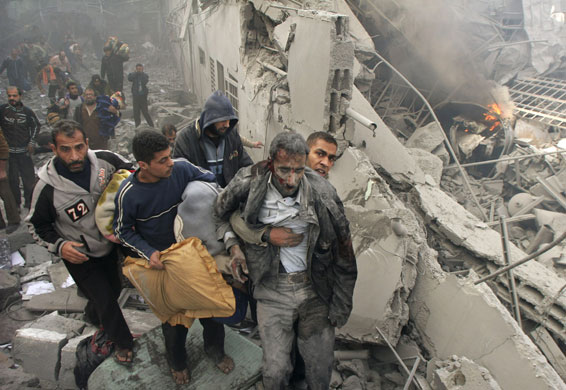
Statement by the Patriarchs and Heads of the Churches in Jerusalem on the current devastating situation in Gaza


Photograph: Adel Hana/AP

We, the Patriarchs, Bishops and the Heads of Christian Churches in Jerusalem, follow with deep concern, regret, and shock the war currently raging in the Gaza Strip and the subsequent destruction, murder and bloodshed, especially at a time when we celebrate Christmas, the birth of the King of love and peace. As we express our deep sorrow at the renewed cycle of violence between Israelis and Palestinians and the continued absence of peace in our Holy Land, we denounce the ongoing hostilities in the Gaza Strip and all forms of violence and killings from all parties. We believe that the continuation of this bloodshed and violence will not lead to peace and justice but breed more hatred and hostility – and thus continued confrontation between the two peoples.

Accordingly, we call upon all officials of both parties to the conflict to return to their senses and refrain from all violent acts, which only bring destruction and tragedy, and urge them instead to work to resolve their differences through peaceful and non-violent means.

We also call upon the international community to fulfill its responsibilities and intervene immediately and actively stop the bloodshed and end all forms of confrontation; to work hard and strong to put an end to the current confrontation and remove the causes of conflict between the two peoples; and to finally resolve the Israeli-Palestinian conflict with a just and comprehensive solution based on international resolutions.

To the various Palestinian factions we say: It is time to end your division and settle your differences. We call on all factions at this particular time to put the interests of the Palestinian people above personal and factional interests and to move immediately toward national comprehensive reconciliation and use all non-violent means to achieve a just and comprehensive peace in the region.

Finally, we raise our prayers to the Child in the manger to inspire the authorities and decision makers on both sides, the Israelis and Palestinians, for immediate action to end the current tragic situation in the Gaza Strip. We pray for the victims, the wounded and the broken-hearted. May the Lord God Almighty grant all those who have lost loved ones consolation and patience. We pray for all those living in panic and fear, that God may bless them with calm, tranquility and true peace.

We call on all to observe next Sunday, January 4, as a day for justice and peace in the land of peace.

+ Patriarch Theophilos III, Greek Orthodox Patriarchate
+ Patriarch Fuad Twal, Latin Patriarchate.
+ Patriarch Torkom II, Armenian Apostolic Orthodox Patriarchate.
Fr. Pier Battista Pizzaballa, ofm, Custody of the Holy Land
+ Anba Abraham, Coptic Orthodox Patriarchate.
+ Archbishop Swerios Malki Mourad, Syrian Orthodox Patriarchate.
+ Abune Matthias, Ethiopian Orthodox Patriarchate
+ Archbishop Paul Nabil Sayyah, Maronite Patriarchal Exarchate.
+ Bishop Suheil Dawani, Episcopal Church of Jerusalem & the Middle East.
+ Bishop Munib Younan, Evangelical Lutheran Church in Jordan & the Holy Land.
+ Bishop Pierre Malki, Syrian Catholic Patriarchal Exarchate
+ Bishop Youssef Zre’i, Greek Catholic Patriarchal Exarchate.
Fr. Raphael Minassian, Armenian Catholic Patriarchal Exarchate

Read John McArthy If it were your home, what hope restraint? and Ilan Pappe Israel’s Righteous Fury and its Victims in Gaza

The Narrow Gate of Justice: Sabeel Statement
Pirates of the Mediterranean: Gaza Update
Photos of Gaza

The Christians of Gaza

Photograph: Musa Al-shaer/AFP/Getty Images

A little known fact is the presence of a small but significant Christian Palestinian presence in Gaza. Gerald Butt wrote about them in Life at the Crossroads: History of Gaza. Read a review here.

Carl Moeller of Open Doors has just sent this news and prayer update on their plight.

“As an estimated 10,000 Israeli ground troops invaded Gaza today, the small community of Christians are drawing strength from their faith in God. Last week’s attacks left over 400 dead and 2,000 injured and the numbers are expected to dramatically increase.

According to reliable reports, the Gaza Baptist Church building was still standing this morning but has had some of its windows shattered by the bombings. Some Christian families left Gaza for Bethlehem over the holidays and are now separated from their loved ones with the border sealed. Many of the hospitals, already lacking basic medicines and medical equipment, are overwhelmed with the casualties and often are without power.

This is serious trouble for Christians in Gaza. Even before the recent end to the ceasefire (December 19) and the bombings, the estimated 3,000 Christians in Gaza have been living in fear from threats from Islamic militants.

Please join me in prayer for these brave Christians in Gaza in the wake of this new outbreak of violence. Pray that the war between Israel and Palestine is shorter and less devastating than what military and political speculators around the world are predicting. Pray that Christian families will be reunited. Pray that the Gaza Baptist Church building will be spared from the bombs.

Earlier this year one believer in Gaza stated: “Seventy percent of the Christians want to leave Gaza because they are very afraid. But we love Gaza. It’s our country, we have roots here, our homes are here. We will not know anyone if we go somewhere else.”

Pray that the seeds Brother Andrew sowed with Hamas and other prominent militant groups and the Gazan Christians sowed throughout the years when the Palestinian Bible Society actively shared God’s love with Muslim friends and neighbors will bear fruit. May their offerings of Christ’s love result in peace and God’s glory. Please check our website at http://www.opendoorsusa.org/ for updates.

In Christ our hope,
Carl Moeller

Dr. Carl A. Moeller
Open Doors USA President/CEO

x

Read John McArthy’s excellent piece in the Independent If it were your home, what hope restraint?

Also:

The Narrow Gate of Justice: Sabeel’s Statement
Statement by the Patriarchs and Heads of the Churches

Pirates of the Mediterranean: Gaza Update

More photos of Gaza

Royal Grammar School Guildford Debates the Arab-Israeli Conflict

Yesterday, the staff of the Royal Grammar School in Guildford, invited John Levy of Friends of Israel Educational Foundation and I to to have a debate on Israel and Palestine before the sixth form students.

It was a good natured affair and we agreed in large measure, for example, on the need for a negotiated and diplomatic settlement based on the Two State solution, repudiating the use of violence and terrorism against civilians. I emphasized that there were at least two sides to this issue and that I was not expecting students to side with one of us but rather hear both perspectives, hold them together and be ready for their homework.

John majored on the relative size of Israel compared to its Arab neighbours, its greater historic claim to the land, the belligerent nature of the Palestinian response to the peace process, the frequent terrorist attacks against Israelis, the refusal of Hamas to recognise the existence of Israel and the Palestinian refusal to accept the ‘generous offer’ under Barak .

I focussed on the strategy of successive Israeli governments to militarily occupy, expel Palestinians and then colonize the West Bank, Golan and Gaza, in breach of international law. I explained the strategy involved land seizure, house demolitions, settlement building, the construction of bipass roads for settlers and roadblocks for the Palestinians, anbd the construction of the separation barrier – Ha’hafrada in Hebrew – meaning ‘separate’ or ‘apart’ as in apartheid. I dwelt on the response of the international community to the illegal occupation of Palestine, human rights abuses, UN Resolutions, the intention of the Roadmap Principles and Annapolis Agreement.

I outlined what appear to be the three options for the way forward.

Like a child with his hand stuck in a sweet jar, Israel wants three but can only have two.

Option 1: The One State Solution
Israel can annexe the Occupied Territories and give all Palestinians equal rights with Jewish Israelis but it would have to amend its constitution and cease being a Zionist State (its important to distinguish between Judaism which is a religion and Zionism which is a political system – the two are not synonymous). That is not going to happen in the short term but its possible in the long term that by mutual agreement some kind of ‘federation’ may emerge between Israel, Palestine and Jordan, for example, of the kind that has occured in the European Community.

Option 2: The Two State Solution
Israel can remain a Zionist State and a democracy but to enjoy both it must give up the aspirations of Eretz Israel – the ‘greater’ Israel and withdraw from the Golan Heights, Gaza and the West Bank to the internationally recognised borders (The 1949 Armistice line, aka the green Line assumed in UN Resolution 242). This is the position favoured by the international community as expressed in the Roadmap for Peace, Annapolis Agreement and latest Quartet Statement and UN Resolution 1850.

Option 3: The No State Solution
Israel can remain a Zionist state and annexe and settle more land in the Occupied Territories and Golan. To do so, however, it must also continue to control the lives of Palestinians by military force. This is the option favoured by many within Netanyahu‘s Likud party, who have a good chance of winning the elections in February (Netanyahu, for example opposed the withdrawal from Gaza). Livni, his main opponent has also indicated that she believes the national aspirations of Israeli Arabs lies in a Palestinian homeland, not Israel. But accepting or justifying the present status quo is incompatable with being a Western-styled democracy, something Jimmy Carter has warned of.

There followed a lively Q&A time with the students asking some penetrating questions. I concluded by explaining the homework – to resolve the conflict as their parents generation (and mine) had failed to – and help both Israelis and Palestinians work toward the implementation of the Roadmap for Peace.

Globalising Hatred: The New Antisemitism

Denis MacShane is the Labour MP for Rotherham, and was the Minister of State for Europe at the Foreign and Commonwealth Office until the ministerial reshuffle that followed the 2005 general election. His book “Globalizing Hatred: The New Antisemitism” was published by Weidenfeld & Nicolson in September 2008.

This week Newsweek published an article by MacShane entitled, ‘Europe’s Jewish Problem‘ It makes sober reading. This is from the introduction.

As Europe faces up to its old demons of financial breakdown and job losses, a wind from the past is blowing through the continent. The politics of moderate center-right and left-liberal democracy that took power after 1945 are giving way to a new old populism. The extravagant rhetoric of the demagogic left and right is gaining ground, and the most obvious manifestation is the return of anti-Semitism as an organizing ideology. Consider the numbers: according to a recent Pew survey, the percentage of Germans who hold unfavorable views of Jews has climbed from 20 percent in 2004 to 25 percent today. In France, which has the largest number of Jews of any European nation, 20 percent of people view Jews unfavorably—up from 11 percent four years ago. In Spain, the figures are even more striking: negative views of Jews climbed from 21 percent in 2005 to nearly one in two this year. In Britain, where the numbers have remained around 9 percent for some time, anecdotal evidence of increased animosity abounds: youngsters returning from the Jewish Free School in middle-class North London are now frightened to go home on public buses on account of anti-Jewish attacks. Their parents hire private buses, as the London police seem unable to staunch anti-Semitic assaults on their children. In Manchester, a Jewish cemetery had to have a Nazi swastika hurriedly cleaned off its walls before a VIP party arrived.”

MacShane concludes, “As jobs are lost and welfare becomes meaner and leaner, the politics of blaming the outsider can only grow. The hard-won European politics of breaking down frontiers and trying to legislate for tolerance will get harder to defend, still less to promote. European populism and the anti-EU nationalism of both the right and the left is now the politics to watch. As America celebrates its first nonwhite president and the hope of a new politics, Europe may be beginning to revisit its past.”

MacShane’s new book has been reviewed by Rafael Behr in the Observer/Guardian, Alasdair Palmer, in the Telegraph, and Geoffrey Alderman in the Jewish Chronicle.

With the recession beginning to bite harder and forecast to last at least a year, with the steady rise in radical political and religious extremism, anti-social behaviour and the threat of terrorism ever before us, the temptation in 2009 will be to retreat into our shells or begin to blame others for our woes. Remember Oswald Mosley and his Black Shirts that fed off the back of the Great Depression? How do we avoid it ever happening again?

If we are tempted to think it could never happen here, we need to think again. The Holocaust Research Centre of Royal Holloway University are collaborating with German educational institutions in a conference 27-29 January in Berlin on holocaust perpetrators. The conference will address how and why ‘normal’ people become genocide perpetrators. History must not be allowed to repeat itself.

While MacShane does not address the correlation between Antisemitism and anti-Zionism, or between Antisemitism and Israeli occupation of the Palestinian Territories, at least not in the Newsweek article, the two issues are clearly linked. But legitimate criticism of Israeli policies toward the Palestinians must not be used as an excuse for racism or attacks against Jewish people. What ever the causes of the rise of the new Antisemitism, it is totally unacceptable and must be repudiated unequivocally.

Adapted from an article in the January edition of Connection, the community magazine of Virginia Water.

Iran and Christianity

I am glad to commend a new book by Mark Bradley entitled, Iran and Christianity: Historical Identity and Present Relevance (Continuum)

Mark Bradley clearly knows Iran and the Iranian people. Dealing honestly with the historical and political identity of Iran as well as the growth and suffering of the Iranian church, the book reads like a novel, I did not want to put it down. With so much mutual misunderstanding and mistrust between the United States and Iran, this is an important and timely book. It deserves a wide readership. I hope it dispels ignorance and helps diffuse tensions between Iran and the West. It should become a standard popular text on the development of Christianity in Iran.

Beginning with an in-depth look at the historical identity of Iran, religiously, culturally and politically, Bradley shows how this identity makes Iranians inclined towards Christianity. He goes on to look at the impact of the 1979 revolution, an event which has brought war, economic chaos and totalitarianism to Iran, and its implications for Iranian faith. The study concludes with an analysis of church growth since 1979 and an examination of the emerging church.

This is a fascinating work, guaranteed to improve any reader’s knowledge of not only Iranian faith and church growth, but of Iranian culture and history as a whole thanks to the thorough treatment given to the country’s background.

Some photos of Iran