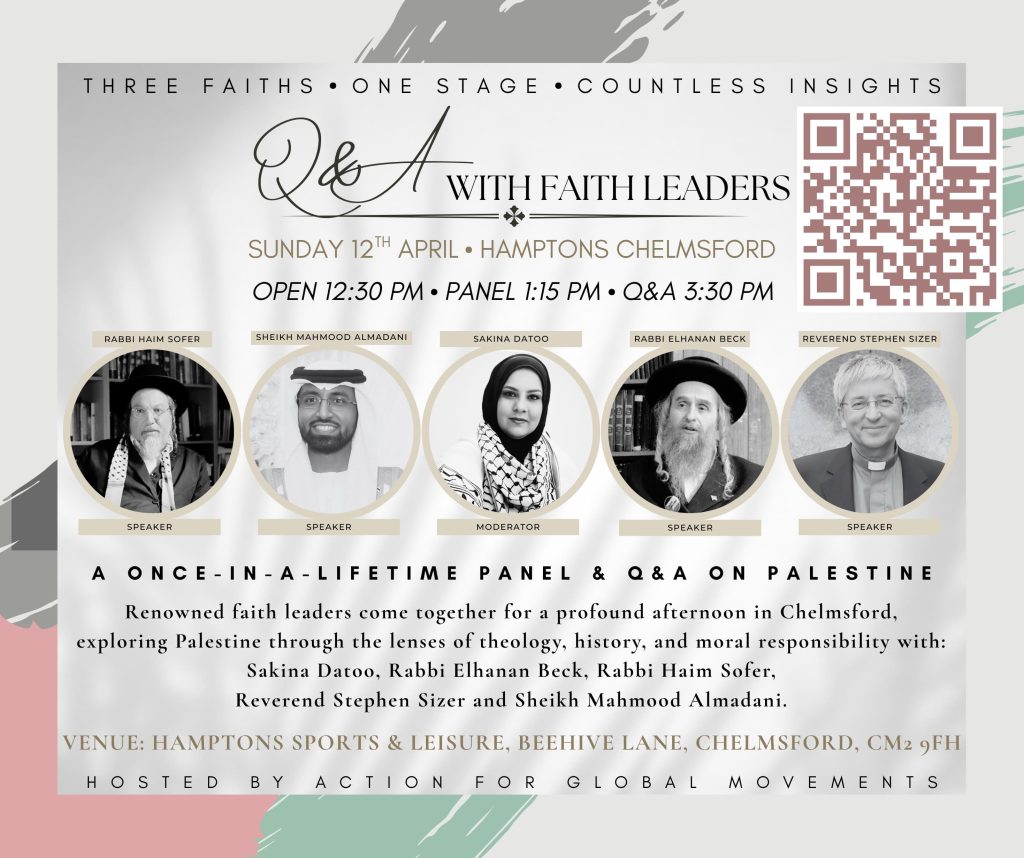
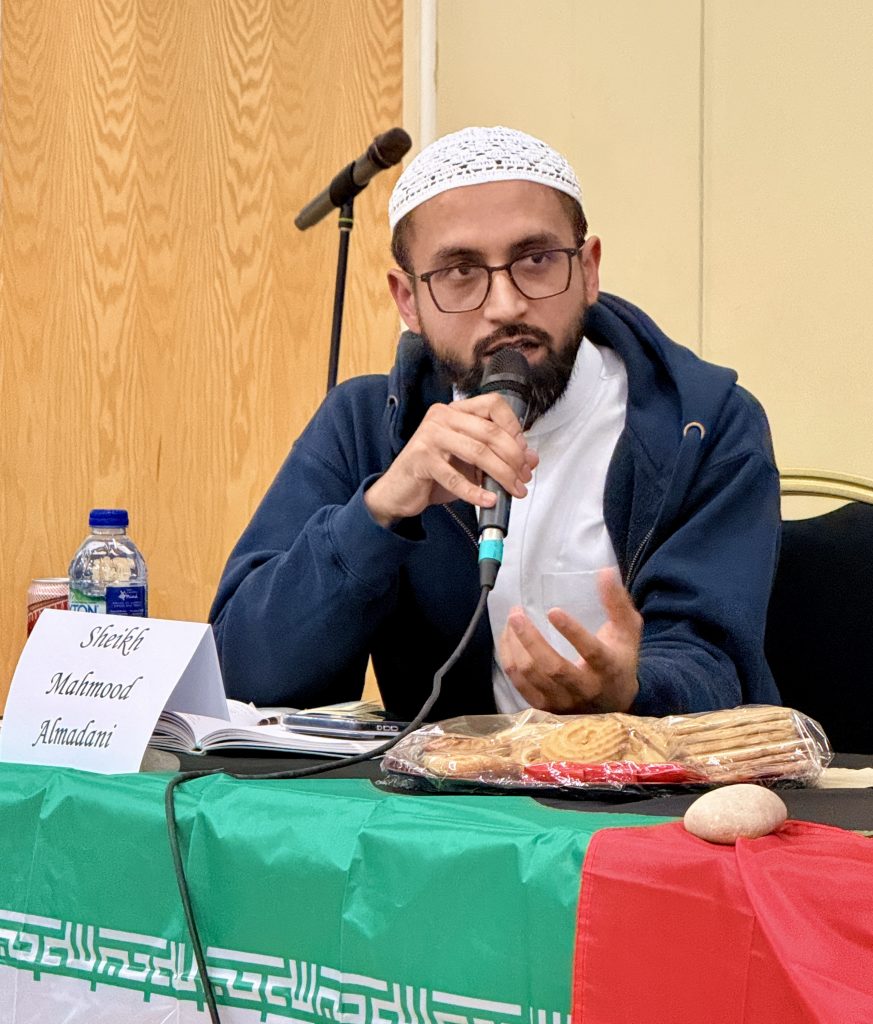
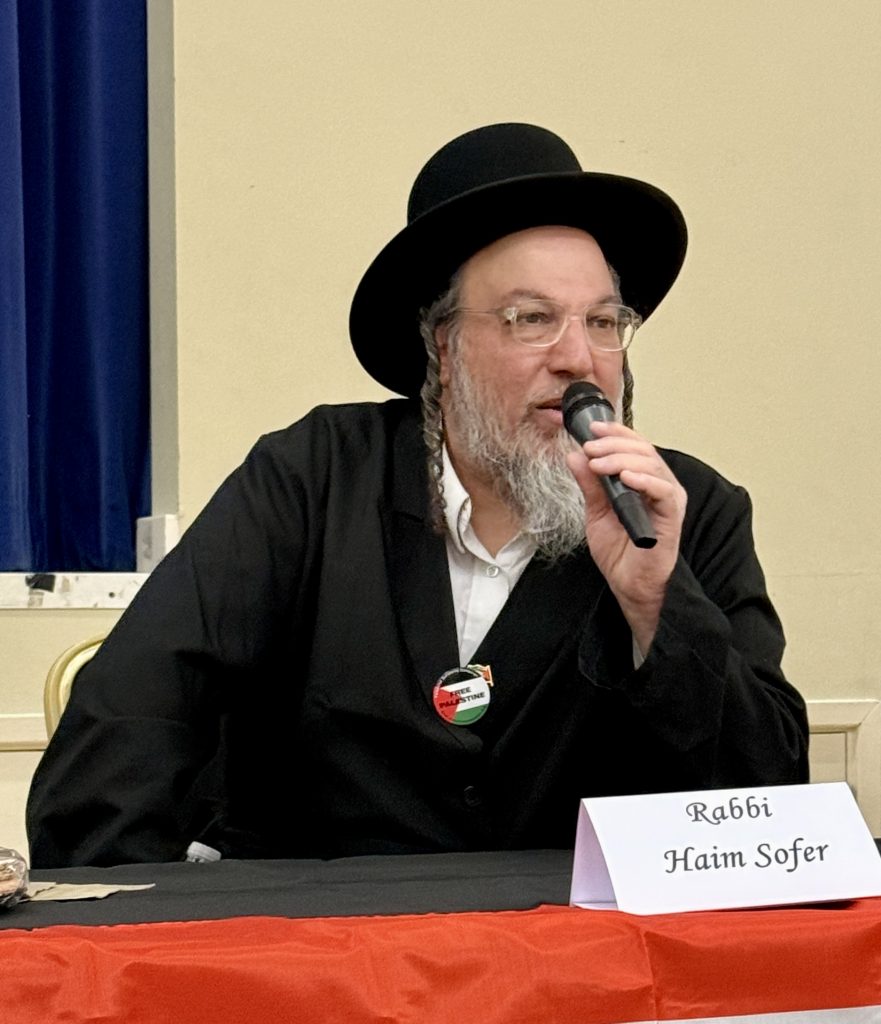
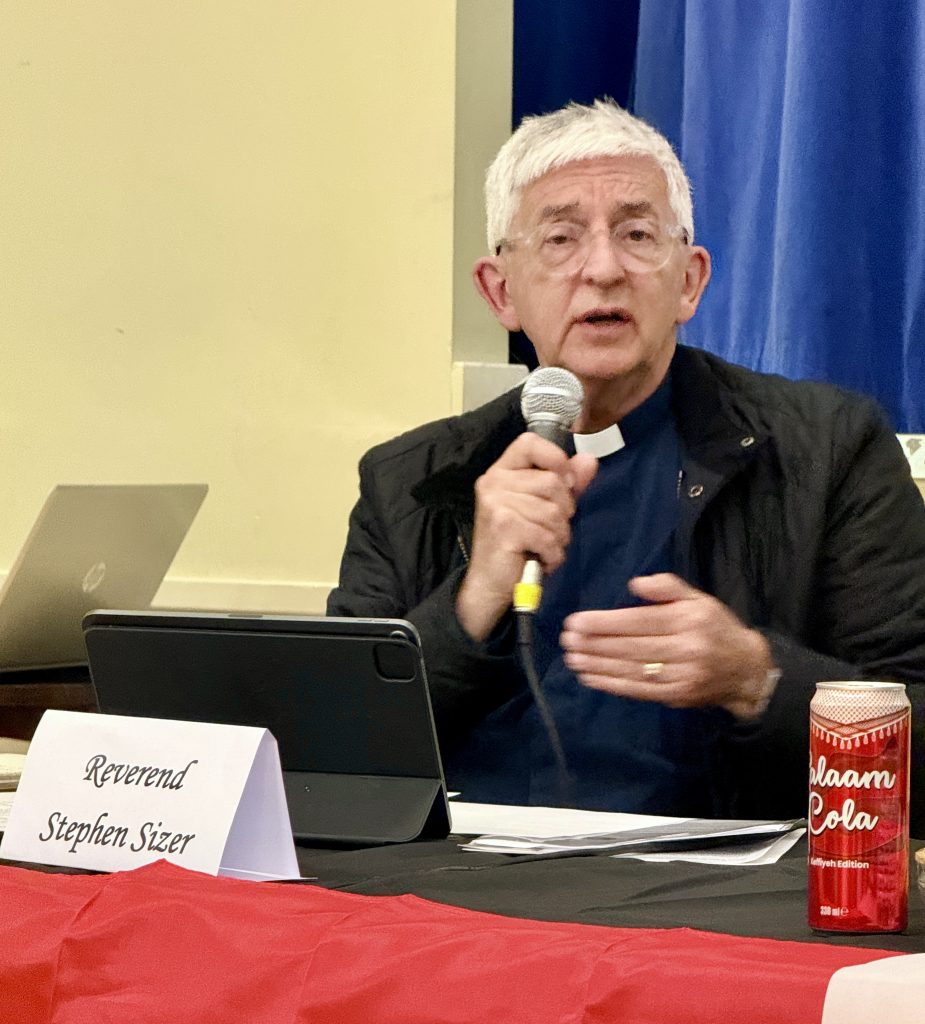
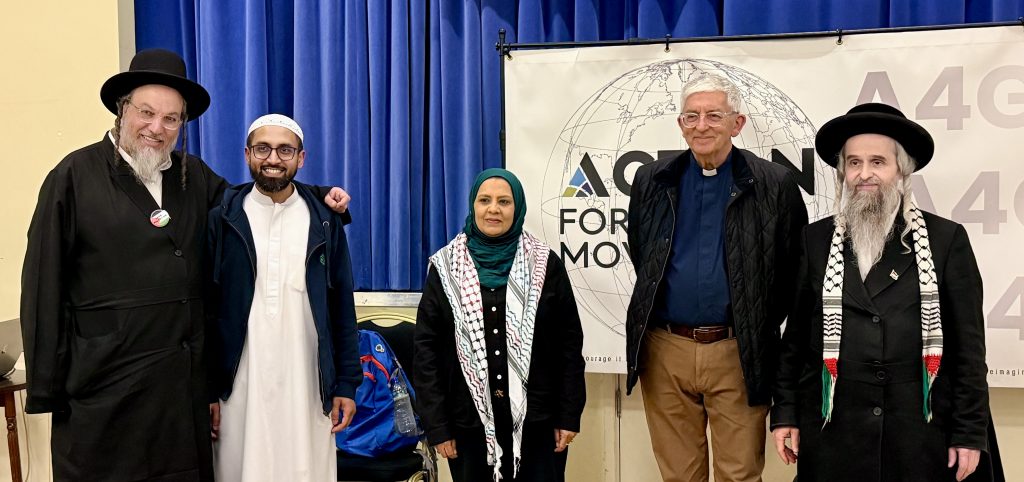
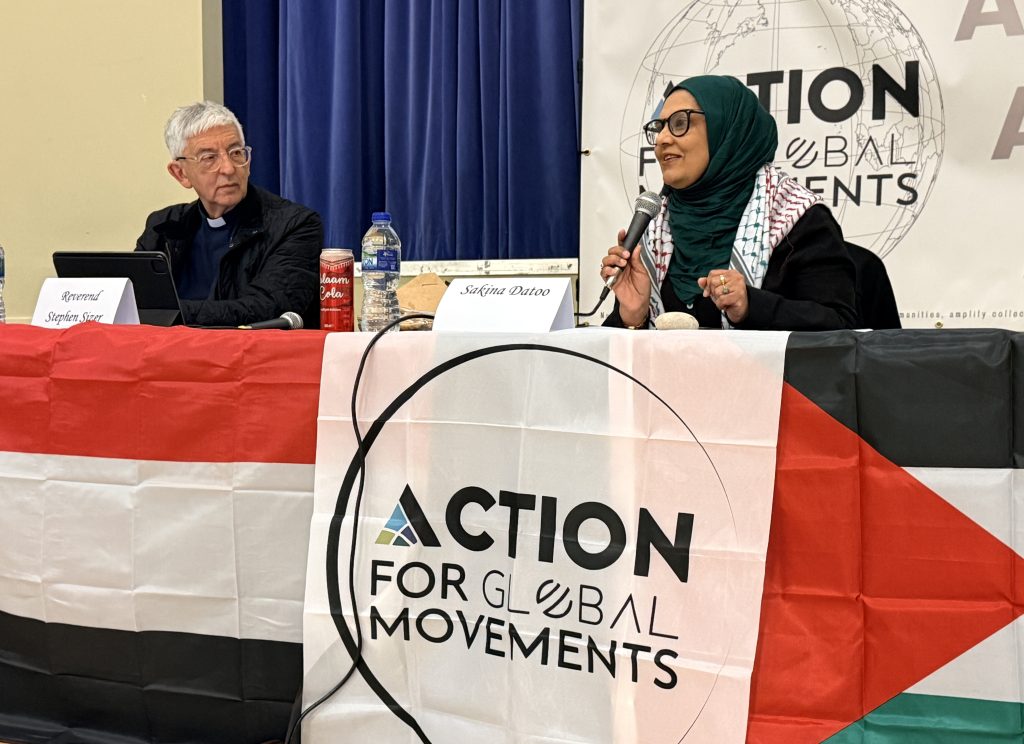
“Three Faiths. One Stage. Countless Insights.” A once in a lifetime interfaith panel discussion and Q&A on Palestine. Chelmsford Multifaith Panel
Here is a summary of my presentation:
How do colonial narratives weaponize religion as a pretext for waging war and genocide?
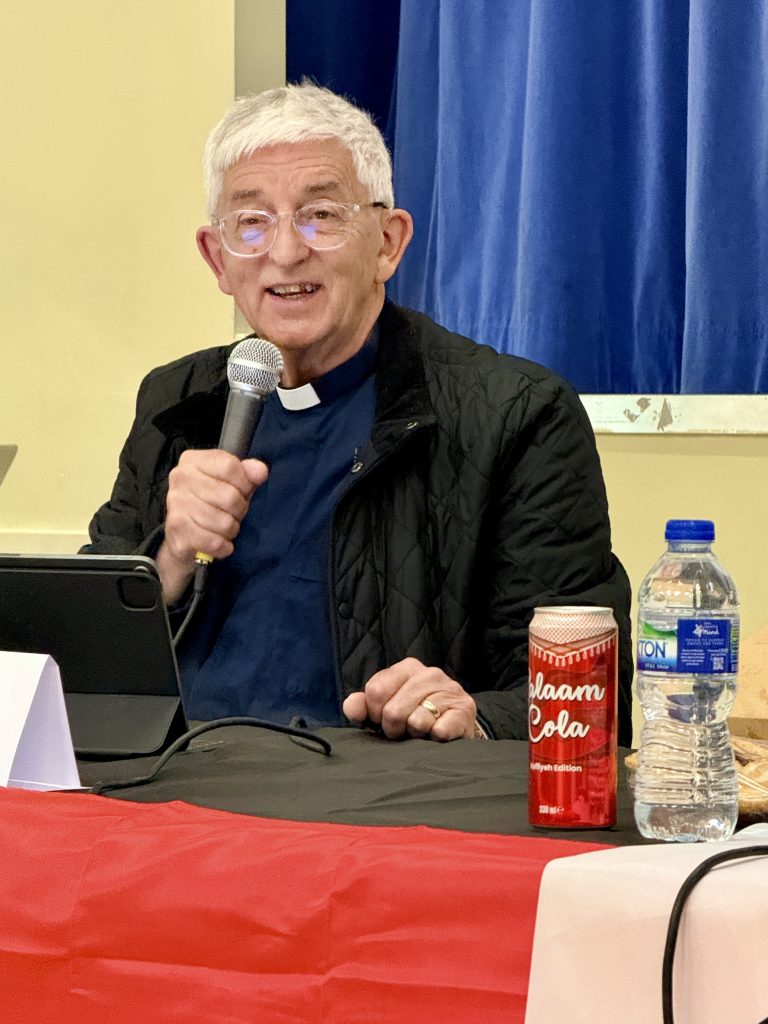
Colonial narratives, especially European, have often used religion as moral cover to justify conquest, exploitation, and even genocide as righteous, necessary, or divinely sanctioned. This “weaponization” works through a few recurring patterns – and I am going to focus in particular on the way Christian Zionists have weaponised religion as a pretext for waging war and genocide.
1. Moral Legitimization of Violence
Colonizers invariably present war as a ‘holy duty’ rather than a political or economic project. By claiming divine approval, violence becomes framed as obedience to God rather than human greed or emnity.
At the first of what have become monthly Christian worship services at the US Department of Defence, the personal pastor of the US defence secretary, Pete Hegseth, delivered a sermon at the Pentagon. Citing the words of Jesus from Matthew 10, Potteiger told the gathered leaders of the US military: “If our Lord is sovereign even over the sparrow’s fallings, you can be assured that he is sovereign over everything else that falls in this world, including Tomahawk and Minuteman missiles …“Jesus has the final say over all of it.”
Claiming to be a Christian, Hegseth has persisted in framing the war in Iran… as divinely sanctioned, repeatedly invoking “God’s almighty providence” and expressing certainty that God is on the side of the US military.[1]
2. Dehumanization and Delegitimization
Indigenous peoples are invariably portrayed as heathens, pagans, or spiritually inferior, which lowers moral barriers to harming them. This logic has justified or led to complicity in ethnic cleansing and genocide. For example,
“Amid boasts about the US’s superior firepower and theatrical disdain for “stupid rules of engagement”, the US defence secretary has promised to give “no quarter” to the “barbaric savages” of the Iranian regime and called on the American people to pray for victory “in the name of Jesus Christ”[2]
Over a two-year period, I monitored the official statement of the Church of England on the genocide in Gaza. Despite Israeli leaders’ long-standing and well-documented agenda to ethnically cleanse Palestine of its indigenous population, and the mounting evidence of apartheid, war crimes and genocide being committed by the Israeli military in Gaza and the Occupied Territories, neither the archbishops nor House of Bishops have shown any willingness to use these terms in their statements. Nor have they been willing to call for a permanent ceasefire; lobby the UK government to ban arms exports; or endorse the South African submission to the International Court of Justice to evidence of genocide and the submissions to the International Criminal Court to investigate evidence of war crimes committed by Hamas and the Israeli government.
3. Theological Framing of Modern Politics
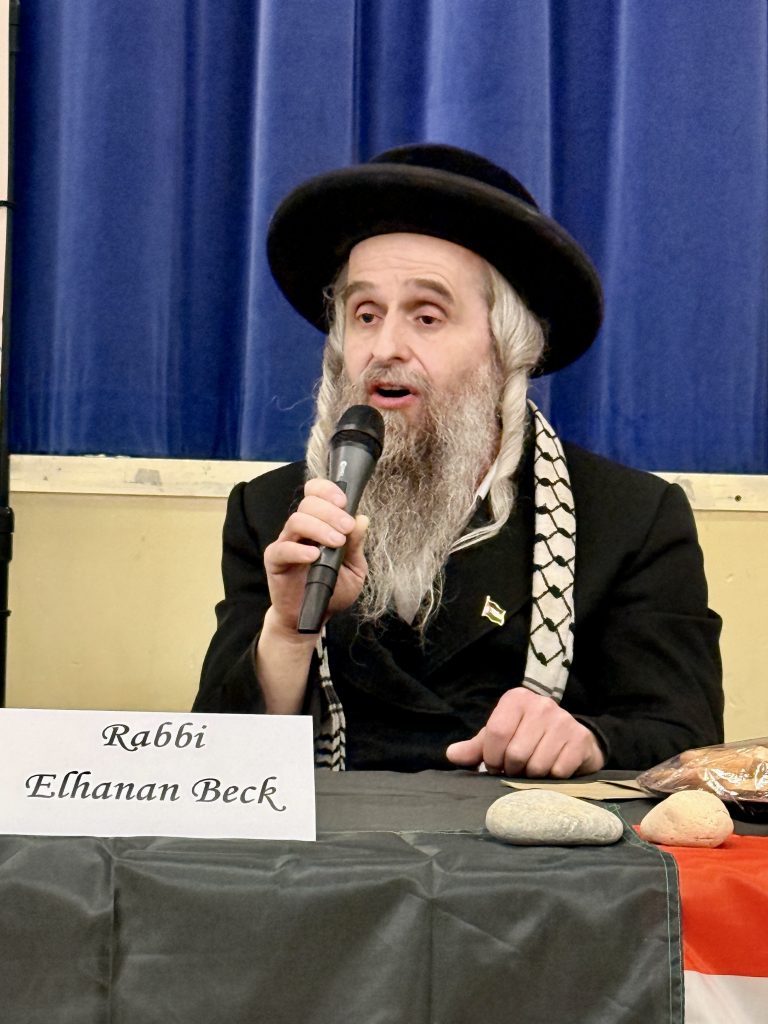
Christian Zionists believe that modern Israel is a continuation of Biblical Israel and therefore should enjoy special privileges. They declare that it is the responsibility of Christians to support the State of Israel and its policies… Christian Zionism is a deviant religious heresy, justifying supremacism, segregation (apartheid), genocide and ethnic cleansing.
Let me elaborate a little on what Christian Zionists typically believe, or rather what motivates them. The DNA of the movement could be encapsulated in seven popular assumptions which, they mistakenly believe, have a biblical or theological foundation.
- God blesses those who bless Israel and curses those who curse Israel.
- The Jewish people are God’s ‘Chosen People’.
- The ‘Promised Land’ was given by God to the Jewish people as an everlasting inheritance.
- Jerusalem is the exclusive and undivided eternal capital of the Jewish people.
- The Jewish temple must be rebuilt before Jesus returns.
- There will be an imminent ‘end-time’ Battle of Armageddon.
- God has a separate plan and destiny for the Jewish people.
It doesn’t take much to see how this theological framework is channeled into a political agenda. If you wish to explore how to deconstruct this heresy – see my book Zion’s Christian Soldiersor website – ‘Seven Biblical Answers’.
Christian Zionism has essentially conflated or fused religious identity with national identity – for example equating ancient biblical Israelites with the contemporary ethno-nationalist Israeli state. They interpret contemporary events in the light of selective texts from the Hebrew Bible. So for example, the establishment of Israel in 1948 and capture of Jerusalem in 1967 are interpreted as the fulfilment of prophecy and therefore justified. So it becomes axiomatic that Christians must support Israel.
4. Sanctifying Territorial Expansion
Control over land—especially all of historic Palestine but ultimately from the Nile to the Euphrates —is seen as divinely mandated, not politically negotiable. So Christian Zionists are at the forefront of funding and supporting the Israeli settlement expansion in the occupied Palestinian territories. Land is viewed not just as strategic, but a sacred inheritance. When land is framed as sacred rather than negotiable, it justifies an absolute and exclusive claim to land which overrides international law.
5. Moral Supremacy and Absolutism and “Good vs Evil” Framing
Christian Zionist rhetoric can portray the conflict in stark dualistic moral terms: Israel is central to God’s plan for the world – Opponents are seen as resisting that plan. The consequence of this dualistic Manichean theology in which there are two sides – the good guys and the bad guys – reinforces the belief in white supremacy that undergirded European colonisation, supremacy and exceptionalism – the belief that God is on our side against our enemies. For Christian Zionists – typically white evangelical Christians – this supremacy and exceptionalism is transferred to or shared with Zionist Jews and State of Israel. An example of this can be seen in this statement by the former Vic e president of the USA, Mike Pence
“We stand with Israel because your cause is our cause, your values are our values, and your fight is our fight. We stand with Israel because we believe in right over wrong, in good over evil, and in liberty over tyranny.”
The effect is to reduce empathy for Palestinians and their fundamental human rights. In this way Christian Zionism is having a real geopolitical impact, particularly in the United States. Organizations like Christians United for Israel lobby strongly for pro-Israel policies convinced that God is on their side.
6. Apocalyptic Narratives
A significant strand of Christian Zionism is tied to an apocalyptic end-times theology. So, conflict in the region is seen as part of a divine timeline leading to the return of Christ. Conflict then becomes inevitable or even necessary, rather than something to prevent. Peace efforts can be viewed with suspicion if they seem to contradict prophecy or compromise an alleged exclusive right to the land of the Middle East.
For example, in 2006, John Hagee, pastor of Cornerstone Church in San Antonia, Texas, founded Christians United for Israel admitting,
“For 25 almost 26 years now, I have been pounding the evangelical community over television. The bible is a very pro-Israel book. If a Christian admits “I believe the Bible,” I can make him a pro-Israel supporter or they will have to denounce their faith. So I have the Christians over a barrel, you might say.”
In March 2007, John Hagee spoke at the American Israel Public Affairs Committee (AIPAC) Policy Conference. He began by saying:
“The sleeping giant of Christian Zionism has awakened. There are 50 million Christians standing up and applauding the State of Israel…”
As the Jerusalem Post pointed out, his speech did not lack clarity. He went on to warn:
“It is 1938. Iran is Germany, and Ahmadinejad is the new Hitler. We must stop Iran’s nuclear threat and stand boldly with Israel, the only democracy in the Middle East… Think of our potential future together: 50 million evangelicals joining in common cause with 5 million Jewish people in America on behalf of Israel is a match made in heaven.”
Christian Zionism is a contemporary example of the “weaponizing of religion” in that it:
- Turns exclusive political claims into divine mandates
- Claims absolute authority without accountability
- Frames compromise as betrayal of faith
- Justify exclusion or violence
- Amplify nationalist claims with sacred authority
- Frames complex issues as morally simple and unquestionable
What can we as people of faith do to counter this?
But these same features—moral vision, community, conviction—can also be used in the opposite direction: to promote truth, justice, and critical reflection. Countering the misuse of religion for misinformation isn’t about attacking faith—it’s about strengthening truth, accountability, and ethical interpretation within and around religious communities. The most effective responses tend to work on several levels at once:
1. Promote Contextual & Responsible Interpretation
Misinformation thrives on isolated or distorted readings of scripture.
Encourage reading biblical texts in their historical, literary, and ethical context. Support teaching that recognizes genre (poetry vs law vs narrative) and original audience. What this does: Reduces the power of cherry-picked verses used to justify harmful claims.
2. Strengthen Theological Literacy
People are less vulnerable when they understand their own tradition more deeply. Teach core principles like justice, humility, and compassion—not just proof-texts. Highlight the diversity of interpretations within traditions. For example, many Christians look to teachings associated with Jesus Christ such as loving our enemies and peacemaking—as a lens for evaluating political claims.
3. Encourage Critical Thinking as a Faith Value
Questioning shouldn’t be framed as disloyalty. Normalize asking: Who is saying this? What’s the evidence? Who benefits? Emphasize that faith and truth-seeking are not opposites. We need a shift: From “blind acceptance” to “faithful discernment.”
4. Hold Leaders Accountable
Religious authority needs transparency. Encourage communities to expect evidence, humility, and openness from leaders. Challenge claims that shut down debate (“God told me, so don’t question”).
5. Expose Misinformation Techniques
Help people recognize how misinformation works:
- Selective scripture use
- Emotional manipulation (fear, destiny, crisis)
- “Us vs them” moral framing
Once people can spot these patterns, they’re less likely to be persuaded by them.
6. Separate Theology from Political Absolutism
Encourage a distinction between: Core spiritual beliefs, and political interpretations. The goal is to make space for disagreement without framing it as rebellion against God.
7. Foster Interfaith & Cross-Community Dialogue
Isolation strengthens misinformation. Conversations across religious and cultural lines reduce caricatures and fear. Hearing directly from others challenges simplified narratives. Bottom Line: The most effective way to counter religious misinformation is not to suppress religion, but to:
- Deepen understanding
- Encourage questioning
- Strengthen ethical interpretation
- Build accountable communities
When faith is tied to truth, humility, and justice, it becomes much harder to weaponize.
From the perspective of the Christian faith, how should we go about decolonising our minds when it comes to global affairs—especially regarding the atrocities and accelerated genocide in Palestine?
Within the Christian tradition there isn’t a single uniform answer, but there are however deep streams—biblical, theological, and historical—that can help shape a response grounded in truth, justice, and humility.
1. Start with Jesus
At the heart of the Christian faith is the example and teaching of Jesus Christ. His life consistently:
- stood with the oppressed
- challenged religious and political power
- rejected violence as a means of establishing God’s kingdom
Passages like Matthew 25 (“whatever you did for the least of these…”) and Luke 10 in the Parable of the Samaritan reframe who our neighbour is—often crossing ethnic, religious, and political boundaries.
Decolonising the mind begins by asking: Am I seeing people as Jesus Christ does, or through inherited political/theological narratives?
2. Recognise how Christianity has been tainted by empire
Historically, Christianity has sometimes been used to justify domination—from Constantine, through the Crusades to European colonialism. In those contexts:
- Scripture was selectively interpreted to legitimise conquest
- Indigenous peoples were dehumanised
- “Divine mandate” language masked political and economic goals
Decolonising involves naming that history honestly and refusing to repeat its patterns.
3. Re-examine theology—especially around land and power
Some modern frameworks—like Christian Zionism interpret biblical promises about land in ways that directly shape political positions today. Re-examining – or rather deconstructing this aberrant theology requires recognising:
- In the New Testament, land promises are reframed around people and justice, not territory
- God’s covenant is understood as inclusive and not tied to ethnic supremacy
- The kingdom of God is not advanced through military or nationalist power
Decolonising here means asking: Is my theology aligned with the life and teachings of Jesus—or with modern political ideologies?
4. Recover the biblical emphasis on justice
The prophets are relentless about injustice:
- “Let justice roll on like a river…” (Amos 5:24)
- “Woe to those who make unjust laws…” (Isaiah 10:1)
Justice in Scripture is not abstract—it includes:
- protection of civilians
- care for the poor and displaced
- opposition to oppression and violence
This applies universally, regardless of nationality or religion.
5. Listen to voices from the margins
Decolonising requires listening, especially to those directly affected. Many Palestinian Christians, for example, speak from within the land and the conflict, offering perspectives often absent in Western theological discourse. One influential document is the Kairos Palestine Document, which calls for:
- nonviolent resistance
- an end to occupation
- theological reflection free from political distortion
Listening doesn’t mean uncritical agreement—but it resists one-sided narratives.
6. Resist the dehumanisation—of anyone
A genuinely Christian response refuses to:
- demonise Palestinians or Muslims
- demonise Israelis or Jewish people
- justify violence against civilians on any side
Every person is made in the image of God (imago Dei). Decolonising the mind means rejecting narratives that rank human worth based on ethnicity, colour, political views or faith.
7. Practice active peacemaking
“Blessed are the peacemakers” (Matthew 5:9) is not passive. It can include:
- campaigning for BDS – boycotts, divestment and sanctions
- resisting evil non-violently through civil disobedience
- supporting interfaith and reconciliation efforts
- giving to charitable aid organisations
Peacemaking is costly—it often means resisting partisan pressure and simplistic narratives. Jesus called his followers to be peacemakers not widow-makers. In essence a decolonised Christian response to global injustice—including Gaza and Iran—would be:
- Christ-centred rather than ideology-driven
- justice-oriented rather than power-aligned
- globally aware rather than tribally loyal
- rooted in truth, compassion, and humility
[1] https://www.theguardian.com/us-news/ng-interactive/2026/apr/10/pete-hegseth-christianity-iran-war-crusade
[2] Ibid.