“Anyone who welcomes you welcomes me, and anyone who welcomes me welcomes the one who sent me. Whoever welcomes a prophet as a prophet will receive a prophet’s reward, and whoever welcomes a righteous person as a righteous person will receive a righteous person’s reward. And if anyone gives even a cup of cold water to one of these little ones who is my disciple, truly I tell you, that person will certainly not lose their reward.” (Matthew 10:40-42)
In today’s Gospel, Jesus says: “Anyone who welcomes you welcomes me, and anyone who welcomes me welcomes the one who sent me.”
These are remarkable words. Jesus literally identifies himself with his disciples. To welcome one of Christ’s followers is to welcome Almighty God himself. They remind us that God is not distant from human suffering but is present among those who bear witness to his kingdom.
Jesus speaks these words as he sends his disciples into a world that will not always welcome them. Some will reject them, denigrate them, and even persecute them. Yet Jesus assures that those who receive them are receiving Christ himself.
This is a profound affirmation of dignity. In Palestine where many feel ignored by the international community, forgotten by powerful nations, or reduced to mere statistics, Jesus declares that those who belong to him are never invisible. Christ so identifies with his followers that by welcoming them we are literally welcoming him.
This truth has both a comfort and a challenge.
Throughout the Gospel, Jesus identifies himself with those whom society overlooks. He was born under foreign military occupation. His family became refugees hiding in Egypt. He grew up among ordinary people far from the centres of power.
When Jesus says, “Whoever welcomes you welcomes me,” he reveals a God who is found not primarily in palaces or military headquarters but in villages and towns struggling to exist; among families mourning loved ones; among those working for peace and justice; among those refusing to surrender their humanity, emigrate or deny their faith. The Gospel challenges the world to recognize Christ in those it is tempted to ignore, and Jesus uses the imagery of a cup of cold water to rebuke those indifferent to or responsible for human suffering.
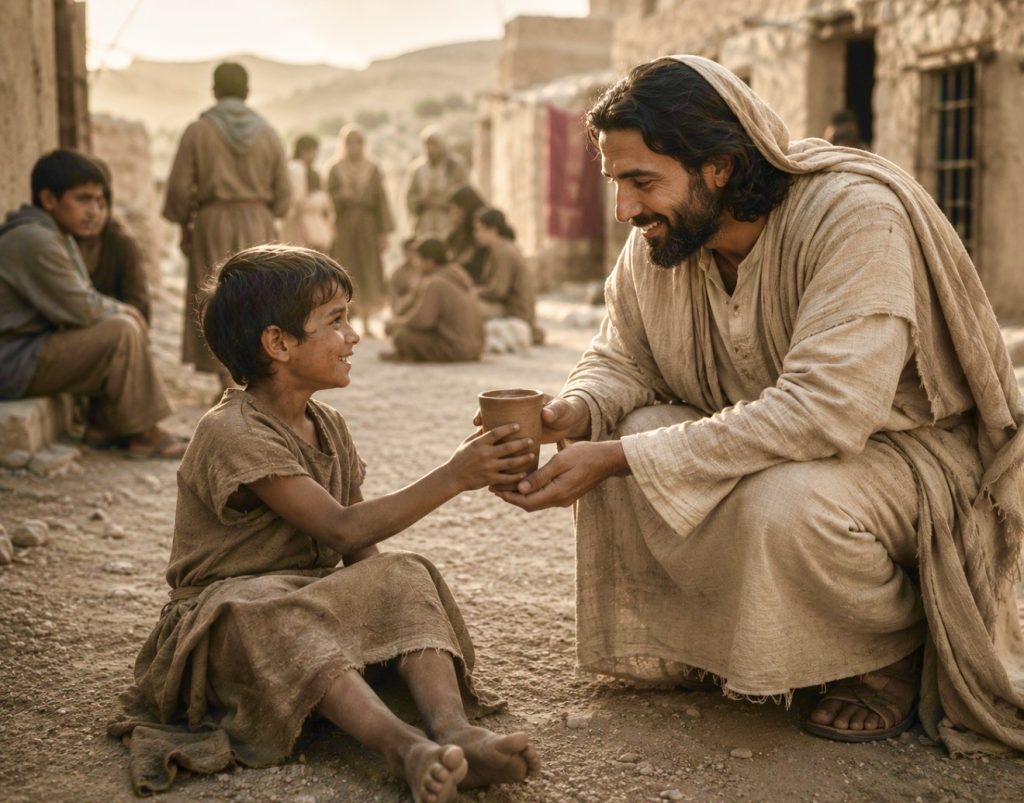
“Whoever gives even a cup of cold water to one of these little ones… will certainly not lose their reward.”
Giving someone a cup of cold water is a simple act but it can save a life. It does not solve every problem. It does not end wars or dismantle systems of injustice. Yet Jesus elevates such acts because they express and reveal the heart of God.
Palestinian society has long been known for hospitality. Even in difficult economic circumstances, guests are welcomed, meals are shared, and neighbours support one another. Jesus teaches that these ordinary acts of kindness are sacred. They are signs that God’s kingdom is already breaking into the world.
When resources are scarce, generosity becomes even more significant.
A small act of mercy can become a powerful witness to God’s presence. I have been challenged on numerous occasions by the way Palestinians have offered me hospitality even when their resources were limited. They vividly remind us of the importance of welcoming the stranger, caring for neighbours, and preserving human dignity in traumatic times.
Jesus reminds us that no act of compassion is too insignificant for God to notice or be present. But if Christ is present among the vulnerable, the displaced, and those suffering under occupation and war, why are so many so-called Christian willing to overlook or even justify Palestinian suffering?
The criticism is not simply political. It is theological. Selective compassion—mourning Israeli victims while ignoring Palestinian victims—fails the test of Matthew 10. If Christ identifies himself with those in need, then we must recognize his image in all people, regardless of nationality, ethnicity, or religion.
One of the greatest dangers in situations of prolonged conflict is dehumanization. People begin to see others as enemies, obstacles, or sub-human rather than unique human beings created in God’s image. In the quotation from Matthew 10, Jesus calls Christians to resist this temptation.
To welcome another person is to acknowledge their God-given dignity. To offer water is to affirm their humanity. To receive Christ himself. This does not mean ignoring injustice or abandoning the pursuit of freedom and rights. Rather, it simply means refusing to allow conflict to destroy our capacity for compassion.
In our gospel reading Jesus teaches us to hold together two commitments: the pursuit of justice and the preservation of human dignity.
Christian discipleship requires solidarity with those who suffer injustice, rather than unconditional support for any state or government. The Gospel calls us to resist the temptation to become indifferent. Christ tells us that every act of mercy matters. Every visit, every prayer, every word of encouragement, every gesture of solidarity, literally every cup of cold water is a sign of our faithfulness to Jesus Christ.
In the reading from Romans 6, the Apostle Paul explains why Jesus teaching is ignored by so many. Paul insists that believers must resist the temptation to become slaves to any power, any political theory, any ideology, any creed or religion except God alone. Those who do become slaves to sin, to hatred, or revenge which is self destructive behaviour.
Paul reminds us that followers of Jesus belong to a different kingdom. We must never allow evil to shape our character. The powers of this world may seek to dominate people and conquer territory, but Christ repudiates pride and greed.
Let me be blunt, Christian Zionists are turning a racist nation-state into an object of worship. When biblical promises are interpreted in ways that justify supremacism, settler colonialism, apartheid, ethnic cleansing and genocide, so called Christians become servants of Satan rather than servants of Christ. Paul concludes with a warning and a promise: “The wages of sin is death, but the gift of God is eternal life in Christ Jesus our Lord.” (Romans 6:23)
The Christian hope is not based on political power, military strength, or human success. Our hope rests in God’s free gift of life. The resurrection assures us that injustice, and oppression do not and will not have the final word. God’s future belongs only to those who pursue truth, justice, peace and reconciliation.
In Matthew 10 Jesus reminds us that God comes to us in ordinary people and simple acts of mercy.
- Christ is present among those who remain faithful amid hardship.
- Christ is present in the stranger who is welcomed.
- Christ is present in the neighbour who receives a cup of cold water.
- Christ is present wherever human dignity is honoured and God’s love is embodied.
In a land marked by division and suffering, Jesus points to a different way—the way of hospitality and compassion. He promises that no act of love, however small, is ever forgotten by God.
So today Jesus Christ calls us to do two things:
First, to welcome Christ by welcoming others, to show respect and compassion toward the vulnerable, the ignored, those suffering, those who weep and mourn.
Second, to refuse to become servants of hatred or revenge, and instead live as servants of God’s justice, truth and righteousness.
May God give us the courage to be people of hospitality, people of justice, compassion and mercy, bearing witness to Christ knowing he is present with us wherever and whenever he calls us to follow him.
a reflection given at the Sabeel Liberation Theology Centre, Jerusalem weekly service 25th June 2026