Category Archives: Palestine

A Critique of Christian Zionism: Tony Higton

Published in Mishkan, A Forum on the Gospel and the Jewish People: Issue 55/2008

The following quotations are taken from an article by Tony Higton published in Mishkan which includes a response to my book, Christian Zionism: Road-map to Armageddon?

Tony Higton is Rector of North and South Wootton near Kings Lynn. The fact that I was married in South Wootton and my mother in law lives in the parish is purely, if delightfully, coincidental. Tony previously served as the General Director of the Church’s Ministry among Jewish People and Rector of Christ Church, Jerusalem. Before publishing my book, he read the draft sections pertaining to CMJ, made comments, and these were all incorporated in the published version.

I warmly commend his article and the case he makes for Moderate Christian Zionism, and invite you to read it and decide whether the selective quotations below, which specifically pertain to my views or book, are in any way taken out of context.

In his introduction, Tony writes:

“After years of sparring, Stephen Sizer and I met up and found we had wide areas of agreement. Having worked in Jewish ministry for seven years, half of them in Jerusalem, I have seen the best and worst of Christian Zionism. Insofar as it combats anti-Semitism, defends the existence of a safe homeland for Jewish people, promotes evangelism among Jewish people, and supports reconciliation in the Holy Land, it is good.
However, Sizer is right to criticize the serious failings of some Christian Zionism. I agree with him in rejecting the following errors which are held by many Christian Zionists:

  • Lack of godly compassion for the Palestinians, and of concern for their human rights and about their legitimate aspirations.
  • A negative attitude toward Palestinians, and Arabs in general, to the point of racism.
  • Uncritical support for Israel (a secular, sinful state like any other), justifying all its actions against the Palestinians.
  • Neglecting or even opposing and forbidding evangelism of Israelis, sometimes believing that Jewish people can experience salvation through Judaism.
  • Being more interested in the fulfilment of prophecy than in application of kingdom principles such as justice and reconciliation.
  • Opposing the peace process.
  • Sometimes advocating the ethnic cleansing of Palestinians from the Holy Land.
  • Sometimes supporting the rebuilding of the temple regardless of the problematic theological implications and the danger of provoking extreme violence.” (p. 18)

In the second section entitled, “Dangers of Unbiblical Views” Tony writes:

“I am grateful for Sizer’s book because it stimulates thought and, in my case, underlines many of the questions I have been asking about Christian Zionism in recent years. And I speak currently describing myself (provocatively) as a pro-Palestinian Christian Zionist!”
“Having said that, I am unhappy about calling myself a Zionist because of the prevalence of extreme Christian Zionism which Sizer describes. I attended a week-long conference on Christian Zionism held in Jerusalem by the Sabeel Palestinian Liberation Theology Centre. Initially, I was quite irritated by what I felt was their extreme model of Christian Zionism. I thought it was a caricature and the moderate view I held was the majority view. But one of the main things I learned from that conference was that it is American Christian Zionism (which is very influential among Messianic believers in Israel) which is dominant, and it is very extreme. British (and other moderate) Christian Zionists need to understand this.” (pp. 19-20)

In the fourth section entitled, “Putting Principles into Practice”, Tony writes:

“Sizer seems not fully to understand the Israeli need for security. We once stood together in Abu Dis, just outside Jerusalem, at the foot of the security wall – ten meters of concrete towering above us. He asked me: “Well, what do you think of the wall, Tony?” I replied: “I think it is obscene. But terrorism is even more extreme.” (p. 24) – on this I concur.

In the fifth section in which Tony makes the case for “Moderate Biblical Zionism” he writes:

“It seems to me that Sizer, in his convert’s passion for justice for the Palestinians, tends to throw the baby out with the bathwater with respect to Christian Zionism. One result is that he does not treat the biblical material seriously enough… I still believe that a biblical case can be made for (balanced and moderate Christian Zionism).” (p. 25)

“Sizer raises various criticisms of the biblical justification Christian Zionists claim. In particular he claims that Christian Zionism has an “ultra-literal” and futurist hermeneutic. It is, of course, very simple to make out that all the prophecies referred to by Christian Zionists are not to be taken literally as referring to the Jewish people. In one stroke it removes all sorts of questions and difficulties. But, as we shall see, there are difficulties with this view.
I am also aware that the New Testament radically develops the teaching of the Old Testament. The Old is the bud and the New is the flower. In rightly stressing the Jewish roots of the Christian faith, we must never forget this radical development, which Sizer stresses. So there are important developments of land to world, temple to Jesus, etc.” (p. 25-26)

“I is true that some, including some Orthodox Jewish people, think that such a re-establishment of the state is not the real thing prophesied in Scripture, which could only be established by Messiah. Others, including Sizer, think Israel, because of disobedience to God, could lose the land again.” (p. 28)

“Sizer writes: “Belief in the final restoration of the Jews to Zion is also based on a literal and futurist reading of selective Old Testament prophecies. However, the texts themselves indicate that such a return occurred under Ezra and Nehemiah and that no further return is to be anticipated. It may be argued that Jesus repudiated any such expectation. New Testament writers apply such Old Testament promises to both believing Jews and Gentiles.”
However, there are OT prophecies which scholars believe relate to a time much later than the return under Ezra and Nehemiah, and are often in a messianic context. I refer to Isaiah 11:11-12; 60:4, 9, 21-22; 61:4-5; Jeremiah 3:12-18; 23:7-8; Ezekiel 38:8, 16; 39:25-29; Joel 3:1-2, 17, 20; Amos 9:14-15; Zechariah 12:2-3, 10-11; and 14.” (p 29)

“In conclusion, then, I agree with much of the criticism Sizer makes of Christian Zionism and particularly of its lack of commitment to justice and reconciliation. Like him, I too reject the extremes of Christian Zionism, seen particularly in the USA and Israel. However, I believe Sizer throws the baby out with the bathwater, particularly by not dealing seriously enough with the biblical material, which I believe forms a credible foundation for a balanced, moderate Christian Zionism.
Moderate Christian Zionists will:

  • Pray for the Israelis and the Palestinians, showing compassion for their needs, pain, and fears, and an awareness of their faults.
  • Pray for and, where possible, take action to promote reconciliation, peace, security, and justice for both people groups and an end to violence on both sides.
  • Pray for and support evangelism among both people groups.

Having read Sizer’s book carefully, I remain a pro-Palestinian Christian Zionist who is passionate about justice and reconciliation and sensitive to the needs, pain, and fears of both Palestinians and Israelis.” (p. 29)

It was in part to encourage further dialogue on the interpretation of Scripture regarding the relationship between Israel and the Church that I wrote the sequel, Zion’s Christian Soldiers. I look forward to further conversations with Tony Higton on the case for Moderate Christian Zionism.

Radical Islam: How to live with it

What is an appropriate response to radical Islam? Weapons grade rhetoric that calls down fire from heaven to ignite the apocalypse or passive acquiescence that leads to dhimmitude and interfaith worship? Does it have to be one or the other? Racism or appeasement? The clash of civilisations or the Islamisation of the West?

Fareed Zakaria, writing in Newsweek suggests we must learn to live with radical Islam. Writing from an Islamic perspective he insists, “We don’t have to accept the stoning of criminals. But it’s time to stop treating all Islamists as potential terrorists.”

In what many coinsider his finest piece of writing in Newsweek, Zakaria makes a convincing case for why the West needs to adopt a more “sophisticated strategy” toward Radical Islam.

Pierre Tristam, writing for about.com summarises this important article: “The current with-us-or-against-us business won’t do, Zakaria argues, with eight years of evidence on his side. Not every radical Islamic regime is a synonym of al-Qaeda.”

Zakaria admits, “The militants are bad people and this is bad news. But the more difficult question is, what should we—the outside world—do about it? That we are utterly opposed to such people, and their ideas and practices, is obvious. But how exactly should we oppose them? In Pakistan and Afghanistan, we have done so in large measure by attacking them—directly with Western troops and Predator strikes, and indirectly in alliance with Pakistani and Afghan forces. Is the answer to pour in more of our troops, train more Afghan soldiers, ask that the Pakistani military deploy more battalions, and expand the Predator program to hit more of the bad guys? Perhaps—in some cases, emphatically yes—but I think it’s also worth stepping back and trying to understand the phenomenon of Islamic radicalism.”

There is realism in his assessment of the threat posed by Islamists: “Reports from Nigeria to Bosnia to Indonesia show that Islamic fundamentalists are finding support within their communities for their agenda, which usually involves the introduction of some form of Sharia—Islamic law—reflecting a puritanical interpretation of Islam. No music, no liquor, no smoking, no female emancipation.The groups that advocate these policies are ugly, reactionary forces that will stunt their countries and bring dishonor to their religion. But not all these Islamists advocate global jihad, host terrorists or launch operations against the outside world—in fact, most do not.”

He cites examples in Pakistan and other countries where attempts have been made to distinguish between Islamists who are violent and those who are extreme.

“Over the past eight years such distinctions have been regarded as naive. In the Bush administration’s original view, all Islamist groups were one and the same; any distinctions or nuances were regarded as a form of appeasement. If they weren’t terrorists themselves, they were probably harboring terrorists. But how to understand Afghanistan and Pakistan, where the countries “harbor” terrorists but are not themselves terrorist states?”

Zakaria also warns us not to over-estimate the influence of Al Qaeda:

“To be clear, where there are Qaeda cells and fighters, force is the only answer. But most estimates of the number of Qaeda fighters in Pakistan range well under a few thousand. Are those the only people we are bombing? Is bombing—by Americans—the best solution? The Predator strikes have convinced much of the local population that it’s under attack from America and produced a nationalist backlash. A few Qaeda operatives die, but public support for the battle against extremism drops in the vital Pashtun areas of Pakistan. Is this a good exchange?”

The danger Zakaria highlights is that believing in the existence of an “Axis of Evil” and Huntingdon’s theory  is becoming a self fulfilling prophecy.

“We have placed ourselves in armed opposition to Muslim fundamentalists stretching from North Africa to Indonesia, which has made this whole enterprise feel very much like a clash of civilizations, and a violent one at that. Certainly, many local despots would prefer to enlist the American armed forces to defeat their enemies, some of whom may be jihadists but others may not. Across the entire North African region, the United States and other Western powers are supporting secular autocrats who claim to be battling Islamist opposition forces. In return, those rulers have done little to advance genuine reform, state building or political openness. In Algeria, after the Islamists won an election in 1992, the military staged a coup, the Islamists were banned and a long civil war ensued in which 200,000 people died. The opposition has since become more militant, and where once it had no global interests, some elements are now aligned with Al Qaeda.”

Zakaria then examines the painful lessons learnt by the Bush Administration in Iraq and Afghanistan:

“We have an instant, violent reaction to anyone who sounds like an Islamic bigot. This is understandable. Many Islamists are bigots, reactionaries and extremists (others are charlatans and opportunists). But this can sometimes blind us to the ways they might prove useful in the broader struggle against Islamic terror. The Bush administration spent its first term engaged in a largely abstract, theoretical conversation about radical Islam and its evils—and conservative intellectuals still spout this kind of unyielding rhetoric. By its second term, though, the administration was grappling with the complexities of Islam on the ground. It is instructive that Bush ended up pursuing a most sophisticated and nuanced policy toward political Islam in the one country where reality was unavoidable—Iraq.”

Zakaria urges the new US Administration to break with the Bush model of doing geopolitics.

“Beyond Afghanistan, too, it is crucial that we adopt a more sophisticated strategy toward radical Islam. This should come naturally to President Obama, who spoke often on the campaign trail of the need for just such a differentiated approach toward Muslim countries. Even the Washington Institute, a think tank often associated with conservatives, appears onboard. It is issuing a report this week that recommends, among other points, that the United States use more “nuanced, noncombative rhetoric” that avoids sweeping declarations like “war on terror,” “global insurgency,” even “the Muslim world.” Anything that emphasizes the variety of groups, movements and motives within that world strengthens the case that this is not a battle between Islam and the West. Bin Laden constantly argues that all these different groups are part of the same global movement. We should not play into his hands, and emphasize instead that many of these forces are local, have specific grievances and don’t have much in common.”

“That does not mean we should accept the burning of girls’ schools, or the stoning of criminals. Recognizing the reality of radical Islam is entirely different from accepting its ideas. We should mount a spirited defense of our views and values. We should pursue aggressively policies that will make these values succeed. Such efforts are often difficult and take time—rebuilding state structures, providing secular education, reducing corruption—but we should help societies making these efforts. The mere fact that we are working in these countries on these issues—and not simply bombing, killing and capturing—might change the atmosphere surrounding the U.S. involvement in this struggle.”

Counselling a dose of realism Zakaria concludes,

“The veil is not the same as the suicide belt. We can better pursue our values if we recognize the local and cultural context, and appreciate that people want to find their own balance between freedom and order, liberty and license. In the end, time is on our side. Bin Ladenism has already lost ground in almost every Muslim country. Radical Islam will follow the same path. Wherever it is tried—in Afghanistan, in Iraq, in parts of Nigeria and Pakistan—people weary of its charms very quickly. The truth is that all Islamists, violent or not, lack answers to the problems of the modern world. They do not have a world view that can satisfy the aspirations of modern men and women. We do. That’s the most powerful weapon of all.”

Tristam summarises Zakaria thus: “Zakaria resolves the contradiction by suggesting that accepting that fundamentalist wave, dealing with it, letting it unravel of its own, is a far smarter strategy than any attempt to bomb it. Again, evidence is on his side.”

Between annihilation and assimilation there is a third way: constructive engagement.

Melanie Phillips: Beware The New Axis of Evangelicals and Islamists

Melanie Phillips’ article “Beware the New Axis of Evangelicals and Islamists” published in the Spectator last week is libellous. It contains untruthful statements about me which may injure my reputation or standing in the community.

I have never said that I wish Israel, in her words, “to be destroyed” or to “disappear just as did the apartheid regime in South Africa.” I have never believed this and categorically reject any position that threatens the integrity of Israel as a sovereign nation.

On the contrary I have repeatedly stated in writing (for example here, here and here) that I wish to see a safe and secure Israel with internationally recognised borders, alongside a sovereign, viable, independent Palestine.

I have, however, spoken out against Holocaust denial as well as religious extremism. I have also highlighted British involvement in saving Jewish people from the Nazi Holocaust. I have specifically challenged Christians who see nothing incompatible with membership of the BNP.

Far from seeking to “appease radical Islam”, I have criticised Islamist attacks against Christians in Iraq here and here, as well as in Afghanistan. I have challenged Iran’s human right’s record here and here and commended an important book about the Church in Iran here.

I have never knowingly, to use her words, “given interviews to, endorsed or forwarded material from American white supremists and Holocaust deniers”. My publisher in the USA, InterVarsity Press, occasionally arrange TV and radio interviews for me with Christian stations to promote my books. I trust their judgement.

On her use of the term “islamofacism“, I subscribe to the view of a leading authority on Fascism, Walter Laqueur, who concluded that “Islamic fascism, Islamophobia and antisemitism, each in its way, are imprecise terms we could well do without but it is doubtful whether they can be removed from our political lexicon.” The best piece of writing I have seen recently on “Radical Islam” is by Fareed Zakaria in Newsweek.

I keep an extensive and growing mailing list and am no more responsible that Melanie Phillips is for how others make use of material I write, or forward, which is invariably from mainstream newspapers and journals. Unlike those who choose to use anonymous blogs and websites to express their opinions, I have made my own views plain and my external ministry public.

“we have renounced secret and shameful ways; we do not use deception, nor do we distort the word of God. On the contrary, by setting forth the truth plainly we commend ourselves to every man’s conscience in the sight of God.” (2 Corinthians 4:2).

To clarify my position and to anticipate such criticisms, in my book Zion’s Christian Soldiers?, I wrote the following:

“It is true that at various times in the past, churches and church leaders have tolerated or incited anti-Semitism and even attacks on Jewish people. Racism is a sin and without excuse. Anti-Semitism must be repudiated unequivocally. However, we must not confuse apples and oranges. Anti-Zionism is not the same thing as anti-Semitism despite attempts to broaden the definition. Criticising a political system as racist is not necessarily racist. Judaism is a religious system. Israel is a sovereign nation. Zionism is a political system. These three are not synonymous. I respect Judaism, repudiate anti-Semitism, encourage interfaith dialogue and defend Israel’s right to exist within borders recognised by the international community and agreed with her neighbours. But like many Jews, I disagree with a political system which gives preference to expatriate Jews born elsewhere in the world, while denying the same rights to the Arab Palestinians born in the country itself.”

I endorse the position taken by the Heads of Churches in Israel regarding the need for a peaceful resolution of the conflict.

Others such as former US President Jimmy Carter and Archbishop Desmond Tutu have made comparisons between Israeli policies in the Occupied Territories and South Africa under apartheid.

I do wish to see the present illegal occupation of Gaza, the Golan and the West Bank “disappear”, but only as a result of the peaceful implementation of all relevant UN Resolutions, the Roadmap to Peace previously agreed by the US, EU, Russia and UN in April 2003, and Annapolis Agreement of November 2007 and Quartet Statement of December 2008.

I have a high regard for Bishop Michael Nazir-Ali and the courageous stand he has taken on inter-faith as well as ecclesiastical issues. Indeed I helped organise and promote his recent visit to Guildford Diocese.

I also deeply regret hearing that Patrick Sookhdeo has received a death threat as a result of writing his recent book, Global Jihad. Unfortunately, it is increasingly common. I have too. Veiled threats even feature on pro-Zionist Christian websites that seem to want me dead. Another example on the same website has the author lament, “Unfortunately (in my opinion) we no longer publicly and immediately stone false prophets to death.” then a few sentences later asserts, “One of the latest in a very long line of succession is a false teacher by the name of Stephen Sizer.” Thankfully, the police take these threats seriously and have arranged a measure of additional protection for my family also.

Back to Melanie Phillips. Her inflammatory alleagations about my involvement in interfaith conferences or TV programmes, alongside Jewish or Islamic leaders, is a tried and tested method intended to alienate, isolate and silence the views of those deemed critical of her own. Prior knowledge of, or agreement with, the views of others invited onto radio or TV programmes or conference platforms is not a significant criteria I use to decide whether to participate. Gaining a hearing for an explicitly Christian perspective committed to peacemaking and non-violence is.

What saddened me most, however, about Melanie Phillips’ article, were her concluding remarks criticising the Archbishops and Bishops of the Church of England. This is what she wrote:

“Many will be deeply shocked that the Church of England harbours individuals with such attitudes. But the church hierarchy is unlikely to act against them. Extreme hostility towards Israel is the default position among bishops and archbishops; while the establishment line is to reach out towards Islam in an attempt to accommodate and appease it. With Christians around the world suffering forced conversion, ethnic cleansing and murder at Islamist hands, the church utters not a word of protest. Instead, inter-faith dialogue is the order of the day…”

I have been a Christian minister for just short of 30 years but have yet to meet a priest, let alone a Bishop or Archbishop who displays, “extreme hostility towards Israel” or who wishes to “accommodate and appease” Islam. Just the reverse. While there is clearly a spectrum of opinion on the best way to resolve the Arab-Israeli conflict within the House of Bishops, and the most appropriate way to present the good news of Jesus Christ in a multi-faith context, they are nevertheless united in opposing racism and religious intolerance whether directed toward Jewish people or Muslims.

One has to ask what has motivated her to compose such a mendacious and libellous caricature of Christians within the Church of England concerned for justice and peace in the Middle East? Is it to deflect attention from Israel’s recent wanton killing spree in Gaza? Or was it written out of frustration at the decision of the Church of England Synod to divest its shares in Caterpillar? Or just part of the wider Zionist lobby targetting Barak Obama’s new Administration? Or is it perhaps a precursor to an imminent pre-emptive attack against Iran? Lets hope not otherwise it won’t be the libel or calumny we are debating but whether her friends who seem anxious for Armageddon are right after all.

For answers – check out Melanie’s Wiki entry – that bastion of ‘objectivity’ and truth. It alleges,

“Phillips strongly defends Israel and its actions. She argues the Palestinians are an “artificial” people who can be collectively punished for acts of terrorism by Islamist terrorists because they are “a terrorist population”. She believes that while “individual Palestinians may deserve compassion, their cause amounts to Holocaust denial as a national project”.[12] She has repeatedly claimed that footage of those injured in Israeli attacks on Palestinian areas has been “fabricated/faked”.[13][14]

She frequently accuses Israel’s critics (including many Jews) of being motivated by anti-Semitism. She has described the paper “The Israel Lobby and U.S. Foreign Policy” written by John Mearsheimer and Stephen Walt as a “particularly ripe example of the ‘global Zionist conspiracy’ libel” and expressed her astonishment at what she calls “the fundamental misrepresentations and distortions in the paper”.[15]

In a recent article, she criticised the membership and leadership of the Anglican and Roman Catholic churches in Britain, and specifically the Archbishop of Canterbury, Dr. Rowan Williams, accusing them of antisemitism because of remarks made by the Archbishop about the plight of Bethlehem Christians under Israeli occupation; another factor was an opinion poll showing that the majority of Anglicans were opposed to the Israeli occupation of the West Bank. The article ended with a condemnation of what she sees as the churches’ failure to criticise the President of Iran’s desire to “destroy Israel”,[16] and that “the churches in Britain are not only silent about the genocidal ravings emanating from Iran but are themselves helping pave the way for a second Holocaust“.[17]

I think its time Melanie came back to church and stopped telling porkies.

For the official response from the Church of England – see here.
A Palestinian Christian Cry for Reconciliation: Naim Stifan Ateek

Twenty years in the writing, Canon Naim Ateek’s long awaited sequel to Justice only Justice, may prove to be the most important work ever written by a Palestinian theologian.
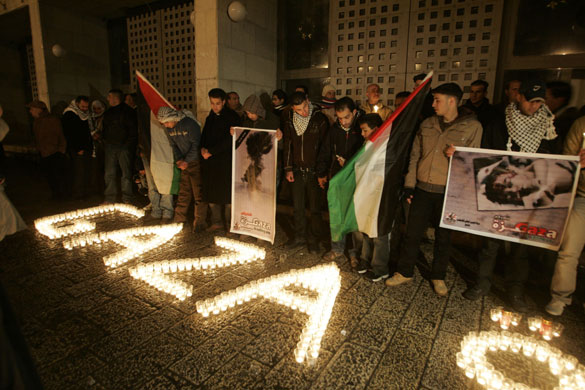
For those who know and respect Canon Ateek and the reconciliation work of the Sabeel Liberation Theology Centre in Jerusalem, the title says it all: A Palestinian Christian Cry for Reconciliation. He is unwavering in his conviction that “Our God-given mandate is to see that an enduring peace is achieved in the Middle East” (p. xiii). The book explains the reasons for the struggle for justice; the tortuously slow progress made in the last twenty years; why successive peace agreements have failed; and why reconciliation between Palestinians and Israelis is as elusive today as it was in 1948 or 1967. While brutally realistic, it is nevertheless a hopeful book, calling for justice for Palestinians, peace for Israelis and reconciliation for both.

The book has three parts. The first part is entitled, “Recapping History” and traces the birth of Sabeel, Canon Ateek’s own personal story, the generous offer of the Palestinians to share the land in a “two state solution” and the consistent refusal of Israel to abide by international law which has led to both political extremism and the breeding of violence. There is an extended exposition of the parable of the unjust judge (Luke 18) and some of Jesus’ harshest words against those who deprive others of justice (Matthew 23:25-26). With great care, Canon Ateek explains why successive peace negotiations failed because they failed to address the root cause of the conflict – Israel’s illegal occupation, annexation and colonisation of the West Bank. One of the most helpful sections refutes Zionist propaganda about the “generous offer” and shows how Palestinians have consistently been willing to compromise land for peace but to no avail.

The second part addresses Palestinian Liberation Theology in the service on nonviolence and peace. Here Canon Ateek examines the place of “Land” in Scripture and the centrality of the biblical demand for justice. He exposes the deficiencies and inherent racism of Zionist theology. There follows an examination of the theology and politics of Christian Zionism and he contrasts this with the non-violent way of the cross of Jesus. In successive chapters, Canon Ateek compares the strategies and paradigms of contemporary, historical and biblical figures such as Saddam Hussein, Jonah, Samson, Daniel  and Judah Maccabeus.

The third and final part is appropriately entitled “The Peace we Dream of”. With sensitivity and compassion, Canon Ateek summarises Israel’s predicament – how to remain a Jewish State committed to ethnic nationalism without rightly being compared to apartheid South Africa. He identifies the deficiencies of the “Two State Solution” and need for Israelis and Palestinians to move from justice to forgiveness and reconciliation.

The foreword is written by Archbishop Desmond Tutu, and there are four appendixes dealing with the Zionist plan for Palestine from 1919, the infamous Balfour Declaration, Palestinian loss of land from 1946-2005, and the West Bank Barrier route as of June 2007.

Consistently throughout the book, Canon Ateek, seeks faith based solutions based on biblical models and scriptural injunctions “to do justice, love mercy and walk humbly with our God”. Canon Ateek shows compellingly that one cannot divorce religion from politics. Both are he insists “deeply intertwined” He insists “Religion can be a source of tremendous spiritual strength, but religion, when misused and translated into action by people of power, can also become a deadly weapon.” (p. xiv).

It is clear why to many Zionists, Canon Ateek and other Palestinians who have disavowed violence as a means of achieving independence, are a greater threat than the terrorists. (see Camera and CUFI for examples)

In this vitally important book, Canon Ateek identifies the major principles or building blocks upon which a just and lasting peace can and must be built. Canon Ateek strikes at the heart of the conflict and fearlessly addresses the major obstacles to peace, not least the unconditional support successive US administrations have afforded Israel. Canon Ateek warns prophetically, “Only when justice is done and Palestinians can celebrate their own independence will a comprehensive peace be felt throughout the land. As long as one side celebrates while the other mourns, no authentic celebration or peace is possible.”  As Jesus says, “Now that you know these things you will be blessed if you do them.” (John 13:17)

Some Reviews:

“This is one of those books that are capable of transforming the reader and can change the world” Walter Wink.

“An important book for understanding the deeper issues impacting the path to peace for the people of Palestine and Israel. The concrete course of action Fr. Ateek proposes is rooted in non-violence, grounded in current realities, and can finally open a clear path to justice, reconciliation, and forgiveness for all the peoples of the Holy Land” Dave Robinson, Pax Christi USA.

“This book… is essential reading for anyone committed to the non-violent struggle for justice and peace in the Middle East” John H. Thomas, President, United Church of Christ.

Ateek’s vision is three-fold: the unity of all Palestinian Christians, dialogue and solidarity between Christian and Muslim Palestinians, and the creation of justice and peace between Israelis and Palestinians. It demands dismantling those theologies and readings of the Bible that turn God into a racist God of war who chooses one people over others…” Rosemary Radford Ruether, Pacific School of Religion.

“Naim Ateek offers a welcome contribution to the struggle that so many share for peace, justice and reconciliation in Israel and Palestine. His new book is an important reminder of the unique role that Palestinian Christians… can and should play in resolving one of the most painful situations of injustice and violence in our world today. I share its dream of a Holy Land that truly is a land of peace, justice and reconciliation.” Clifton Kirkpatrick, President, World Alliance of Reformed Churches.

The Revd Dr Naim Stifan Ateek, a Palestinian Anglican priest, is an Arab citizen of Israel. He is the president and director of Sabeel, an ecumenical theological centre in Jerusalem, which he founded to work for the liberation of Palestinians. For more information see the Friends of Sabeel North America and Friends of Sabeel UK.

A Prayer for Gaza

O God our prayer today is more like an inarticulate cry and our hearts ache. We saw a man in Gaza weeping beside his three little dead children – innocent beauty now bloodied in death

A massacre that started on the eve of Holy Innocents Day claims more and more women and children’s lives.

UN schools bombed, where families had sought refuge.

The people of Gaza with nowhere to run.

They are imprisoned under a harsh siege, bombed by the most sophisticated new weapons and then attacked in their own streets and houses.

O God where can they find refuge. No one has listened to their suffering for over 60 years.

O God of the oppressed and suffering we see you in the wounded of Gaza – we hear your cries of pain – we share your tears. May we never be silent in the face of such pain.

O God may world leaders at last hear the cries of the children and the suffering of Gaza.

May the siege be removed. The gates be opened. May they be allowed to have food, water, medicine, human rights, dignity, justice, democracy.

O God hear the cry of Gaza.

May freedom come – may healing come – may hope come.

May they be treated as we would like to be treated.

And we pray for the people of Israel because there will be no peace for them until the occupation ends and the siege is over – no peace for them until justice comes to Palestine.

And we pray that peace will come soon and that each person will recognise the value of the other and Israel and Palestine become a Holy Land once more.

Amen.

Garth Hewitt
Director, Amos Trust
Canon, Jerusalem Cathedral

January 2009, www.amostrust.org

Statement by the Patriarchs and Heads of the Churches in Jerusalem on the current devastating situation in Gaza


Photograph: Adel Hana/AP

We, the Patriarchs, Bishops and the Heads of Christian Churches in Jerusalem, follow with deep concern, regret, and shock the war currently raging in the Gaza Strip and the subsequent destruction, murder and bloodshed, especially at a time when we celebrate Christmas, the birth of the King of love and peace. As we express our deep sorrow at the renewed cycle of violence between Israelis and Palestinians and the continued absence of peace in our Holy Land, we denounce the ongoing hostilities in the Gaza Strip and all forms of violence and killings from all parties. We believe that the continuation of this bloodshed and violence will not lead to peace and justice but breed more hatred and hostility – and thus continued confrontation between the two peoples.

Accordingly, we call upon all officials of both parties to the conflict to return to their senses and refrain from all violent acts, which only bring destruction and tragedy, and urge them instead to work to resolve their differences through peaceful and non-violent means.

We also call upon the international community to fulfill its responsibilities and intervene immediately and actively stop the bloodshed and end all forms of confrontation; to work hard and strong to put an end to the current confrontation and remove the causes of conflict between the two peoples; and to finally resolve the Israeli-Palestinian conflict with a just and comprehensive solution based on international resolutions.

To the various Palestinian factions we say: It is time to end your division and settle your differences. We call on all factions at this particular time to put the interests of the Palestinian people above personal and factional interests and to move immediately toward national comprehensive reconciliation and use all non-violent means to achieve a just and comprehensive peace in the region.

Finally, we raise our prayers to the Child in the manger to inspire the authorities and decision makers on both sides, the Israelis and Palestinians, for immediate action to end the current tragic situation in the Gaza Strip. We pray for the victims, the wounded and the broken-hearted. May the Lord God Almighty grant all those who have lost loved ones consolation and patience. We pray for all those living in panic and fear, that God may bless them with calm, tranquility and true peace.

We call on all to observe next Sunday, January 4, as a day for justice and peace in the land of peace.

+ Patriarch Theophilos III, Greek Orthodox Patriarchate
+ Patriarch Fuad Twal, Latin Patriarchate.
+ Patriarch Torkom II, Armenian Apostolic Orthodox Patriarchate.
Fr. Pier Battista Pizzaballa, ofm, Custody of the Holy Land
+ Anba Abraham, Coptic Orthodox Patriarchate.
+ Archbishop Swerios Malki Mourad, Syrian Orthodox Patriarchate.
+ Abune Matthias, Ethiopian Orthodox Patriarchate
+ Archbishop Paul Nabil Sayyah, Maronite Patriarchal Exarchate.
+ Bishop Suheil Dawani, Episcopal Church of Jerusalem & the Middle East.
+ Bishop Munib Younan, Evangelical Lutheran Church in Jordan & the Holy Land.
+ Bishop Pierre Malki, Syrian Catholic Patriarchal Exarchate
+ Bishop Youssef Zre’i, Greek Catholic Patriarchal Exarchate.
Fr. Raphael Minassian, Armenian Catholic Patriarchal Exarchate

Read John McArthy If it were your home, what hope restraint? and Ilan Pappe Israel’s Righteous Fury and its Victims in Gaza

The Narrow Gate of Justice: Sabeel Statement
Pirates of the Mediterranean: Gaza Update
Photos of Gaza

The Christians of Gaza

Photograph: Musa Al-shaer/AFP/Getty Images

A little known fact is the presence of a small but significant Christian Palestinian presence in Gaza. Gerald Butt wrote about them in Life at the Crossroads: History of Gaza. Read a review here.

Carl Moeller of Open Doors has just sent this news and prayer update on their plight.

“As an estimated 10,000 Israeli ground troops invaded Gaza today, the small community of Christians are drawing strength from their faith in God. Last week’s attacks left over 400 dead and 2,000 injured and the numbers are expected to dramatically increase.

According to reliable reports, the Gaza Baptist Church building was still standing this morning but has had some of its windows shattered by the bombings. Some Christian families left Gaza for Bethlehem over the holidays and are now separated from their loved ones with the border sealed. Many of the hospitals, already lacking basic medicines and medical equipment, are overwhelmed with the casualties and often are without power.

This is serious trouble for Christians in Gaza. Even before the recent end to the ceasefire (December 19) and the bombings, the estimated 3,000 Christians in Gaza have been living in fear from threats from Islamic militants.

Please join me in prayer for these brave Christians in Gaza in the wake of this new outbreak of violence. Pray that the war between Israel and Palestine is shorter and less devastating than what military and political speculators around the world are predicting. Pray that Christian families will be reunited. Pray that the Gaza Baptist Church building will be spared from the bombs.

Earlier this year one believer in Gaza stated: “Seventy percent of the Christians want to leave Gaza because they are very afraid. But we love Gaza. It’s our country, we have roots here, our homes are here. We will not know anyone if we go somewhere else.”

Pray that the seeds Brother Andrew sowed with Hamas and other prominent militant groups and the Gazan Christians sowed throughout the years when the Palestinian Bible Society actively shared God’s love with Muslim friends and neighbors will bear fruit. May their offerings of Christ’s love result in peace and God’s glory. Please check our website at http://www.opendoorsusa.org/ for updates.

In Christ our hope,
Carl Moeller

Dr. Carl A. Moeller
Open Doors USA President/CEO

x

Read John McArthy’s excellent piece in the Independent If it were your home, what hope restraint?

Also:

The Narrow Gate of Justice: Sabeel’s Statement
Statement by the Patriarchs and Heads of the Churches

Pirates of the Mediterranean: Gaza Update

More photos of Gaza

Royal Grammar School Guildford Debates the Arab-Israeli Conflict

Yesterday, the staff of the Royal Grammar School in Guildford, invited John Levy of Friends of Israel Educational Foundation and I to to have a debate on Israel and Palestine before the sixth form students.

It was a good natured affair and we agreed in large measure, for example, on the need for a negotiated and diplomatic settlement based on the Two State solution, repudiating the use of violence and terrorism against civilians. I emphasized that there were at least two sides to this issue and that I was not expecting students to side with one of us but rather hear both perspectives, hold them together and be ready for their homework.

John majored on the relative size of Israel compared to its Arab neighbours, its greater historic claim to the land, the belligerent nature of the Palestinian response to the peace process, the frequent terrorist attacks against Israelis, the refusal of Hamas to recognise the existence of Israel and the Palestinian refusal to accept the ‘generous offer’ under Barak .

I focussed on the strategy of successive Israeli governments to militarily occupy, expel Palestinians and then colonize the West Bank, Golan and Gaza, in breach of international law. I explained the strategy involved land seizure, house demolitions, settlement building, the construction of bipass roads for settlers and roadblocks for the Palestinians, anbd the construction of the separation barrier – Ha’hafrada in Hebrew – meaning ‘separate’ or ‘apart’ as in apartheid. I dwelt on the response of the international community to the illegal occupation of Palestine, human rights abuses, UN Resolutions, the intention of the Roadmap Principles and Annapolis Agreement.

I outlined what appear to be the three options for the way forward.

Like a child with his hand stuck in a sweet jar, Israel wants three but can only have two.

Option 1: The One State Solution
Israel can annexe the Occupied Territories and give all Palestinians equal rights with Jewish Israelis but it would have to amend its constitution and cease being a Zionist State (its important to distinguish between Judaism which is a religion and Zionism which is a political system – the two are not synonymous). That is not going to happen in the short term but its possible in the long term that by mutual agreement some kind of ‘federation’ may emerge between Israel, Palestine and Jordan, for example, of the kind that has occured in the European Community.

Option 2: The Two State Solution
Israel can remain a Zionist State and a democracy but to enjoy both it must give up the aspirations of Eretz Israel – the ‘greater’ Israel and withdraw from the Golan Heights, Gaza and the West Bank to the internationally recognised borders (The 1949 Armistice line, aka the green Line assumed in UN Resolution 242). This is the position favoured by the international community as expressed in the Roadmap for Peace, Annapolis Agreement and latest Quartet Statement and UN Resolution 1850.

Option 3: The No State Solution
Israel can remain a Zionist state and annexe and settle more land in the Occupied Territories and Golan. To do so, however, it must also continue to control the lives of Palestinians by military force. This is the option favoured by many within Netanyahu‘s Likud party, who have a good chance of winning the elections in February (Netanyahu, for example opposed the withdrawal from Gaza). Livni, his main opponent has also indicated that she believes the national aspirations of Israeli Arabs lies in a Palestinian homeland, not Israel. But accepting or justifying the present status quo is incompatable with being a Western-styled democracy, something Jimmy Carter has warned of.

There followed a lively Q&A time with the students asking some penetrating questions. I concluded by explaining the homework – to resolve the conflict as their parents generation (and mine) had failed to – and help both Israelis and Palestinians work toward the implementation of the Roadmap for Peace.

Bethlehem

“But you, Bethlehem Ephrathah, though you are small among the clans of Judah, out of you will come for me one who will be ruler over Israel, whose origins are from of old, from ancient times.” (Micah 5:2)

The first occasion in which Bethlehem is mentioned in history has been found in the Amarna letters written from tribal kings of Palestine to the Egyptian pharaohs probably sometime between 1400-1360 B.C. The ruler in Jerusalem complains that Bit-Lahmi has deserted to the ‘Apiru people, a word probably referring to the Hebrews. Bethlehem is about 9 kilometres south of Jerusalem just off the main road to Hebron and Egypt. A strategic position perched 750 metres above sea level, the town sprawls out along several limestone ridges like the tentacles of an octopus. To the east lies Beit Sahour which means the Shepherd’s Fields and the barren hills of the Judean desert. To the west are more fertile slopes around Beit Jala where corn and figs, olive fields and vineyards abound.

The town of Bethlehem is mentioned frequently in the Bible. Its location became sacred when Jacob buried his beloved wife Rachel by the road side near the entrance to Bethlehem. (Genesis 35:19; 48:7). It is possible that Salma, the son of Caleb, built the first Jewish settlement there (1 Chronicles 2:51). The town and surrounding fields also feature prominently in the romantic love story of Ruth and Boaz who became the great-grandparents of David (Ruth 1; 2:4; 4:11). The town grew in prominence when Samuel anointed the shepherd boy David, to be king of Israel there (1 Samuel 16:4-13). By New Testament times Bethlehem had come to be known as ‘The town of David’ (Luke 2:4,11).

Around 700 B.C. the prophet Micah predicted that someone greater than David would be born in Bethlehem whose origins, incredibly, would be earlier than his human birth (Micah 5:2). When the Magi came from the East searching for the one to be born king of the Jews, Herod consulted with the chief priests and biblical scholars, who it seems knew full well the significance of Micah’s prophecy (Luke 2:1-8; John 7:42).

Bethlehem is therefore unique. It is the place where Almighty God, the Creator of the universe, entered our world and became a human being. It is hard to comprehend the wonder and enormity of this fact. Words cannot improve on the declaration of the angels to the shepherds, “Today in the town of David a Saviour has been born to you; he is Christ the Lord.” (Luke 2:11).

Under the Church of the Nativity, probably the oldest church in the world and best authenticated site in the Holy Land, is a simple cave. In the silence of this ancient site, best visited in the early morning, it is possible to pause and worship near the place where the Lord Jesus Christ was born. To enter the church one must first stoop low below the lintel. The tallest must stoop the furthest, only children can enter without bending down. What a lesson in humility.

For many, Bethlehem and the Christmas story is the place where they first begin to experience the meaning of that enigmatic phrase “He has also set eternity in the hearts of men…” (Ecclesiastes 3:11), for here in this place time, eternity and destiny meet in Jesus.

Incidentally, in Hebrew, Bethlehem means ‘The house of bread’. How appropriate that the One who said “I am the Bread of Life” should be born in the house of bread. On another occasion Jesus said, “Whoever eats my flesh and drinks my blood has eternal life, and I will raise him up at the last day. For my flesh is real food and my blood is real drink.” (John 6:54-55). Let us indeed feed on Him in our hearts by faith with thanksgiving.

This chapter is taken from my book, In the Footsteps of Jesus and the Apostles

My Top 5 Books on Social Justice: Tony Campolo in Christianity Today


Rich Christians in An Age of Hunger: Moving from Affluence to Generosity Ron Sider

Continues to make the evangelical community aware of what the Bible says about our responsibilities to the poor, and calls Christians to do something about it.

Christian Zionism: Road-map to Armageddon? Stephen Sizer

A comprehensive survey describing how Christians have embraced a theological perspective that has encouraged justice for Jews, but has also led to the oppression of Palestinian people and extreme hostility between Christians and Muslims worldwide

The Irresistible Revolution: Living as an Ordinary Radical Shane Claiborne

If you want to get a glimpse of what radical obedience looks like when lived out by a Red-Letter Christian, then this book is a must.

God’s Politics: Why the Right Gets It Wrong and the Left Doesn’t Get It Jim Wallis

A New York Times bestselling book offering an alternative to the polarizing politics promoted by many in the religious culture wars. Wallis helps us find unity with a politics that addresses the needs of the poor and oppressed.

The Prophets Abraham J Heschel

Provides rich insights from the Hebrew prophets as they empathized with the pathos that God shows upon seeing the oppression of the poor.

See Christianity Today