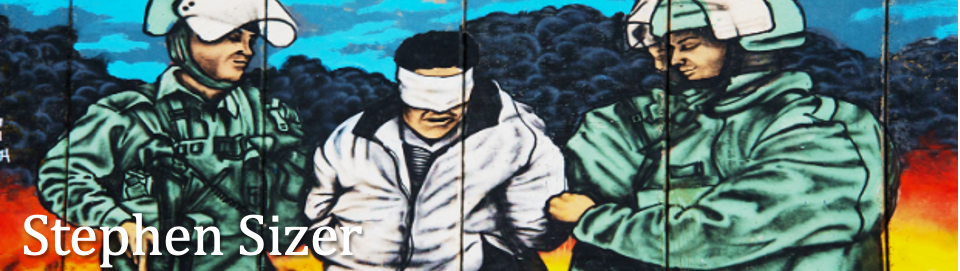
 The Right Revd Riah Hanna Abu El Assal, the retired Anglican bishop in Jerusalem, was interviewed on Sunday about the situation in the Middle East. He speaks candidly about the plight of the Christian community and his hopes for peace. You can listen to the interview here
Author Archives: Stephen Sizer
Christmas for Children at Christ Church

Christmas at Christ Church

John 15:1-17 “I am the Vine”
 “Jacob came for a bride from his own people. He desired Rachel, but he did not get Rachel at first, but Leah. After he learned to love Leah as much as he did Rachel, he got Rachel as well. In the beginning Leah had all the babies, her womb was most fruitful. But then Rachel conceives. Israel shall be a fruitful vine. Jesus came for Israel. He wanted to marry Israel, but He did not get Israel. He ends up with the bride He did not desire at first, the Gentile church. After He learns to love the Gentile church, then He gets Israel. In the beginning, the church has all the babies. But in the end, Israel becomes a fruitful vine.” (Jacob Prasch).
What is the relationship between Israel and the Church? Does God have one ‘chosen people’ or two? What is the relationship between God and his people? Who is the fruitful vine?
These were the subjects addressed at a conference in Johannesburg, I attended earlier this month. It was sponsored by Messianic Good News, an organisation dedicated to take the good news of Jesus to Jewish people. It was a great encouragement to spend a week with Jews who love Jesus and who have a passion to make him known within the Jewish community. I hope we can build on this relationship and support their work in the future. Following our day with Chawkat Moucarry looking at Islam earlier in the year, and with Juge Ram on Hinduism and Sikhism yesterday, I hope that early next year we can arrange a teaching day on Judaism and learn how to share our faith with Jewish people.
Please turn with me to John 15 and let us examine the meaning of this image of the vine and the branches.
“I am the true vine, and my Father is the gardener. He cuts off every branch in me that bears no fruit, while every branch that does bear fruit he prunes so that it will be even more fruitful.” (John 15:1-2)
Jesus makes three main assertions: God the Father is the Vineyard Owner. God the Son is the Vine. God’s People who remain and bear fruit are the Branches.
A foot in many camps – a reply to Stephen Kuhrt
 by Chris Sugden in the Church of England Newspaper November 21 2008
In his CEN article last week, Stephen Kuhrt argued that the 57 member CEEC is not representative because 28 members belong to what he defines as one, conservative, stream. Stephen argues, as does Graham Kings in a parallel article in the Church Times last week, that there are three streams in the Evangelical Constituency and any organization claiming to represent that constituency needs to reflect them in proportion.
PROPORTIONALITY
Arguments about proportionality encourage a particularly narrow view of ‘representation’. Like MPs and Bishops, CEEC members – drawn as Stephen’s piece shows from different types of ‘constituency’ – are there to represent the whole constituency. That should be common ground about how we understand the ‘Evangelical Constituency’ to be made up.
Stephen speaks of ‘three streams’: but why (only) three? How do we know their relative strengths? The usual way is by elections – to see which groups win support. Even accepting the argument for proportionality, applying it in the evangelical constituency is problematic. The categories overlap. Many, but not all, conservatives are charismatics. There are different kinds of charismatics and conservatives, just as there are different kinds of points of view in Fulcrum. Fuclrum itself illustrates the difficulty. Its strap-line refers to ‘The Evangelical Centre’. But what is the ‘centre’? Identifying the centre requires an agreed definition of the limits of the range – the meaning of ‘Evangelical’.
DEFINING IDENTITY
A representative organization like CEEC needs some means of establishing what makes it distinctive so that it can be seen who and what it represents. When an organization consists, as many do, of a number of viewpoints, defining its identity is difficult. This is particularly so when some who agree on some points but disagree on others find allies with those on the outside who are in fundamental disagreement with the view of other members of the first organization.
“I am the Way, the Truth and the Life” John 14

Hands up if you own one of these? (a GPS unit). If so, do you remember what life was like before you had one? I do. Painful. The low point for me came the day I got lost in Bedford. I had gone there for a meeting and forgot the location of the road. After a fruitless half an hour trying to find my way, I was ready to give up and drive home. Then James Hughes, the former curate, phoned. “Where are you” he said. “I don’t know” I replied.
“Let me help you” and he then proceeded to open up his computer which had street maps of England. Having identified the name of the road I was parked in and the name of the road I was heading for, he literally talked me there road by road, on my hands free phone, of course. That is what made me realize I needed a GPS. I never leave home without Sean Connery now – or at least a digitized version of Sean Connery’s voice. You know when you have arrived because he says “shaken not stirred”.
Do you know how GPS works? You turn it on and type in the post code. No, that is not what I mean. Do you know how it works? “When people talk about “a GPS,” they usually mean a GPS receiver. The Global Positioning System (GPS) is actually a constellation of 27 Earth-orbiting satellites (24 in operation and three extras in case one fails). The U.S. military developed and implemented this satellite network as a military navigation system, but soon opened it up to everybody else.
The Episcopal Church: A New Religious Movement. TEC Leaders in their Own Words
 † “I am the way, and the truth and the life…”
“‘I am the way, and the truth and the life. No one comes to God except through me.’ The first thing I want you to explore with me is this: I simply refuse to hold the doctrine that there is no access to God except through Jesus. I personally reject the claim that Christianity has the truth and all other religions are in error… I think it is a mistaken view to say Christianity is superior to Hinduism, Buddhism, Islam, and Judaism and that Christ is the only way to God and salvation.” The Rev. Dr. George F. Regas, Rector Emeritus All Saints Episcopal Church, Pasadena, California, April 24, 2005, guest sermon at Washington National Cathedral
“My understanding of idolatry includes the assumption that I can know and comprehend the way in which God saves people who are not overtly Christian. I understand that Jesus is my savior, I understand that Jesus is the savior of the whole world. But I am unwilling to do more than speculate about how God saves those who don’t profess to be Christians. I look at the fruits of the life of someone like Mahatma Ghandi and the Dhali Lama and I see Christ-like features …” Presiding Bishop Katharine Jefferts Schori, Virginia Theological Seminary, May 25, 2007
Audio Recordings of the All Souls GAFCON Consultation

GAFCON Jerusalem Report Consultation, 1st July 2008
Orthodoxy & Effective Mission : Archbishop Henry Orombi
Orthodoxy & Global Connections : Archbishop Greg Venables
Orthodoxy & Personal Experience : Dr Jim Packer
Questions to the Panel – Henry Orombi, Peter Jensen, Greg Venables & Jim Packer
More photos of All Souls
Audio Recordings of GAFCON Jerusalem

Audio recordings of the presentations made at the Global Anglican Futures Conference in Jerusalem. (the videos are accessible here)
 1. Welcome Address: Archbishop Akinola
2. Opening Sermon: Archbishop Orombi
3. The Gospel and Secularism: Dr Os Guiness
4. The Nature and Future of the Anglican Communion: Bishop Michael Nazir-Ali
5. The Gospel and Religion: Professor Lamin Sanneh
6. Genesis 12: The Promise of God: Archbishop Akrofi
7. Exodus 24: The Presence of God: Revd David Short
8. 2 Samuel 1:1-17: The King of God: Revd Vaughan Roberts
10. Closing Sermon: Jesus Christ is Lord: Archbishop Venables
Photos taken at GAFCON may be viewed here
An Open Letter to Mordechai Ben Emet

Dear Mordechai,
I promised to write one more time and offer to meet, as Jesus instructed us to do in Matthew 18, in response to your decision to use an anonymous blog to criticise me in September.
You also gained access to our church facebook account without revealing your identity and then wrote to many of our church family to warn them about me, including children who were, not surprisingly, disturbed as were their parents. You also wrote anonymously to the hosts of various conferences I was invited to, to urge them not to allow me to speak. You know from the responses you received, some from Messianic leaders, that they share the Apostle Paul’s disdain for your methods.
“Rather, we have renounced secret and shameful ways; we do not use deception, nor do we distort the word of God. On the contrary, by setting forth the truth plainly we commend ourselves to every man’s conscience in the sight of God.” (2 Corinthians 4:2).
In one of your blogs you referred to Jacob Prasch as an “authentic Messianic teacher”. I therefore assume you are a Messianic believer also. On that basis I invite you again to meet with me to resolve the issues that concern you rather than continue to use an anonymous blog to slander me. I realize this may be difficult if you are presently in Israel.
You specifically criticize me for associating with people who have in the past or indeed presently justify the use of violence against Israel or whom you designate as anti-semitic or holocaust deniers. You are wrong to assume that in dialoguing with them, or by participating in conferences with them, that I in any way approve of, or agree with, their views or methods. On the contrary I have made my own views plain through my writings, website and lectures, on the illegitimacy of the use of violence as a means of resolving the Arab-Israeli conflict.
To clarify my position and to anticipate such criticisms, in my book Zion’s Christian Soldiers, I wrote the following:
“It is true that at various times in the past, churches and church leaders have tolerated or incited anti-Semitism and even attacks on Jewish people. Racism is a sin and without excuse. Anti-Semitism must be repudiated unequivocally. However, we must not confuse apples and oranges. Anti-Zionism is not the same thing as anti-Semitism despite attempts to broaden the definition. Criticising a political system as racist is not necessarily racist. Judaism is a religious system. Israel is a sovereign nation. Zionism is a political system. These three are not synonymous. I respect Judaism, repudiate anti-Semitism, encourage interfaith dialogue and defend Israel’s right to exist within borders recognised by the international community and agreed with her neighbours. But like many Jews, I disagree with a political system which gives preference to expatriate Jews born elsewhere in the world, while denying the same rights to the Arab Palestinians born in the country itself.”
In any future edition, I will emphasize, as I have done elsewhere, that I also believe the resolution of the Arab-Israeli conflict can only be achieved by peaceful means and through the implementation of international law.
Like you, I care passionately for the Jewish people and pray for a secure Israel, as well as the fulfilment of the legitimate aspirations of Palestinians to an independent, sovereign and democratic state. I believe justice for Palestinians will bring peace for Israel, reconciliation with their neighbours and the marginalisation of extremists.
As you know, followers of Jesus Christ are:
1. called to be peacemakers (Matthew 5:9)
2. to fulfill a ministry of reconciliation (2 Corinthians 5:11-21)
3. to disavow the use of violence or intimidation to further the will and purposes of God (Matthew 5:38-48).
4. and when they disagree, seek reconciliation privately and if necessary, with the mediation of others (Matthew 18:15-19)
As a minister of the gospel, my primary motivation is to share the good news of Jesus Christ with all who will listen. “I am not ashamed of the gospel, because it is the power of God for the salvation of everyone who believes: first for the Jew, then for the Gentile.” (Romans 1:16).
Jesus himself was accused of being “a friend of tax collectors and “sinners.” ’ (Luke 7:34). As one myself, I am grateful to know him as my friend, and desire to share that friendship with those who at present are outside his family, even at the expense of being maligned or misunderstood by others.
As Brother Andrew has said of his own approach, “the best way I can show my love of Israel is to seek to convert her enemies.” You have questioned my integrity, my motives and methods from a position of anonymity.
While you have expended many hours to watch videos of me, to listen to debates with me, or read sermons by me, I suggest you do not yet know me well enough to condemn me. I feel under no obligation to justify my ministry to those who hide behind the cloak of anonymity – “the men in the shadows” as Jackson Browne put it in one of his songs. I invite you instead to meet and find out whether your criticisms are really justified.
The invitation will remain open but I will not respond to you further unless and until we meet.
Yours in Yeshua
Stephen
p.s. Why are you using the IP address of Agaf HaModin, the Israeli Military Intelligence Directorate?