Category Archives: Israel

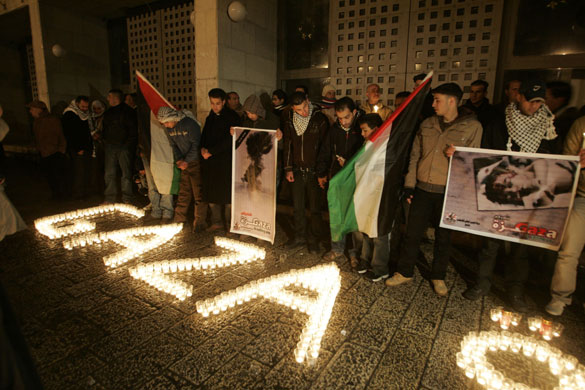
A Prayer for Gaza

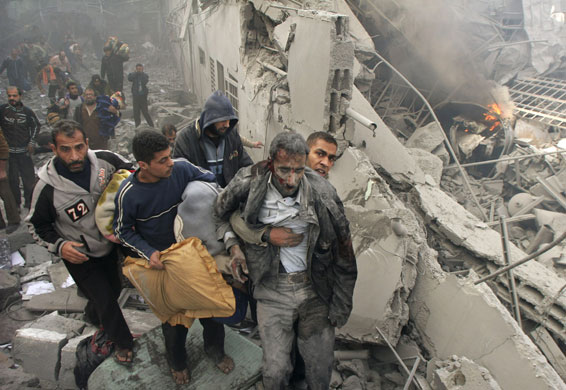
O God our prayer today is more like an inarticulate cry and our hearts ache. We saw a man in Gaza weeping beside his three little dead children – innocent beauty now bloodied in death

A massacre that started on the eve of Holy Innocents Day claims more and more women and children’s lives.

UN schools bombed, where families had sought refuge.

The people of Gaza with nowhere to run.

They are imprisoned under a harsh siege, bombed by the most sophisticated new weapons and then attacked in their own streets and houses.

O God where can they find refuge. No one has listened to their suffering for over 60 years.

O God of the oppressed and suffering we see you in the wounded of Gaza – we hear your cries of pain – we share your tears. May we never be silent in the face of such pain.

O God may world leaders at last hear the cries of the children and the suffering of Gaza.

May the siege be removed. The gates be opened. May they be allowed to have food, water, medicine, human rights, dignity, justice, democracy.

O God hear the cry of Gaza.

May freedom come – may healing come – may hope come.

May they be treated as we would like to be treated.

And we pray for the people of Israel because there will be no peace for them until the occupation ends and the siege is over – no peace for them until justice comes to Palestine.

And we pray that peace will come soon and that each person will recognise the value of the other and Israel and Palestine become a Holy Land once more.

Amen.

Garth Hewitt
Director, Amos Trust
Canon, Jerusalem Cathedral

January 2009, www.amostrust.org

Statement by the Patriarchs and Heads of the Churches in Jerusalem on the current devastating situation in Gaza


Photograph: Adel Hana/AP

We, the Patriarchs, Bishops and the Heads of Christian Churches in Jerusalem, follow with deep concern, regret, and shock the war currently raging in the Gaza Strip and the subsequent destruction, murder and bloodshed, especially at a time when we celebrate Christmas, the birth of the King of love and peace. As we express our deep sorrow at the renewed cycle of violence between Israelis and Palestinians and the continued absence of peace in our Holy Land, we denounce the ongoing hostilities in the Gaza Strip and all forms of violence and killings from all parties. We believe that the continuation of this bloodshed and violence will not lead to peace and justice but breed more hatred and hostility – and thus continued confrontation between the two peoples.

Accordingly, we call upon all officials of both parties to the conflict to return to their senses and refrain from all violent acts, which only bring destruction and tragedy, and urge them instead to work to resolve their differences through peaceful and non-violent means.

We also call upon the international community to fulfill its responsibilities and intervene immediately and actively stop the bloodshed and end all forms of confrontation; to work hard and strong to put an end to the current confrontation and remove the causes of conflict between the two peoples; and to finally resolve the Israeli-Palestinian conflict with a just and comprehensive solution based on international resolutions.

To the various Palestinian factions we say: It is time to end your division and settle your differences. We call on all factions at this particular time to put the interests of the Palestinian people above personal and factional interests and to move immediately toward national comprehensive reconciliation and use all non-violent means to achieve a just and comprehensive peace in the region.

Finally, we raise our prayers to the Child in the manger to inspire the authorities and decision makers on both sides, the Israelis and Palestinians, for immediate action to end the current tragic situation in the Gaza Strip. We pray for the victims, the wounded and the broken-hearted. May the Lord God Almighty grant all those who have lost loved ones consolation and patience. We pray for all those living in panic and fear, that God may bless them with calm, tranquility and true peace.

We call on all to observe next Sunday, January 4, as a day for justice and peace in the land of peace.

+ Patriarch Theophilos III, Greek Orthodox Patriarchate
+ Patriarch Fuad Twal, Latin Patriarchate.
+ Patriarch Torkom II, Armenian Apostolic Orthodox Patriarchate.
Fr. Pier Battista Pizzaballa, ofm, Custody of the Holy Land
+ Anba Abraham, Coptic Orthodox Patriarchate.
+ Archbishop Swerios Malki Mourad, Syrian Orthodox Patriarchate.
+ Abune Matthias, Ethiopian Orthodox Patriarchate
+ Archbishop Paul Nabil Sayyah, Maronite Patriarchal Exarchate.
+ Bishop Suheil Dawani, Episcopal Church of Jerusalem & the Middle East.
+ Bishop Munib Younan, Evangelical Lutheran Church in Jordan & the Holy Land.
+ Bishop Pierre Malki, Syrian Catholic Patriarchal Exarchate
+ Bishop Youssef Zre’i, Greek Catholic Patriarchal Exarchate.
Fr. Raphael Minassian, Armenian Catholic Patriarchal Exarchate

Read John McArthy If it were your home, what hope restraint? and Ilan Pappe Israel’s Righteous Fury and its Victims in Gaza

The Narrow Gate of Justice: Sabeel Statement
Pirates of the Mediterranean: Gaza Update
Photos of Gaza

The Christians of Gaza

Photograph: Musa Al-shaer/AFP/Getty Images

A little known fact is the presence of a small but significant Christian Palestinian presence in Gaza. Gerald Butt wrote about them in Life at the Crossroads: History of Gaza. Read a review here.

Carl Moeller of Open Doors has just sent this news and prayer update on their plight.

“As an estimated 10,000 Israeli ground troops invaded Gaza today, the small community of Christians are drawing strength from their faith in God. Last week’s attacks left over 400 dead and 2,000 injured and the numbers are expected to dramatically increase.

According to reliable reports, the Gaza Baptist Church building was still standing this morning but has had some of its windows shattered by the bombings. Some Christian families left Gaza for Bethlehem over the holidays and are now separated from their loved ones with the border sealed. Many of the hospitals, already lacking basic medicines and medical equipment, are overwhelmed with the casualties and often are without power.

This is serious trouble for Christians in Gaza. Even before the recent end to the ceasefire (December 19) and the bombings, the estimated 3,000 Christians in Gaza have been living in fear from threats from Islamic militants.

Please join me in prayer for these brave Christians in Gaza in the wake of this new outbreak of violence. Pray that the war between Israel and Palestine is shorter and less devastating than what military and political speculators around the world are predicting. Pray that Christian families will be reunited. Pray that the Gaza Baptist Church building will be spared from the bombs.

Earlier this year one believer in Gaza stated: “Seventy percent of the Christians want to leave Gaza because they are very afraid. But we love Gaza. It’s our country, we have roots here, our homes are here. We will not know anyone if we go somewhere else.”

Pray that the seeds Brother Andrew sowed with Hamas and other prominent militant groups and the Gazan Christians sowed throughout the years when the Palestinian Bible Society actively shared God’s love with Muslim friends and neighbors will bear fruit. May their offerings of Christ’s love result in peace and God’s glory. Please check our website at http://www.opendoorsusa.org/ for updates.

In Christ our hope,
Carl Moeller

Dr. Carl A. Moeller
Open Doors USA President/CEO

x

Read John McArthy’s excellent piece in the Independent If it were your home, what hope restraint?

Also:

The Narrow Gate of Justice: Sabeel’s Statement
Statement by the Patriarchs and Heads of the Churches

Pirates of the Mediterranean: Gaza Update

More photos of Gaza

Royal Grammar School Guildford Debates the Arab-Israeli Conflict

Yesterday, the staff of the Royal Grammar School in Guildford, invited John Levy of Friends of Israel Educational Foundation and I to to have a debate on Israel and Palestine before the sixth form students.

It was a good natured affair and we agreed in large measure, for example, on the need for a negotiated and diplomatic settlement based on the Two State solution, repudiating the use of violence and terrorism against civilians. I emphasized that there were at least two sides to this issue and that I was not expecting students to side with one of us but rather hear both perspectives, hold them together and be ready for their homework.

John majored on the relative size of Israel compared to its Arab neighbours, its greater historic claim to the land, the belligerent nature of the Palestinian response to the peace process, the frequent terrorist attacks against Israelis, the refusal of Hamas to recognise the existence of Israel and the Palestinian refusal to accept the ‘generous offer’ under Barak .

I focussed on the strategy of successive Israeli governments to militarily occupy, expel Palestinians and then colonize the West Bank, Golan and Gaza, in breach of international law. I explained the strategy involved land seizure, house demolitions, settlement building, the construction of bipass roads for settlers and roadblocks for the Palestinians, anbd the construction of the separation barrier – Ha’hafrada in Hebrew – meaning ‘separate’ or ‘apart’ as in apartheid. I dwelt on the response of the international community to the illegal occupation of Palestine, human rights abuses, UN Resolutions, the intention of the Roadmap Principles and Annapolis Agreement.

I outlined what appear to be the three options for the way forward.

Like a child with his hand stuck in a sweet jar, Israel wants three but can only have two.

Option 1: The One State Solution
Israel can annexe the Occupied Territories and give all Palestinians equal rights with Jewish Israelis but it would have to amend its constitution and cease being a Zionist State (its important to distinguish between Judaism which is a religion and Zionism which is a political system – the two are not synonymous). That is not going to happen in the short term but its possible in the long term that by mutual agreement some kind of ‘federation’ may emerge between Israel, Palestine and Jordan, for example, of the kind that has occured in the European Community.

Option 2: The Two State Solution
Israel can remain a Zionist State and a democracy but to enjoy both it must give up the aspirations of Eretz Israel – the ‘greater’ Israel and withdraw from the Golan Heights, Gaza and the West Bank to the internationally recognised borders (The 1949 Armistice line, aka the green Line assumed in UN Resolution 242). This is the position favoured by the international community as expressed in the Roadmap for Peace, Annapolis Agreement and latest Quartet Statement and UN Resolution 1850.

Option 3: The No State Solution
Israel can remain a Zionist state and annexe and settle more land in the Occupied Territories and Golan. To do so, however, it must also continue to control the lives of Palestinians by military force. This is the option favoured by many within Netanyahu‘s Likud party, who have a good chance of winning the elections in February (Netanyahu, for example opposed the withdrawal from Gaza). Livni, his main opponent has also indicated that she believes the national aspirations of Israeli Arabs lies in a Palestinian homeland, not Israel. But accepting or justifying the present status quo is incompatable with being a Western-styled democracy, something Jimmy Carter has warned of.

There followed a lively Q&A time with the students asking some penetrating questions. I concluded by explaining the homework – to resolve the conflict as their parents generation (and mine) had failed to – and help both Israelis and Palestinians work toward the implementation of the Roadmap for Peace.

Globalising Hatred: The New Antisemitism

Denis MacShane is the Labour MP for Rotherham, and was the Minister of State for Europe at the Foreign and Commonwealth Office until the ministerial reshuffle that followed the 2005 general election. His book “Globalizing Hatred: The New Antisemitism” was published by Weidenfeld & Nicolson in September 2008.

This week Newsweek published an article by MacShane entitled, ‘Europe’s Jewish Problem‘ It makes sober reading. This is from the introduction.

As Europe faces up to its old demons of financial breakdown and job losses, a wind from the past is blowing through the continent. The politics of moderate center-right and left-liberal democracy that took power after 1945 are giving way to a new old populism. The extravagant rhetoric of the demagogic left and right is gaining ground, and the most obvious manifestation is the return of anti-Semitism as an organizing ideology. Consider the numbers: according to a recent Pew survey, the percentage of Germans who hold unfavorable views of Jews has climbed from 20 percent in 2004 to 25 percent today. In France, which has the largest number of Jews of any European nation, 20 percent of people view Jews unfavorably—up from 11 percent four years ago. In Spain, the figures are even more striking: negative views of Jews climbed from 21 percent in 2005 to nearly one in two this year. In Britain, where the numbers have remained around 9 percent for some time, anecdotal evidence of increased animosity abounds: youngsters returning from the Jewish Free School in middle-class North London are now frightened to go home on public buses on account of anti-Jewish attacks. Their parents hire private buses, as the London police seem unable to staunch anti-Semitic assaults on their children. In Manchester, a Jewish cemetery had to have a Nazi swastika hurriedly cleaned off its walls before a VIP party arrived.”

MacShane concludes, “As jobs are lost and welfare becomes meaner and leaner, the politics of blaming the outsider can only grow. The hard-won European politics of breaking down frontiers and trying to legislate for tolerance will get harder to defend, still less to promote. European populism and the anti-EU nationalism of both the right and the left is now the politics to watch. As America celebrates its first nonwhite president and the hope of a new politics, Europe may be beginning to revisit its past.”

MacShane’s new book has been reviewed by Rafael Behr in the Observer/Guardian, Alasdair Palmer, in the Telegraph, and Geoffrey Alderman in the Jewish Chronicle.

With the recession beginning to bite harder and forecast to last at least a year, with the steady rise in radical political and religious extremism, anti-social behaviour and the threat of terrorism ever before us, the temptation in 2009 will be to retreat into our shells or begin to blame others for our woes. Remember Oswald Mosley and his Black Shirts that fed off the back of the Great Depression? How do we avoid it ever happening again?

If we are tempted to think it could never happen here, we need to think again. The Holocaust Research Centre of Royal Holloway University are collaborating with German educational institutions in a conference 27-29 January in Berlin on holocaust perpetrators. The conference will address how and why ‘normal’ people become genocide perpetrators. History must not be allowed to repeat itself.

While MacShane does not address the correlation between Antisemitism and anti-Zionism, or between Antisemitism and Israeli occupation of the Palestinian Territories, at least not in the Newsweek article, the two issues are clearly linked. But legitimate criticism of Israeli policies toward the Palestinians must not be used as an excuse for racism or attacks against Jewish people. What ever the causes of the rise of the new Antisemitism, it is totally unacceptable and must be repudiated unequivocally.

Adapted from an article in the January edition of Connection, the community magazine of Virginia Water.

Bethlehem

“But you, Bethlehem Ephrathah, though you are small among the clans of Judah, out of you will come for me one who will be ruler over Israel, whose origins are from of old, from ancient times.” (Micah 5:2)

The first occasion in which Bethlehem is mentioned in history has been found in the Amarna letters written from tribal kings of Palestine to the Egyptian pharaohs probably sometime between 1400-1360 B.C. The ruler in Jerusalem complains that Bit-Lahmi has deserted to the ‘Apiru people, a word probably referring to the Hebrews. Bethlehem is about 9 kilometres south of Jerusalem just off the main road to Hebron and Egypt. A strategic position perched 750 metres above sea level, the town sprawls out along several limestone ridges like the tentacles of an octopus. To the east lies Beit Sahour which means the Shepherd’s Fields and the barren hills of the Judean desert. To the west are more fertile slopes around Beit Jala where corn and figs, olive fields and vineyards abound.

The town of Bethlehem is mentioned frequently in the Bible. Its location became sacred when Jacob buried his beloved wife Rachel by the road side near the entrance to Bethlehem. (Genesis 35:19; 48:7). It is possible that Salma, the son of Caleb, built the first Jewish settlement there (1 Chronicles 2:51). The town and surrounding fields also feature prominently in the romantic love story of Ruth and Boaz who became the great-grandparents of David (Ruth 1; 2:4; 4:11). The town grew in prominence when Samuel anointed the shepherd boy David, to be king of Israel there (1 Samuel 16:4-13). By New Testament times Bethlehem had come to be known as ‘The town of David’ (Luke 2:4,11).

Around 700 B.C. the prophet Micah predicted that someone greater than David would be born in Bethlehem whose origins, incredibly, would be earlier than his human birth (Micah 5:2). When the Magi came from the East searching for the one to be born king of the Jews, Herod consulted with the chief priests and biblical scholars, who it seems knew full well the significance of Micah’s prophecy (Luke 2:1-8; John 7:42).

Bethlehem is therefore unique. It is the place where Almighty God, the Creator of the universe, entered our world and became a human being. It is hard to comprehend the wonder and enormity of this fact. Words cannot improve on the declaration of the angels to the shepherds, “Today in the town of David a Saviour has been born to you; he is Christ the Lord.” (Luke 2:11).

Under the Church of the Nativity, probably the oldest church in the world and best authenticated site in the Holy Land, is a simple cave. In the silence of this ancient site, best visited in the early morning, it is possible to pause and worship near the place where the Lord Jesus Christ was born. To enter the church one must first stoop low below the lintel. The tallest must stoop the furthest, only children can enter without bending down. What a lesson in humility.

For many, Bethlehem and the Christmas story is the place where they first begin to experience the meaning of that enigmatic phrase “He has also set eternity in the hearts of men…” (Ecclesiastes 3:11), for here in this place time, eternity and destiny meet in Jesus.

Incidentally, in Hebrew, Bethlehem means ‘The house of bread’. How appropriate that the One who said “I am the Bread of Life” should be born in the house of bread. On another occasion Jesus said, “Whoever eats my flesh and drinks my blood has eternal life, and I will raise him up at the last day. For my flesh is real food and my blood is real drink.” (John 6:54-55). Let us indeed feed on Him in our hearts by faith with thanksgiving.

This chapter is taken from my book, In the Footsteps of Jesus and the Apostles

My Top 5 Books on Social Justice: Tony Campolo in Christianity Today


Rich Christians in An Age of Hunger: Moving from Affluence to Generosity Ron Sider

Continues to make the evangelical community aware of what the Bible says about our responsibilities to the poor, and calls Christians to do something about it.

Christian Zionism: Road-map to Armageddon? Stephen Sizer

A comprehensive survey describing how Christians have embraced a theological perspective that has encouraged justice for Jews, but has also led to the oppression of Palestinian people and extreme hostility between Christians and Muslims worldwide

The Irresistible Revolution: Living as an Ordinary Radical Shane Claiborne

If you want to get a glimpse of what radical obedience looks like when lived out by a Red-Letter Christian, then this book is a must.

God’s Politics: Why the Right Gets It Wrong and the Left Doesn’t Get It Jim Wallis

A New York Times bestselling book offering an alternative to the polarizing politics promoted by many in the religious culture wars. Wallis helps us find unity with a politics that addresses the needs of the poor and oppressed.

The Prophets Abraham J Heschel

Provides rich insights from the Hebrew prophets as they empathized with the pathos that God shows upon seeing the oppression of the poor.

See Christianity Today

Bishop Riah on prospects for peace in the Middle East

The Right Revd Riah Hanna Abu El Assal, the retired Anglican bishop in Jerusalem, was interviewed on Sunday about the situation in the Middle East. He speaks candidly about the plight of the Christian community and his hopes for peace. You can listen to the interview here

An Open Letter to Mordechai Ben Emet

Dear Mordechai,

I promised to write one more time and offer to meet, as Jesus instructed us to do in Matthew 18, in response to your decision to use an anonymous blog to criticise me in September.

You also gained access to our church facebook account without revealing your identity and then wrote to many of our church family to warn them about me, including children who were, not surprisingly, disturbed as were their parents. You also wrote anonymously to the hosts of various conferences I was invited to, to urge them not to allow me to speak. You know from the responses you received, some from Messianic leaders, that they share the Apostle Paul’s disdain for your methods.

“Rather, we have renounced secret and shameful ways; we do not use deception, nor do we distort the word of God. On the contrary, by setting forth the truth plainly we commend ourselves to every man’s conscience in the sight of God.” (2 Corinthians 4:2).

In one of your blogs you referred to Jacob Prasch as an “authentic Messianic teacher”. I therefore assume you are a Messianic believer also. On that basis I invite you again to meet with me to resolve the issues that concern you rather than continue to use an anonymous blog to slander me. I realize this may be difficult if you are presently in Israel.

You specifically criticize me for associating with people who have in the past or indeed presently justify the use of violence against Israel or whom you designate as anti-semitic or holocaust deniers. You are wrong to assume that in dialoguing with them, or by participating in conferences with them, that I in any way approve of, or agree with, their views or methods. On the contrary I have made my own views plain through my writings, website and lectures, on the illegitimacy of the use of violence as a means of resolving the Arab-Israeli conflict.

To clarify my position and to anticipate such criticisms, in my book Zion’s Christian Soldiers, I wrote the following:

“It is true that at various times in the past, churches and church leaders have tolerated or incited anti-Semitism and even attacks on Jewish people. Racism is a sin and without excuse. Anti-Semitism must be repudiated unequivocally. However, we must not confuse apples and oranges. Anti-Zionism is not the same thing as anti-Semitism despite attempts to broaden the definition. Criticising a political system as racist is not necessarily racist. Judaism is a religious system. Israel is a sovereign nation. Zionism is a political system. These three are not synonymous. I respect Judaism, repudiate anti-Semitism, encourage interfaith dialogue and defend Israel’s right to exist within borders recognised by the international community and agreed with her neighbours. But like many Jews, I disagree with a political system which gives preference to expatriate Jews born elsewhere in the world, while denying the same rights to the Arab Palestinians born in the country itself.”

In any future edition, I will emphasize, as I have done elsewhere, that I also believe the resolution of the Arab-Israeli conflict can only be achieved by peaceful means and through the implementation of international law.

Like you, I care passionately for the Jewish people and pray for a secure Israel, as well as the fulfilment of the legitimate aspirations of Palestinians to an independent, sovereign and democratic state. I believe justice for Palestinians will bring peace for Israel, reconciliation with their neighbours and the marginalisation of extremists.

As you know, followers of Jesus Christ are:

1. called to be peacemakers (Matthew 5:9)
2. to fulfill a ministry of reconciliation (2 Corinthians 5:11-21)
3. to disavow the use of violence or intimidation to further the will and purposes of God (Matthew 5:38-48).
4. and when they disagree, seek reconciliation privately and if necessary, with the mediation of others (Matthew 18:15-19)

As a minister of the gospel, my primary motivation is to share the good news of Jesus Christ with all who will listen. “I am not ashamed of the gospel, because it is the power of God for the salvation of everyone who believes: first for the Jew, then for the Gentile.” (Romans 1:16).

Jesus himself was accused of being “a friend of tax collectors and “sinners.” ’ (Luke 7:34). As one myself, I am grateful to know him as my friend, and desire to share that friendship with those who at present are outside his family, even at the expense of being maligned or misunderstood by others.

As Brother Andrew has said of his own approach, “the best way I can show my love of Israel is to seek to convert her enemies.” You have questioned my integrity, my motives and methods from a position of anonymity.

While you have expended many hours to watch videos of me, to listen to debates with me, or read sermons by me, I suggest you do not yet know me well enough to condemn me. I feel under no obligation to justify my ministry to those who hide behind the cloak of anonymity – “the men in the shadows” as Jackson Browne put it in one of his songs. I invite you instead to meet and find out whether your criticisms are really justified.

The invitation will remain open but I will not respond to you further unless and until we meet.

Yours in Yeshua
Stephen

p.s. Why are you using the IP address of Agaf HaModin, the Israeli Military Intelligence Directorate?
An Open Letter to Jacob Prasch

Dear Jacob,

I have read with sadness your comments about me on your website. In obedience to
our Lord’s instructions in Matthew 18, I am willing to meet with you privately or with a mediator and seek reconciliation as brothers in Christ.

I realise you are disappointed at not being able to debate me on television. I was willing to do so until I read what you had written about me, especially the imprecatory associations with Menelaus. That was also the legal advice I received.

Through an intermediary I merely requested a postponement of the debate. Without knowing my reasons, rather prematurely you wrote, “I have nothing to say to such an utterly contemptible servant of hell, and I am not interested in hearing anything from him. He is of his father the devil.”

In response to my attempt to make contact with you, you wrote, “It is too late for that. That twisted snake should not have agreed to the television debate to begin with if he was going to run scared or back down.”

I suggest this is not especially edifying language and indeed may undermine the credibility of your ministry. I have recently debated both Geoffrey Smith of Christian Friends of Israel and David Pawson both on Premier Radio. Both conversations were constructive and honouring to the Lord.

I readily concede that you will not be happy with my critique of your interpretation of the relationship of Israel and the Church. However, on this occasion, the only one I can think of, I have not slandered you, questioned your motives or denigrated you personally.

Initially you were critical of me for being an Anglican. I am guilty as charged. In my defence I am part of the Fellowship of Confessing Anglicans committed to reforming the church on biblical grounds.

More recently you have criticised me for visiting Iran and for sharing a platform with an IRA member. You are wrong to assume that in doing so I am in agreement with the policies or actions of the Iranian government or the IRA. On the contrary I have made my own views plain through my writings, website and lectures, on the illegitimacy of the use of violence as a means of resolving the Arab-Israeli conflict.

Jesus himself was accused of being “a friend of tax collectors and “sinners.” ’ (Luke 7:34). As one myself, I am grateful to know him as my friend, and desire to share that friendship with those who at present are outside his family, even at the expense of being maligned or misunderstood by others.

As Paul says in Romans 10, “Everyone who calls on the name of the Lord will be saved.” How, then, can they call on the one they have not believed in? And how can they believe in the one of whom they have not heard? And how can they hear without someone preaching to them? And how can they preach unless they are sent?” (Romans 10:13-15)

I believe I have been ‘sent’ as I know you do too. We have clearly been sent to different people. We stand or fall before our Sovereign Lord to whom we are accountable not each other.

Like you, I care passionately for the Jewish people and pray for a secure Israel, as well as the fulfilment of the legitimate aspirations of Palestinians to an independent, sovereign and democratic state. I believe justice for Palestinians will bring peace for Israel, reconciliation with their neighbours and the marginalisation of extremists.

So Jacob, thank you for reading thus far. I repeat, I am willing to meet privately or with a mediator as our Lord instructed. While I may disagree with you theologically in the future, I will continue to pray for you and ask God’s blessing on your ministry.

Yours in Yeshua,
Stephen