If you went in search of the village of Emmaus today, you would not find it. This Sunday, literally hundreds of millions of Christians around the world will hear the Easter story of the encounter between two disciples and the risen Lord Jesus on the Road to Emmaus. Few however, will hear mention of Emmaus today, or what has happened there in our lifetime. In an article published by If Americans Knew, Sacred Christian Site Emmaus Destroyed by Israel, Alison Weir writes,
“In 1967, after Israel launched its Six Day War, Israel expelled the inhabitants of Emmaus and obliterated almost all traces of the village, along with two other Palestinian villages nearby. This was part of the Israeli strategy, in the words of an Israeli historian, “to take over as much of Palestine as possible with as few Palestinians as possible” Israeli journalist Amira Hass describes Emmaus before it was levelled:
“Schools, mosques, an ancient church, olive presses, paths to fields and orchards, bubbling streams, mountain air, sabra bushes, carob and olive and deciduous trees, harvested fields, graves, water cisterns.” Israel then “brought in the bulldozers and destroyed and detonated and trampled. Not for the first time, not for the last. And the owners of all that beauty – the elderly, the children, the infants – heard and watched the explosions from a kilometre or two away.”
John Wesley preached outdoors because the Church of England denied him a pulpit over his evangelical theology. He could have left the Anglican Church but didn’t. They didn’t want him. His theology was too evangelical. His love was too extravagant. His methods too unorthodox. So they shut him out of churches and pulpits. They could not silence Wesley. Instead he preached in the open air – in fields, markets, and cemeteries and the crowds loved him.
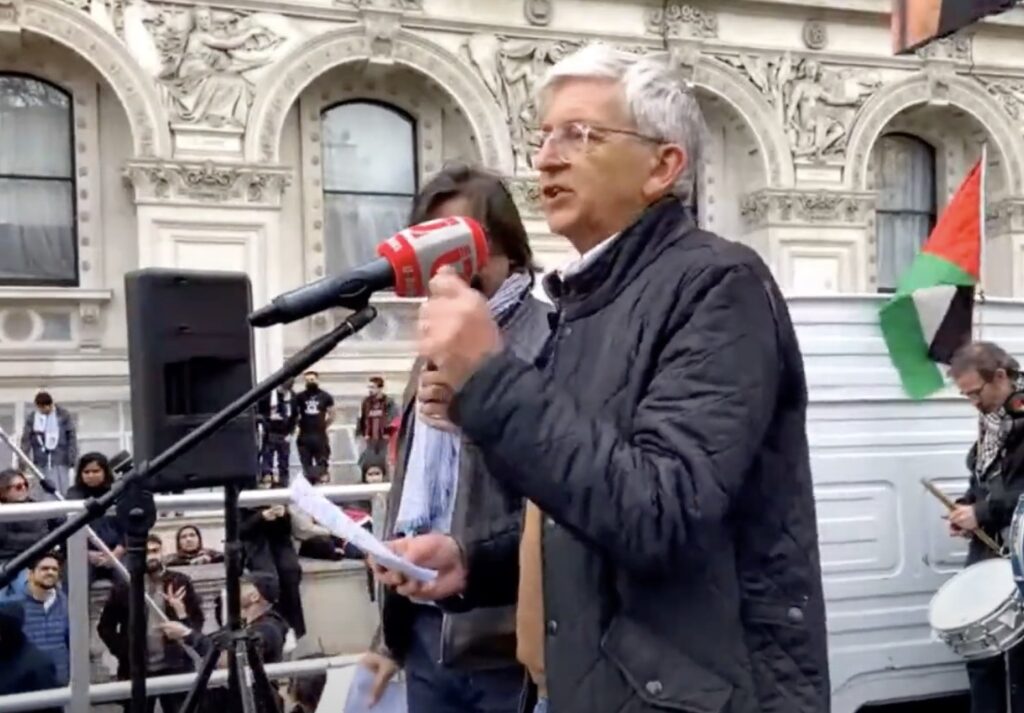
Today it was my privilege to read and expound the scriptures in the open air in Whitehall outside Downing Street before an estimated 15,000+ Jews, Muslims, Christians and those of no faith, all with police protection. It was truly one of the highlights of my ministry. (click on the photo above to watch my presentation). The text of my presentation together with photos and more short videos may be found below.
When the Lord Jesus Christ died on the cross, how large was the remnant of Israel?
God had promised Abraham that his descendants would be like the stars in the sky and the sand on the seashore (Genesis 22:17-18). Through the history of God’s people recorded in the Hebrew Scriptures we see the Lord blessing and cursing his people according to their faithfulness (Deuteronomy 11:26-28; 2 Kings 17). Sent into exile first into Assyria and then into Babylon, on each occasion only a remnant returned.
So when Christ died on the cross, how large was the remnant? Where were the remnant who had acclaimed Jesus the Messiah just a week earlier on Palm Sunday? Where were the disciples? Where was Peter and the other Apostles? Who were present at the cross when Jesus died? Mary Magdalene, Mary his mother and the Apostle John. Did they understand what was happening? Were they singing ‘When I survey the wondrous cross”? No, they were weeping. They did not understand.
When Jesus died on the cross he was the sole remnant, the sole faithful remnant of Israel. This is crystal clear from Isaiah 53.
“Surely he took up our pain and bore our suffering, yet we considered him punished by God, stricken by him, and afflicted. 5 But he was pierced for our transgressions, he was crushed for our iniquities; the punishment that brought us peace was on him, and by his wounds we are healed. 6 We all, like sheep, have gone astray, each of us has turned to our own way; and the Lord has laid on him the iniquity of us all.” (Isaiah 53:4-6)
Read verse 6 again. “We all, like sheep, have gone astray, each of us has turned to our own way and the Lord has laid on him the iniquity of us all.”
When Jesus hung on the cross he was Israel. The remnant was reduced to one man, who died and three days later was raised to new life. In the resurrection narratives we read how Jesus forgives, restores and recommissions his remnant. First, of his apostles (John 20-21), and then after his ascension and bestowing of the Holy Spirit, on the Day of Pentecost, three thousand people of many nationalities were added (Acts 2:41). By Acts 4:4, the remnant had grown to more than five thousand men.
The promises God made to Abraham have and are being fulfilled in and through the Church of Jesus Christ. The Book of Revelation provides a vision of there ultimate fulfilment.
“After this I looked, and there before me was a great multitude that no one could count, from every nation, tribe, people and language, standing before the throne and before the Lamb. They were wearing white robes and were holding palm branches in their hands. And they cried out in a loud voice: “Salvation belongs to our God, who sits on the throne, and to the Lamb.” (Revelation 7:9-10)
Was the coming of Jesus the fulfilment or the postponement of the promises God made to Abraham? The Scriptures are clear:
Jesus answered, “I am the way and the truth and the life. No one comes to the Father except through me.” (John 14:6)
“Salvation is found in no one else, for there is no other name under heaven given to mankind by which we must be saved.” (Acts 4:12)
The remnant of God’s chosen people are saved by grace through faith and faith alone in the Lord Jesus Christ, not race, not law, not works, but grace through faith.
The Cross. It struck fear in the hearts of the world. It was Rome’s ruthless means of control. Excruciating torture. Prolonged agony. Humiliating death. According to Roman custom, the penalty of crucifixion was always preceded by scourging. After this initial punishment, you carried your cross, or at least the transverse beam of it, to the place of execution. Besides the physical pain there was also the psychological torture. Because crucifixion was a public form of execution. The crosses were located by the roadside or at a crossroads. There was no hiding.
You were exposed to the jibes and insults of the people who passed by. Stripped naked, you were bound to the cross with cords and fastened with nails like these here. Roman nails, 2000 years old. Finally, a placard called the titulus bearing your name and your crime, was placed above your head. You would not die of hunger or thirst, but might hang on the cross for days. To breathe, you must stretch upward and stand to take the weight on your legs and off your arms and chest. So if your legs were broken, death would come mercifully swift from asphyxiation.
2000 years ago Jerusalem was under a siege. One man set out on a lonely road to do something about it. Only 14 miles long. A day’s journey, up-hill, Jericho to Jerusalem. A one-way ticket. Jesus is out in front leading the way, setting the pace. Here is Mark’s eyewitness account:
“They were on their way up to Jerusalem, with Jesus leading the way, and the disciples were astonished, while those who followed were afraid. Again he took the Twelve aside and told them what was going to happen to him. “We are going up to Jerusalem,” he said, “and the Son of Man will be delivered over to the chief priests and the teachers of the law. They will condemn him to death and will hand him over to the Gentiles, who will mock him and spit on him, flog him and kill him. Three days later he will rise.” (Mark 10:32-34)
“To explore strange new worlds. To seek out new life and new civilisations. To boldly go where no one has gone before!” I’m sure you know these are the opening lines from the iconic TV series Star Trek. At the beginning of every episode, Captain James Kirk of the Starship Enterprise says “Space: The final frontier”
Most of us will never get to test that frontier but there is another frontier we all face with a 100% certainty. Death is usually the last thing we want to talk about and yet it comes to us all, sometimes prematurely. And too many people are ill-prepared. When a loved one in mid-life is diagnosed with inoperable cancer, your world is turned upside down. Your faith is tested. Your priorities and hopes for the future are changed, instantly, radically, irrevocably. And so by the way does your circle of friends. Invariably it gets smaller, but I’m thankful for those who have stuck with us over the past five years, who have encouraged us to persevere.
I woke up the other day and couldn’t see properly. I could see a blurred object like a large hair moving around in one eye. When I looked in the mirror there was nothing on my eye, but I could still see something moving around. That was when my curiosity turned to mild panic. Was I losing my eyesight? Was it cancer?
I phoned the medical helpline 111 and was referred to the local Accident and Emergency Eye Hospital. A nice person triaged me over the phone and made an appointment for me to visit the next day. I was seen quickly by an eye specialist who did numerous tests, one of which is not for the faint hearted. It involved smearing my eye with aesthetic jelly and then placing an instrument on the pupil to explore the inside of my eye. Her diagnosis was that I have a vitrous detachment or ‘floater’.
This week we celebrated International Women’s Day. The same day the UK government announced they would be funding more football sessions in schools for girls to improve gender equality in sport. I remember when our daughter wanted to play football at school she found it difficult to get picked for the team. The assumption then was that boys played football, while girls played netball.
But as you know sexism on the playing field is tame compared to the gender discrimination women face in career opportunities, in promotion prospects, in pay differentials, in the stereotype roles expected of men and women, even within such a liberated and enlightened society as ours.
One female executive put it like this, “To get anywhere in the corporate world a woman has to do the same work a man would do in the same job, but she must do it twice as well.” Then she added, “Fortunately, that is not difficult.” Another said, “We deserve more pay than men. After all, anything Fred Astaire could do, Ginger Rogers could do backwards and on high heels.”
How good are you at memorising information? Probably better than you realise. I suspect over the years you have memorised hundreds of messages without realising it. Let me test you. How many of these messages you can complete? And for a bonus point, can you remember who said it.
To our members we’re the fourth…emergency service: AA Bread wi’ nowt …taken out: Allinsons. Vorsprung durch… technik: Audi The United Colors of… Benetton: Benetton The taste of… Paradise: Bounty The World’s Favourite… Airline: BA Go to work on… an egg: Egg Marketing Board A glass and a half in every… half pound: Cadburys And all because the lady loves… Milk Tray A pint a day helps you… work, rest and play: Milk Board The man from Del Monte he… say yes: Del Monte Put a tiger in… your tank: Esso Hands that do dishes can feel… soft as your face: Fairy Liquid No FT… no comment: Financial Times The best a man… can get. Gillette Guinness is… good for you. Guinness Refreshes the parts other… beers cannot reach: Heineken Beanz Meanz… Heinz Graded grains make… finer flour: Homepride Have a break. Have a… Kit-Kat Never knowingly… undersold: John Lewis Because you’re… worth it: L’Oreal It does exactly what it says… on the tin: Ronseal Diamonds are a girl’s… best friend: De Beers. And lastly…
I am sure like me you have been shocked at the eruption of violence in Palestine this week. The Israeli newspaper Haaretz invariably goes for the jugular with its headlines where Western media normally fear to tread. On Tuesday, for example, Haaretz ran the headline, “Israeli Settlers’ Hawara Pogrom was a Preview of Sabra and Chatila 2” In case you were born after 1982, in September that year, after invading Southern Lebanon, the Israeli military allowed the Lebanese Phalangist Militia to enter the Palestinian refugee camps of Sabra and Shatila and massacre over 3,500 Palestinian men, women and children. Haaretz drew the comparison, “This week in the West Bank, no one stopped the extremist settlers from running amok in Hawara.”
On Wednesday alone, 30 homes were torched, 40 cars and a fire engine burned and the hospitals filled with over 100 wounded civilians. The Guardian ran the headline “Israeli Settlers on the rampage isn’t a shock – its daily life for Palestinians in the West Bank.” The Israeli human rights organisation, B’Tselem went further pointing out, “This isn’t “loss of control” this is exactly what Israeli control looks like. The settlers carry out the attack, the military secures it, the politicians back it. It’s a synergy.”