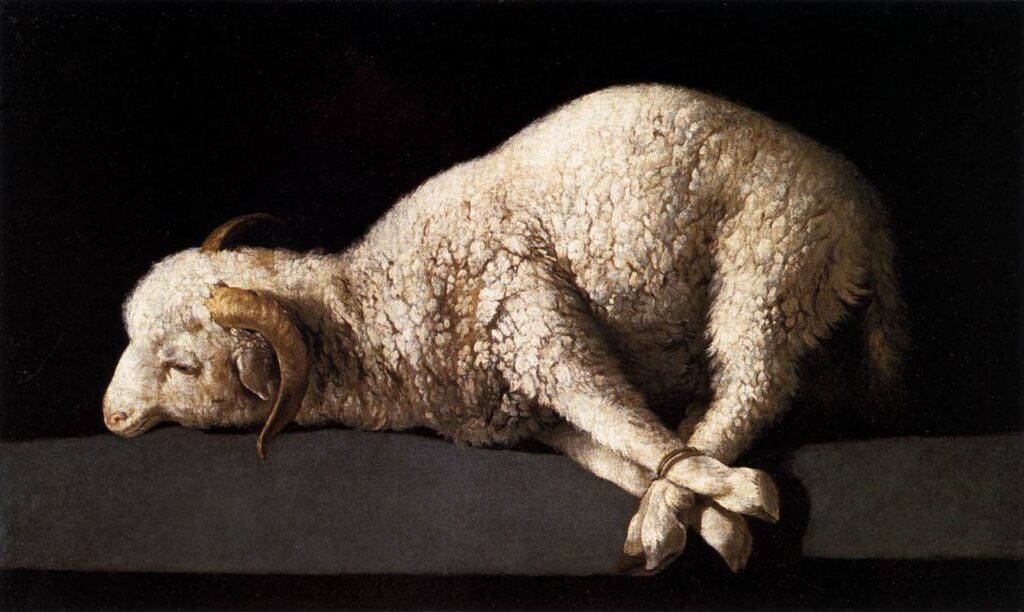
The Book of Isaiah, written around 700 years before the coming of Jesus Christ, is quoted more times in the New Testament than any other book of the Hebrew Scriptures. Why is that? 754 of Isaiah’s 1292 verses are predicting the future. That means 59% of Isaiah is prophecy. Isaiah contains 11 direct prophecies concerning Jesus and it is cited or alluded to in at least 50 NT passages. Why? Why? Lets find out. With the eyes of faith we see Isaiah 53 so explicitly refers to the Lord Jesus it doesn’t need much by way of explanation. Indeed it became so obvious that Isaiah was referring to Jesus after he was crucified and rose again from the dead, that, as the Church separated from the Synagogue, Isaiah 53 was no longer read as part of the Jewish lectionary. There are five paragraphs, each of three verses, and it begins in chapter 52:13.
1. The Predicted Saviour: The Servant’s Role (52:13-15) 2. The Rejected Saviour: The Servant’s Life (53:1-3) 3. The Representative Saviour: The Servant’s Suffering (53:4-6) 4. The Crucified Saviour: The Servant’s Death (53:7-9) 5. The Glorious Saviour: The Servant’s Resurrection (53:10-12)
This webinar will address how the US administration is embracing Christian Zionism and “end time” theology to justify unconditional support for Israel and unprovoked war against Iran.
Some Americans have referred to what it is doing in Iran as the US’s “Holy War”. Mike Huckebee, the US’s Ambassador to Israel, remarked in February that it would be fine if Israel took control of land that would include a huge swathe of the Middle East.
Such positions come from an interpretation of Bible verses identified as Christian Zionism. This theological and political belief system says that the modern State of Israel’s existence is a fulfilment of biblical prophecy and a necessary sign to the Second Coming of Jesus Christ. It combines strong support for Israel, particularly regarding control over Jerusalem and the West Bank, with an end-times world view.
During this hour-long webinar, Stephen Sizer will provide a summary about Christian Zionist beliefs. He will be followed by Michael Spath who will unpack how Christian Zionist theology as influenced US foreign policy and how US churches are responding to it.
Well here we are again. Another year gone. It hardly seems possible does it? Have you noticed how the pace of life seems to accelerate as we grow older? True, people seem to live life at a much faster pace these days more than ever before.
And it is infectious isn’t it? Think about it; how did Kwik-Fit get to be the world’s leading tyre, exhaust and brake specialist? By promising to fit quickly. How did Proctor and Gamble become the number one seller of shampoo? One reason – by putting shampoo and conditioner in the same bottle. Remember all those years when you had to shampoo and then rinse, then condition and rinse. Now it’s just all in one bottle. “Wash and go” is their slogan. Number one.
And if you are old enough to remember, it was 1974 when a new kind of restaurant became very popular in the UK. For the first time in human history a restaurant sold food not on the basis of its quality, nor even on the basis even of its price, but on the speed of service. And we coined a phrase for those kinds of restaurants. We called them “fast food.” Fast food. Not good food, not even cheap food. Just fast. But even with fast food restaurants, you still had to park the car and get out and walk all the way inside and order the food and sit down and eat it. And all of that took time. So we invented drive-through lanes, so that families could eat in cars as God intended us to. And the beautiful thing about this is that if you haven’t got time to stop at a fast food restaurant, the children can just scrounge around in the cracks underneath the seats for cold potato chips and lost gummy bears. Continue reading →
“Far over the misty mountains cold. To dungeons deep and caverns old. We must ere break of day. To seek the pale enchanted gold.”
Is that a line from
A. Nativity 2? B. James Bond? C. Life of Pi?
The correct answer is D. The Hobbit.
J.R.R. Tolkein’s fantasy takes place in “Middle-earth.” Middle Earth is not some never-never land. It is simply an adaptation of the Old English Middle–erthe from Middan-geard which is the name inhabited lands “between the seas.” Which means, in some profound sense Tolkien’s intended his fantasy world to be a mirror, or reflection of our own. So what has a fairy story about elves and dwarves got to do with Christmas? Lets try and find an answer through three riddles.
It became a popular tradition at my former parish, Christ Church, Virginia Water, for my annual sermon at the Christmas Carol Service to feature one of the films being shown in cinemas in December. Here is a selection:
If you were like me, when you were very young, there were only two really important events in your life. You felt like they could not come soon enough. What were they? The first was… your birthday. The second was… Jesus’ birthday. Both involved presents. Lots of presents. Then when you were old enough to know that Father Christmas was not in the Nativity Play and you were allowed to stay up late, there was a third special day. New Year’s Eve. There were no presents but you still looked forward to the party and seeing in the New Year. For me, Summer holidays were special but never as special as my birthday and Christmas Day. We love to celebrate beginnings. We celebrate new life. Our birthday. Family birthdays. Jesus’ birthday. The birth of a new year. So what is it with the Church? When does the Church year begin? Not Christmas and the birth of our Saviour. Not Easter and the gift of new life. Not even Pentecost and the birth of the Church. The Church year begins with Advent. Continue reading →
This month we’re continuing the conversation about Christian Zionism with Rev. Dr Stephen Sizer, the first Director of ISCZ. We’ll uncover more about the history of Christian Zionism and learn about why engaging in the work to combat this theology is so necessary.
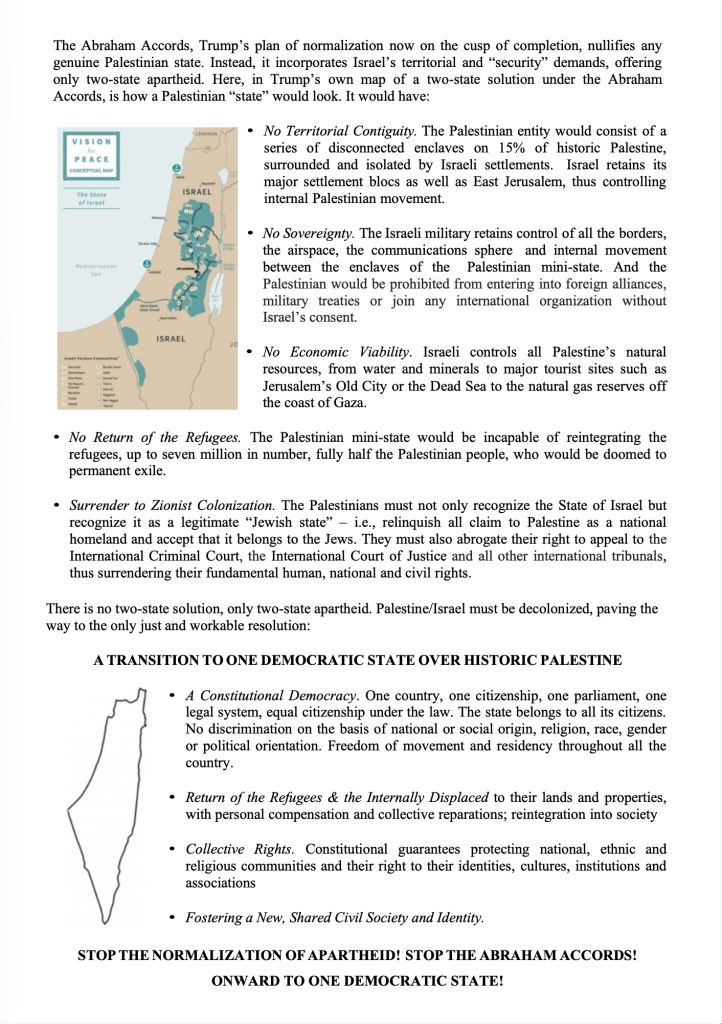
This two-page summary, prepared by ICAHD and Jeff Halper, sums up concisely where we are in the political moment in the struggle for a decolonized and free Palestine, which we hope you will consider and share.
As the page shows, we are in a confused but crucial moment between two initiatives that are coming down the pipeline and are being integrated — Trump/Netanyahu’s plan of normalization with the European/Saudi need for a Palestinian state (what I call a “good enough” Palestinian state, a Bantustan) — and the still embryonic, perhaps fantastical one-state idea, which, for all its far-fetchedness, is truly the only just and workable way out. So the page is a kind of combined reality-check of where we are politically and a warning that we are in the danger of being overtaken by events. Normalization is a closure. It is imposed by the US, Israel and the Arab states (plus other Muslim countries like Indonesia, Pakistan and Kazakhstan), not negotiated, and the Palestinians have little if any say. And after normalization, little space exists for furthering political struggle.
We may say, OK, let’s go with the flow. Apartheid is inevitable. Palestinian civil society and all of us, supporters of the Palestinians in their struggle for liberation, is simply not able to make its voice heard, fragmented and so harshly repressed as it is by both Israel and the Palestinian Authority. And so the Palestinians have no end-game of their own, the one-state idea far from being agreed-upon and formulated into a political program around which their supporters can be mobilized. When the Abraham Accords are imposed and apartheid becomes a reality, then, we can simply shift to an anti-apartheid struggle a la the ANC in South Africa. The Palestinians will then, with no choice, have the same end-game: decolonization (but more complete than what was done in South Africa) leading to a democracy based on one person, one vote.
There is a fatal flaw in this (sort of) strategy, however. While the international community refused to recognize the Bantustans in South Africa and finally rejected the apartheid regime, in the case of the Palestinians and Israel it will accept a Palestinian Bantustan as part of a “two-state solution” if only to wash its hands of this persky nuisance and move on to more weighty issues, like consolidating the rising Israeli/Saudi hegemony over the region as a NATO counterweight to China. Accepting and normalizing Israeli apartheid is a small price to pay. Good enough.
All this is to question whether a post-normalization strategy in fact exists; indeed, whether any political space exists after normalization, since normalization is, well, normalization. it’s done, it’s a closure, the international community has moved on. If we don’t try (and succeed) to block the vehicle of normalization, the impending Abraham Accords, I really wonder whether we have run out of political space for further struggle. Will the Palestinian people, despite the fervent support they enjoy from the peoples of the world, be able to continue their struggle, first and foremost against the very collaborationist Bantustan government the Abraham Accords will establish?
There is an urgency here. The Palestinian struggle is in danger of being overtaken by events. We do not determine the political timetable. Palestinian agency as expressed in the BDS movement, in film and literature, in sumud and resistance on the ground, in rallies and protests abroad must, in the end — and urgently — be accompanied by a political program, an end-game, with which to push back against the normalization of Israeli apartheid and effectively mobilize the global forces that played such a key role in defeating apartheid in South Africa.
This ICAHD page attempts to focus on the political moment we are in and the immediate threat normalization poses. Indeed, we argue that normalization represents the greatest threat to the Palestinian people since the Nakba. It also points to where, in our view and that of our Palestinian partners, the struggle should be going. A useful appraisal of the political moment, I hope, but an urgent warning as well. Please circulate.
Scientists tell us that we can survive for about three weeks without food, three days without water but only about three minutes without oxygen. If that is true physically, it is also true spiritually. Our gospel and epistle readings for today, while written by Luke and Paul with different purposes in mind, actually complement each other. They describe the two most fundamental ways we grow to know God and become more like Jesus. Bible reading and prayer can be likened to breathing. Spiritual breathing. We breathe in God’s word and breathe out God’s word in our prayers – that is, the scriptures guide us in what to pray, when to pray and how to pray.