Category Archives: Sabeel

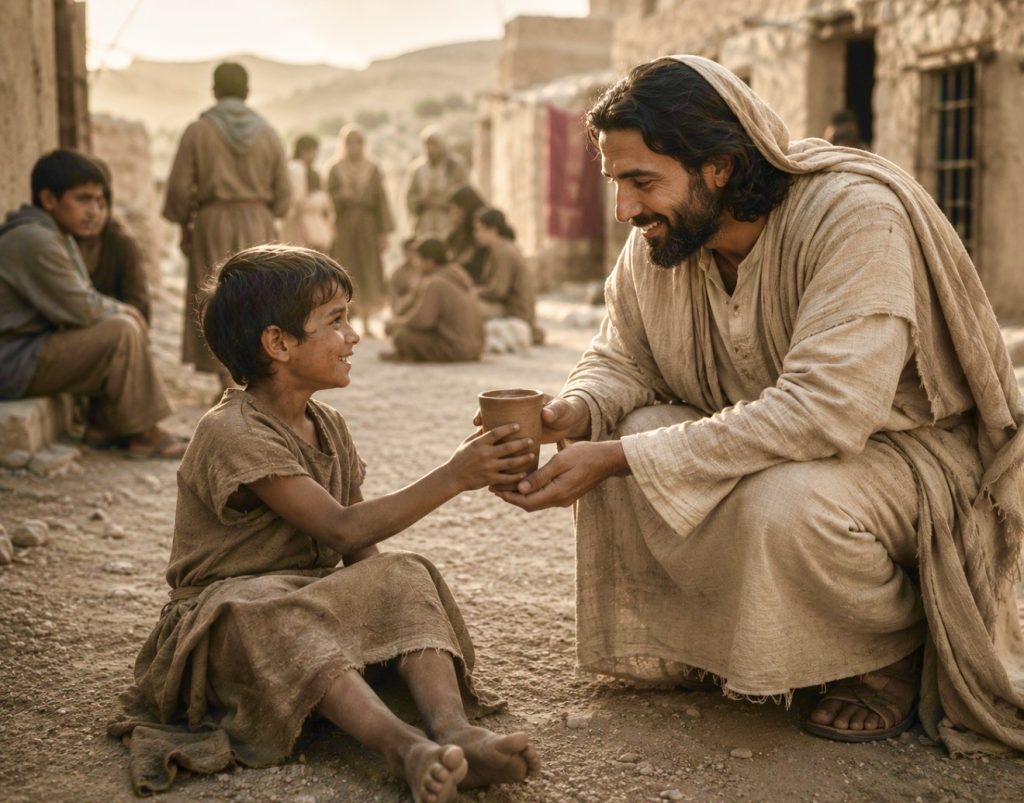
Jesus and the Cup of Cold Water


“Anyone who welcomes you welcomes me, and anyone who welcomes me welcomes the one who sent me. Whoever welcomes a prophet as a prophet will receive a prophet’s reward, and whoever welcomes a righteous person as a righteous person will receive a righteous person’s reward. And if anyone gives even a cup of cold water to one of these little ones who is my disciple, truly I tell you, that person will certainly not lose their reward.” (Matthew 10:40-42)

In today’s Gospel, Jesus says: “Anyone who welcomes you welcomes me, and anyone who welcomes me welcomes the one who sent me.”

These are remarkable words. Jesus literally identifies himself with his disciples. To welcome one of Christ’s followers is to welcome Almighty God himself. They remind us that God is not distant from human suffering but is present among those who bear witness to his kingdom.

Jesus speaks these words as he sends his disciples into a world that will not always welcome them. Some will reject them, denigrate them, and even persecute them. Yet Jesus assures that those who receive them are receiving Christ himself.

This is a profound affirmation of dignity. In Palestine where many feel ignored by the international community, forgotten by powerful nations, or reduced to mere statistics, Jesus declares that those who belong to him are never invisible. Christ so identifies with his followers that by welcoming them we are literally welcoming him. 

This truth has both a comfort and a challenge.

Throughout the Gospel, Jesus identifies himself with those whom society overlooks. He was born under foreign military occupation. His family became refugees hiding in Egypt. He grew up among ordinary people far from the centres of power.

When Jesus says, “Whoever welcomes you welcomes me,” he reveals a God who is found not primarily in palaces or military headquarters but in villages and towns struggling to exist; among families mourning loved ones; among those working for peace and justice; among those refusing to surrender their humanity, emigrate or deny their faith. The Gospel challenges the world to recognize Christ in those it is tempted to ignore, and Jesus uses the imagery of a cup of cold water to rebuke those indifferent to or responsible for human suffering.

“Whoever gives even a cup of cold water to one of these little ones… will certainly not lose their reward.”

Giving someone a cup of cold water is a simple act but it can save a life. It does not solve every problem. It does not end wars or dismantle systems of injustice. Yet Jesus elevates such acts because they express and reveal the heart of God.

Palestinian society has long been known for hospitality. Even in difficult economic circumstances, guests are welcomed, meals are shared, and neighbours support one another. Jesus teaches that these ordinary acts of kindness are sacred. They are signs that God’s kingdom is already breaking into the world.

When resources are scarce, generosity becomes even more significant. 

Continue reading
Always Pray and Do Not, Repeat Not, Give Up (Luke 18:1-8)

Scientists tell us that we can survive for about three weeks without food, three days without water but only about three minutes without oxygen. If that is true physically, it is also true spiritually. Our gospel and epistle readings for today, while written by Luke and Paul with different purposes in mind, actually complement each other. They describe the two most fundamental ways we grow to know God and become more like Jesus. Bible reading and prayer can be likened to breathing. Spiritual breathing. We breathe in God’s word and breathe out God’s word in our prayers – that is, the scriptures guide us in what to pray, when to pray and how to pray.  

Continue reading

Does God Have One People or Two? (John 15)

A homily given at the weekly Sabeel Jerusalem Service 25th April 2024

 “I am the true vine, and my Father is the gardener. He cuts off every branch in me that bears no fruit, while every branch that does bear fruit he prunes so that it will be even more fruitful. You are already clean because of the word I have spoken to you. Remain in me, as I also remain in you. No branch can bear fruit by itself; it must remain in the vine. Neither can you bear fruit unless you remain in me. “I am the vine; you are the branches. If you remain in me and I in you, you will bear much fruit; apart from me you can do nothing. If you do not remain in me, you are like a branch that is thrown away and withers; such branches are picked up, thrown into the fire and burned. If you remain in me and my words remain in you, ask whatever you wish, and it will be done for you.” (John 15:1-7)

Who are God’s ‘chosen people’? Does God have one people or two? A simple question. In our gospel reading today, the Lord Jesus is crystal clear as to the answer. I am sure you have heard numerous sermons on John 15. We rightly focus on Jesus profound description of himself, “I am the Vine”. It is the last of the seven great “I am” statements Jesus made recorded uniquely in John’s gospel. What is the context? In Exodus 3, when Moses asks God his name, the Lord says “I am who I am. This is what you are to say to the Israelites: ‘I AM has sent me to you’” (Exodus 3:14). The website Got Questions has a helpful explanation.

Continue reading

Challenging Apartheid and Religious Extremism: Sabeel Jerusalem Conference and Webinars

Conference Purpose Statement: 
After ignoring 75 years of Israeli settler-colonial violence, since the 7th of October last year, the world has been shocked into taking notice of the genocide occurring against Palestinians in Gaza. With the aim of speaking into these tragedies, the 2024 Sabeel International Conference will challenge apartheid and religious extremism through a liberationist approach to theology by ecumenical and interfaith collaboration. Thought leaders representing the Abrahamic faiths will guide participants in reflecting on the current situation and exploring ecumenical, interfaith, non-violent avenues for fostering peace and justice in Palestine and Israel. 

Webinars: Sabeel has organized five webinars, each at 8pm Jerusalem time, from January to May. These webinars, facilitated by distinguished academics and activists, serve as a prelude to the conference by introducing themes and topics that will be explored in depth in November.

Register for the webinars here

Wednesday 31st January: An Introduction to Religious Extremism
This webinar will introduce religious extremism and outline the November conference.

Wednesday 28th February: Zionism and Antisemitism
How the term antisemitism has been weaponised and an examination of the relationship between Zionism, apartheid, and religious extremism in Judaism. 

Wednesday 27th March: Islam and Islamophobia
Define Islamophobia, challenge stereotypes and prejudice toward Muslims, and examine how Islamophobia has been exploited to silence criticism of Israel.

Wednesday 24th April: Christophobia and the Persecution of Christians
A discussion on the persecution of Christians and how Christian Zionism exacerbates tensions for Palestinian Christians. 

Wednesday 29th May: A Summary on Religious Extremism
A summary of the series and information about the November conference including the schedule and how to maximize your participation.

Principles: The principles guiding this conference include facilitating constructive interfaith dialogue, promoting human rights and justice in Palestine and Israel, challenging misinterpretations of religious texts contributing to extremism, empowering grassroots activism and advocacy, and strengthening collaborative networks. The Sabeel conference aims to create a platform for dialogue across faiths to address the root causes of extremism and advance human rights in Palestine.

Register for the webinars here

Peacemaking & the Right of Resistance (Romans 12:9-21)

My favorite hotel in all the world is the Walled Off in Bethlehem. Designed by Banksy, the anonymous British artist, it overlooks the Separation Wall. In bricks and mortar Banksy demonstrates how art can become an act of defiance against Israeli settler colonialism and apartheid. Tuesday this week, 29th August, was the anniversary of the assassination of Naji Al-Ali, the Palestinian political cartoonist and writer who drew the iconic image of the 10-year-old child Handala, which you often find drawn on the Apartheid Wall dividing the illegal Israeli colonies from the Palestinian ghettos.  Appropriately therefore this week’s Kumi Now reflection, is entitled, ‘Art as Resistance’. 

“Too often the Palestinian tragedy is portrayed as a humanitarian crisis rather than one that has to do with identity and self-determination. They believe art is a luxury that Palestinians cannot afford. That, instead, what they need is bread to eat, to fill their stomach, so they can think and live another day. But people “shall not live by bread alone” (Matthew 4:4). Art and culture instead feed the soul and allow it to thrive. It gives people the strength to refuse being on the receiving end, perceived as victims. It allows people to become actors instead of spectators. It gives them the long breath necessary to resist. For wherever there is occupation, there will be resistance. The question therefore is not whether to resist, but how to resist.”

Continue reading

Together for the Protection of Our Presence 

“In recent times, we’ve witnessed a series of events that have disrupted the harmony of the Christian presence in the Holy Land. One such event is the controversial deal involving a portion of properties in the Armenian Quarter of the Old City in Jerusalem. These occurrences are part of a broader pattern of recurring attacks on Christian churches, cemeteries, clergy, nuns, pilgrims, and Christian gatherings across various regions in our lands. This situation leads us to believe that there is a deliberate Israeli policy aimed at targeting our historical existence, institutions, rituals, and spiritual symbols. This policy is occurring within the context of the occupation’s efforts to assert control over Jerusalem, to Judaize sacred lands, and to intimidate and displace Christians. 

Continue reading

Overcoming Christian Zionism in the Quest of Justice

The launch of the Sabeel Booklet on Overcoming Christian Zionism in the Quest of Justice will take place on May 9th 6pm Jerusalem Time.

Please join us on the 9th of May 4pm London, 6pm Jerusalem, 11am New York, 8am Los Angeles.

Listen to the reflections of Rev. Don Wagner and The Revd Dr Stephen Sizer on the Launching of Sabeel Booklet on Overcoming Christian Zionism in the Quest of Justice

Please do register for this important session.

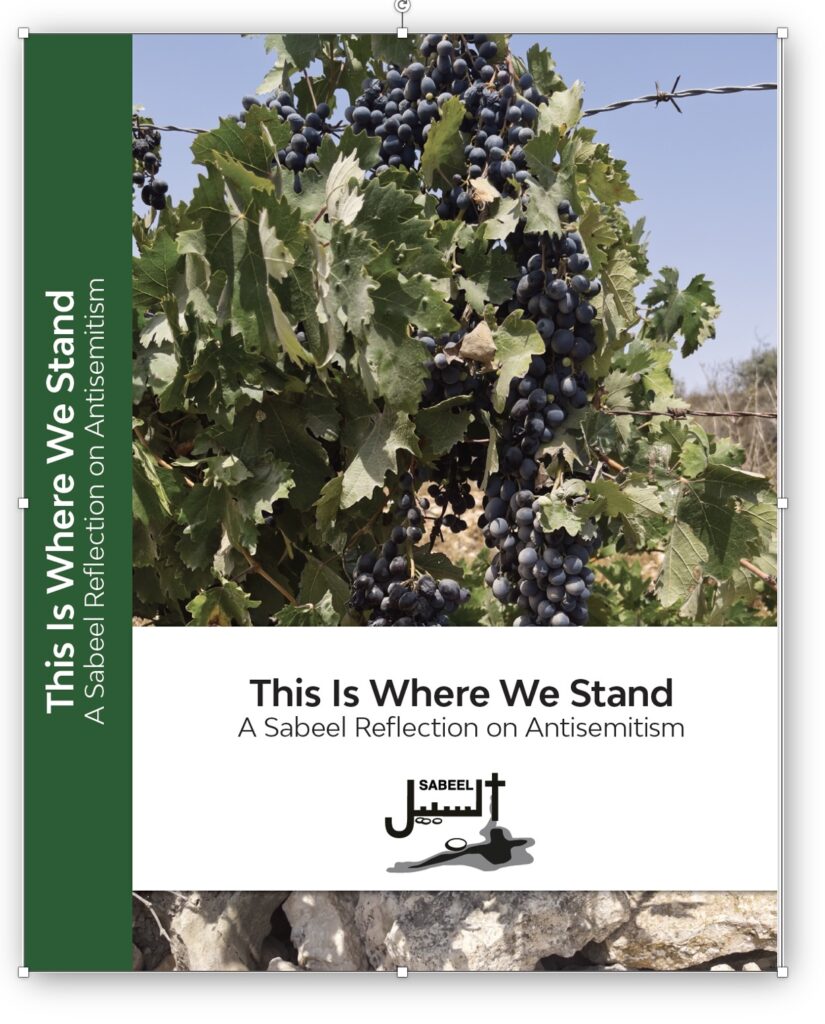
This Is Where We Stand: A Sabeel Reflection on Antisemitism

Why then do we write about antisemitism? The answer is simple. 

The foundations on which we struggle against Palestinian oppression are the same foundations on which we are committed to fighting against antisemitism. Furthermore, if it is wrong of the state of Israel to deny our full humanity, it is futile and unacceptable for us to do the same. There will be no peace in our land until all of us recognize the full humanity of all who live here – especially Palestinian refugees, forcibly exiled who wish to return and have been denied that right.

Continue reading