Category Archives: Theology

What are you really passionate about?

What are you passionate about? I mean really passionate about? Or put another way, What do you care about most?  It may be a burden we carry, a call we’ve received, a dream we have, or a vision we’ve glimpsed. Whatever you call it, passion is the God-given desire to make a difference somewhere. What you are passionate about? We are all passionate about someone or something.

It might be your wife or your husband, a girlfriend or a boyfriend, maybe its your children, your grandchildren, your family, a hobby, some cause, a sport or maybe the armed forces. Today we are remembering with gratitude those who gave their lives in the service of their country. Passionate about defending our country. Passionate about protecting our democracy. Passionate enough to give their lives. You may not be called to give your life up but if you are a Christian you have been called to invest your life in His majesty’s service. What are you passionate about?  Others can easily tell even if you can’t. When someone asks you about your passion, you come alive, your eyes open wide, your pupils dilate, you raise your voice, you become animated, your skin has more colour, you can’t stop talking about it, you feel energized. What are you passionate about? In John’s gospel we find Jesus encouraging us to be passionate about three things. To develop a passion for God, a passion for the Church and a passion for the lost.

Continue reading

Evangelical Theology & American Politics in the Middle East

On September 12th, following the tragic news of the murder of Ambassador Stevens, together with members of his staff, sheltering in the US Consulate in Benghazi, a grief stricken Secretary of State, Hilary Clinton asked a simple question. A question that was on the lips of many Americans: “How could this happen in a country we helped liberate, in a city we helped save from destruction?” Andrew Bacevich, writing in Newsweek, asks,

“Why the Arab anger against the United States? Why the absence of gratitude among the very people the United States helped save, in the very countries Americans helped liberate? The way Secretary Clinton frames the question practically guarantees a self-satisfying but defective answer.”

The question, he argues, is predicated on three propositions that are regarded as sacrosanct by most US politicians and policy makers.

“First: humanity yearns for liberation, as defined in Western (meaning predominantly liberal and secular terms). Second: the United States has a providentially assigned role to nurture and promote this liberation… Third: given that American intentions are righteous and benign (most of the time) – the exercise of US power on a global scale merits respect and ought to command compliance.”[i]

I would add a fourth proposition, assumed as self evident, especially among Evangelicals, that, as God’s ‘chosen people’ the security of the State of Israel is synonymous with US interests in the Middle East and her God ordained role.

The problem is that the Arab world and Muslims, in particular, do not only not share these propositions, they repudiate them theologically. It is not that they do not aspire to political freedom from despotic rulers and oppressive governments. The Arab Spring has shown that many do indeed hunger for freedom. The problem is, observes Bacevich, “that 21st century Muslims don’t necessarily buy America’s 21st century definition of it – a definition increasingly devoid of moral content.”

Freedom of speech is assumed sacrosanct even if it offends those of other religions. Whether the movie, Innocence of Muslims was indeed responsible for sparking Muslim outrage and the subsequent violence against US interests is irrelevant. The promotion of the film by Fundamentalist Christians and their antipathy toward Islam certainly is.  What we tend to ignore, while Muslims cannot forget, it the simple fact is that for more than 100 years, Christians in the USA and Europe have sponsored, defended, funded and sustained the Zionist enterprise in preference to developing normative relations with the Arab world.

Continue reading

Does God have a Purpose for my Life?

Does God have a Purpose for my Life? from Stephen Sizer on Vimeo.

Over the next few weeks we are going to discover God’s plan for his Church and your place within it.

Each week we will ask one question. As we begin the series today, the question I want us to answer is this, “Does God have a purpose for my life?” Yes he does. In fact the Bible tells us that God has at least five purposes for our lives.

  1. We were planned for God’s pleasure – to know him and love him (John 17:3).
  2. We were formed for God’s family – to find a spiritual home and family (Acts 2:42).
  3. We were created to become like Christ – revealing his character (Galatians 5:22-23).
  4. We were shaped for serving God – with a unique mix of talents, skills and passion for serving in the Body of Christ (1 Corinthians 12).
  5. We were made for a mission – to introduce other people to God’s five purposes for them too – to win, build and send (Matthew 28:18-20).

Without knowing our God-given purpose we can so easily become driven by destructive influences. Here are three of the most common that drive people.

Continue reading

Jesus is the Bridegroom

Jesus is the Bridegroom from Stephen Sizer on Vimeo.

The prosecuting lawyer calls his first witness to the stand in a trial—a grandmotherly, elderly woman with white hair. He approaches her and asks, “Mrs. Jones, do you know me?” “Why, yes” she responds, “I do know you Mr. Williams. I’ve known you since you were a young boy. And frankly, you’ve been a big disappointment to me. You lie; you cheat on your wife. You manipulate people and talk about them behind their backs. You think you are a rising big shot when you have not the brains to realize you never will amount to anything more than a two-bit paper pusher. Yes, I know you.” The lawyer is stunned. Not knowing what else to do, he points across the room and asks, “Mrs. Williams, do you know the defence lawyer?” “Why, yes I do too,” she replies, “I’ve known Mr. Bradley since he was a youngster, like you. I used to baby sit him for his parents. And he, too, has been a real disappointment to me. He is lazy, bigoted, and he has a drinking problem. The man cannot build a normal relationship with anyone and his law firm is one of the most dubious in the entire county. Yes, I know him.” At this point, the judge raps his gavel and calls the courtroom to order. Asking both lawyers to approach the bench he whispers with menace, “If either of you asks her if she knows me, you’ll be jailed for contempt!”[1]  Three preliminary observations. Continue reading

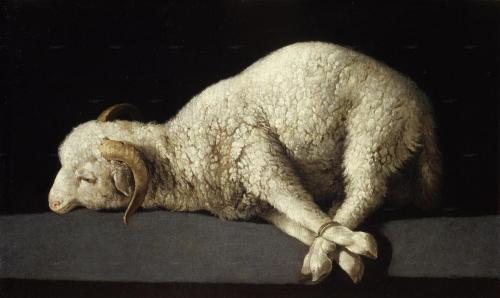
Jesus is the Lamb of God

A Highland farmer was overseeing his animals in a remote mountainous pasture when suddenly a brand-new BMW coupe appeared out of a dust cloud towards him. The driver, a young man in a white Armani suit, Ray Ban sunglasses, YSL tie, and Mediterranean tan, leans out the window and asks in a perfect Oxbridge accent, “If I tell you exactly how many cows and calves you have in your herd, Will you give me a calf?”

The farmer looks at the man, obviously a yuppie, then looks at his peacefully grazing flock and calmly answers, “Sure, why not?” The yuppie parks his car, whips out his Mac Book Air, links by wifi to his iPhone 5. He turns on his Garmin Nuvi sat nav to get an exact fix on his location, uploads his location to a NATO satellite which then creates a series of ultra-high-resolution images of the hillsides around him. Downloading the photos via a real time image enhancing facility in Hamburg, Germany, within seconds, he prints out the full-colour, 150 page report on his portable LaserJet printer. Taking off his Ray Bans, the young man unbuttons his Armani jacket and smiles to reveal two rows of perfect ultra-white teeth. Turning to the farmer he says, “You have 1,586 cows and calves.” “That’s right. Well then, I guess you can take one of my ‘calves’,” says the farmer. He watches the young man select one of the animals.

He looks on amused as the young man stuffs it into the trunk of his car. Then the farmer says to the young man, “Now, if I can tell you exactly what your business is, will you give me back my calf and your sunglasses?” The young man thinks about it for a second and then says, “Okay, why not?” The farmer looks up, scratches his stubble, leans on his stick and says, “You’re one of those non-elected ‘special advisors’ to the Prime Minister working for one of them publically funded Quangos with offices in Westminster but living tax free in Brussels aren’t you?”, says the farmer. “Wow! That’s correct,” says the yuppie, “but how did you guess all that?” “No guessing was required” answered the farmer. “You showed up here even though nobody called you; you want to get paid for an answer I already knew, to a question I don’t need to ask. And you really don’t know a thing about cows…this is a herd of sheep. Now give me back my sheep dog.”

Continue reading

Jesus is the Son of God

Wednesday was our monthly day of prayer and fasting. In the evening we prayed for Kylie serving in India, for Francis and Georgina moving to Holland and for Ian and Suzanne going soon to Uganda.

But what if you knew I fast and pray every Wednesday. Impressed? And not just during the day but through the night as well? Twenty four hours of prayer and fasting. More impressed? But what if you knew I do it standing on top of a tall tree stump at the bottom of our garden, in all weather, on one leg. Incredulous? Well don’t be, because I don’t, at least not on one leg… or on a tree stump… but you get the point.

You know what? Every religion in the world has one basic thing in common. They tell you what you must do to get right with God. Fulfilling the appropriate rituals, saying the correct prayers, wearing the approved clothing, giving the required tithes. And the more you do, and the more you give and pray and sacrifice, the more holy you must be. Right?

Wrong.  You see religion is mankind’s best attempt to reach God. Christianity is God reaching down to us.  It is not about what I must do, but about what God has done. You see, Christianity is not a religion, it’s a relationship. For many this is a crushing blow to their pride or their security.  They prefer religion to a relationship.  Let’s meet someone who felt just like that.

His name was Nicodemus. Please turn with me to John 3.

Jesus is the Son of God from Stephen Sizer on Vimeo.

Continue reading

Jeremiah and the New Covenant of Jesus

An hour outside the Saudi capital of Riyadh, in the rocky terrain of the desert, a Saudi family concludes a daylong outing. A full moon illuminates the black line of silhouettes in prayer. Karen House, writes of what happened next in Newsweek, “While I sit by myself on a blanket nearby, Ahmad and his father, brother, and young sister prostrate themselves in the direction of Mecca. Observing my failure to pray, Ahmad, who is 6, approaches, clearly concerned. “I need to teach you something,” he says. “What?” I ask. “Do you know what to say when the angel of death comes?” he says. Assuming I do not, the little boy then provides the answers that the dying should give if they want to transit successfully to the hereafter: “The angel asks you, ‘Who is your God?’ and you say, ‘Allah,’?” says Ahmad. “?‘Who is your prophet?’ You say, ‘Muhammad.’ ‘What is your faith?’ You say, ‘Islam.’”

It is hard to imagine a child of that age in the UK, as concerned about the hereafter for themselves—let alone for a stranger. But this 6-year-old believer, seeking to save the soul of an infidel, suggests how pervasive religion is in Saudi Arabia. And you don’t have to go as far as Saudi Arabia to witness that kind of fervour.

On Friday I visited the journalist’s watering hole, the Frontline Club near Paddington.  Lapido Media, an international religious literacy charity, launched a book about  Tablighi Jamaat.  You may never have heard of them, but TJ, as they are nicknamed, is the world’s biggest Islamic revival movement, founded in India in 1926.  What’s special about them? Every member commits to undertake a 40-day preaching tour, every year, to proselytise backslidden Muslims. 40 days each, every year…

And they are currently seeking planning permission to build the largest mosque in Europe near the Olympic Arena in Newham. Their initial proposal was to build a mosque capable of holding 12,000 people at a cost of £100 million. Because of local objections, they have toned down their proposals but you get some idea of their vision.

How does that compare with yours and with mine? Our 2020 Vision is rooted in the Word of God and the conviction that the Lord Jesus Christ is the Saviour of the world, that lost people matter to God and that the local Church is the only hope for the world. That is why we are undertaking this sermon series, Christ in all the Scriptures, to show that God has only ever had one plan to save the world, and that is through Jesus.  You see, Jesus is central to every book of the Bible. After his resurrection Jesus said to his disciples,

“How foolish you are, and how slow to believe all that the prophets have spoken! Did not the Messiah have to suffer these things and then enter his glory?” And beginning with Moses and all the Prophets, he explained to them what was said in all the Scriptures concerning himself… Everything must be fulfilled that is written about me in the Law of Moses, the Prophets and the Psalms.” Then he opened their minds so they could understand the Scriptures.” (Luke 24:25-27; 44-45)

In the Gospels, Jesus confounds his critics not just by quoting Scripture but by identifying himself as the one the Scriptures are speaking about.

“You diligently study the Scriptures because you think that by them you possess eternal life. These are the Scriptures that testify about me.” (John 5:39).

Jeremiah and the New Covenant of Jesus from Stephen Sizer on Vimeo.

Continue reading

Jesus is the True Temple

“The Temple Mount is like a smouldering volcano that is bubbling and threatening to erupt – a threat that is liable to endanger Israel’s existence.’ That was the summary of a report delivered to the Israeli prime minister by the former head of the Israeli secret service and by the former police commissioner. And the tragedy is this – some misguided Christians it seems are ready to light the fuse. Many Christians raised on the Scofield Reference Bible and books by authors like Hal Lindsey are convinced the Jewish Temple must be rebuilt so that it can be desecrated by the Anti-Christ, before Jesus can return. Hal Lindsey writes,

“Obstacle or no obstacle, it is certain that the Temple will be rebuilt. Prophecy demands it… [is] the most important sign of Jesus Christ’s soon coming is before us… It is like the key piece of a jigsaw puzzle being found… For all those who trust in Jesus Christ, it is a time of electrifying excitement.[1]

With Christians in the Middle East targeted because of the provocative film “Innocence of Muslims, with the church in Iraq decimated because of Western intervention, with civil war raging in Syria, and speculation mounting about a pre-emptive strike against Iran by Israel, I have to say the Christians I know in the Middle East don’t exactly see this as a time of ‘electrifying excitement’.

Orthodox Jews 3 times a day that the Temple will be rebuilt in their life time. And Zionist fundamentalists are dedicated to destroying the Dome of the Rock to achieve it.

But what on earth would cause Bible-believing Christians to agree with them on such a provocative act? If you want to explore what the Bible says about relationship between Israel and the Church and the place of the Temple today, check out my book, Zion’s Christian Soldiers, available from the church bookstore.

This morning I want us to explore what Jesus thinks about the idea. What does Jesus have to say about the Jewish Temple? Please turn with me to John 2:12.

“After this he went down to Capernaum with his mother and brothers and his disciples. There they stayed for a few days. When it was almost time for the Jewish Passover, Jesus went up to Jerusalem.” (John 2:12-13)

Jesus the True Temple from Stephen Sizer on Vimeo.

Continue reading

Jesus is the Suffering Servant

The Book of Isaiah, written around 700 years before the coming of Jesus Christ, is quoted more times in the New Testament than any other book of the Hebrew Scriptures. Why is that? 754 of Isaiah’s 1292 verses are predicting the future. That means 59% of Isaiah is prophecy.  Isaiah contains 11 direct prophecies concerning Jesus and it is cited or alluded to in at least 50 NT passages. Why? Why? Lets find out.

With the eyes of faith we see Isaiah 53 so explicitly refers to the Lord Jesus it doesn’t need much by way of explanation. Indeed it became so obvious that Isaiah was referring to Jesus after he was crucified and rose again from the dead, that, as the Church separated from the Synagogue, Isaiah 53 was no longer read as part of the Jewish lectionary.  There are five paragraphs, each of three verses, and it begins in chapter 52:13.

1. The Predicted Saviour: The Servant’s Role (52:13-15)
2. The Rejected Saviour: The Servant’s Life (53:1-3)
3. The Representative Saviour: The Servant’s Suffering (53:4-6)
4. The Crucified Saviour: The Servant’s Death (53:7-9)
5. The Glorious Saviour: The Servant’s Resurrection (53:10-12)

Jesus : the Suffering Servant (Isaiah 53) from Stephen Sizer on Vimeo.

Continue reading