Category Archives: Palestine

World Vision – Willow Creek Association: Holy Land Tour for Church Leaders

Jesus as Lord, Servant and Peacemaker:
A Holy Land Tour for Church Leaders

21 March-1 April 2011

Trip Facilitators: Lynne Hybels, Steve Haas and Stephen Sizer. Hosted jointly by World Vision and the Willow Creek Association with the assistance of the Holy Land Trust

Download the brochure here

“As followers of Jesus called to be peacemakers, we need to understand the context in which Jesus lived, as well as the current tragic conflict in the Holy Land. This tour offers both as we follow the Jesus story, and meet with indigenous Christians committed to incarnating the spirit of Jesus today.” Lynne Hybels (Advocate for Global Engagement, Willow Creek Community Church)

This encounter will stretch and provide you with insights on how to lead your church more effectively. It will also provide a life-line to those of our Christian family that remain in this turbulent region of the world.” Steve Haas (VP & Chief Catalyst, World Vision)

“If you want to make a difference to the ‘peace-process’ stalemate, this tour is for you. You’ll get to see the main biblical sites but more importantly you will meet fellow church leaders working for justice, peace and reconciliation and discover how you can partner with them.”  Stephen Sizer (Senior Pastor, Christ Church, Virginia Water)

Tour objectives in collaboration with the Willow Creek Association, Holy Land Trust and World Vision:

  1. Renew our appreciation for the ministry of Jesus the Servant as the model for our personal commitment to God’s purposes.
  2. Experience the land and its culture to broaden our understanding of Scripture and renew our spiritual commitment.
  3. Deepen our understanding of current events in Israel/Palestine and of their global impact.
  4. Meet with local leaders to learn of their work for peace and justice in the Middle-East.
  5. Create opportunities for North American churches to partner with Middle Eastern churches and agencies.

Download the brochure here

World Vision – Willow Creek Association : Leadership Tour of the Holy Land

Jesus as Lord, Servant and Peacemaker: A Holy Land Tour for Church Leaders: 21 March-1 April 2011

Trip Facilitators: Stephen Sizer, Lynne Hybels and Steve Haas. Hosted jointly by World Vision and the Willow Creek Association with the assistance of the Holy Land Trust

“As followers of Jesus called to be peacemakers, we need to understand the context in which Jesus lived, as well as the current tragic conflict in the Holy Land. This tour offers both as we follow the Jesus story, and meet with indigenous Christians committed to incarnating the spirit of Jesus today.” Lynne Hybels (Advocate for Global Engagement, Willow Creek Community Church)

“This encounter will stretch and provide you with insights on how to lead your church more effectively. It will also provide a life-line to those of our Christian family that remain in this turbulent region of the world.” Steve Haas (VP & Chief Catalyst, World Vision)

“If you want to make a difference to the ‘peace-process’ stalemate, this tour is for you. You’ll get to see the main biblical sites but more importantly you will meet fellow church leaders working for justice, peace and reconciliation and discover how you can partner with them.”  Stephen Sizer (Senior Pastor, Christ Church, Virginia Water)

Tour objectives in collaboration with the Willow Creek Association, Holy Land Trust and World Vision:
  1. Renew our appreciation for the ministry of Jesus the Servant as the model for our personal commitment to God’s purposes.
  2. Experience the land and its culture to broaden our understanding of Scripture and renew our spiritual commitment.
  3. Deepen our understanding of current events in Israel/Palestine and of their global impact.
  4. Meet with local leaders to learn of their work for peace and justice in the Middle-East.
  5. Create opportunities for North American churches to partner with Middle Eastern churches and agencies.

Download a brochure here

Little Town of Bethlehem

Little Town of Bethlehem, the Trailer, EGM Films

Sami, Ahmad, Yonatan come from radically different backgrounds in a land of unending war. Yet, against all odds, including some within their Israeli and Palestinian communities, they are able to find common ground. They walk a path of nonviolence struggle in lockstep with Martin Luther King and Mahatma Gandhi. For them courage is found not in taking up arms, but setting them down once and for all and extending a hand in peace.

From the award-winning team that brought you End of the Spear (2006) and Miss HIV (2007) comes director Jim Hanon’s latest documentary, Little Town of Bethlehem. Unscripted and unrehearsed, discover the humanity lurking behind an ancient cycle of violence.

Featuring: Sami Awad, Ahmad Al’Azzeh, Yonatan Shapira. Music Produced by: Kirk Whalum. Film Design by: Mike Galloway and Mark Arnold. Produced by: Mart Green. Written, Directed and Filmed by: Jim Hanon. Feature running time: Approximately 77 minutes. This film is rated PG-13, Some material may be inappropriate for children under 13, for some violent and disturbing images.

This is a ‘must see’ film.

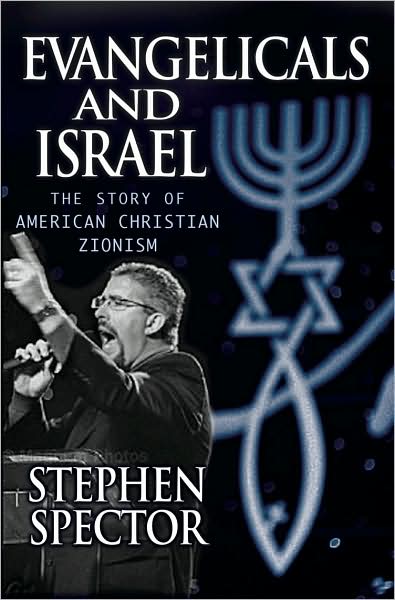
Evangelicals and Israel: A Review


Evangelicals and Israel: The Study of American Christian Zionism: Stephen Spector
Oxford University Press (2009)

After decades of reluctance to address this deeply controversial issue, in recent years there has been a veritable avalanche of books critical of the Christian Zionist movement. Authors include Grace Halsell, Don Wagner, Timothy Weber, Victoria Clark, Dan Cohen-Sherbok, Naim Ateek, Gary Burge, as well as two books of my own. It is perhaps therefore not surprising to find a growing reaction among Jewish Zionists who have begun to come to the defence of their Christian allies.

Stephen Spector’s work is representative of this genre of Jewish apologists, which includes Paul Merkley, David Brog, Shalom Goldman and Gerhard Falk. Their agenda appears to be to justify a strand within Christian Zionism that is neither popular nor representative of evangelicalism as a whole, but which nevertheless plays a strategic role within the Israel Lobby.

The book purports to be the story of American evangelical Christian Zionism. It is a good read, as one should expect for a Professor of English. It would be more accurate, however, to describe it as the story of political Christian Zionism as represented by organisations such as Eagles Wings, Bridges for Peace, Christian Friends of Israel, Christians United for Israel and the International Christian Embassy. These self appointed para-church organisations have publically disavowed both proselytism among Jews as well as apocalypticism, based on a reductionist interpretation of the Bible. They are primarily lobby organisations, advocating on behalf of a Zionism among churches and in Washington among politicians.

While critical of both evangelistic Christian Zionism (such as Jews for Jesus) as well as apocalyptic or dispensational Christian Zionism (such as Hal Lindsey and Tim LaHaye), Spector reserves his strongest criticisms for evangelicals who oppose Zionism on theological grounds.

So, although Spector interviewed over 70 Evangelical and Jewish Zionists in the course of his research, he relies on anecdotes and paraphrases to portray the views of those he deems ‘liberal’ or ‘modernist’ who regard biblical Zionism as an oxymoron. The chapter addressing criticisms of Christian Zionism is therefore one of the weakest and least convincing.

It is simply untrue to say that evangelicals who oppose Zionism “are closer to liberal mainline Protestants than to most conservative born-again Christians,” Academics at the bastions of evangelicalism in the USA, such as Fuller and Wheaton, repudiate Christian Zionism just as much as their counterparts in Europe. John Stott, the ‘father’ of evangelicalism, is not alone in describing ‘Christian Zionism’ as ‘biblical anathema’.

If evangelicalism is defined by the centrality of the gospel, the necessity of a personal faith in Jesus Christ, in the authority of the Scriptures and in the verbal proclamation of the gospel to all nations, it is actually Christian Zionists who, having reinterpreted the gospel and disavow proslytism, are closer in spirit to mainstream liberalism rather than conservative evangelicalism.

It is therefore not surprising that it is in assessment of the biblical and theological presuppositions of Christian Zionism that the book is probably at its weakest. While strong on dialogue with Jewish and Christian Zionists, there is little evidence that Spector understands the theological presuppositions and tenuous biblical basis for the various strands of Christian Zionism. He is reassured that none of those he interviewed tried to convert him and that evangelical Zionists can share the gospel in acts of kindness toward the Jews rather than through proselytism. This is not evidence of the orthodoxy of Christian Zionists, just the opposite.

While Old Testament Bible verses are occasionally quoted without context to demonstrate that Zionism is biblically rooted, it is the evangelical critics of Christian Zionism, according to Spector, who ‘unfairly’ quote ‘the biblical prophets to attack the modern state of Israel’.

The fundamental question Christian Zionists avoid is whether the coming of Jesus Christ was the fulfilment or the postponement of the promises God made to Abraham? Which is central to the New Testament – Jesus or Israel? Ironically, Christian Zionists are portrayed as the new Zealots. Like their 1st Century forebears, they are trying to impose a Jewish kingdom by force, something Jesus repudiated. Spector cites, for example and without comment, Jack Hayford as promising, “if the Israelis need soldiers, he and his Pentecostal congregants will fight side by side with them.” Portraying the modern state of Israel as God’s chosen people on earth, the role of the Church is therefore reduce to providing dubious justification for Israel’s colonization of Palestine.

While ostensibly a book about evangelicals, it soon becomes rather tiresome when, in any debate or disagreement posed, it is always Zionists who are given the last word. So, for example, in a dismissal of Walt and Mearsheimer’s definitive work on the Israel Lobby, Spector defers to Alan Dershowitz suggesting the author’s claims “are variations on old anti-Semitic themes of the kind found in the notorious czarist forgery The Protocols of the Elders of Zion and in Nazi literature.”

Conversely, Spector gives ample space to some of the worst examples of Islamaphobia. There is a deep paranoia regarding the motives of Arabs in general and Palestinians in particular. He refuses to see that Israel could be, in any way responsible, partly or otherwise, for the perpetuation of the Middle East conflict. They are always, in his words, “the victims of injustice, not the perpetrators.”

Disappointingly, for a book with 82 pages of notes and indexes, there is no conclusion or summary chapter. It is as if the publisher has left it out by mistake or needed to reduce the word count. Whatever the reason, the book is weaker for it.

Instead, the last chapter is given to an assessment of the influences on George W Bush’s Middle East policy. Here Spector tries to downplay the impact of the Israel Lobby. Without really explaining why, he would have us believe there is “broad and deep support” for Israel in America because “that position is politically sound and morally just, not because of political pressure or influence” from evangelicals. Ironically, he gives the last sentence in the book to Hal Lindsey.

If first impressions count, the eulogy on the back cover from Abraham Foxman, National Director of the Anti-Defamation League, must surely be the kiss of death to any work claiming to be balanced or objective. One surprised Cambridge academic did ask me rhetorically, who on earth could have possibly vetted the book for Oxford University Press? One wonders. But then it is worth remembering that it was the Oxford University Press who published (and still publishes) the first Christian defence of Zionism, namely the Scofield Reference Bible.

Little Town of Bethlehem

I’m in Colorado Springs tonight in the home of film producer, Porter Speakman. I’m in the USA to promote our new film With God on our Side. But tonight we are watching someone elses film. Little Town of Bethlehem is produced by Sami Awad and the Holy Land Trust.

It is utterly brilliant. It tells the story of the Arab-Israeli conflict and why non-violence is the only solution to the conflict. If you care about the security of Israel and/or justice for the Palestinians, you must see this film. If you want to be part of the solution instead of the problem, make this film a priority and spread the word.

The film follows the story of three separate men, each from a different religion, who grew up in the Holy Land amidst perpetual war and constant conflict and finding the courage to end violence through nonviolence. “Little Town of Bethlehem” shares the gripping story of three men, born into violence, willing to risk everything to bring an end to violence in their lifetime. All shaped by events of their Palestinian and Israeli upbringing—find inspiration in the words and actions of Martin Luther King Jr. and Mahatma Gandhi.

Immersed in an environment of turbulent political and religious forces – and a perpetuating cycle of violence – each of the three men struggle independently to use non-violent conflict to change the paradigm. As their separate stories converge, they begin to find the commonality that bands everyone, regardless of beliefs, in their quest for peace. They believe that violence can indeed be stopped but recognize their own struggles will remain. Yet they will struggle together to discover a common humanity through non-violent action.

In the city of Bethlehem where it is said God became man, these men stand alongside others whose central desire is to be accepted and treated as fully human.

Watch the trailer here. Join the fans on facebook here. See photos the film making on Flickr

China Overture

China Overture II: 7-16th April 2010

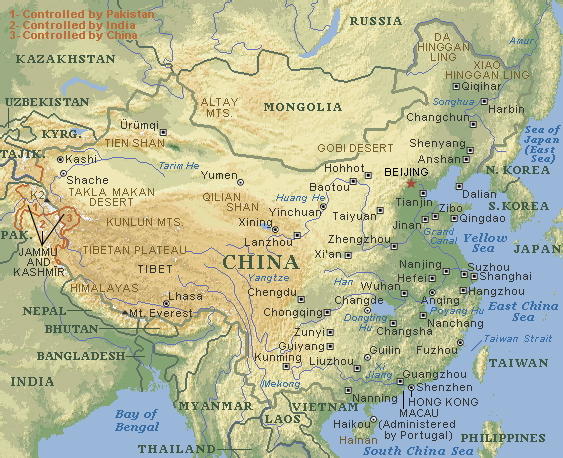
China is the world’s most populous country and also the most rapidly urbanizing nation on earth. That’s why I was eager to participate in the Spring 2010 Bakke Graduate University tour of China. The focus of the BGU China Overture was on urbanization and the challenges of Christian mission in China following the Cultural Revolution.  The religious policies of the Peoples Republic of China, along with exposure to registered churches and non-registered churches, seminaries and NGOs were analyzed through face to face contact and firsthand experience.

Hong Kong, Macau, and Shanghai were visited. Hong Kong was a former British colony. Under the British rule, Hong Kong developed into a world class city. Since the change of sovereignty back to China, the churches are reorientating themselves in the light of the new challenges and opportunities. Macau was a colony of Portugal, a Catholic enclave where Robert Morrison first landed and then began the modern missionary era in China. Shanghai is the largest commercial centre in China, adopting with great enthusiasm, the free market economy in a communist country. Shanghai is also the power centre of the Christian Church in China.

Questions we raised during the China Overture include:

1.    How do you effectively engage the diverse development of cities within China, and the ministries arising from that development?

2.    What are the essential differences between a missiology for the city, and a theology of the city?

3.    How do we celebrate the “whole church of Jesus Christ” when congregations and leaders are so incredibly different?

4.    What does it mean for urban churches in China to be signs of and agents for a Kingdom agenda?

5.    How do churches ministering in the context of poverty work without falling into the “charity trap,” or are they?

6.    How do leaders sustain themselves as Christians when the culture is not so favorable?

7.    Is the incarnation our model as well as our message?  What is the difference?

8.   How are churches handling pluralism in worship, leadership or other aspects of community life?

9.    Specifically in Macau, how do the Protestants witness in a Catholic society with gambling as the main source of income for the city?

10.  How are you preparing yourself for globalization?  How are you accommodating to the fact that more than 80% of the world’s Christians are non-white, non-western and non-northern?  How is Christianity being re-defined in China?

11. What are the real issues facing pastors in these strategic cities?

Day 1: Wednesday 7th April
Our first full day in Hong Kong. We are staying on Noah’s Ark. That’s right. Noah’s Ark is an imaginative multi-million dollar creation-based theme park built around the blue print God gave Noah for the Ark in the Book of Genesis. The hotel inside the Ark is run by the YMCA. My bedroom window and patio looks out over the deck of the Ark. The perspective is rather surreal. I wake up to see animals, frozen in the act of departing the open door of the Ark. Above us is not a rainbow but a giant motor way bridge connecting Ma Wan Island with Hong Kong Island. The Ark looks as if it has come to rest under the bridge on the island as the flood receded. Maybe this is the real Mount Ararat.  Apparently, in the present economic climate, Noah’s Ark is doing better that Disney over on Lantau Island.  The YMCA have a big presence here, with 50-60 different centres, they employ around 1500 staff in Hong Kong. Twenty four churches are accommodated in other YMCA buildings around Hong Kong.

Most of the other participants of BGU’s China Overture are studying for a Master’s degree or PhD. They are expected to undertake two overseas trips, such as this one as part of their course. We represent churches and mission agencies drawn from the USA, China, France, Holland, Nigeria, Kenya, Ethiopia, Ghana, South Korea, Myanmar and the Philippines.

After an orientation morning in a local church school (50% of schools in Hong Kong are church schools), we visit the Urban Peacemaker Evangelistic Fellowship working on the Po Tin Estate in Tuen Wan in the New Territories. China is about 5 miles away to the north. This government built estate houses around 30,000 urban poor in 8,000 housing units in high density tower blocks with 30 or more floors.

The UPEF employ six staff who care for around 1,500 of the poorest families. We spend some of the afternoon visiting families and a homeless shelter for men. Everywhere is very clean and orderly. One resident is heard to say “Are you the Christians who have come to talk to us?” We visit one lady living alone in a flat just big enough to put a bed and set of drawers. The kitchenette is large enough for a sink and portable stove. The toilet is, well, small. The flat is crowded as four of us try and squeeze in with her, three on the bed. It is tidy because she has very few possessions and typically eats just one meal a day. She has a handmade cross on the back of her door. She is pleased to show us and share her testimony.

First impressions? Hong Kong is a colourful, bustling, densely populated, polluted, international 24/7 city that never sleeps. I wonder if this is because it is afraid to fall asleep and wake up to find it has lost its cherished independent status within China. Young people I talk to are afraid of China and what life is like there (they mention crime, etc). The reality is many of the youth of Hong Kong will never leave the colony. The official title of the government here gives a clue to its fluid if ambiguous status.  It is called “The government of the Hong Kong Special Administrative Region of the People’s Republic of China.” I am glad I don’t have to have that written on my business cards.

Many of the shops are still open at midnight and the trams, buses and MTR run well into the early morning. The air is heavily polluted, which, combined with high humidity and hundreds of open cafes and restaurants, makes for strong, pungent aromas as well as a sticky existence day and night. Air conditioning in some of the shops is heaven.

Day 2: Thursday 8th April
Hong Kong has 7 million residents. Christians represent only 6% (475,000 registered) but church based agencies provide 60% of social welfare provision, 50% of schools and 20% of hospitals. There are 1,250 churches in the former British colony and 400 Christian para-church organisations, many of which operate in mainland China. After a morning learning about the history of Hong Kong and the Christian presence here, we visit a ‘Missional church’ which has a marketplace ministry among Hong Kong’s business community. Supper is in a revolving rooftop restaurant with stunning night scenes of Hong Kong.

Day 3: Friday 9th April
Today we visit a group of former teenage drug smugglers and addicts on Lan Tau Island, Hong Kong. The drug problem among Hong Kong’s young has been growing at an alarming rate. Social workers and academics speak of encountering addicts as young as 9 and point out that there were 8,306 reported psychotropic drug users in Hong Kong. The most popular drug among the young is ketamine, an animal tranquilizer produced illegally on the Chinese mainland and in Hong Kong.

The Christian Zheng Sheng Association (基督教正生會有限公司) was founded to help drug addicts in 1985. The Chinese characters “Zheng Sheng” (正生) mean, “repent to live”. And independent surveys show that 90% of the teenagers who spend up to three years in the school do indeed repent and break free of their addiction. In the world of drug rehabilitation this is unheard of. What makes this work unique however is that it is the only project for child addicts in the whole of Asia and costs half the amount of money spent on equivelent projects among adults.

Children as young as 11 who have been charged with possession, smuggling or use of drugs are sent to the school by Hong Kong Social Services or assigned by the Juvenile Court. Zheng Sheng also take children from other Asian countries as far away as Thailand and Indonesia. Christian Zheng Sheng College bases its drug rehabilitation therapy on creating a climate of mutual respect and self-reliance. No pharmaceutical products are used in the treatment.

There are presently 115 pupils cared for by 35 full time staff who share the same facilities as the children just like an extended family. The facilities are very basic because most of the investment is made in the future of the teenagers who learn to excel in sports, technical skills and further education. Most have little problem finding jobs when they graduate. Detoxification is the easy part. Pupils typically stay for three years during which time they learn to become children again. The focus is on the future not the past, and on developing life skills that will make them attractive to future employers. It is the only young person’s drug rehabilitation centre in Asia and takes teenagers from many other countries.

Alman Chan Siu-cheuk, is Principal of Christian Zheng Sheng College. He is one amazing guy. Not without its critics, Christian Zheng Sheng is an amazing testimony to the transforming power of God’s love found in Jesus Christ. For more information see Wikipedia and also this article from the People’s Daily. If I were younger, I would apply to work here.

Day 4: Saturday 10th April
Today we catch the jetfoil to Macau, the former Portuguese colony, across the Pearl River Estuary. Smaller than Hong Kong, Macau has nevertheless become the Las Vegas of China. The government benefits from a healthy 70% tax on the casinos. The port of Macau aspires to be the Monte Carlo of Asia, complete with a Le Man’s look-a-like race control tower. It comes close. The bridges that seem to span the horizon link Macau to Taipa.

There are also 12 universities here, including a tourism college, funded from gambling profits. Nobody complains. Chinese students are allowed to study here (unlike Hong Kong which is still kept at arms length for fear of corrupting the youth). Macau is becoming a training centre for Chinese leaders. Campus Crusade for Christ has a strong presence here. Lunch is in the University of Macau student union and it brings back vivid (read ‘bad’) memories of my own long forgotten student days.  We soon regret it. It is claustrophobic inside and raining outside.

In presentations later that afternoon in the University, we learn a lot about life in China and the contrast between rural and urban life. China is now a mix of socialist constitutionalism and relatively free market capitalism. There are, for example, 50 different airlines in China competing with each other. With a population of over 1 billion, there are only 78 million Communist party members and most are government workers (who have to be members). There are a further 35 million members of the Communist Youth League. There are, however, estimated to be over 100 million religious believers which include Buddhists and Muslims. China is hardly a secular state. In Macau there are 70,000 migrant Chinese workers in the construction industry. It is hard to see where they can be hidden (housed) in such a small place.

In the early evening we visit a casino – we are told – in order to observe and make notes on how business is conducted, who the clientele are and who works in the industry. The casino is one of several Disney castle-like structures that fight with each other for height, luminosity, gravity-defying design and general gaudiness. The Venetian, the one we are dropped off at, is actually a giant multi-story shopping mall with various casinos thrown in. A map is essential. GPS and a golf-buggy would be nice. Apparently extra oxygen is pumped in to minimise tiredness to shoppers and gamblers. The whole place is bathed in artificial light to simulate daylight so that gamblers will lose any sense of the time. Even the ceilings are painted blue to look like the sky. I withstand the temptation to have a flutter but energised by the extra oxygen and fooled by the light, lose all track of time and nearly miss the bus home. I get some amazingly surreal photos of mock Venetian canals and very real gondoliers. This is the ultimate in virtual reality.

Day 5: Sunday 11th April
Although we are billeted in the five star Royale Hotel, breakfast is not included but an expensive extra, so we walk down the road to a cafe and have a simple egg on toast. The tea comes strong, sweet and milky. We attend a church service entirely in Cantonese so I use the hour for a very quiet time. The afternoon includes a walking tour of Macau, the famous ruins of St Paul’s Cathedral, the city museum and Morrison (Anglican) Church and graveyard. It is very moving to sit for a while in the churchyard and see how many young European colonisers, seafarers and traders died from shipwrecks, disease, drowning or in battle.

While Ray Bakke is giving us a presentation about the Church here, a lady wanders in. Someone begins a conversation about Christianity. She replies “I don’t want to rush into being a Christian. It’s like rushing into a marriage.” Very thoughtful. Churches here are small. This may be the Catholic influence. A hundred members would be considered large. Half the Protestants attend a church founded by Campus Crusade for Christ. Apparently they are rather self contained and don’t engage with the Macau Seminary. At least that is one side of the story. Sadly, only two of the seventy local churches are addressing the issue of gambling and prostitution.

Day 6: Monday 12th April
We take the ferry from Macau to Shenzhen back across the Pearl River Estuary and then travel to the airport for our flight to Shanghai. Shenzhen has grown from a small village into a booming trading city because of its strategic location near Hong Kong and Macau. The airport is impressive. Security is light. I spy the new MG 6 saloon on display and get permission to take some close up photos. Whether Rove (the name Rover is owned by BMW) decides to export the car in the UK has yet to be seen. The old Rover 75 (and my ex-MG ZTT estate) are now for internal Chinese consumption only.

We are flying Shenzhen Airways. One of the 50 now competing for internal business in China. I am surprised to see eight very large tempting empty leather first class seats at the front of this socialist aircraft.  We land safely in Shanghai at the ‘domestic’ airport. It makes Heathrow’s Terminal 5 look positively provincial. It has only been opened a month in readiness for the International Shanghai Expo. China is anticipating 70 million visitors to Shanghai between May and October.

Day 7: Tuesday 13th April
In presentations on China we learn that despite the State embracing Communism, China is a multi-faith society with large followings of Buddhism, Daoism, Christianity and Islam.

In 1996 there were 100 million religious believers. In 1998 there were estimated to be 10 million Protestants, 4 million Roman Catholics and 18 million Muslims. Ancestor, hero or patron worship if common. Outside people’s doorways its common to see small shrines with incense sticks burning. The gods are very much alive in China. In a 2005 survey, 300 million people claimed to be religious. According to the 1998 White Book, there were 10 million Protestant Christians, an official figure considered by many too low. The more recent 2007 World Christian Database claims there are 99.9 million Christians in China, a figure many consider too high. A more accurate survey of 2005, based on a sample of 4,500 participants estimates 40 million Christians. In 2008, the Three Self Patriotic Movement which regulates the official church in China had 20 million members. Numbers within the unregistered ‘underground’ house church movement are impossible to estimate.

We visit Shanghai International Church. There are separate services for expats and Chinese Christians. They are not allowed to mix. Expats must show their passports to attend the English speaking service. It is a beautiful building but stands as testament to the segregation of the Body of Christ within the registered church in China.

Day 8: Wednesday 14th April
We visit the headquarters of the Chinese Christian Council (CCC) / Three Self Patriotic Movement (TSPM) in Shanghai, for an informal meeting with the leaders of the movement. It is ‘informal’ to avoid months of negotiation to set up an appointment with the government.

We learn about some of the challenges they face:

  1. A lack of trained pastors
  2. A lack of church buildings
  3. The need for a theology that challenges the inherent syncretism
  4. Overcome its marginalisation. 47% of members are over 50; 56% are female; 11% are illiterate.
  5. Heresy and superstition among rural Christians.

These ‘challenges’ reflect the perspective of the TSPM Church and not necessarily the unregistered House Church movement.

In a recent survey of university students, 20% said they were religious. Of these:

73%      Animist
6%      Buddhist
6%      Catholic
3.9% Muslim

20% said they would be interested
10% said they were not interested in religion.

The survey suggests an increasingly more tolerant approach to religion in China than at any time since 1948.  In Shanghai, we are told there are 20,000 Christians out of a population of 17 million. 70% of the students training in the Seminary are women.

There are several criteria for registering a church with the Three Self Patriotic Movement.

They must have:

  1. a full time pastor
  2. a constitution
  3. regular income
  4. a building
  5. a management council
  6. be non-denominational
  7. be independent and not interfere with their neighbours
  8. agree to the three self principles

This introduction is taken, for convenience, from Wikipedia:

The three principles of self-governance, self-support (i.e., financial independence from foreigners) and self-propagation (i.e., indigenous missionary work) were first articulated by Henry Venn, General Secretary of the Church Missionary Society from 1841–73, and Rufus Anderson, foreign secretary of the American Board of Commissioners for Foreign Missions[1][2]. The principles were drafted formally during an 1892 conference in Shanghai of Christian missions reflecting an almost unilateral agreement that the future of the Chinese church depended on the indigenization of the leadership, and the finding of sufficiently Chinese modes of worship[3]. Dixon Edward Hoste, head of the China Inland Mission was known for putting the same principles into practice in the effort of assisting the Chinese to establish their own indigenous churches during the early 20th Century.

In 1951, a Cantonese Christian named Y. T. Wu (吴耀宗, 1893–1979) initiated the Three-Self Patriotic Movement, which promoted a strategy of ‘self-governance, self-support, and self-propagation’ in order to remove foreign influences from the Chinese churches and to assure the communist government that the churches would be patriotic to the newly-established People’s Republic of China. The ‘Three-Self’ is a characteristically Chinese way of abbreviating ‘self-governance, self-support, self-propagation’ (自治、自养、自传). The movement began formally in 1954 and allowed the government to infiltrate, subvert, and control much of organized Christianity[4].

From 1966 to 1976 during the Cultural Revolution, the expression of religious life in China was effectively banned, including even the TSPM. The growth of the Chinese house church movement during this period was a result of all Chinese Christian worship being driven underground for fear of persecution. To counter this growing trend of “unregistered meetings”, in 1979 the government officially restored the TSPM after thirteen years of non-existence[5], and in 1980 the CCC was formed.

In 1993 there were 7 million members of the TSPM with 11 million affiliated, as opposed to an estimated 18 million and 47 million “unregistered” Protestant Christians respectively.

The TSPM / China Christian Council see themselves as the scaffolding to help local churches come together. Their vision of the church is the one Jesus prayed for – “that they may be one”, except here it is under State control. While this is concerning, I share their desire to avoid the return of free market denominationalism to China.

Agencies such as World Vision, the YMCA and the Salvation Army minister openly in China .

The bookstore attached to the TSPM is full of good Christian literature including copies of the Jesus film, Bibles and books by authors such as John Stott, Rick Warren and Bill Hybels.

Their website is www.ccctspmbook.org

Behind the bookshop and TSPM building is Holy Trinity Church, the former Anglican Church in Shanghai. It is being handed back in the next few months and uis presently being renovated. I manage to slip inside and take some photos of this wonderful old building – before being politely asked to leave by the builders.

After lunch we visit Moore Memorial Church, a former Weslyan building. It was built in the concession area of Shanghai for the European traders. It presently has 10,000 members, 80% of which are women and only 20% are baptised. Sunday attendance is around 4,000.

We are reminded that Shanghai, Macau and Hong Kong are special economic zones and that 600 million Chinese still live on under $2 per day.

In the evening we go for a walking tour of the city centre and river. The light show is simply amazing, If this was America, I would describe it as ostentatious.

Day 9: Thursday 15th April
Today we visit East Shanghai Church. It was the first church to be built after the Cultural Revolution. On the balcony as we arrive, ladies are performing traditional dance with music and red flags. Inside, the church orchestra is practising using traditional Chinese instruments. Soon Moses and Ching join in an impromptu performance.

The church apparently has 13,000 members. Although there are no longer any denominations in China, three ‘denominations’ use the building simultaneously at 9.00am on Saturday mornings. The Three Self Patriotic Movement (TSPM) meets in the main part of the building while the Adventists and the True Jesus Church, meet in side rooms.  The TSPM has three services of 1500 each, meeting once on Saturday and twice on Sunday,  while the other two denominations have about 300 in each. The church also is responsible for two ‘Meeting Points’ of 600 members meeting in other parts of Shanghai. The expression ‘Meeting Points’ is also used by the unregistered church to describe their gatherings. East Shanghai has one pastor and five staff. There are 400 in the youth programme. How can they pastor these numbers of people? Through a network of volunteers. I wish I had time to discover how they do it.

East Shanghai Church must be unique in accommodating denominations in a country where denominations do not exist. In 1968, all churches were forced to come together to worship, so that is what they do here, except in different rooms. Very creative. “We try to respect their traditions” the leader says. While in other cities there have been tensions between Adventists and the TSPM, here in Shanghai there appears to be harmony. Perhaps this is also because the building originally belonged to the Adventists and so the TSPM is keen to accommodate them separately. It is perhaps evidence of the TSPM principle of ‘mutual respect’ and Confucius wisdom.

We have some free time to explore the heart of Shanghai’s old town district and discover a healthy trade in counterfeit watches, bags and designer clothes.

Day 10: Friday 16th April
Our last day. It is always hard to say ‘good-bye’ to the friends we have made, especially the YMCA staff in Shanghai who have made us feel so welcome. In one last evaluation session we share what we will take home from this life changing tour. I lead the morning worship and summarise the lessons of the story of the ‘good’ Samaritan.  As we return to our home countries, the temptation is to retreat back into familiar ways of looking at the world. Jesus teaches us to be a neighbour to everyone we meet, irrespective of who they are or what they look like.

It has been a long journey, physically, emotionally and spiritually, first to Hong Kong, then Macau and then to Shanghai. We have begun to empathise with the Church in China, as it has adapted to and risen to the challenges posed first by Communism and then by China’s transforming relationship to the rest of the world.

Unprecedented and dramatic changes are taking place in China. Population growth, rising standards of living, technological advancement and a greater openness to the rest of the world, pose incredible opportunities and challenges for the Church. By this I do not mean simply in how to reach a billion Chinese people with the gospel, but how we partner with the Chinese Church in reaching the world for Jesus Christ. I am convinced that in the next decade or two, Chinese Christians and Chinese mission agencies will take the lead in helping fulfil the Great Commission. If  the 18th and 19th Century were largely the era of European mission and the 20th Century of American mission, I am confident the 21st Century will be the era of Chinese global mission.

Little did I realise my Chinese adventures were only just beginning. News of the Icelandic ash cloud spreading across Europe is beginning to filter through the Chinese media. I relax knowing I am flying back to Hong Kong and have the weekend with my daughter there.

Day 12: Monday 19th April
Its Monday and I should be flying home to the UK tonight, but is am not going anywhere for several weeks. I discover I am grounded in Hong Kong for at least a week as BA, along with all the other airlines, have cancelled their flights to Europe due to the volcanic ash cloud. There’s a sermon illustration here somewhere.

The BA staff in Hong Kong are coping amazingly well given the hundreds of other stranded passengers. The earliest BA can get me a seat to London from Hong Kong is now on the 10th May or in 21 days time. I work out I could get home by train via Beijing and Moscow in just 8 days or take a berth on a container ship and be home in 22 days. I suspect these are all booked by now though. 
According to the BBC, after 4 days, the plume of ash from Iceland has paralysed 313 airports, caused the cancellation of 63,000 flights and affected 6.799.999 other travellers.

Instead, I plan to fly East to Seattle via Tokyo on Sunday to be there in time for the launch of our film With God on our Side next Tuesday. One small consolation is I get to circumnavigate the world in 33 days, and to see Tokyo as well as the Pacific on my way home via seven cities in the USA. Ironically, I should eventually get home on 7th May, three days ahead of the earliest direct flight I can get from Hong Kong and just four days ahead of the container ships also leaving today.
World Vision – Willow Creek Association Holy Land Tour

World Vision and the Willow Creek Association are hosting a unique and exclusive study tour of the Holy Land for Church leaders from September 28 – October 8, 2010. Click here for the brochure.

Led by Dr. Gilbert Bilezikian, one of the founding fathers of Willow Creek Community Church, and Professor emeritus of Biblical Studies, Wheaton College, this will be his last study-program to the land of the Bible, a truly “one-of-a-kind” experience.

Four Objectives in Collaboration with World Vision and the WCA

1. To renew appreciation for the ministry of Jesus the servant in a power-obsessed world as the model for our personal commitment to God’s purposes.

2. Experience the land and its culture so as to:

  • broaden our knowledge and understanding of Scripture
  • confirm the historical foundations of our faith
  • renew Spiritual commitments
  • To develop an understanding of current events in and around the Land and of their global impact.

3. Facilitate interaction with local religious leaders for their own encouragement, and for team-members to gain perspective about the challenges pertaining to ministry and peace concerns in the Middle-East

4. To open opportunities for Western churches to partner with Middle Eastern communities, churches and children.

Dr Bilezikian writes, “The unique character of this study tour is that it is designed for pastors and Christian leaders, especially as a training tool for those who may aspire to conduct their own groups in the future. Whether you eventually intend to lead a group of your own to the “Holy Land” or not, we can promise that this experience will enrich your ministry immensely.”

Four Reasons For Participating

Steve Haas, Vice President of World Vision, gives four reasons why this will be a strategic opportunity to engage with the Christian community in Israel/Palestine:

First, as you probably know, for more than three decades, Dr. Bilezikian has led multiple trips to the Middle East, under the auspices of Wheaton College and Willow Creek Community Church always with the purpose of studying Scripture where Jesus lived and ministered..  “Dr. B” as he is affectionately known, has served as counselor to thousands of church leaders, most prominently those who founded and led Willow Creek Community Church.  As a result of these trips, countless leaders have experienced recommitment to the dominant motif and calling of their lives.

Secondly, Jesus was born and raised a Palestinian Jew.  Like in no other study program, participants will immerse themselves in the cultural context of which Jesus was a part.  Vital elements of the environment in which He lived continue to survive among the native people of Palestine—some of whom are the descendants of the original occupants of the land since Canaanite times.  In this way, we will grow in our understanding of Jesus the Servant in His own cultural context, and be challenged to redefine our roles as church leaders while moving in current social settings not much different from those in which Jesus lived.

Third, during this trip you will visit sites where New Testament events took place under the tutelage of a prominent biblical scholar.    We believe the theme and purpose of this journey—Jesus the Servant in a Power-Obsessed World— offers a message that you will want to share to your congregation and others.  Therefore the program is also designed to equip participants to lead their own groups in the future if they so desire.

Finally, serving as a co-host for this journey are your friends and partners in ministry, World Vision. For over 35 years, World Vision has served the poor in bringing “life in all of its fullness” to the people of the Middle East.  As one of the largest Christian organizations serving the poor, WV continues to have significant interest in the establishment of peace in the region. World Vision continues to work to encourage and maintain the stability of the indigenous Church that exists there.”

You can access the brochure that provides all the travel details including itinerary, costs, and the “fine print.”  Please note that the cost includes registration, entrance fees, most meals, lodging, gratuities, and land travel while in the Middle East.  Travellers will be responsible for their own inbound and outbound air travel to Tel Aviv, as well as transportation by taxi between the airport and Jerusalem.  We ask that you plan your arrival at the hotel in Jerusalem in time for the welcome dinner on Tuesday, September 28.  Departure from Jerusalem will be on Friday, October 8.  For any wanting to extend their trip to include a visit to Jordan, this is also offered.

Currently, Dr. Bilezikian is holding open 40 places on a first-come, first-served basis.  In order to obtain additional information or to secure reservations, you can connect directly with Jim Schiltz, field administrator of the program, via email at Jim630@sbcglobal.net.

You can access the brochure here and the original as a zip file here

Bethlehem Evangelical Affirmation

We affirm the foundational truth that God loves everyone (John 3:16).

We affirm that as followers of Jesus Christ we are called to do justice and love mercy (Micah 6:8), to be ministers of reconciliation (2 Corinthians 5:11-21), and to be peacemakers (Matthew 5:9).

We affirm that the Holy Spirit empowers followers of Jesus to speak and live humbly and prophetically (Acts 1:8).

We recognize that this is the time to resolve the Israeli-Palestinian conflict.

Therefore, we are convinced that the Holy Spirit is leading us at such a time as this to unite as Christians throughout the world in order to pray and work for a just peace in Israel and Palestine.

To this end, we commit to reconnect with the local Palestinian church and to listen and learn from all those who follow Jesus in the Holy Land and to share their stories with our own faith communities.

We further commit to work together to advocate changes in public policy and so achieve a just and lasting resolution of the conflict. Our vision and our hope is that Israelis and Palestinians will live in justice and peace in the land of the Holy One.

Endorsed by participants in the 2010 Christ at the Checkpoint conference, Bethlehem

Drafting Committee

Paul Alexander
Christine M. Anderson
Brother Andrew
Alex Awad
Bishara Awad
Mubarak Awad
Sami Awad
Gary Burge
Tony Campolo
Steven Haas
Lynne Hybels
Manfred Kohl
Jonathan Kuttab
Paul Johnson
Stephen Sizer
Porter Speakman, Jr.

With God on Our Side: Porter Speakman Interview

Porter Speakman Interview from Stephen Sizer on Vimeo.

Porter Speakman shares about his new film “With God on our Side” For more information see withgodonourside.com

“With God On Our Side takes a look at the theology of Christian Zionism, which teaches that because the Jews are God’s chosen people, they have a divine right to the land of Israel. Aspects of this belief system lead some Christians in the West to give uncritical support to Israeli government policies, even those that privilege Jews at the expense of Palestinians, leading to great suffering among Muslim and Christian Palestinians alike and threatening Israel’s security as a whole.

This film demonstrates that there is a biblical alternative for Christians who want to love and support the people of Israel, a theology that doesn’t favor one people group over another but instead promotes peace and reconciliation for both Jews and Palestinians.”

The title for our film, “With God on Our Side” was inspired by the verse:

…while Joshua was there near Jericho: He looked up and saw right in front of him a man standing, holding his drawn sword. Joshua stepped up to him and said, “Whose side are you on—ours or our enemies’?” He said, “Neither. I’m commander of God’s army. Joshua 5:13-14a (The Message)

We believe this verse is still true today, that God does not take sides with certain people groups, nations or agendas. Rather He is for all people. Throughout history, those who have claimed God was on their side have used it to justify atrocities done in the name of Jesus. We believe once again certain Christians are approaching the people in the Middle East claiming God is on their side in a way that disregards human rights and gives unilateral support to a secular State, elevates one people group over another while using the Bible as justification. We believe there is a better way, a way of justice, peace and love for Jews and Palestinians. One that is inclusive, not exclusive. That is the heart of God.

See http://www.withgodonourside.com

The issues surrounding the situation with Israel and Palestinians whether they be Historical or Political bring up very passionate displays of support and activism on all sides. However, it has been my experience that when theology, whether it be Islamic, Judaic or Christian is mixed in with these issues, these passions spill into a new level and becomes a “holy war” in itself.

As a Christian, I wanted to look deeper at Christian approaches into some of these issues and at a theology called Christian Zionism. Although many Evangelical Christians in the United States may not know what Christian Zionism is, most would adhere to some of the basic beliefs Christian Zionists have toward Israel, the Jewish people and the End Times. That supporting Israel is a mandate for all Christians and that support also meant political support for the State.

I also saw that once people understood the political and historical consequences Christian Zionism has on people in the Middle East, they began to question some of the things they have always just taken for granted.

There are several purposes for making this film:
To bring a different perspective to some of the historical, political and theological viewpoints we just taCase for granted involving Israel and the Jewish people.

To look at the consequences Christian Zionism has on the local people in the Middle East, especially Palestinian, who are most directly influenced by Christian political support for the State of Israel and it’s policies, which are then defended using the Bible.

To raise awareness that there are Palestinian Christians, and these consequences affect them as well Muslim Palestinians.

We believe there is an alternative approach to Christian Zionism. An approach that sees both Jews and Palestinians as equal in God’s sight and one that promotes reconciliation, justice and peace.

We recognize that most people who adhere to a Christian Zionist theology have the best intentions in mind. They love and support Israel and the Jewish people out of sincere hearts and what they feel is the Biblical approach to this situation.

We also recognize that being “Pro-Israel” in the minds of most Christian Zionists is not synonyms with being “Anti-Arab”. However, this is why it is important to look at what we believe alongside with how it affects people. Good intentions can still have devastating effects. Some of the most tragic events in history have occurred from a bad interpretation of biblical texts and understanding of who God is. Any approach to the Middle East must be one that sees the needs of all people, not just one, because at the heart of who God is the God of love who commands us to love one another, whether that be our neighbor or someone we consider our enemy.

These are not easy issues to look at and we are all continuing to learn. However we feel it is important to ask questions and we believe no topics are off limits, when the goal is truth.

The “Key Issues” section of this site has some general information on Christian Zionism, History, and Current Events. These are just small snippets of information on subjects addressed in our film. For those who want to learn further, we strongly recommend looking at our resource page for further studies. We also strongly recommend that books from people offering differing perspectives be read.

Porter Speakman, Jr.
Director / Executive Producer “With God on Our Side”

With God on our Side: UK Film Launch

With God on our Side:  Film Launch on Sunday 28th February, Christ Church, Virginia Water, GU25 4PT, 2:30pm

“With God On Our Side takes a look at the theology of Christian Zionism, which teaches that because the Jews are God’s chosen people, they have a divine right to the land of Israel. Aspects of this belief system lead some Christians in the West to give uncritical support to Israeli government policies, even those that privilege Jews at the expense of Palestinians, leading to great suffering among Muslim and Christian Palestinians alike and threatening Israel’s security as a whole.

This film demonstrates that there is a biblical alternative for Christians who want to love and support the people of Israel, a theology that doesn’t favor one people group over another but instead promotes peace and reconciliation for both Jews and Palestinians.”

Middle Eastern Perceptions of Western Christians

Issue of “Balance” When Sharing the Palestinian Narrative

Gary Burge on the Biblical View of Justice & the Middle East

The title for our film, “With God on Our Side” was inspired by the verse:

…while Joshua was there near Jericho: He looked up and saw right in front of him a man standing, holding his drawn sword. Joshua stepped up to him and said, “Whose side are you on—ours or our enemies’?” He said, “Neither. I’m commander of God’s army. Joshua 5:13-14a (The Message)

We believe this verse is still true today, that God does not take sides with certain people groups, nations or agendas. Rather He is for all people. Throughout history, those who have claimed God was on their side have used it to justify atrocities done in the name of Jesus. We believe once again certain Christians are approaching the people in the Middle East claiming God is on their side in a way that disregards human rights and gives unilateral support to a secular State, elevates one people group over another while using the Bible as justification. We believe there is a better way, a way of justice, peace and love for Jews and Palestinians. One that is inclusive, not exclusive. That is the heart of God.

See http://www.withgodonourside.com