When I meet a couple wishing to get married, the first thing I have to do is ascertain that there are no impediments. I am required to ask them a series of questions. How old are you? Where do you live? Have you been married before? Are you related to one another? In the reading of the banns and at the very beginning of the marriage service we ask publicly if anyone knows of any reason why these persons may not lawfully marry to declare it now. You will be relieved to know that I don’t ask them about their foundation, mascara, lipstick, cosmetic surgery or hair colouring. In 1770 things were very different. In that year the British Parliament passed an Act which specified additional impediments to marriage which applied not only here but throughout the British Colonies including America:
“All women, of whatever age, rank, profession or degree, whether virgins, maids or widows, that shall, from and after such Act impose upon, seduce or betray into matrimony, any of his Majesty’s subjects by virtue of scents, paints or cosmetics, artificial teeth, false hair, Spanish wool, iron-stays, bolstered hips or high-heeled shoes, shall incur the penalty of the law now in force against witchcraft, and like misdemeanours, and that the marriage upon conviction shall be null and void.”
And had you attended a church in that generation you would have heard clergy warn that the use of lipstick was of the devil, used to seduce men into marriage by witchcraft. I hope the Act was repealed but so far my searches have not brought any assurances.
The controversies surrounding what hairstyles, clothing and makeup are acceptable for Christians today goes way, way back before the very birth of the church and the cultural values of Roman, Greek and Jewish society. For example, the Jewish Talmud contains this ruling:
“A woman may not go out on the Sabbath [in the courtyard of her house only] wearing plaits of hair, whether of her own hair or of another woman or of an animal; or with frontlets or other kinds of ornaments sewn to her headgear; or with a hairnet or false curl, or with wadding in her ear or shoe…”
But in Ephesus, immoral and pagan Greek and Roman values were also influential. Young believers, Jewish and Gentile, were confused about how to express their new found freedoms in Christ.
The controversies were dividing the Christians and scandalising their witness. So Paul is inspired to write to Timothy two letters to help regulate the life of the church in Ephesus. As we have already seen, he begins with doctrine in chapter 1, urging Timothy to confront false teaching and to remain loyal to the apostolic faith.
Do you ever worry about your neighbours? About that they may think of you? What impression you give them as a neighbour? When they meet you or see you from a distance, what impression do they get? Is it accurate or a distortion? Are your neighbours threatened or confused by the impressions you give? Do they want to get to know you or do they lock the door and hide? Scientists tell us that the further away your neighbours live, the more likely they are to hold outdated, inaccurate and stereotypical views of you. Did you know, for example, that once broadcast, TV signals begin an endless journey outward into the cosmos at the speed of light? That means our earliest TV broadcasts are probably travelling through star systems more than 400 trillion miles from earth. Do you realise that our neighbours living 60 light years away are watching the first episodes of the Lone Ranger in black and white. 50 light years away they are now watching Rawhide and Bonanza. 40 light years away they have moved on to the original Star Trek series. 30 light years away they are able to watch the Dukes of Hazzard and Knots Landing. Just 20 light years away its Seinfeld and the Sopranos. Those only 10 light years away are being blessed by the Apprentice and countless episodes of Lost. Does it worry you what our neighbours in space may think about us? Does it matter what impression we give? If you want to explore this further I recommend the new film District 9
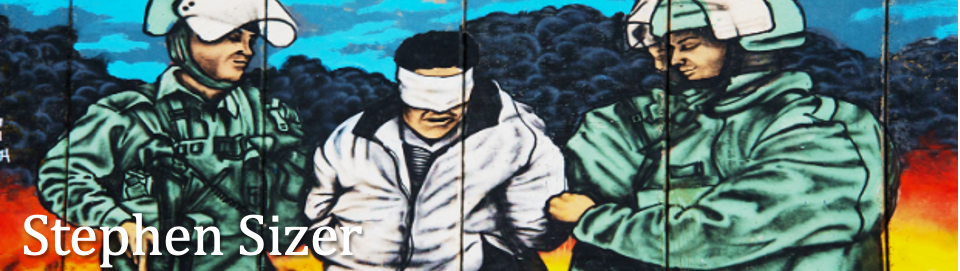
Tonight I had supper with Victor Batarseh, the Mayor of Bethlehem along with a few friends of Bethlehem Bible College. Victor is a gentle grandfather figure, a retired physician and active Christian. He also happens to be a US citizen, although the US Consulate General in Jerusalem refuses to meet with him. The British Consulate general is also unwilling to meet him. “They will meet with the Mayors of other Palestinian towns but not with the Christian Mayor of Bethlehem.” It is also almost impossible for him to leave Bethlehem without special permission from the Israeli authorities. I asked him why. He said “Because I am calling for justice for the Palestinians and peace with Israel and that is not the non-violent message Israel wants to hear from the Occupied Territories.”
He derided the idea that for the last ten months Israel has abided by a moratorium on Settlement expansion. “The settlement expansion has been continuing” he insisted. “The municipal boundary of Bethlehem used to encompass 35 square kilometers of territory. Now it is only six.” he insisted. The rest, mostly the agricultural land has been stolen by the 18 illegal Jewish settlements that now encircle Bethlehem.
He was elected Mayor of Bethlehem in 2005. On his election, he made this speech which, five years later, appears just as timely.
As the newly elected mayor of Bethlehem, I feel proud and privileged. Though it is little in size, it is one of the most famous cities on earth. Bethlehem is a name that lives in the hearts of millions of people. It signifies love, hope and peace for mankind.
It is true we do not have skyscrapers in Bethlehem, but we have the formidable Church of the Nativity, the place where it all started. We do not have natural resources, but we have the holy manger, the source of spiritual fulfillment and nourishment. We do not possess modern technology and satellites, but we have the star of the Nativity, the beacon that has embodied hope in the minds of all believers.
Our history is full of inspirational stories but also of bad times. The bad times under the recent Israeli aggression have led to enormous pain and suffering for Bethlehem and to unprecedented deterioration in its situation.
Throughout the past years, the Israeli settlements’ greedy campaign has cost us considerable loss of our land and resources. The continuous closure imposed on Bethlehem has crippled our freedom to move about, our trade and our labor force. What aggravated the matter, however, is the construction of the separation wall that is slicing the northern borders of Bethlehem, tearing apart many of our families and isolating our holy town from the outside world. We are living in the horror of this apartheid wall that has grabbed our land and seriously affected all aspects of our life, including our ability to access basic services and work, thus our ability to sustain ourselves. Actually, we live today in what is similar to a big prison.
Such a massive obstruction, a concrete wall nearly 40 feet high, is closing the main and historic entrance of the town of the Nativity and has decimated tourism, our major source of income. Except for the last three months when a few pilgrims and tourists were seen again at the Church of the Nativity, tourism in Bethlehem has reached a stage of total standstill over the last four consecutive years. Unemployment in town has therefore soared to 55 percent. With a bleeding heart, I regret to say that more than half of Bethlehemites live today under the poverty line, which encouraged a serious wave of emigration among them, in particular Christians, the custodians of the holy manger.
With lack of adequate support from our Palestinian National Authority, the municipality lives at present in a dire financial crisis. Last month we could not afford to pay the salaries of our employees. The situation portends further deterioration should no immediate support be received, including the risk of cutting off essential municipal services rendered to our people, which would make things even worse.
Ladies and gentlemen, I am not telling a story nor am I trying to be gloomy. I am only conveying the truth that Bethlehem lives today. At this difficult time, we turn toward the sons of Bethlehem, toward our friends and partners throughout the world, asking them to reach out with a helping hand. To them we say Bethlehem, the cradle of Christianity, needs you more than ever before.
For sure one day the wall around Bethlehem will fall. Examples in old and recent history confirm this fact. We will strive to bring that day closer. But until then, we can refuse to live in its shadow. Bethlehem deserves to be open because it stands for the values of openness, an open democracy built on the open hearts of its citizens. The rich and unique heritage of Bethlehem reminds the world that we all face a poorer future without the hope and promise of our little town.
Ladies and gentlemen, despite our suffering and the oppression we are afflicted with, we hold deep faith in peace. We believe peace is the only solution. Peace is a blessing from God we all need. However, peace should be based on justice, equality and respect of others’ rights if it is to prevail, and not on oppression, might and separation.
I should say the Israeli occupation of our land is the sole obstacle to peace and the major cause of instability in our region.
Being on the soil of the U.S.A., the biggest democracy on earth, I call upon the U.S. government, the main sponsor of the Middle East peace process, to do its utmost toward implementing the international legitimacy represented in the United Nations Security Council resolutions, for the sake of a just, comprehensive peace in our region to allow both peoples, Israelis and Palestinians, to live in the Holy Land together and forever as good and equal neighbors.
May the star of the Nativity that shone onto Bethlehem more than 2,000 years ago and led the kings of the Orient to come and meet the Prince of Peace be a symbol of hospitality and guide all people of goodwill toward Bethlehem once again to restore its former glory as a place of dignity, a pilgrimage destination and an open city for peace.
The historic visit to the UK this weekend of Pope Benedict 16th has rightly received considerable media attention. There are several reasons for the media interest: Although Pope John Paul II came on a pastoral visit in 1982, this is the first ever state visit by a Pope. The invitation came from Her Majesty the Queen. More controversially, while the Church of Rome forbids its clergy from marrying, it is embroiled in a deeply damaging scandal of child abuse that is truly global in scale. Then, just before Pope Benedict arrived, one of his senior advisers – Cardinal Walter Kasper – suggested to a German magazine that arriving at Heathrow airport was like landing in a “Third World country”. Benedict has also offended some humanists by associating their view with the “Nazi tyranny that wished to eradicate God from society.”
While journalists have focused on these controversies, few have asked the more fundamental question of why England is not Catholic like France, Spain and Italy. Why is England Protestant? On Friday Benedict gave an address in Westminster Hall. It was here that Sir Thomas More, the Lord Chancellor, was tried and condemned to death for defending his ultimate allegiance to the Holy See rather than his loyalty to King Henry VIII. This is why English Monarch can never be Roman Catholic. Pope Benedict came on this historic visit, in his words, to heal wounds and extend the hand of friendship to the British people. This dialogue is welcomed.
The impression given though, even some religious journalists, is that the RC and Anglican churches believe much the same thing and that our differences are trivial, or the result of Henry VIII’s testosterone levels. The fact is there remain serious theological differences between the Church of Rome and England.
Since the Reformation both churches have believed that the other has departed from the true faith. This is why studying 1 Timothy this Autumn is going to be so important and relevant. We will find practical guidance on how to live as Christ followers. We will also find answers to the questions that continue to divide Christians. Lets recap what we learnt two weeks ago.
The Purpose of 1 Timothy
The central purpose of First Timothy is found in 1:3 and 3:15:
“As I urged you when I went into Macedonia, stay there in Ephesus so that you may command certain men not to teach false doctrines any longer.” (1 Timothy 1:3).
“if I am delayed, you will know how people ought to conduct themselves in God’s household, which is the church of the living God, the pillar and foundation of the truth. (1 Tim. 3:15)
The primary focus concerns false teaching and its devastating effects. But the letter also contains positive instruction that inoculates against the errors of the false teachers. Paul’s real concern is with the results of the false teaching – promoting speculations (1:4; 6:4), arrogance (6:4), and greed (6:5–10). Paul focuses on how authentic faith leads to godly lifestyles. Lives not shaped by the gospel have turned away from the faith. 1 Timothy is therefore a clear call for Christians to live out the gospel – to live like Jesus.
With the appointment of Andy Bruins as co-pastor of Cornerstone Church in Kingston-upon-Thames, we are seeking to appoint a new Youth Pastor from early in 2011.
And did those feet in ancient time
Walk upon England’s mountains green?
And was the holy Lamb of God
On England’s pleasant pastures seen?
And did the Countenance Divine
Shine forth upon our clouded hills?
And was Jerusalem builded here
Among those dark Satanic mills?
Bring me my bow of burning gold:
Bring me my arrows of desire:
Bring me my spear: O clouds, unfold!
Bring me my chariot of fire!
I will not cease from mental fight,
Nor shall my sword sleep in my hand
Till we have built Jerusalem
In England’s green and pleasant land.
The singing of William Blake’s poem, immortalised by Sir Hubert Parry’s music, has become a national institution. It is sung every year by tens of thousands of people on the Last Night of the Proms at the Royal Albert Hall and simultaneously in the Proms in the Park venues around the country. Since 2004, it has also been the anthem of the England cricket team. And at the forthcoming Commonwealth Games, Team England will use “Jerusalem” as the victory anthem from 2010 onwards. The Commonwealth Games Council for England conducted a poll of members of the public which decided the anthem for the 2010 Commonwealth Games. The three options were “God Save The Queen”, “Jerusalem” and “Land of Hope and Glory”. Jerusalem was the clear winner with 52% of the vote. It has literally become the nation’s hymn.
But what many people do not realise is that beneath this poem, in the illuminated hand written original, which appears in the preface to his epic Milton a Poem, Blake wrote a verse from the Bible: ‘”Would to God that all the Lord’s people were prophets” (Numbers 11:29). The New International translation reads, “I wish that all the LORD’s people were prophets and that the LORD would put his Spirit on them!” (Numbers 11:29).
Thirty seven years ago next month I became a fresher at Sussex University. I was just settling into my new room when two American missionaries with Campus Crusade for Christ knocked on my door. Was I interested in doing a survey on religious opinions? I was. We met again a few weeks later and they led me to Christ, for which I will forever be grateful.
They recommended a good church where the Bible was taught and I began attending every Sunday. Another soul won for the Kingdom. Mission accomplished. Job done? No, not quite. In fact, definitely not. This is not what Jesus commanded his disciples to do in the Great Commission. Because this is not the way to reach the world for Christ. Jesus said,
“All authority in heaven and on earth has been given to me. Therefore go and make disciples of all nations, baptizing them in the name of the Father and of the Son and of the Holy Spirit, and teaching them to obey everything I have commanded you. And surely I am with you always, to the very end of the age.” (Matthew 28:18-20)
What did Jesus instruct his disciples to do? Make disciples.
What were they to do? “teach them everything Jesus taught them. Right? Wrong. That is not what Jesus told them to do. He said “Teaching them to obey everything I commanded you…” The Church is a body. It is not just a mouth. We need to put the hands and feet back on the body of Christ.
When Trent led me to Christ that was only the beginning of his responsibility for me. You see we are born to reproduce. After I became a Christian, we met weekly for Bible study and prayer. We went out witnessing together and I learnt how to share my faith from him. He discipled me. After a year, he weaned me off my dependency on him by leaving the country.
Before he left, he wrote in my Bible, “Several guys, mainly one, shared with me about the love of God found in Christ. It changed my life. I shared that message with you and it changed yours. Don’t let it stop with you, pass it on.” I began to meet with one of his colleagues for Bible study and prayer and together we shared our faith, led students to Christ, took them through some basic Bible studies, showed them how to feed themselves, took them to a good church, took them out with us to share our faith, led other students to Christ, let them lead the basic Bible studies and they began reproducing themselves as well. Trent continued writing me letters from Easter Europe, like the one Paul wrote Timothy. He challenged me to work with him.
Over the years I made numerous trips behind the Iron Curtain to help Christians become disciple makers. In May this year I went back to Beilsko Bala, in Poland – the venue of my first trip in the mid 1970s. This time we were training church leaders to use the CE course.
There are two models of church growth. One that works and one that doesn’t. One that Jesus endorsed and one that many churches employ. The difference? It’s the difference between addition and multiplication. The difference between encouraging discipleship and encouraging dependency. Jesus said “make disciples” or “multiply disciples”. He did not say “add dependents” but that is what we do most of the time. The Church will never fulfil the Great Commission this way.
Let me illustrate. If the 12 Apostles had all been as fruitful as Billy Graham and each led a Crusade mission reaching 5,000 people every day, five days a week, for 50 weeks of the year, for 50 years, how many people would they reach for Christ? 750 million people. And the world’s population is? 6 billion. But if each of those Apostles shared their faith with one person a day and saw one person come to faith in six months but during the next six months discipled them and so that the 24 shared their faith with one person a day and saw one person come to faith in the next six months, how many people would have heard the gospel in a year? 6480. How many believers would there be after one year? 48. And if those 48 disciples shared their faith with one person a day and led one person to faith in Jesus in the next six months and in turn discipled them over the next six months as Jesus instructs, how many would have heard the gospel in two years? 32,688. How many believers would there be after two years? 192. After 5 years how many would have heard the gospel? 780,000. How many believers? 94,000. Using this simple method, the numbers hearing the gospel and the number brought to faith in Jesus double every six months. After 50 years how many people in the world will have heard the gospel? It would not take 50 years. Every person in the world would have heard the gospel within about 18 years – less than half a generation.
Why hasn’t it happened then? Partly because of isolation, distances involved, war and language barriers which still inhibit the proclamation of the gospel – but the greatest impediment is not linguistic, its not lack of technology or the fault of geography. It’s because the Church is largely content with addition instead of multiplication. Content with encouraging dependency rather than discipleship. That is why our mission statement is to know Jesus and make Jesus known, to win, build and send. And that is why we are going to study Paul’s these Sunday evenings in the Autumn.
The Recipient of 1 Timothy
The assumption in 1 Timothy, made explicit in Paul’s second letter is that they were in the disciple training business.
“And the things you have heard me say in the presence of many witnesses entrust to reliable men who will also be qualified to teach others.” (2 Timothy 2:2).
On the back of Time and Newsweek, there’s often an advert for Patek Philippe watches. The photograph shows a father playing with his son and the slogan says “You never actually own a Patek Philippe. You merely look after it for the next generation.” That is what Paul is saying about the gospel in 1 Timothy.
The church does not own the gospel. We are to guard it and share it with the next generation. Paul urges Timothy over and over again to remain faithful to what he had taught him (1:18; 5:12–16, 21; 6:11–13). The letter concludes with Paul’s heartfelt cry: “Timothy! Guard what was committed to your trust” (6:20).
We know Timothy was taught the Scripture from early childhood by his mother Eunice and his grandmother Lois (2 Tim. 3:15). He was born of a Jewish mother and a pagan Greek father (Acts 16:1). He was saved during Paul’s ministry in Lystra during his first missionary journey (Acts 14:6-23). Timothy was probably a teenage boy at the time. He became Paul’s disciple, his friend and co-worker.
The words “my true son in the faith” (v2) denote his affinity or legitimate spiritual birth. By the time this letter is written Timothy has been Paul’s constant companion for fifteen years. He has frequently served as Paul’s trouble-shooter and as such was sent to Corinth (1 Cor. 4:17), to Thessalonica (1 Thess. 3:2), Philippi (Phil 2:19) and now Ephesus. He is probably in early to middle thirties by this point in his life. In many ways I think this letter resonates with us because we can identify with Timothy. First, he is not some kind of super-saint but a young man with real problems and yet used greatly by the Lord. Timothy considered himself inexperienced, insecure about the burdens and responsibilities being expected of him. Do you feel like that? I do.
If that is what is inhibiting you from active service for Christ then this letter is for you, this series is for you. Second, Timothy was also by disposition not an outgoing man but by temperament shy and needing affirmation. (2 Tim 1:7). Third, Timothy did not seem to enjoy great physical health.
He suffered from some kind of reoccurring problem with his stomach. (5:23). So this letter is intended as an encouragement, to motivate and challenge Timothy to remain faithful to his commission. In effect, this letter is Timothy’s charge from his teacher and mentor, the apostle Paul. The recipient of 1 Timothy.
The Purpose of 1 Timothy
The central purpose of First Timothy is found in 1:3 and 3:15:
“As I urged you when I went into Macedonia, stay there in Ephesus so that you may command certain men not to teach false doctrines any longer.” (1 Timothy 1:3).
“if I am delayed, you will know how people ought to conduct themselves in God’s household, which is the church of the living God, the pillar and foundation of the truth. (1 Timothy 3:15)
A primary focus of the letter concerns false teaching and its devastating effects. The letter as a whole is bracketed by discussion of the false teaching, and the positive instruction is crafted in direct contrast to the false teachers. The false teaching apparently involved speculation about the law (1:7–11) and asceticism (4:1–5). Paul’s real concern is with the results of the false teaching—for example, promoting speculations (1:4; 6:4), arrogance (6:4), and greed (6:5–10). Paul addresses the content of the false teaching only in passing but focuses on the fact that true Christianity is evidenced by lifestyles shaped by the gospel. Those whose lives are not shaped by the gospel show that they have turned away from the faith (1:6, 19–20; 4:1; 5:6, 8, 11–12, 15; 6:9–10). 1 Timothy is then a clear call for the church to live out in tangible ways the ethical implications of the gospel. The church is God’s primary vehicle for accomplishing His work on earth (see Matt. 16:18–20). The local church is the hope of the world.
The recipient of 1 Timothy. The purpose of 1 Timothy.
The Key Themes of 1 Timothy
1. The gospel produces holiness in the lives of believers, and there is no legitimate separation between belief and behaviour. Thus, those who profess faith but do not demonstrate any progress in godliness should question their spiritual state.1:5; 2:8–15; 3:1–16; 4:6–16; 5:4–6, 8; 6:3–5, 11–14, 18–19
2. Worldwide evangelization is essential and is rooted in God’s own evangelistic desire.1:15; 2:1–7; 3:16; 4:10
3. One key evidence of reception of the gospel is proper behaviour in corporate worship (evangelistic prayer, unity, modesty, and submission).2:1–15
4. Church leaders should be people whose lives are shaped by the gospel.3:1–13; 4:6–16
5. Appropriate honour is a key element in how Christians should relate to one another in the church.5:1–6:2
6. The created order (e.g., wealth) is good and is to be appreciated, though not worshiped.4:4–5; 6:17–19
These are the core themes we shall address in the following weeks. For now, here is an outline of 1 Timothy.
An Outline of 1 Timothy
1. The Church’s doctrine (1:3-20)
2. The Church’s worship (2:1-15)
3. The Church’s church leadership (3:1-16)
4. The Church’s moral behaviour (4:1-10)
5. The Church’s social responsibilities (5:3-6:2)
6. The Church’s attitude towards possessions (6:3-21)
In more detail:
A. The Church and its Message – Ch. 1
1. Teaching sound doctrine – (vv. 1-11)
2. Proclaiming the Gospel – (vv. 12-17)
3. Defending the faith – (vv. 18-20)
B. The Church and its Members – Ch. 2-3
1. Praying men – (2:1-8)
2. Submitting women – (2:9-15)
3. Qualified pastors – (3:1-7)
4. Qualified deacons – (3:8-13)
5. Behaving believers – (3:14-16)
C. The Church and its Minister – Ch. 4
1. A good minister, preaching the Word – (vv. 1-6)
2. A godly minister, practicing the Word – (vv. 7-12)
3. A growing minister, progressing in the Word – (vv. 13-16)
D. The Church and its Ministry – Ch. 5-6
1. To older members – (5:1-2)
2. To older widows – (5:3-10)
3. To younger widows – (5:11-16)
4. To church officers – (5:17-25)
5. To servants (slaves) – (6:1-2)
6. To false teachers – (6:3-10)
7. To the pastor – (6:11-16, 20-21)
8. To the rich – (6:17-19)
This is where we are headed over the next few months these Sunday evenings. I invite you to read 1 Timothy with me on Sunday afternoons each week. If you want to read a commentary alongside your Bible, I recommend John Stott’s in the IVP Bible Speaks Today series. On Monday, December 29, 1913, an article appeared on page 6 of the Times newspaper.
Sir,–It has been an open secret for some time past that I have been desirous of leading another expedition to the South Polar regions.
I am glad now to be able to state that, through the generosity of a friend, I can announce that an expedition will start next year with the object of crossing the South Polar continent from sea to sea.
I have taken the liberty of calling the expedition “The Imperial Trans Antarctic Expedition,” because I feel that not only the people of these islands, but our kinsmen in all the lands under the Union Jack will be willing to assist towards the carrying out of the full programme of exploration to which my comrades and myself are pledged.
Yours faithfully,
ERNEST H. SHACKLETON.
4, New Burlington-street, Regent-street, W., Dec. 27.
The story ran again a week later on January 5th, 1914 indicating that Shackleton was already swamped with applications. The often quoted advert which Shackleton allegedly wrote has never been corroborated.
“Men wanted for hazardous journey, small wages, bitter cold, long months of complete darkness, constant danger, safe return doubtful. Honour and recognition in case of success.”
Unlike Paul’s letter to Timothy, this advert is most probably apocryphal. But it causes me to wonder what kind of ad Jesus would place today. “Men and women wanted for the task of helping to build my church. Even those working with you will often misunderstand you. You will face constant attack from an invisible enemy. You may not see the results of your labour, and your full reward will not come until all your work is completed. It may cost you your home, your family, your friends, even your life.” As we have begun to see, Timothy was willing to answer the ad. Have you? Will you?
Lets pray.
With thanks to John Stott, Warren Wersbie, Thomas Cash, Dennis Selfridge and Travis Moore (Sermon Central), the Nelson Study Bible and English Standard Version Study Bible.
Websites store cookies to enhance functionality and personalise your experience. You can manage your preferences, but blocking some cookies may impact site performance and services.
Essential cookies enable basic functions and are necessary for the proper function of the website.
Name
Description
Duration
Cookie Preferences
This cookie is used to store the user's cookie consent preferences.