Author Archives: Stephen Sizer

World Vision & Willow Creek Association: Holy Land Tour for Church Leaders

Jesus as Lord, Servant and Peacemaker: A Holy Land Tour for Church Leaders (21 March-1 April 2011)

Trip Facilitators: Lynne Hybels, Steve Haas and Stephen Sizer. Hosted jointly by World Vision and the Willow Creek Association with the assistance of the Holy Land Trust

Visit the Tour Website here.  Download the brochure here

“As followers of Jesus called to be peacemakers, we need to understand the context in which Jesus lived, as well as the current tragic conflict in the Holy Land. This tour offers both as we follow the Jesus story, and meet with indigenous Christians committed to incarnating the spirit of Jesus today.” Lynne Hybels (Advocate for Global Engagement, Willow Creek Community Church)

“This encounter will stretch and provide you with insights on how to lead your church more effectively. It will also provide a life-line to those of our Christian family that remain in this turbulent region of the world.” Steve Haas (VP & Chief Catalyst, World Vision)

“If you want to make a difference to the ‘peace-process’ stalemate, this tour is for you. You’ll get to see the main biblical sites but more importantly you will meet fellow church leaders working for justice, peace and reconciliation and discover how you can partner with them.”  Stephen Sizer (Senior Pastor, Christ Church, Virginia Water)

Tour objectives in collaboration with the Willow Creek Association, Holy Land Trust and World Vision:

  1. Renew our appreciation for the ministry of Jesus the Servant as the model for our personal commitment to God’s purposes.
  2. Experience the land and its culture to broaden our understanding of Scripture and renew our spiritual commitment.
  3. Deepen our understanding of current events in Israel/Palestine and of their global impact.
  4. Meet with local leaders to learn of their work for peace and justice in the Middle-East.
  5. Create opportunities for North American churches to partner with Middle Eastern churches and agencies.

Visit the tour website here. Download the brochure here

Ruth Dickenson, the New Editor of Christianity Magazine


Ruth Dickenson, Christianity Magazine from Stephen Sizer on Vimeo.

Ruth Dickinson is the new editor of Christianity Magazine. I interviewed her today about what she is looking forward to in her new role. christianitymagazine.co.uk/

Christianity aims to provide news and articles for Christians and those interested in the Christian faith from across the denominational spectrum. Most of its readers are from the evangelical and/or charismatic traditions.

With a current readership of 30,000 Christianity is seen as the UK’s primary non-denominational evangelical magazine.

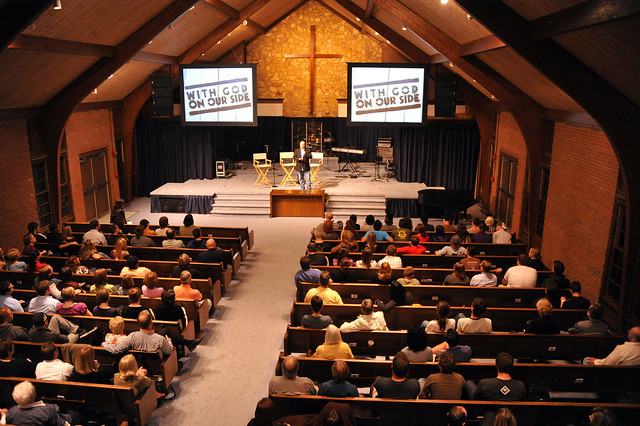
With God on our Side: UK Tour

“The first obvious challenge of “With God On Our Side” was articulating a perspective on the Middle East debate anchored in history and sound theology. Porter Speakman has not only met that test, but also delivered one of the clearest assessments of the struggle between Palestinians and Jews, and a US Church largely unaware of their complicity in the current conflict. Speakman’s second more ominous challenge will be obtaining an audience, often steeped with established notions, open to wrestling with the film’s content. The hope of an ongoing Christian presence in the Holy Land may depend on the success of his message… I dare anyone to see this film and remain unchanged.” Steven W. Haas – Vice President/Chief Catalyst, World Vision United States

“This film is informative, it’s inspiring, it’s challenging and it summarizes in brilliant fashion, what the problem is and what needs to change in order to solve the problem. I don’t know of anything quite like it – and I would have to say the church desperately needs it.” Tony Campolo Professor emeritus of sociology, Eastern University and founder and president of the Evangelical Association for the Promotion of Education

“I can’t think of any form of media in recent years that deals more clearly and powerfully with the most complex region of the world. I can’t recommend it enough!” Carl Medearis Author  “Muslims, Christians, and Jesus”  & “Tea With Hezbollah”

“Finally! A look at what Christian Zionism teaches and more importantly, the real implications it has on the people of the Middle East. A perspective not heard often in the church.” Brian McLaren – Author / Speaker / Activist

4 stars “…Christian Zionism is officially on notice…Whether one agrees with Speakman or not, his challenging glimpses remind us that people are at stake here.” Christianity Today – July 2010, pg. 56.

With God on our Side: UK Tour

Manchester, England
November 8, 2010
Nazarene Theological College – 7:00 PM

Dundee, Scotland
November 9, 2010
Hilton Hotel – Earl Grey Place – 7:15 PM

Edinburgh, Scotland
November 10, 2010
Holyrood – Scottish Parliament
Invitation Only

Belfast, Northern Ireland
November 11, 2010
Stormont – Northern Ireland Assembly (Afternoon)
Invitation Only

Belfast, Northern Ireland
November 11, 2010
Queens University Belfast – 7:30 pm
The School of Sociology, Social Policy and Social Work
6 College Park – Belfast BT7 1LP

Dublin, Ireland
November 12, 2010 – 7:30 pm
Synge Theatre – Trinity College, Dublin

Cambridge University
November 13, 2010 – 2:00 PM
Queen’s Building Auditorium, Emmanuel College
St Andrew’s Street
Ben White will be joining Porter Speakman, Jr. and Rev. Stephen Sizer

With God On Our Side takes a look at the theology of Christian Zionism, which teaches that because the Jews are God’s chosen people, they have a divine right to the land of Israel. Aspects of this belief system lead some Christians in the West to give uncritical support to Israeli government policies, even those that privilege Jews at the expense of Palestinians, leading to great suffering among Muslim and Christian Palestinians alike and threatening Israel’s security as a whole.

This film demonstrates that there is a biblical alternative for Christians who want to love and support the people of Israel, a theology that doesn’t favor one people group over another but instead promotes peace and reconciliation for both Jews and Palestinians.”

For more information see With God on our Side

With God on our Side: Preview

With God On Our Side – Trailer 2 from Porter Speakman Jr on Vimeo.

“With God On Our Side takes a look at the theology of Christian Zionism. Aspects of this belief system lead some Christians in the West to give uncritical support to Israeli government policies, even those that privilege Jews at the expense of Palestinians, leading to great suffering among Muslim and Christian Palestinians alike and threatening Israel’s security as a whole. This film demonstrates that there is a biblical alternative for Christians who want to love and support the people of Israel, a theology that doesn’t favor one people group over another but instead promotes peace and reconciliation for both Jews and Palestinians.”

The Need, Process and Results of Renewal (Nehemiah 8)

Nehemiah 8 from Stephen Sizer on Vimeo.

Today, many celebrate the Celtic festival of Samhain or Samuin (pronounced sow-an or sow-in)”. The word is derived from Old Irish and means roughly “summer’s end”. The festival celebrates the end of the “lighter half” of the year and beginning of the “darker half”. It is sometimes regarded as the “Celtic New Year”. The ancient Celts believed that the border between this world and the next became thin on Samhain, allowing spirits (both harmless and harmful) to pass through. The family’s ancestors were honoured and invited home while harmful spirits were warded off. It is believed that the need to ward off harmful spirits led to the wearing of costumes and masks to disguise oneself as a harmful spirit. The word Halloween is first attested in the 16th century and represents a Scottish variant of the fuller All-Hallows-Even (“evening”), that is, the night before All Hallows or All Saints Day when the church celebrates the unity of the church, visible and invisible, earthly and heavenly, the church penitent and the church triumphant.

But on All Hallows Eve, the 31st October 1517, a 34 year old Augustinian monk gave us another reason to celebrate today, when he nailed a statement to the door of the Schlosskirche in the Saxon town of Wittenberg. And so today also marks the first day of the Reformation. What triggered Martin Luther’s historic challenge to the Church of Rome was Pope Leo X’s decision to complete the rebuilding of Rome’s ancient and crumbling St Peter’s Cathedral. Or rather, should I say, how Pope Leo proposed to pay for the work. In order to raise the funds needed, he authorised Bishops to sell indulgences promising to deliver souls from Purgatory. One particularly energetic salesman was Johann Tetzel. Tetzel was a German Dominican friar assigned by the Archbishop of Mainz to collect the revenue in that part of Germany. Using a drum to gain attention, Tetzel apparently wrote praise songs with imaginative words like “As soon as a coin in the coffer rings / the soul from purgatory springs.”  Tetzel sold pardons for murder, for incest, theft, adultery, perjury and other crimes, all for hard cash. The pardons not only covered past sin but future sins also. With the blessing of the church, therefore, recipients could indulge themselves in the belief that they had bought their forgiveness. Luther vowed ‘to beat a hole in Tetzel’s drum’ and that is why he pinned his 95 thesis to the door of the church in Wittenburg. Continue reading

The Parable of the ‘Good’ Palestinian (Luke 10)

Do you ever worry about your neighbours? About that they may think of you? What impression you give them as a neighbour? When they meet you or see you from a distance, what impression do they get? Is it accurate or a distortion? Are your neighbours threatened or confused by the impressions you give? Do they want to get to know you or do they lock the door and hide? Scientists tell us that the further away your neighbours live, the more likely they are to hold outdated, inaccurate and stereotypical views of you. Did you know, for example, that once broadcast, TV signals begin an endless journey outward into the cosmos at the speed of light? That means our earliest TV broadcasts are probably travelling through star systems more than 400 trillion miles from earth. Do you realise that our neighbours living 60 light years away are watching the first episodes of the Lone Ranger in black and white. 50 light years away they are now watching Rawhide and Bonanza. 40 light years away they have moved on to the original Star Trek series. 30 light years away they are able to watch the Dukes of Hazzard and Knots Landing. Just 20 light years away its Seinfeld and the Sopranos. Those only 10 light years away are being blessed by the Apprentice and countless episodes of Lost. Does it worry you what our neighbours in space may think about us? Does it matter what impression we give? If you want to explore this further I recommend the new film District 9.

Continue reading

With God on our Side: US Film Tour

Photo taken by Emily Stock

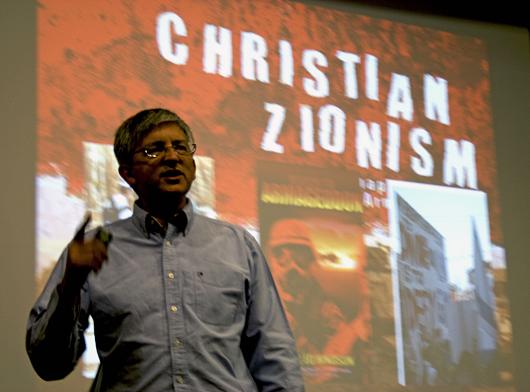
This week I am  helping Porter Speakman promote the film With God on our Side at the invitation of Christian universities and churches in the USA.

Porter used my book Zion’s Christian Soldiers as one of the background sources for the film. The Bible Study Guide which accompanies the film is also based on the chapters of my book. Perhaps not surprisingly, some folk are not so happy that the spotlight has been turned on the dubious link between Christianity and Zionism.

I have been called a lot of things over the years. The more printable ones include a liberal, an anti-Semite, and a supercessionist (an advocate of Replacement theology). Lets begin by debunking these three red herrings.

Liberals and Evangelicals
Dispensationalists like to think they alone read the Bible literally and are more consistent than other Christians who, for example, ‘spiritualise’ away the promises made to the Israelites. That is probably why they get upset when some conservative evangelicals beg to differ. It would be more accurate to say that sometimes Dispensationalists accept a literal interpretation without acknowledging how Scripture interprets Scripture, for example, how Jesus and the Apostles use Old Testament promises and terminology in new ways. By imposing seven ‘dispensations’ on the Bible, some Dispensationalists seem to turn what is intended to be a unified plan of salvation for a sick world into separate isolation wards for different races.

Zionism and Anti-Semitism
It is true that at various times in the past, churches and church leaders have tolerated or incited anti-Semitism and even attacks on Jewish people. Racism is a sin and without excuse. Anti-Semitism must be repudiated unequivocally. However, we must not confuse apples and oranges. Anti-Zionism is not the same thing as anti-Semitism despite attempts to broaden the definition. Criticising a political system as racist is not necessarily racist. Judaism is a religious system. Israel is a sovereign nation. Zionism is a political system. These three are not synonymous. I respect Judaism, repudiate anti-Semitism, encourage interfaith dialogue and defend Israel’s right to exist within borders recognised by the international community and agreed with her neighbours. But like many Jews, I disagree with a political system which gives preference to expatriate Jews born elsewhere in the world, while denying the same rights to the Arab Palestinians born in the country itself. Jimmy Carter is not alone in describing the Zionism practiced by the present government of Israel as a form of apartheid.

Supercessionism or Replacement Theology
This is a favourite ‘straw man’ of Christian Zionists. They criticise their opponents for implying the Church has ‘replaced’ Israel. The implication is that the Jewish people cease to have any role within the purposes of God. This is clearly refuted in Romans 9-11.
The Scriptures are however unambiguous in distinguishing between the old and new covenants. In Hebrews, the writer says, “By calling this covenant “new,” he has made the first one obsolete; and what is obsolete and outdated will soon disappear.” (Hebrews 8:13). There is therefore, from a Christian perspective, no sense in which the old covenant can be viewed as still in force or applicable. On the night that Jesus was betrayed, after the supper he took the cup, saying, “This cup is the new covenant in my blood, which is poured out for you.” (Luke 22:20). When Jesus died on the cross, a new covenant was established with his precious blood that supercedes the basis of the old covenant. The writer to Hebrews continues, “For this reason Christ is the mediator of a new covenant, that those who are called may receive the promised eternal inheritance—now that he has died as a ransom to set them free from the sins committed under the first covenant.” (Hebrews 9:15).

Here then is the biblical basis for a kind of supecessionism. But notice the succession is first of all from one covenant to another, not from Israel to the Church. This is because both covenants were, in their first instance, made with the people of God who at that stage were predominantly Jewish. “The days are coming,” declares the LORD, “when I will make a new covenant with the house of Israel and with the house of Judah.” (Jeremiah 31:31). This is why Jesus initially sent his Apostles only to the Jews. “These twelve Jesus sent out with the following instructions: ‘Do not go among the Gentiles or enter any town of the Samaritans. Go rather to the lost sheep of Israel.’” (Matthew 10:5-6). But when the majority rejected his ministry, Jesus warned, “Therefore I tell you that the kingdom of God will be taken away from you and given to a people who will produce its fruit.” (Matthew 21:43). Jesus here describes the succession that would occur within a generation.

The apostle Peter, preaching after Pentecost, and citing Moses, similarly warned those who rejected Jesus, “Anyone who does not listen to him will be completely cut off from their people.” (Acts 3:23). Covenantalists believe there has only ever been one people of God – whether under the old or new covenant – and one way to God – by grace alone and through faith alone. Both Israel and the Church have been a mixed company of believers and unbelievers, Jews and Gentiles. Only God knows who is numbered among his faithful remnant. At various times in history it has been clearer than in others – for example when all but the family of Noah perished or the entire generation who entered Sinai, perished there apart from a handful. That is why many Covenantalists are uncomfortable describing the Church as the ‘New Israel’. The term never appears in the Bible. However, as we shall see in more detail in chapter 3, Peter uses language describing Israel and applies it to the Church.

“They stumble because they disobey the message—which is also what they were destined for. But you are a chosen people, a royal priesthood, a holy nation, God’s special possession, that you may declare the praises of him who called you out of darkness into his wonderful light. Once you were not a people, but now you are the people of God; once you had not received mercy, but now you have received mercy.” (1 Peter 2:8-10)

It is not that the Church has replaced Israel. Rather, in the new covenant church, God has fulfilled the promises originally made to the old covenant church. So, for example, when Jesus affirms Peter’s declaration of faith and says, “on this rock I will build my church, and the gates of death will not overcome it.” (Matthew 16:18), the word translated for ‘church’ in Greek is ‘ekklesia’ – the very word used in the Greek Old Testament to describe God’s people. No – Covenantalists are not liberal, anti-Semitic or into ‘replacement’ theology.

Is there an Elephant in the Room?
I hope you are beginning to see why this is such an important subject. There is a giant elephant in the room and its time we started talking about it. As I intimated in the foreword, fear of being accused of anti-Semitism for challenging the Zionist agenda is enough to keep many evangelicals under their beds. In my view, and that of an increasing number of other evangelicals, it is time to speak out because Christian Zionism has become a formidable and dangerous movement. Portraying the modern state of Israel as God’s chosen people on earth, the role of the Church has been reduced in the eyes of many to providing moral and biblical justification for Israel’s colonization of Palestine. Those who oppose her are demonised.

While not all Christian Zionists endorse the apocalyptic views of Hal Lindsey and Tim LaHaye, the movement as a whole is nevertheless leading the West, and the Church with it, into a confrontation with Islam. Using biblical terminology to justify a preemptive global war against ‘the Axis of Evil’ merely reinforces stereotypes, fuels extremism, incites fundamentalism and increases the likelihood of nuclear war. Do I think the Bible predicts all this? No I don’t.

It is not an understatement to say that what is at stake is our understanding of the gospel, the centrality of the cross, the role of the Church and the nature of our missionary mandate, not least, to the beloved Jewish people.

Taken from the Introduction to Zion’s Christian Soldiers
Runnymede Mayor’s Civic Service: Church and State

Runnymede Mayor’s Civic Service Romans 13 from Stephen Sizer on Vimeo.


Thomas Jefferson once asked the rhetorical question: “Can the liberties of a nation be thought secure when we have removed their only firm basis, a conviction in the minds of the people that these liberties are of the gift of God? That they are not to be violated but with his wrath?”

In the 18th Century, on both sides of the Atlantic, there might have been a consensus that the answer was self-evident – at least in Britain if not in France. When the same revolutionary spirit infected the North American Colonies it became a more debatable question there also. The First Amendment to the United States Constitution, which Jefferson helped write, provided one solution – separate church and state.

While originally intended to protect the church from the state, since 1947, the U.S. Supreme Court has interpreted it to mean that religion and government must stay separate for the benefit of both. Not so today. Most people believe the Church should keep its nose out of politics. Which is why our Bible reading from Romans may have sounded somewhat reactionary or fundamentalist depending on your political affiliation?

Even the idea of holding a religious ceremony to inaugurate the appointment of a new civic leader may to some, appear eccentric or inappropriate. What has religion got to do with politics? I suggest a great deal, and worthy of our attention today. Please turn with me to our Bible reading from Romans.

That we have responsibilities to both God and the state was clearly implied in Jesus’ enigmatic epigram, ‘Give to Caesar what is Caesar’s and to God what is God’s.’ (Matthew 22:21)

Now the Apostle Paul enlarges on the state’s God-appointed role and on the responsibility of Christian citizens in relation to it. His emphasis however, is on personal citizenship rather than on any particular theory of church—state relations.

1. The Authority of the State
2. The Role of Government
3. The Responsibility of Citizens

Continue reading

The Servant Leader (Nehemiah 5)

Have you ever wondered what leads most people into debt? It’s trying to catch up with people who are already there. It’s the same with nations. Do you remember the Jubilee 2000 Campaign? The international campaign to have the crippling debts of the poorest countries in the world cancelled. How are we doing? Hasn’t most of the debt been cancelled? The good news is that $100 billion of Third World debt has been written off. The bad news is that the total debt owed by the developing world is still $3.7 trillion. In order for the poorest countries of the world to meet their basic needs, a further $400 billion needs to be written off. That is unlikely. Unlikely because most debt relief is administered through the International Monetary Fund (IMF) and the World Bank. Both are controlled by wealthy creditor nations. We set the rules that allow poor countries to qualify for debt cancellation. If countries do not follow the demands of the IMF or World Bank they cannot get debt relief. To make matters worse, for every £1 developing countries receive from developed countries in aid, they return £5 in debt service repayments. Five times more money still flows out of the developing world than is given in aid and support. [See the Jubilee Debt Campaign]

What does God think about this? Does he care? Yes, he does, most emphatically. Today we come to chapter 5 in the story of Nehemiah and the rebuilding of God’s people as well as their walls. Last Sunday in chapter 4 we saw there were three different threats to God’s people. Their enemies used both verbal abuse and violent threats. They were provocative and powerful. But the biggest threat was internal. It came from vision fatigue. Their initial enthusiasm was waning. They had begun to focus on their problems and become demotivated. We saw how Nehemiah inspired them to have a mind to work, a heart to pray and an eye to watch. Today in chapter 5 the external enemies and the city walls recede from view, to reveal a more subtle and more fundamental problem. Here the menace is hunger and exploitation, and the structure at risk is not the walls but the community of God’s people itself.

Continue reading