If you went in search of the village of Emmaus today, you would not find it. This Sunday, literally hundreds of millions of Christians around the world will hear the Easter story of the encounter between two disciples and the risen Lord Jesus on the Road to Emmaus. Few however, will hear mention of Emmaus today, or what has happened there in our lifetime. In an article published by If Americans Knew, Sacred Christian Site Emmaus Destroyed by Israel, Alison Weir writes,
“In 1967, after Israel launched its Six Day War, Israel expelled the inhabitants of Emmaus and obliterated almost all traces of the village, along with two other Palestinian villages nearby. This was part of the Israeli strategy, in the words of an Israeli historian, “to take over as much of Palestine as possible with as few Palestinians as possible” Israeli journalist Amira Hass describes Emmaus before it was levelled:
“Schools, mosques, an ancient church, olive presses, paths to fields and orchards, bubbling streams, mountain air, sabra bushes, carob and olive and deciduous trees, harvested fields, graves, water cisterns.” Israel then “brought in the bulldozers and destroyed and detonated and trampled. Not for the first time, not for the last. And the owners of all that beauty – the elderly, the children, the infants – heard and watched the explosions from a kilometre or two away.”
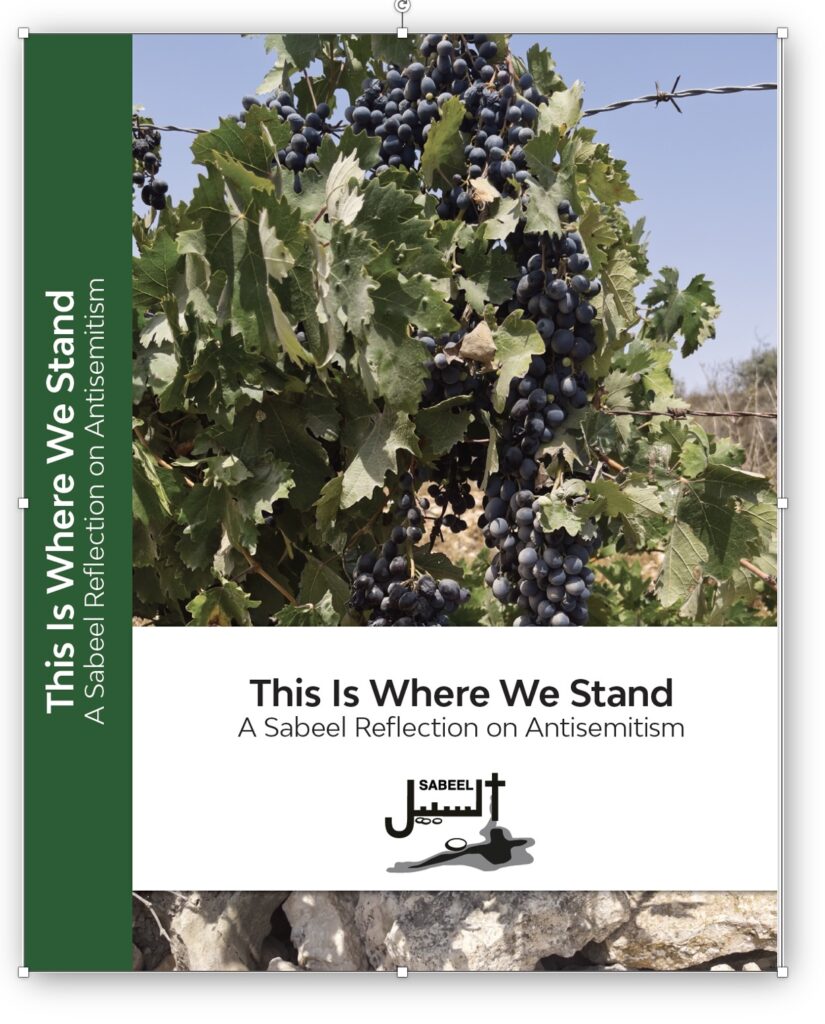
Why then do we write about antisemitism? The answer is simple.
The foundations on which we struggle against Palestinian oppression are the same foundations on which we are committed to fighting against antisemitism. Furthermore, if it is wrong of the state of Israel to deny our full humanity, it is futile and unacceptable for us to do the same. There will be no peace in our land until all of us recognize the full humanity of all who live here – especially Palestinian refugees, forcibly exiled who wish to return and have been denied that right.
John Wesley preached outdoors because the Church of England denied him a pulpit over his evangelical theology. He could have left the Anglican Church but didn’t. They didn’t want him. His theology was too evangelical. His love was too extravagant. His methods too unorthodox. So they shut him out of churches and pulpits. They could not silence Wesley. Instead he preached in the open air – in fields, markets, and cemeteries and the crowds loved him.
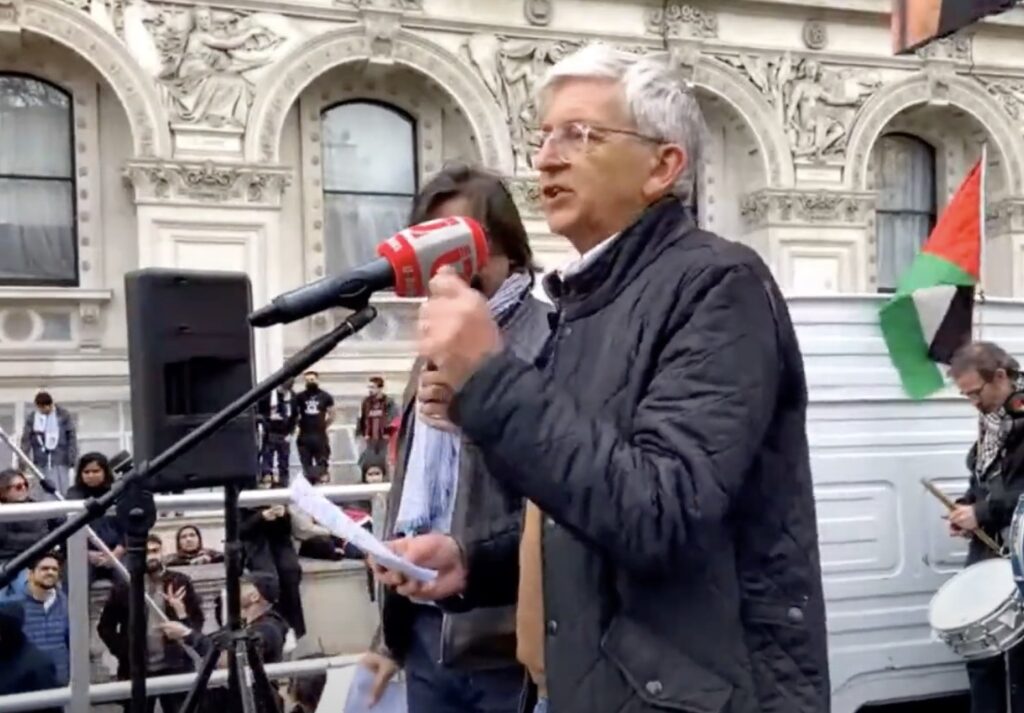
Today it was my privilege to read and expound the scriptures in the open air in Whitehall outside Downing Street before an estimated 15,000+ Jews, Muslims, Christians and those of no faith, all with police protection. It was truly one of the highlights of my ministry. (click on the photo above to watch my presentation). The text of my presentation together with photos and more short videos may be found below.
An update from Jeff Halper, the director of the Israeli Committee Against House demolitions (ICAHD), on the situation in Israel/Palestine. This is the first of what will be a monthly update I am recording with Jeff about what is happening on the ground in Palestine/Israel.
This month Jeff speaks about the push of international right-wing organisations to change the face of democracy in the world, with Netanyahu and his group leaders in this effort. However, Netanyahu’s agenda has fractured Israeli society and coming to the surface are questions about how Israel can be a democracy with an occupation and apartheid policies. Jeff goes on to speak about the heighten repression of the Palestinians during Ramadan and again calls for the UN to provide protective presence for the Palestinians.
Please become a member of ICAHD and receive the monthly Newsletter and Bulletin.
Its confession time. I didn’t mean to do it. I know I should not have done it. Every week I carefully avoid looking but this Friday I did. I don’t know what possessed me. I put it down to mid-life crisis. My eyes just wandered and there it was, the most enticing, the most tantalizing, the most tempting job offer I have ever read in the Church of England Newspaper.
“It’s True Adelaide is a great place… No doubt you’ve read about Adelaide’s fine weather, fine beaches, fine food and fine wine. Its all true! South Australia wants people who see their future in its progressive climate. The archbishop of Adelaide welcomes enquiries from clergy wishing to minister in parishes and schools. Find out more about South Australia at www.southaustralia.com. Send your expressions of interest to…” and then it gave the address.
In this interview Bishop Richard Llewellin talks about his experiences of serving his curacy in South Africa under the apartheid regime and the parallels with Palestine today. (apologies for the quality of the audio)
In this interview Bishop Richard Llewellin shares his experiences with the Ecumenical Accompaniment Programme in Israel and Palestine (EAPPI). EAPPI is an international programme coordinated by the World Council of Churches. It brings people from around the world to the West Bank to serve for three months as human rights monitors. For more information see https://eappi.org
Bishop Richard was ordained in 1964 and was a curate at Radlett. After serving a second curacy at Johannesburg Cathedral, and being expelled from South Africa by the apartheid Nationalist government of the day in 1971, he was then successively the Vicar of Waltham Cross, the Rector of Harpenden and a canon of Truro Cathedral before being ordained to the episcopate as the suffragan Bishop of Street Germans (1985-1992).
He later became the suffragan Bishop of Dover (1992-1999) and was subsequently appointed Bishop at Lambeth and Chief of Staff to the Archbishop by the then Archbishop of Canterbury, a position he held until 2004. In retirement he was appointed an honorary fellow of Canterbury Christ Church University.
When the Lord Jesus Christ died on the cross, how large was the remnant of Israel?
God had promised Abraham that his descendants would be like the stars in the sky and the sand on the seashore (Genesis 22:17-18). Through the history of God’s people recorded in the Hebrew Scriptures we see the Lord blessing and cursing his people according to their faithfulness (Deuteronomy 11:26-28; 2 Kings 17). Sent into exile first into Assyria and then into Babylon, on each occasion only a remnant returned.
So when Christ died on the cross, how large was the remnant? Where were the remnant who had acclaimed Jesus the Messiah just a week earlier on Palm Sunday? Where were the disciples? Where was Peter and the other Apostles? Who were present at the cross when Jesus died? Mary Magdalene, Mary his mother and the Apostle John. Did they understand what was happening? Were they singing ‘When I survey the wondrous cross”? No, they were weeping. They did not understand.
When Jesus died on the cross he was the sole remnant, the sole faithful remnant of Israel. This is crystal clear from Isaiah 53.
“Surely he took up our pain and bore our suffering, yet we considered him punished by God, stricken by him, and afflicted. 5 But he was pierced for our transgressions, he was crushed for our iniquities; the punishment that brought us peace was on him, and by his wounds we are healed. 6 We all, like sheep, have gone astray, each of us has turned to our own way; and the Lord has laid on him the iniquity of us all.” (Isaiah 53:4-6)
Read verse 6 again. “We all, like sheep, have gone astray, each of us has turned to our own way and the Lord has laid on him the iniquity of us all.”
When Jesus hung on the cross he was Israel. The remnant was reduced to one man, who died and three days later was raised to new life. In the resurrection narratives we read how Jesus forgives, restores and recommissions his remnant. First, of his apostles (John 20-21), and then after his ascension and bestowing of the Holy Spirit, on the Day of Pentecost, three thousand people of many nationalities were added (Acts 2:41). By Acts 4:4, the remnant had grown to more than five thousand men.
The promises God made to Abraham have and are being fulfilled in and through the Church of Jesus Christ. The Book of Revelation provides a vision of there ultimate fulfilment.
“After this I looked, and there before me was a great multitude that no one could count, from every nation, tribe, people and language, standing before the throne and before the Lamb. They were wearing white robes and were holding palm branches in their hands. And they cried out in a loud voice: “Salvation belongs to our God, who sits on the throne, and to the Lamb.” (Revelation 7:9-10)
Was the coming of Jesus the fulfilment or the postponement of the promises God made to Abraham? The Scriptures are clear:
Jesus answered, “I am the way and the truth and the life. No one comes to the Father except through me.” (John 14:6)
“Salvation is found in no one else, for there is no other name under heaven given to mankind by which we must be saved.” (Acts 4:12)
The remnant of God’s chosen people are saved by grace through faith and faith alone in the Lord Jesus Christ, not race, not law, not works, but grace through faith.
The first team of Muslim and Christian leaders have now been trained and begun to initiate peace building projects. The need is great, especially in Upper Egypt.
The plan therefore is to train five further teams in 2023. The budget for this is modest – $16,000. If you would like to support this exciting project you may do so through the Friends of the Anglican Province of Alexandria (specifying your gift is for the Peace Building Team).
You can make a donation by bank transfer in UK Sterling directly to the FAPA account: Account No: 00018311 Sort Code: 40-52-40
Peacemaker trust is delighted to promote this exciting peacemaking project and hope that you will also.
In May 2022, Archbishop Mouneer Anis, First Archbishop of the Anglican Province of Alexandria, launched the Centre for Christian Muslim Understanding and Partnership at All Saints Cathedral in Cairo. The vision is to promote peace and harmony between faith communities through more understanding of faiths, cultures and through working together for the common good. Read more here.
Cookie Consent
We use cookies to improve your experience on our site. By using our site, you consent to cookies.
Websites store cookies to enhance functionality and personalise your experience. You can manage your preferences, but blocking some cookies may impact site performance and services.
Essential cookies enable basic functions and are necessary for the proper function of the website.
Name
Description
Duration
Cookie Preferences
This cookie is used to store the user's cookie consent preferences.