The Road from Jericho to Jerusalem is just 14 miles long. A day’s journey on foot, uphill all the way. Bethany is on one side of the Mount of Olives. A natural place to stop and rest before the final ascent and panoramic view of all Jerusalem. But it is not the road that should capture our attention. Dusty roads through dramatic scenery were as common then as now, indeed little has changed. Israeli checkpoints, barbed wire, military settlements and the Separation Wall have replaced the Roman garrisons but it is still Occupied Territory. It is ironic that if Jesus were born in Binfield he would have no problem getting from Jericho to Jerusalem today. But because he was born in Bethlehem he would not be able to make the journey to Jerusalem. Like thousands of West Bank Christians he would be turned back at any one of the 400 military checkpoints that clog Palestine. Each one acts like plaque narrowing the arteries – constricting the flow of Palestinian life.
The Right Revd Suheil Dawani is the Anglican Bishop of Jerusalem. He was born in Nablus but serves at the Cathedral in Jerusalem. At least he did so until this week. He too has just had his Jerusalem residence permit revoked. Under international law he has every right to live and work in his own country but the Israeli government is seeking to empty East Jerusalem of Palestinians and so under it is illegal for the Bishop to visit his Cathedral in Jerusalem. Pray for your brothers and sisters today in the Holy Land who are denied the most basic of human rights – freedom of movement, freedom to worship, freedom to live in the land of their birth. Sadly they are haemorrhaging, as they are in Iraq and other Middle East countries.
Last week, for example, the most prominent Christian in Pakistan was murdered. Shahbaz Bhatti, 42, was shot outside his mother’s home in Islamabad Wednesday morning. He was the only Christian serving in Pakistan’s government. As Pakistan’s Federal Minister for Minorities Affairs, Shahbaz was well known for campaigning against the nation’s strict blasphemy law and lobbying for the rights of religious minorities. Last year Shahbaz made a video to be released in the event of his death. You can view it on my blog and also Christianity Today. We need to do more than pray and give financially to mission.
That is why I travelled 7,000 miles to speak at Taylor University in Upland and Indiana University in Fort Wayne earlier this week. If we want to break the log jam in the Middle East we need to challenge the mindset in Middle America. Taylor maybe a small Christian University of only 3,500 students but everyone is challenged to go on mission trips, and boy were they fired up about the Middle East. So, on Tuesday night, when the University had invited Alvin Plantinga, described by Time magazine as the “leading philosopher of God,” to give a prestigious lecture, the students themselves organised a viewing of With God on our Side and at least 250 students showed up. We hope to have a recording of the Q&A online soon. On Thursday just before I flew home, I gave a 50 minute lecture on the Middle East to students at Indiana State University, that was also broadcast live by the local TV station. Continue reading →
Do you like dancing? Hands up if you like dancing. Hands down. Hands up if you have never danced in your entire life? We all dance when we are children don’t we? Its natural?
But what happens when we begin to grow up? We begin to get self-conscious. We think we have two left feet. We worry about what other people might think. And we say “I can’t dance” which roughly translated means “I won’t dance.”
When do you feel like dancing? When you have something to celebrate? When there is some dance music playing? When other people are dancing? When you come to church? Hands up if you are comfortable with dancing in church? Any kind of dancing or only some kinds of dancing? Dancing is popular in many different cultures isn’t it?
Would you be comfortable with this kind of dancing at Christ Church? Hands up. How about this one? And this one? We all have different opinions don’t we? What matters? Why we are dancing? Are we dancing for the Lord? Or are we drawing attention to ourselves? I’m a little embarrassed to show you this picture, but I wanted to prove that I can dance too. Do you want me to show you? Maybe not… I don’t know what Joanna thinks, because she hasn’t seen the picture. It doesn’t really matter now because we have all our children …
In our Bible story David and Michal couldn’t agree on dancing either could they? What was the difference between King David and his wife Michal? Verse 16. He was dancing. She was despising. Why was David dancing? Why wasn’t Michal dancing? See verse 15-16. The text says “the entire house of Israel were bringing….” But they weren’t were they? David was worshipping. All the people were worshipping. But Michal wasn’t worshipping. She was watching. They were worshipping. She was watching. That is why she was bitter in her heart.
What was David thinking of? What God had done. What was Michal thinking of? What David had done. Who was David thinking of? The Lord not himself. Who was Michal thinking of? Herself, not the Lord. See how David replied to Michal when she criticised him when he came in for supper.
Read 2 Samuel 6:21-22. David was willing to humble himself before the Lord his king, in order that he be honoured by his subjects. Michal did not honour God or humble herself and that is why became sad and bitter. How can we apply this lesson? And that is why it doesn’t matter what kind of dancing we have at Christ Church. Or if we do dance or if we don’t.
It doesn’t matter if you do like dancing or don’t like dancing. It doesn’t matter if you do like singing or don’t like singing. It doesn’t matter if you do want to raise your hands or don’t want to raise your hands. What matters is our motive not our moves. What matters is not what other people think but what God thinks. The lesson here doesn’t only apply to dancing. It can apply to what we wear? Who did you get dressed for today? Who will you go to school for tomorrow? Who will you be working for tomorrow?
Who do you relate to most in our story? With David or with Michal?
The Apostle Peter learnt this lesson the hard way, after he boasted about what he would do for Jesus, before he understood all that Jesus would do for him: “Humble yourselves, therefore, under God’s mighty hand, that he may lift you up in due time.” (1 Peter 5:6)
Let’s make it our prayer today and maybe our memory verse for the week. So that whether we are dancing with praise to the Lord on the outside, we are dancing with praise to the Lord on the inside.
Do you remember your very first Bible? Mine was a gift from my grandfather. I must have been six or seven years old. It had a hard red cover. It was small, had very thin pages and tiny script. But that didn’t matter because it was unreadable anyway. On the occasions I tried, I had absolutely no idea what I was reading. It was a closed book. King James could keep his Bible. At senior school, I encountered the Revised Standard Version (RSV) in RE lessons, but I was more interested in the line drawings and maps than the text itself.
At University, when I became a Christian, the Bible really came to life. And I wanted a copy just like the guy who led me to Christ. It didn’t do much for my spelling because it was the New American Standard Bible (NASB) but at least it had a readable font, the sentences went right across the page like a real book and it had cross references that kept me occupied for hours. This was around the time of Woodstock and the fashion in Christian circles was to cut off the hard cover of your Bible and glue on a piece of off cut leather. So we could walk around campus, bare foot, carrying the kind of Bible John the Baptist must have had. I thought it would be cool to underline passages that spoke to me and I also used a highlight pen. The only problem was it bled through to the other side and pretty soon I was underlining most of the text.
Then I discovered my pastor had a wide margin, loose leaf Bible, so he could add his notes and make it look like he was preaching straight from the Bible. So I wanted one too. I bought my very own loose leaf Bible and added my notes in the margins and on extra pages. But I gave up because my writing wasn’t that good and there wasn’t enough room anyway.
Eventually I upgraded to an all leather New International Study Bible (NIV) and decided not to write anything in it. And that’s been my companion for the last 25 years. If you don’t own a Study Bible and you are serious about growing in Christ, I recommend you invest in one. I’d go for the TNIV or the ESV Study Bible. The Life Application Study Bible is also good. And if you want a Bible for daily devotions, go for the One Year Bible which provides you with an OT, NT, Psalm and Proverb for each day, and you can read the whole Bible in a year.
In this series on the Privileges of Church Membership, today we are thinking about how to read the Bible carefully. This morning I want us to answer 3 questions:
What comes to mind when you think of the word ‘missionary’? Pith helmets, savages, martyrs? Ever think of yourself as a ‘missionary’? Or to use more contemporary language, a ‘mission partner’? Well that’s the theme of our Mission Sunday with special guest speaker Dick Dowsett on Sunday 27th March. We are going to see that the Lord has entrusted to each one of us, the good news of the gospel. He has given each one of us a ministry of reconciliation. On our Mission Sunday we are going to be challenged to get involved with one of more of our mission partner agencies – not just pray for them, not just give to them, but go with them. Our aim is that in years to come we will be sending mission teams out every year to work with churches in other parts of the Uk, Europe and the world. Tonight we are going to tag along with the Apostle Paul on his first missionary journey. I want us to see that it is in fact a continuing missionary adventure because it isn’t over yet. We usually identify the preaching of the Gospel with the quiet rural lakeside villages of Galilee where our Lord ministered. It can all sometimes seem rather remote and distant from our busy urban environment. The irony is however that the Church growth recorded in the Book of Acts was almost exclusively an urban expansion. Historian Wayne Meeks writes,
“within a decade of the crucifixion of Jesus, the village culture of Palestine had been left behind, and the Greco-Roman city had become the dominant environment of the Christian movement.”
Introduction: Sometimes, after a death in the family a lawyer reads a will to the surviving family members. As the will is read, some family members accept their inheritance with humility and gratitude, while others might respond in anger or surprise at their inheritance. In Genesis 25 we see no surprises about the inheritance. Abraham’s sons all know that Isaac will receive the blessing. Later, Isaac’s son, Jacob, is the one chosen to receive the blessing. Abraham left his material inheritance to his family, and he left his spiritual inheritance to all those who believe in Jesus Christ. Abraham left us a clear inheritance of salvation by faith; he trusted the one true and living God.
Chapter Divisions
Abraham provides for his many sons, but Isaac gets the blessing (Genesis 25: 1-11).
Ishmael has many sons (Genesis 25: 12-18).
Isaac’s son Jacob tries to insure his inheritance (Genesis 25:19-34).
1. Abraham provides for his many sons, but Isaac gets the blessing (Gen 25: 1-11).
Explain: Abraham eventually had many sons. His first was Ishmael, then Isaac, then the sons from the wife he took after Sarah’s death. Abraham provided for all of his sons, but Isaac was the one to whom he gave the blessing. “Abraham left everything he owned to Isaac. But while he was still living, he gave gifts to the sons of his concubines and sent them away from his son Isaac to the land of the east” (vv. 5-6). “After Abraham’ s death, God blessed his son, Isaac …” (v. 11). Abraham faithfully, though not flawlessly, followed God’s plan. He made provision for God’s plan to continue after him. Because Abraham had made his desires known throughout his lifetime, after his death there was no surprise in the distribution of his property. He would follow God’s will, and Isaac would be the one to inherit the blessing, according to what God had told Abraham before Isaac’s birth. Isaac was the one through whom God’s purposes would be worked out.
Illustrate: That’s not fair! We often hear people complaining that something isn’t fair. Why didn’t God allow Abraham to divide his fortune evenly between all his sons? Why did Isaac get all the blessing? Simply put, “Because God said so.” But why was it God’s plan for Isaac to be Abraham’s rightful heir? In this case, God had clearly spoken that the blessing of multiple descendants and possession of land would go to the child born of Abraham and Sarah. As we have seen throughout Scripture, God keeps His word. God also kept His word to Hagar and made Ishmael a father of many nations as well. Abraham was conscientious and gracious toward all his sons, insuring they had gifts before he died.
Apply: What seems unfair in your life? Did God give someone else more gifts, better parents, better children, more opportunities? Sometimes people decide their lives have been unfair, so they become bitter and angry and stop serving the Lord. Perhaps we need to take our eyes off the physical things we’ve inherited and focus on our inheritance in the Lord! We’re all richly blessed in Him with a Savior, with a purposeful life, and with an eternal future with the Lord. Divine sovereignty doesn’t destroy human responsibility. Let’s accept what God has given us with thankful hearts. Because our true inheritance comes from the Lord—not from man.
2. Ishmael has many sons (Gen 25: 12-18).
God heard Hagar’s cries and He promised her He would make her son into a great nation (Genesis 16:10, 17:20-21 and 21:18). Sometimes we forget that God had promises and a plan for Ishmael also. Isaac received Abraham’s blessing, but, as God had promised, Ishmael had 12 sons, who became tribal rulers (Genesis 25:16).
Illustrate: Sometimes people try to get an elderly man or woman to change his/her will and name different heirs. Occasionally the aged person does change the will, but later the rightful heirs have the decision reversed in court. Hagar was despondent about her son and cried out to God, and God gave him a blessing, but He didn’t take away Isaac’s blessing to do it. We cannot determine our own inheritance. Our inheritance depends on the One who gives it.
Apply: From birth we depend on the older generation to take care of us until we can take care of ourselves. We should be grateful for the previous generation’s wisdom, knowledge, and traditions; they’re important for the next generation. Imagine how difficult it would be for each generation to start from scratch. God gave Isaac and Ishmael promises about their lives, and He fulfilled them. God didn’t reverse them—Ishmael’s descendents did become a mighty nation; he was the father of 12 rulers. Ishmael had the same choice as Isaac to come to faith in Abraham’s God or to turn his back on God. Sadly, he made the wrong choice.
The Central Idea? Our true inheritance comes from the Lord—not from man.
3. Isaac’s son Jacob tries to insure his inheritance (Gen 25:19-34).
Again, there should have been no surprise about who was to inherit the blessing from Isaac. After a 20-year wait for their child, Rebekah became pregnant with twins. Rebekah could not understand what was happening to her as her babies were “jostling in the womb,” so she asked God about it. “The Lord said to her, ‘Two nations are in your womb, and two peoples from within you will be separated; one people will be stronger than the other, and the older will serve the younger.’” When the twin boys were born, the older was red and hairy, and they named him Esau. The younger was born grasping his brother’s heel. They named him Jacob. In time, Esau became Isaac’s favorite, and Rebekah favored Jacob. The boys were polar opposites, and their parents’ conduct served to divide them even more. Despite God’s statement to Rebekah that her older son would serve her younger, Genesis 25:29-34 describes how Jacob insured the birthright inheritance by manipulating his older brother. Jacob schemed and took advantage of his brother’s hunger and made Esau swear to sell his birthright for a dish of stew. “So Esau despised his birthright.”
God had promised Rebekah that Jacob would have the inheritance, but Jacob tried to accomplish on his own what God had already promised. In manipulating his brother, it became obvious that Jacob was deceptive, but Esau was impulsive and shortsighted—willing to sell his future for instant gratification. Our motorways are peppered with large bright warning signs. These are “loud” signs that tell us to slow down and approach carefully. But the Lord warns us in a still, small voice: “Careful! Be Patient! Wait on Me!”
Apply: We continue to see these patriarchs causing themselves problems by trying to work out God’s purposes on their own. Abraham and Sarah became impatient, did things their own way, and Ishmael was born. Here, instead of patiently waiting for God to accomplish His own purpose, Jacob tries to speed things up by scheming and by manipulating his brother. In the next chapter we’ll see all the pain Jacob causes with his impatient plans. Now Jacob owns the birthright, but he has to flee; the birthright didn’t bring him any joy. Do we become impatient and manipulate situations and people to try to work out God’s will for Him? Is God telling you to be careful, to be patient, to wait on Him? Jacob didn’t believe God’s promises and inheritance could be his apart from his own sinful manipulation of Esau. Do I do that?
Do I take “shortcuts” instead of waiting and trusting God? Faith and scheming can’t coexist. Because our true inheritance comes from the Lord—not from man. Sometimes, when we read Scripture, we can think God’s plans seem unfair. However, when we look at the results of who God picked to inherit His blessings, we have to conclude that God knew what he was doing. Once upon a time…
Final Illustration: “A certain man had two sons. One was rich and the other was poor. The rich son had no children while the poor son was blessed with many sons and many daughters. In time the father fell ill. He was sure he would not live through the week so on Saturday he called his sons to his side and gave each of them half of the land of their inheritance. Then he died. Before sundown the sons buried their father with respect as custom requires. That night the rich son could not sleep. He said to himself, ‘What my father did was not just. I am rich, my brother is poor. I have bread enough and to spare, while my brother’s children eat one day and trust God for the next. I must move the landmark which our father has set in the middle of the land so that my brother will have the greater share. Ah – but he must not see me. If he sees me he will be shamed. I must arise early in the morning before it is dawn and move the landmark!’ With this he fell asleep and his sleep was secure and peaceful. Meanwhile, the poor brother could not sleep. As he lay restless on his bed he said to himself, ‘What my father did was not just. Here I am surrounded by the joy of many sons and many daughters, while my brother daily faces the shame of having no sons to carry on his name and no daughters to comfort him in his old age. He should have the land of our fathers. Perhaps this will in part compensate him for his indescribable poverty. Ah – but if I give it to him he will be shamed. I must awake early in the morning before it is dawn and move the landmark which our father has set!’ With this he went to sleep and his sleep was secure and peaceful. On the first day of the week – very early in the morning, a long time before it was day, the two brothers met at the ancient land marker. They fell with tears into each other’s arms. And on the spot was built the city of Jerusalem.”
Final Application: Here is the New Testament fulfilment of the promise God gave to Abraham: “If you belong to Christ, then you are Abraham’s seed, and heirs according to the promise.” (Galatians 3:29).
“Because you are his sons, God sent the Spirit of his Son into our hearts, the Spirit who calls out, “Abba,Father.” So you are no longer slaves, but God’s children; and since you are his children, he has made you also heirs… Now you, brothers and sisters, like Isaac, are children of promise.” (Galatians 4:6-7, 28)
God knows our hearts too. He knows what blessings we’re able to receive while still giving Him the glory. He knows that we all need each other and the blessings and gifts that each person brings to the church (Romans 12). There is no place for jealousy or envy or competition or fear within his family for he longs to bless each one of us. As his adopted children, we’re all valuable to Him.
Adapted from Lesson 17 (Community Bible Study International) Genesis 25 “The Death and Descendants of Abraham”
“Then James and John, the sons of Zebedee, came to Jesus. “Teacher,” they said, “we want you to do for us whatever we ask.” “What do you want me to do for you?” he asked. They replied, “Let one of us sit at your right and the other at your left in your glory.” “You don’t know what you are asking,” Jesus said. … When the ten heard about this, they became indignant with James and John. Jesus called them together and said, “You know that those who are regarded as rulers of the Gentiles lord it over them, and their high officials exercise authority over them. Not so with you. Instead, whoever wants to become great among you must be your servant, and whoever wants to be first must be slave of all. For even the Son of Man did not come to be served, but to serve, and to give his life as a ransom for many.” (Mark 10:35-45)
“Not so among you. Instead, whoever wants to become great among you must be your servant.” Here is the DNA of the Church.
Back in the 1950’s, at the request of the Church Assembly, the Archbishops of Canterbury and York issued “A Short Guide to the Duties of Church Membership”. A few years ago, we adopted this guide as the basis for our own Membership Covenant. You can pick up a copy from the information desk or website.[i] Between now and Easter we are exploring what it means to be a member of Christ Church. At Easter we will invite you to rededicate yourself to follow Jesus and serve in and through his Church.
Today we begin with the first of nine duties or privileges of church membership: “To follow the example of Christ at home and daily life, and to bear personal witness to him.” How can we do that?
What does it mean? Please turn with me to John 13. Chapters 13-17 are known as the Upper Room Discourse. What is surprising is that in the first twelve chapters of John’s Gospel, Agape, God’s love is mentioned 8x. But in chapters 13-17, it is mentioned 31x. I want us to see the connection between love and service by what Jesus knew, what Jesus did and what Jesus taught. Continue reading →
Have you ever been in a really bad storm? Howling winds, driving rain, rough waves? How did you feel? Scary wasn’t it? We don’t forget storms easily do we? I’ve only been in one really bad storm at sea. Crossing the English Channel on a ferry to France. Everyone on board was sea sick. It can get really rough on the Sea of Galilee too, very quickly because it has hills on three sides. It did on the night we’ve read about in Matthew 14.
“Immediately Jesus made the disciples get into the boat and go on ahead of him to the other side.” (Matthew 14:22)
Immediately after what? The amazing miracle of the feeding of 5000, it seems Jesus wanted his friends to learn a lesson. To trust him in the storms of life.
“When evening came, he was there alone, [on a mountainside overlooking the lake] but the boat was already a considerable distance from land, buffeted by the waves because the wind was against it.” (Matthew 14:22-23)
Jesus sent them on ahead, maybe to think about how on earth he had been able to feed 5000 people with a few rolls and fish. By the middle of the night all their energy was going into staying afloat and not with the fish. Then they got the shock of their life.
“Shortly before dawn Jesus went out to them, walking on the lake. When the disciples saw him walking on the lake, they were terrified. “It’s a ghost,” they said, and cried out in fear.
But Jesus immediately said to them: “Take courage! It is I. Don’t be afraid.” (Matthew 14:25-27)
How did Jesus try and get them to trust him? First they saw him. Second they heard him.
“Take courage! It is I. Don’t be afraid.” (Matthew 14:27)
Jesus wanted them to trust Him. If he could feed 5000 and walk on water Jesus could look after them in any storm. Jesus must have smiled when Peter cried,
“Lord, if it’s you,” Peter replied, “tell me to come to you on the water.” “Come,” he said.
Then Peter got down out of the boat, walked on the water and came toward Jesus. But when he saw the wind, he was afraid and, beginning to sink, cried out, “Lord, save me!”
Immediately Jesus reached out his hand and caught him. “You of little faith,” he said, “why did you doubt?” (Matthew 14:28-31)
Maybe Peter figured he was safer out of the boat with Jesus than in the boat without him. How did Jesus try and get Peter to trust him? As long as he listened to Jesus and kept his eyes on Jesus he was fine. But when he looked at the waves he was afraid and began to sink. He cried out and Jesus caught him.
“And when they climbed into the boat, the wind died down. Then those who were in the boat worshipped him, saying, “Truly you are the Son of God.” (Matthew 14:32-33)
They were beginning to realise that Jesus was the Son of God. Notice what Jesus said to Peter “You of little faith, why did you doubt?” (Matthew 14:31) Peter only had a “little faith”. By now Jesus expected Peter to have more faith. Why? Because of the evidence Jesus had provided. Now it is not about how much faith you have but who you place your faith in. “Faith” is simply another word for “Trust”. Jesus wanted them to trust him more and more, to grow in faith. How? Through what they saw (the miracles), what they heard (his amazing teaching) and what they touched (when he rescued them).
Then they would learn to trust him,
even when they could not see him, hear him, or touch him. Lets do a little experiment in faith building… [see, hear and touch]
Now we can’t see, or hear, or feel Jesus, so how can we trust Jesus in our storms of life?
1. We Hear Jesus through the Bible
God continues to speak to us about his wonderful plans and purposes for our lives through the living Bible.‘People do not live on bread alone, but on every word that comes from the mouth of God.’ (Matthew 4:4) That is why its important we read the Bible.
2. We See Jesus in the Church
When we first put our trust in Jesus, we are born into a new family of brothers and sisters. “Now you are the body of Christ, and each one of you is a part of it.” (1 Cor. 12:27)
We grow to trust Jesus more and more as we see him at work in other another, as we help each other discover his purposes for our lives, just as his first disciples did.
3. We Experience Jesus by His Spirit
Jesus has not left us alone. He sent his Holy Spirit to be with us, to live in us and help us to trust him through the storms of life. Jesus has not left us alone.
“The Spirit of God testifies with our spirit that we are God’s children. Now if we are children, then we are heirs—heirs of God and co-heirs with Christ.” (Romans 8:14-16)
That is why, no matter what storms we may face this week or any time in the future, we can trust Jesus to be with us. For…
“we know that in all things God works for the good of those who love him, who have been called according to his purpose.” (Romans 8:28)
So let me ask you. Like Peter have you ever cried out, “Lord, save me!” Sooner or later we all recognise we need a Saviour. And like the disciples, we need to realise who Jesus is, worship him, saying “Truly you are the Son of God.” If you haven’t yet, don’t wait for a storm. Jesus wants you to trust him to be your Saviour and friend today and everyday.
And if you have already trusted in Jesus, are you growing in your relationship with him? Are you trusting him a little more and more each day, so when the big storms come you will not be afraid? Get to know him better.
How? Hear Jesus speak to you through his Word. See Jesus at work in and through his Church. And trust Jesus to guide you moment by moment through his Holy Spirit. Lets ask him right now.
(talk given at the annual Virginia Water Cubs and Scouts service and annual Christ Church School Thanksgiving service)
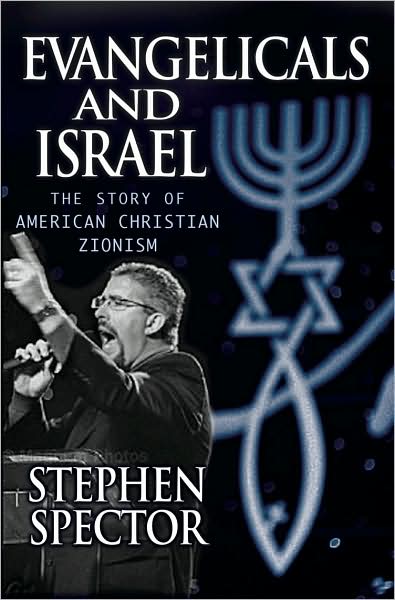
Evangelicals and Israel: Stephen Spector Oxford University Press (2009) 338 pages.
Reviewed for American Studies Today, Issue 19, September 2010
After decades of reluctance to address this deeply controversial issue, in recent years there has been a veritable avalanche of books critical of the Christian Zionist movement. Authors include Grace Halsell, Don Wagner, Timothy Weber, Victoria Clark, Dan Cohen-Sherbok, Naim Ateek, Gary Burge, as well as two books of my own. It is perhaps therefore not surprising to find a growing reaction among Jewish Zionists who have begun to come to the defence of their Christian allies.
Stephen Spector’s work is representative of this genre of Jewish apologists, which includes Paul Merkley, David Brog, Shalom Goldman and Gerhard Falk. Their agenda appears to be to justify a strand within Christian Zionism that is neither popular nor representative of evangelicalism as a whole, but which nevertheless plays a strategic role within the Israel Lobby.
The book purports to be the story of American evangelical Christian Zionism. It is a good read, as one should expect for a Professor of English. It would be more accurate, however, to describe it as the story of political Christian Zionism as represented by organisations such as Eagles Wings, Bridges for Peace, Christian Friends of Israel, Christians United for Israel and the International Christian Embassy. These self appointed para-church organisations have publically disavowed both proselytism among Jews as well as apocalypticism, based on a reductionist interpretation of the Bible. They are primarily lobby organisations, advocating on behalf of a Zionism among churches and in Washington among politicians.
While critical of both evangelistic Christian Zionism (such as Jews for Jesus) as well as apocalyptic or dispensational Christian Zionism (such as Hal Lindsey and Tim LaHaye), Spector reserves his strongest criticisms for evangelicals who oppose Zionism on theological grounds.
So, although Spector interviewed over 70 Evangelical and Jewish Zionists in the course of his research, he relies on anecdotes and paraphrases to portray the views of those he deems ‘liberal’ or ‘modernist’ who regard biblical Zionism as an oxymoron. The chapter addressing criticisms of Christian Zionism is therefore one of the weakest and least convincing.
It is simply untrue to say that evangelicals who oppose Zionism “are closer to liberal mainline Protestants than to most conservative born-again Christians,” Academics at the bastions of evangelicalism in the USA, such as Fuller and Wheaton, repudiate Christian Zionism just as much as their counterparts in Europe. John Stott, the ‘father’ of evangelicalism, is not alone in describing ‘Christian Zionism’ as ‘biblical anathema’.
If evangelicalism is defined by the centrality of the gospel, the necessity of a personal faith in Jesus Christ, in the authority of the Scriptures and in the verbal proclamation of the gospel to all nations, it is actually Christian Zionists who, having reinterpreted the gospel and disavow proslytism, are closer in spirit to mainstream liberalism rather than conservative evangelicalism.
It is therefore not surprising that it is in assessment of the biblical and theological presuppositions of Christian Zionism that the book is probably at its weakest. While strong on dialogue with Jewish and Christian Zionists, there is little evidence that Spector understands the theological presuppositions and tenuous biblical basis for the various strands of Christian Zionism. He is reassured that none of those he interviewed tried to convert him and that evangelical Zionists can share the gospel in acts of kindness toward the Jews rather than through proselytism. This is not evidence of the orthodoxy of Christian Zionists, just the opposite.
While Old Testament Bible verses are occasionally quoted without context to demonstrate that Zionism is biblically rooted, it is the evangelical critics of Christian Zionism, according to Spector, who ‘unfairly’ quote ‘the biblical prophets to attack the modern state of Israel’.
The fundamental question Christian Zionists avoid is whether the coming of Jesus Christ was the fulfilment or the postponement of the promises God made to Abraham? Which is central to the New Testament – Jesus or Israel? Ironically, Christian Zionists are portrayed as the new Zealots. Like their 1st Century forebears, they are trying to impose a Jewish kingdom by force, something Jesus repudiated. Spector cites, for example and without comment, Jack Hayford as promising, “if the Israelis need soldiers, he and his Pentecostal congregants will fight side by side with them.” Portraying the modern state of Israel as God’s chosen people on earth, the role of the Church is therefore reduce to providing dubious justification for Israel’s colonization of Palestine.
While ostensibly a book about evangelicals, it soon becomes rather tiresome when, in any debate or disagreement posed, it is always Zionists who are given the last word. So, for example, in a dismissal of Walt and Mearsheimer’s definitive work on the Israel Lobby, Spector defers to Alan Dershowitz suggesting the author’s claims “are variations on old anti-Semitic themes of the kind found in the notorious czarist forgery The Protocols of the Elders of Zion and in Nazi literature.”
Conversely, Spector gives ample space to some of the worst examples of Islamaphobia. There is a deep paranoia regarding the motives of Arabs in general and Palestinians in particular. He refuses to see that Israel could be, in any way responsible, partly or otherwise, for the perpetuation of the Middle East conflict. They are always, in his words, “the victims of injustice, not the perpetrators.”
Disappointingly, for a book with 82 pages of notes and indexes, there is no conclusion or summary chapter. It is as if the publisher has left it out by mistake or needed to reduce the word count. Whatever the reason, the book is weaker for it.
Instead, the last chapter is given to an assessment of the influences on George W Bush’s Middle East policy. Here Spector tries to downplay the impact of the Israel Lobby. Without really explaining why, he would have us believe there is “broad and deep support” for Israel in America because “that position is politically sound and morally just, not because of political pressure or influence” from evangelicals. Ironically, he gives the last sentence in the book to Hal Lindsey.
If first impressions count, the eulogy on the back cover from Abraham Foxman, National Director of the Anti-Defamation League, must surely be the kiss of death to any work claiming to be balanced or objective. One surprised Cambridge academic did ask me rhetorically, who on earth could have possibly vetted the book for Oxford University Press? One wonders. But then it is worth remembering that it was the Oxford University Press who published (and still publishes) the first Christian defence of Zionism, namely the Scofield Reference Bible.
It’s Sunday morning. You’re eating breakfast, alone, peacefully. Then the door opens, and in comes… you know who, looking slightly dishevelled and half asleep. They look at you inquisitively. They look at the clock. They look back at you, sitting there in your Sunday best. There’s a long pause. And then it begins. Round 1: Scepticism. “Where are you off to then? All dressed up at this hour of the morning? “I’m going to church. It’s Sunday…” You want to add something else but you resist the temptation. Silence. Round 2: Cynicism.“Off to your little holy huddle then. They’re just a bunch of hypocrites,” with an emphasis on the ‘your’ holy huddle. “Well, one more won’t make a difference” you reply, regretting saying it. Silence. Round 3: Sarcasm. “You think you’re better than the rest of us, don’t you?” “No, I just know I need God’s help to make it through the day” and you feel like adding, “and find the strength to keep loving you.” Silence. Sound familiar? Don’t tell me that conversation has never happened to you.
For some of you, coming to church on a Sunday morning is a real sacrifice. It’s a war zone at home and you tread so carefully to avoid the minefield of unbelief. Family members can make you feel really guilty being here, and not with them. It only takes one member of the family, a father, a mother, a partner or sibling, ever so sweetly and not so innocently to wind you up and ruin your day even before you get here. And I know it’s even more embarrassing if “you know who” is reluctantly sitting next to you right now. Just don’t look at them…
It’s tempting to wish, if only we had been in Jesus’ family. Listening to his pearls of wisdom at every meal. I can’t imagine his mother or brothers or sisters ever went hungry, ever told him to shut up and go to his room, ever got ill, at least not for long. Headache dear? Period pain? Toothache? Arthritis? Surely no problem living with the Son of God? And mothers, I bet Jesus always put the seat down, washed his hands, brushed his teeth and went to bed when he was told. And he certainly never left his dirty clothes on the floor. Surely the family of Jesus were the happiest people on earth. But the Scriptures reveal the reality was actually very different. Surprisingly, Jesus was given a really hard time by his close family. On one occasion :
During 2011, at Christ Church we are reading, reflecting upon and applying the biblical principles highlighted in John Stott’s book The Living Church: Convictions of a lifelong pastor. In the foreword, he compares and contrasts two kinds of churches, ‘traditional’ and ’emerging’.
It seems to me that traditional and ‘emerging’ churches need to listen attentively to one another, with a view to learning from one another. The former must recognize that much of what we recognize as traditional today was itself once revolutionary and even ‘emerging’, and therefore be open to today’s creative thinking. The latter should be wary of loving newness for newness’ sake. We both could afford to be less suspicious, less dismissive of one another, and more respectful and open. For, as Archbishop Rowan Williams has written, ‘there are many ways in which the reality of ‘‘church’’ can exist’. Nevertheless, it has certain essential marks which will always characterize an authentic and living church.
John Stott insists we need churches that combine the best of both strands, in his words, “more ‘R.C.’ churches” – that is Radical Conservative churches –
‘conservative’ in the sense that they conserve what Scripture plainly requires, but ‘radical’ in relation to that combination of tradition and convention which we call ‘culture’. Scripture is unchangeable; culture is not.”
This month, the Evangelical Alliance publish the findings of a survey into the views of 17,000 evangelicals in the UK. It is the most extensive piece of research of its kind ever conducted. Speaking as someone who aspires to be a ‘Radical Conservative’ the results are most heartening. They demonstrate that the kind of Christianity John Stott was calling for as long ago at 1958 in his first book, Basic Christianity – far from being in decline or irrelevant – is setting the pace and the agenda for the Church in Britain and offers the best hope for the conversion of the nation. Here are some of the initial findings:
JESUS: 91% strongly agree that Jesus is the only way to God.
CHURCH: 97% attend a church service at least once a week.
BIBLE: 93% strongly agree that the Bible is the inspired word of God.
PRAYER: 76% pray daily, 95% do so at least a few times a week.
GIVING: 96% have given money to their church in the past year.
MIRACLES: 83% strongly agree miracles did not end in the 1st century.
FAITH: 88% strongly agree their faith is the most important thing in their life.
ENVIRONMENT: 94% believe we have a duty to care for the environment.
ENGAGEMENT: 76% watch, listen or read the news every day.
VOTING: 85% voted in the last General Election.
VOLUNTEERING: 81% do voluntary week every month.
VOICE: 93% believe evangelicals should have a voice in the media and engage with government.
The first report will be available to view online or download from 12th January from the Evangelical Alliance website.




 John Stott insists we need churches that combine the best of both strands, in his words, “more ‘R.C.’ churches” – that is Radical Conservative churches –