Category Archives: Theology

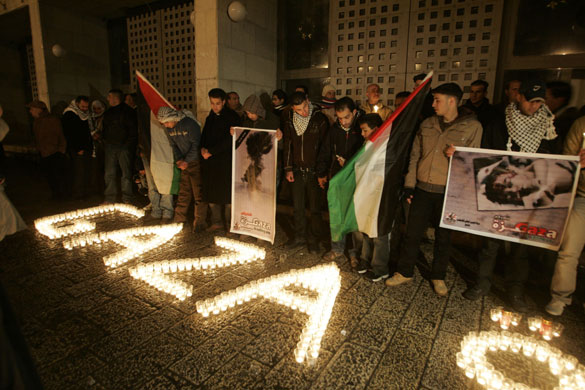
The Christians of Gaza

Photograph: Musa Al-shaer/AFP/Getty Images

A little known fact is the presence of a small but significant Christian Palestinian presence in Gaza. Gerald Butt wrote about them in Life at the Crossroads: History of Gaza. Read a review here.

Carl Moeller of Open Doors has just sent this news and prayer update on their plight.

“As an estimated 10,000 Israeli ground troops invaded Gaza today, the small community of Christians are drawing strength from their faith in God. Last week’s attacks left over 400 dead and 2,000 injured and the numbers are expected to dramatically increase.

According to reliable reports, the Gaza Baptist Church building was still standing this morning but has had some of its windows shattered by the bombings. Some Christian families left Gaza for Bethlehem over the holidays and are now separated from their loved ones with the border sealed. Many of the hospitals, already lacking basic medicines and medical equipment, are overwhelmed with the casualties and often are without power.

This is serious trouble for Christians in Gaza. Even before the recent end to the ceasefire (December 19) and the bombings, the estimated 3,000 Christians in Gaza have been living in fear from threats from Islamic militants.

Please join me in prayer for these brave Christians in Gaza in the wake of this new outbreak of violence. Pray that the war between Israel and Palestine is shorter and less devastating than what military and political speculators around the world are predicting. Pray that Christian families will be reunited. Pray that the Gaza Baptist Church building will be spared from the bombs.

Earlier this year one believer in Gaza stated: “Seventy percent of the Christians want to leave Gaza because they are very afraid. But we love Gaza. It’s our country, we have roots here, our homes are here. We will not know anyone if we go somewhere else.”

Pray that the seeds Brother Andrew sowed with Hamas and other prominent militant groups and the Gazan Christians sowed throughout the years when the Palestinian Bible Society actively shared God’s love with Muslim friends and neighbors will bear fruit. May their offerings of Christ’s love result in peace and God’s glory. Please check our website at http://www.opendoorsusa.org/ for updates.

In Christ our hope,
Carl Moeller

Dr. Carl A. Moeller
Open Doors USA President/CEO

x

Read John McArthy’s excellent piece in the Independent If it were your home, what hope restraint?

Also:

The Narrow Gate of Justice: Sabeel’s Statement
Statement by the Patriarchs and Heads of the Churches

Pirates of the Mediterranean: Gaza Update

More photos of Gaza

Building Community to Defeat Extremism

Remember that phrase in the film Miss Congeniality when all the beauty contestants are asked what is the one most important thing our society needs? They all reply “world peace” and the crowd cheers ecstatically. What is your wish for Virginia Water in 2009? Sounds a little more specific than your hopes for the entire world doesn’t it?

Focussing on Virginia Water moves us from generalities to responsibilities, from what we hope others will do to what we can do. And sometimes it only takes one person’s initiative. I hope you too were inspired by PC Elaine Bryant’s initiative to get the first ever Virginia Water community Christmas trees up. I kept thinking two things – first, why hadn’t we done it before and second, see what a person with vision and determination can achieve in a few weeks to bring us together.

OK, we are only talking about two Christmas trees with lights for heaven’s sake but that is not the point. Judging by the hundreds of people who turned out on a cold wet evening, including families with small children and senior citizens, to sing carols, drink mulled wine and eat mince pies and ginger bread men, perhaps PC Bryant’s initiative struck a chord in a lot of us. We certainly had more police officers in Virginia Water than I have ever seen before.

So what is my hope for Virginia Water in 2009? To see you and everyone else in the community come to know Jesus as your friend and leader. That is my first hope and prayer. If you want to know more, come along any Sunday at 9:30, 11:00 or 6:30.

My second hope is to see us as a community grow closer together in the year ahead. With the recession beginning to bite harder and forecast to last at least a year, with the steady rise in radical political and religious extremism, anti-social behaviour and the threat of terrorism ever before us, the temptation in 2009 will be to retreat into our shells or begin to blame others for our woes.

Remember Oswald Mosley and his Black Shirts that fed off the back of the Great Depression? How do we avoid it ever happening again? If we are tempted to think it could never happen here, we need to think again. I was pleased to see that the Holocaust Research Centre of Royal Holloway University are collaborating with German educational institutions in a conference this month in Berlin on holocaust perpetrators. The conference will address how and why ‘normal’ people become genocide perpetrators.

With the leaking in November of the names, addresses and occupations of the 12,000 members of the British National Party (BNP), media attention, has focussed on the handful of police officers, teachers and soldiers so identified. While membership of the political party is entirely legal, certain occupations are banned from being members of the BNP.

I was encouraged by two aspects of the incident. First, membership of such parties is still perceived to be an embarrassment to the majority of people in Britain. Second, given legitimate concerns over evidence of institutional racism and anti-semitism I was relieved that so few Christian leaders were listed.

Ben Wilson, a spokesman for the Church of England, said in November. “The church’s General Synod passed a motion in 2004 stating that any political movement that seeks to divide our communities on the basis of ethnicity is an affront to the nature of God revealed in creation and scripture and is a grave danger to harmonious community relationships; consequently voting for and/or supporting a political party that offers racist policies is incompatible with Christian discipleship.”

So how do we combat religious and political extremism and build community here in Virginia Water? Here are three ideas:

1. Support the Virginia Water Community Association; the Royal British Legion; our three local schools PTA’s and governing bodies at Trumps Green, Christ Church and St Ann’s Heath; the Scouts, Cubs, Guides and Brownies; the Library; the Help the Aged charity shop; and further afield, White Lodge and St Peters Hospital. There’s also the lobby against the incinerator at Trumps Farm. I am sure you can think of others.

2. Volunteer to serve in the community. At Christ Church, we encourage every member to volunteer at least an hour a week in the church and community – with things like a monthly senior citizen’s lunch club and Scallywags and Cherubs toddler groups. If everyone in Virginia Water volunteered an hour a week to the community, it would be the equivalent of employing 18 people. Two hours each and it would be the equivalent of employing 36 people. A sign of a healthy community is how well it cares for the most vulnerable – whether in terms of gender, health, age or race. How do you think we are doing?

3. Support community based events in 2009. There will hopefully be the VWCA Carnival Capers, the open air Summer art exhibition, the school productions and Fayres, the Polo Championship, the Wentworth bonfire, the Remembrance Sunday wreath laying, and now the Christmas tree lighting. At Christ Church we have added annual events like Mothering Sunday, the Bank Holiday Rogation Walk around Virginia Water, a Summer Picnic in the Park and of course the Church festivals of Easter, Harvest and Christmas to help build community.

So, how about it? What is your hope for Virginia Water in 2009? What are you prepared to do to turn it into a reality? If you have other ideas on how to strengthen our community write a letter to the editor. May the Lord bless you and those you love throughout the year ahead.

Article published in the January edition of Connection, the community magazine of Virginia Water, and delivered at the 2008 Wentworth Christmas Carol Concert

Christmas: God’s Indescribable Gift

Hands up if you have already opened all your Christmas presents. Hands up if you haven’t opened your Christmas presents yet. Hands up if you have only opened some of your Christmas presents. Hands up if you don’t know if you have opened all your Christmas presents yet. In our family we have a tradition that although Father Christmas may leave some small edible gifts in the night by our beds while we are sleeping, we try really hard to restrain ourselves and open our larger gifts after lunch. But why do we give presents at Christmas? Is it because Nicholas gave gifts to a poor family? Is it because the wise men brought gifts to Jesus family? What were the gifts they brought? I like building traditions and so I’d like to suggest that as you share gifts today, or play with the ones you have already opened, you remember the most important gifts of all.

1. God’s Gift of Life

The Apostle Peter speaks of “The gracious gift of life” (1 Peter 3:7). We are alive today because God created us. If you have held a new born baby in your arms then you know what I mean.

2. God’s Gift of Food and Drink

“That everyone may eat and drink, and find satisfaction in all his toil-this is the gift of God.” (Ecclesiastes 3:13)

There are two very ancient prayers prayed by people of faith for centuries: “Blessed are you, O Lord God, King of the Universe, who brings bread up from the earth. Blessed are you, O Lord God, King of the Universe, who creates the fruit of the vine.” These two prayers, prayed during the festival of Passover are at the heart of our desire to thank God before we eat. None more so than today when we will probably eat one of the loveliest meals of the year.

If you don’t normally say grace before your meals, why don’t you start today? Thank God for the gift of food and drink.

3. God’s Ultimate Gift of His Son Jesus

Jesus describes himself in this way.

“If you knew the gift of God and who it is that asks you for a drink, you would have asked him and he would have given you living water.” (John 4:10)

Jesus’ name means Saviour. And that is what he is and that is what he has done. One sentence in the Bible sums up God’s ultimate gift.

“For God so loved the world that he gave his one and only Son, that whoever believes in him shall not perish but have eternal life.” (John 3:16).

Jesus came at Christmas to that we might be forgiven. He came to make us good. He came that we might go to heaven, saved by his precious blood. So when you open your Christmas gifts today, remember the most important gift God has given you. Jesus.

Have you received God’s gift of Jesus? With Jesus, God has given you many other gifts also.

The Gift of a Relationship
“Yet to all who received him, to those who believed in his name, he gave the right to become children of God.” (John 1:12)

The Gift of his Grace
“For it is by grace you have been saved, through faith and this not from yourselves, it is the gift of God not by works, so that no one can boast… the gift of God’s grace.” (Ephesians 2:8-9, 3:7)

The Gift of Eternal Life
For the wages of sin is death, but the gift of God is eternal life in Christ Jesus our Lord.” (Romans 6:23)

The Gift of Righteousness

“how much more will those who receive God’s abundant provision of grace and of the gift of righteousness reign in life through the one man, Jesus Christ.” (Romans 5:17)

The Gift of the Holy Spirit
“Peter replied, “Repent and be baptized, every one of you, in the name of Jesus Christ for the forgiveness of your sins. And you will receive the gift of the Holy Spirit.” (Acts 2:38)

God has given us everything we need to serve him and become like him.

“Therefore you do not lack any spiritual gift as you eagerly wait for our Lord Jesus Christ to be revealed.” (1 Corinthians 1:7)

All of these gifts – a right relationship with God, sins forgiven, eternal life, righteousness, His Holy Spirit – all of these are ours in Christ Jesus.

This is why the Apostle Paul could say, “Thanks be to God for his indescribable gift!” (2 Cor. 9:15). Indescribable!  This is what makes Christmas so special.  This should make us want to give gifts and use our gifts to serve others, not just today but every day. As Peter insists:

“Each one should use whatever gift he has received to serve others, faithfully administering God’s grace in its various forms.” (1 Peter 4:10)

This is what will show we are thankful for God’s gifts this Christmas. When we thank God for the gift of life. When we thank God for the gift of food and rink. And above all when we thank God for the gift of His Son, the Lord Jesus Christ.

If you are not sure about all this take a copy of the booklet, “The Real Christmas”. If you would like to find out more, you are invited to a special supper on Thursday 5th February when we start our Christianity Explored course.  But if you are sure and you want to receive God’s gift of Jesus today, there is no better day in the year. The day that we celebrate when Jesus was born the Son of God can be the day you celebrate when you were born again as a child of God. Pray this prayer with me now silently.

“Lord Jesus, I recognise you as God’s greatest gift. Thank you for coming to earth to enable me to know God as my heavenly Father. Thank you for dying on the cross in my place so that I could be forgiven. I repent of my sin and all that has displeased you. Thank you for rising again so that I can have eternal life. Come into my life to be my Saviour and Lord, so that I can be born again. Thank you for the gift of the Holy Spirit to help me serve you and please you for the rest of my life. I ask these things in Jesus name. Amen.”

If you prayed the prayer for the first time, then tell someone today. May we all treasure the gifts God has given us in Christ Jesus.  May God bless you and those you love this Christmas and for ever more.

Listen here
Recommended Bible Software


The Most important book in the world is the Bible. The most widely read book in the world is the Bible. The most highly prized book in the world is the Bible. The most suppressed book in the world is the Bible. And the most frequently downloaded book in countries that suppress religious freedom… is the Bible.

I probably use electronic versions of the Bible as much as my print version. As I travel a lot to teach and preach, having access to my Bibles, commentaries, encyclopedias and Bible dictionaries on my PDA and laptop is indispensable.

As a trustee of the International Bible Society-Send the Light (IBS-STL) Ministries Trust, its perhaps not surprising that I favour the New International Version (NIV) and Today’s New International Version (TNIV), but then again the NIV is the most widely read translation in English.

So what software would I recommend? The short answer is all of them for different reasons. Here is a list of the software I use regularly – in alphabetical order. True, there is some overlap between them and you will probably only want one or two (and the NET Bible and FreeBibleSoftware from the E4 Group is… free!). And I’m sure there are other excellent packages I do not personally own.

Laridian
Laridian provides a wide range of Bible translations, commentaries, encyclopaedias and dictionaries for the iPhone, Blackberry, iPod, Pocket PC, Palm devices and also Windows based personal computers. I use Laridian on a daily basis.

Libronix
Libronix used to be called Logos. I have had this software package for about as long as my PC Study Bible. I like its seamless library of resources.

The NET Bible
The NET Bible is an imaginative ‘open source’ project that provides high quality Bible study tools and resources within reach of the whole world without charge. You can access the NET Bible here.

PC Study Bible
The PC Study Bible was the first package I bought and I have found it enormously helpful over the years.

Pradis
Pradis is a simple to use but comprehensive Bible software package. I use it most frequently to cut and paste scripture into sermons.

QuickVerse
QuickVerse
produce a wide range of software packages including for Palm Pilots and mobile phones. They even link to Google maps.

WordSearch
I have always liked Wordsearch because they include the Navigator’s Bible study questions – called Lessonmaker. This is a great tool if you are preparing Bible studies. You can buy it separately or as part of WordSearch.

Besides www.Bible.org and the E4 Group, I would also recommend www.Sermoncentral.com for free resources.

I commend these scripture resources that enable you to access the Word of God digitally for free or low cost. And if you want a print version in another language see here.

And since we are having this conversation, may I challenge you to contribute financially to the work of IBS-STL to enable people in other parts of the world receive a copy of the Scriptures in their own language for free?

See here for more information.

Christmas Message

Although they were excluded from the invitation list at the Annapolis Middle East Conference last year, everyone from the Royal Family and the Prime Minister down, and even the US President and people the world over, will soon be celebrating the visit of an Iranian delegation to Palestine. This Christmas, we will remember how a group of Iranians visited Palestine carrying funding for an opposition figure the authorities wanted dead. Then the Iranians evaded the authorities, ignoring the correct exit procedures and fled the country. Of course, the Queen, Prime Minister and President have not been celebrating contemporary Iranian involvement, but the historic visit of a past Iranian delegation – the Magi (the ‘Wise Men’ or ‘Kings’) who came to Bethlehem bringing gifts of gold, frankincense and myrrh for Jesus. So without Iran and Iranian involvement, we would not have exchanged gifts on Christmas Day.

Bethlehem is a very special place, especially in the weeks leading to Christmas. Heading south about five miles out of Jerusalem just off the main road to Egypt lies Bethlehem. It’s quite a small town that has sprawled like the tentacles of an octopus along the rocky ridges of the Judean Hills. The Church of the Nativity, the oldest church in the world lies at the centre of the town square looking more like a fortress than a place of worship. Given the tensions that have plagued this over-promised land for centuries, it has indeed served as both. The Emperor Hadrian, in AD135, built a grove over the site dedicated to the pagan god Adonis, with the intention of stopping Christians from worshipping there. It had the opposite effect as it marked the site until in AD315 the Emperor Constantine’s mother Helena, on the conversion of her son, directed that the pagan shrine be demolished and a basilica be erected over the original cave.

In the eighth century when the Persians invaded Palestine, the Church of the Nativity was the only church to be left standing, simply because they found a painting hanging inside depicting the three wise men whom they took to be Persians. As any pilgrim will discover, Bethlehem is an ordinary place, smelly, dusty, dirty, noisy, and this says something about the identification of God with us in our ordinary situations. The scene of Jesus lying in a stone feeding trough with Mary and Joseph huddled at the back of a cave surrounded by animals sheltering from the cold is not hard to imagine when you visit the barren hills of  Beit Sahour which literally means ‘the shepherds fields’, on the outskirts of Bethlehem.

Shepherds were considered the lowest of the low in those days, indeed they would virtually have been viewed as criminals. Many of the shepherds today are Bedouins, roaming the hills of Judea, living a nomadic life unchanged by thousands of years, alienated from modern civilised Israeli society, a law unto themselves. Yet it was to such as these that the birth of the Son of God is first announced.  News of the “Saviour” and the possibility of “peace” is proclaimed to them, and it is they who carry this news to Mary and Joseph and to all who will listen.

Malcolm Muggeridge once speculated what the situation would be if Jesus were born today.  He said rather provocatively, “He would have been born a Palestinian.” By this he meant that because there is no room for them even in their own country. They are forgotten, hounded from country to country – a curiously similar fate to the other children of Abraham, the Jews. For the Palestinians there is no room at the inn, even in their own society. The irony is that if Mary and Joseph were making the journey from Nazareth to Bethlehem this year they would never make it. The town of Bethlehem is entirely surrounded by a wall eight meters high with watch towers every few hundred metres.

Despite the military occupation, the home demolitions and confiscation of much of the shepherds fields for illegal settlements, Bethlehem has a message of hope for all who are forgotten, where ever they may be – God does not forget, God knows, God sees and God will act with justice and mercy. He will not leave us alone.  The message of the angels was “Emmanuel” – God with us.

Although many to whom he came rejected him, “Yet to all who did receive him, to those who believed in his name, he gave the right to become children of God-  children born not of natural descent, nor of human decision or a husband’s will, but born of God.” (John 1:12-13)

May you know the assurance of being born again this Christmas. The Son of God was born so that you might be born a child of God. In Jesus Christ, we find a life that overcomes death, a love that conquers hate, the truth that prevails over falsehood, and light, light that ever shines in the world’s darkness. May the light of Christ shine upon you and those you love, this Christmas and for evermore.

An article written for the December edition of Connection, the community magazine of Virginia Water, based on a sermon from last Christmas

World Peace : Isaiah 9:1-7

If you were the real Father Christmas and you happened to visit a few hundred thousand churches today on a pre-Christmas dry run, I suspect you would find a common theme running through many sermons preached this morning.

Marc Lawrence and Katie Ford wrote one of my all time favourite films Miss Congeniality. It’s about an FBI agent, played by Sandra Bullock, who must go undercover in the Miss United States beauty pageant to prevent a group of terrorists from bombing the event. It has some classic lines – like when Stan Fields asks Miss Rhode Island, “please describe your idea of a perfect date”. She replies, “That’s a tough one. I would have to say April 25th. Because it’s not too hot, not too cold, all you need is a light jacket”.  Or when Miss New Jersey is asked why it is called  “The Garden State”? Gracie Hart replies, “Because “Oil and Petrochemical Refinery State” wouldn’t fit on a license plate?” Each of the contestants is asked the same final question “what is the one most important thing our society needs?” They all reply “world peace” and the crowd cheers ecstatically. But when Sandra Bullock the undercover FBI agent is asked she replies, “That would be… harsher punishment for parole violators.” And then after a long pause, she adds, “And world peace!” and the crowd cheers ecstatically. What does this world need most?

“World Peace” will be a common, predictable message we will hear on the TV and radio, in charity adverts and from pulpits over the next couple of weeks. The question is – how to achieve it? I believe the UN Declaration of Human Rights to be the finest and most important document devised by mankind. But human words will not bring about peace on earth. I support the humanitarian work of the United Nations wholeheartedly, but the UN will never achieve world peace through passing resolutions and by intervening with peace keeping forces.

This week the Archbishop of Canterbury and other Church leaders in the UK called for military intervention to stop the killing in the Congo. I support that call, and similar initiatives in Afghanistan, Kurdistan, Palestine, Iraq, Zimbabwe, Somalia and Columbia, and a hundred other places in our world where people are hurting one another, but the UN cannot resolve the underlining causes. That is because hunger, ignorance, poverty and disease are the symptoms not the causes.

Only one person can bring world peace and one day he will. Jesus Christ. Among his people, among those who recognise him, who own him, who submit to him, he serve him, we can experience a foretaste of that peace he will most surely bring one day soon.  Please turn with me to Isaiah 9:1-7 and let us meet him, let us learn from his names and learn of his purposes for us, for our families, for our world and for the future.

Read more here

Listen here

Bethlehem

“But you, Bethlehem Ephrathah, though you are small among the clans of Judah, out of you will come for me one who will be ruler over Israel, whose origins are from of old, from ancient times.” (Micah 5:2)

The first occasion in which Bethlehem is mentioned in history has been found in the Amarna letters written from tribal kings of Palestine to the Egyptian pharaohs probably sometime between 1400-1360 B.C. The ruler in Jerusalem complains that Bit-Lahmi has deserted to the ‘Apiru people, a word probably referring to the Hebrews. Bethlehem is about 9 kilometres south of Jerusalem just off the main road to Hebron and Egypt. A strategic position perched 750 metres above sea level, the town sprawls out along several limestone ridges like the tentacles of an octopus. To the east lies Beit Sahour which means the Shepherd’s Fields and the barren hills of the Judean desert. To the west are more fertile slopes around Beit Jala where corn and figs, olive fields and vineyards abound.

The town of Bethlehem is mentioned frequently in the Bible. Its location became sacred when Jacob buried his beloved wife Rachel by the road side near the entrance to Bethlehem. (Genesis 35:19; 48:7). It is possible that Salma, the son of Caleb, built the first Jewish settlement there (1 Chronicles 2:51). The town and surrounding fields also feature prominently in the romantic love story of Ruth and Boaz who became the great-grandparents of David (Ruth 1; 2:4; 4:11). The town grew in prominence when Samuel anointed the shepherd boy David, to be king of Israel there (1 Samuel 16:4-13). By New Testament times Bethlehem had come to be known as ‘The town of David’ (Luke 2:4,11).

Around 700 B.C. the prophet Micah predicted that someone greater than David would be born in Bethlehem whose origins, incredibly, would be earlier than his human birth (Micah 5:2). When the Magi came from the East searching for the one to be born king of the Jews, Herod consulted with the chief priests and biblical scholars, who it seems knew full well the significance of Micah’s prophecy (Luke 2:1-8; John 7:42).

Bethlehem is therefore unique. It is the place where Almighty God, the Creator of the universe, entered our world and became a human being. It is hard to comprehend the wonder and enormity of this fact. Words cannot improve on the declaration of the angels to the shepherds, “Today in the town of David a Saviour has been born to you; he is Christ the Lord.” (Luke 2:11).

Under the Church of the Nativity, probably the oldest church in the world and best authenticated site in the Holy Land, is a simple cave. In the silence of this ancient site, best visited in the early morning, it is possible to pause and worship near the place where the Lord Jesus Christ was born. To enter the church one must first stoop low below the lintel. The tallest must stoop the furthest, only children can enter without bending down. What a lesson in humility.

For many, Bethlehem and the Christmas story is the place where they first begin to experience the meaning of that enigmatic phrase “He has also set eternity in the hearts of men…” (Ecclesiastes 3:11), for here in this place time, eternity and destiny meet in Jesus.

Incidentally, in Hebrew, Bethlehem means ‘The house of bread’. How appropriate that the One who said “I am the Bread of Life” should be born in the house of bread. On another occasion Jesus said, “Whoever eats my flesh and drinks my blood has eternal life, and I will raise him up at the last day. For my flesh is real food and my blood is real drink.” (John 6:54-55). Let us indeed feed on Him in our hearts by faith with thanksgiving.

This chapter is taken from my book, In the Footsteps of Jesus and the Apostles

The Church and the BNP

With the leaking, last month, of the names, addresses and occupations of the 12,000 members of the British National Party (BNP), media attention, such as the BBC and Guardian, has focussed on the handful of police officers, teachers and soldiers so identified. While membership of the political party is entirely legal, certain occupations are banned from being members of the BNP.

While I deplore the threats and attacks that ensued, I am encouraged by two aspects of the incident.

1. Membership of such parties is still perceived to be an embarrassment to the majority of people in Britain.

2. Given legitimate concerns over evidence of institutional racism and anti-semitism within the Church, I am relieved that so few Christian leaders were listed. Ekklesia claims five were identified.

“Further investigation has shown that one of the “Revs” appears to have gained his title through Universal Ministries, an online service which “will ordain anyone, at no charge, for life.” Another had previoulsy said he had joined the BNP by mistake and left the party – although blogs on the internet elsewhere suggest he changed his mind and joined the party again.

It has been previously suggested that the BNP is seeking to gain ground by playing on false fears about race and immigration, and by seeking to exploit the mythology of a white ‘Christian Britain’.

The BNP has also attempted to exploit hard-line Christian conservatism by seeking to set up a body claiming to be a ‘Christian Council of Britain’, by scaremongering about Muslims, and by getting in on anti-Jerry Springer opera protests promoted by the controversial group Christian Voice – which has since distanced itself from them.”

According to Haroon Siddique, writing in the Guardian,

“Ben Wilson, a spokesman for the Church of England, which is not a public body under the Race Relations Amendment Act, said it had seen “no evidence” that any serving vicars were on the list, despite media reports.

“The church’s General Synod passed a motion in 2004 stating that any political movement that seeks to divide our communities on the basis of ethnicity is an affront to the nature of God revealed in creation and scripture and is a grave danger to harmonious community relationships; consequently voting for and/or supporting a political party that offers racist policies is incompatible with Christian discipleship.

He said: “It would be difficult to take any formal action against a vicar on the basis of their alleged membership of the BNP, as membership of any lawful political party is excluded from the grounds for complaint under the clergy discipline measure.”

The best piece of reporting on the relationship between the BNP and the Church has been written by Richard Bartholomew. He identifies three ministers and records the comments of one thus:

“I’m furious. I used to be on the mailing list but I have never been a member. I don’t know why my name has gone out on the list and I’m now considering the action I am going to take.”

There may indeed be others who were ‘relieved’ that they too were not outed. Nevertheless the tally of church leaders associated with the BNP, while just a handful, is, in my opinion, one handful too many.

The Alpha and the Omega: Revelation 22

When do you think about eternity? About your own mortality? I think about eternity whenever I turn my car ignition key. I think about eternity whenever the cabin crew ask me to fasten my seat belt. I think about eternity whenever I stand before a coffin at the crematorium, or before an open grave. I think about eternity whenever I look in the mirror and see the lines and the grey hairs. Watching the tragic events unfold in Mumbai this week again brought home this reality. God has put eternity on our hearts, and our hearts are restless until they find their rest in Him. Its tempting to ignore the news, avoid looking in the mirror, live busy lives in our own little bubble and believe that it would never happen to us, that this life is all there is, that this life is the only one that matters, that this life will go on forever. Only it isn’t and it won’t, will it? It’s a lie and we need to call it that.

Eternity became very real to me when my father died suddenly and I became the oldest male member of our family at the age of 28. It came mid way through my theological training. God in his wisdom, dealt with the one thing I was most worried  about in becoming a vicar – coping with death and supporting others in their grief. I could now empathize. It is never too early to prepare for eternity. That is what Jesus has been teaching us in this series. We have been examining his great “I am” statements.

“I am the bread of life. Whoever comes to me will never go hungry, and whoever believes in me will never be thirsty” (John 6:35). “I am the light of the world. Whoever follows me will never walk in darkness, but will have the light of life.” (John 8:12). “I am who I am” (John 8:58). “I am the gate for the sheep.” (John 10:7). “I am the good shepherd; I know my sheep and my sheep know me.” (John 10:14). “I am the resurrection and the life. Anyone who believes in me will live, even though they die.“ (John 11:25) “I am the way and the truth and the life. No one comes to the Father except through me.” (John 14:6). “I am the true vine.. I am the vine, you are the branches” (John 15:1, 5). Today is Advent Sunday, when we think about the return of Jesus. It is therefore appropriate that we come to the final “I am” in the Bible in Revelation 22.  Please open your Bibles and turn to it with me: “I am the Alpha and the Omega, the First and the last, the Beginning and the End… Yes, I am coming soon.” (Revelation 22:13,20)

Let us consider this final great “I am” statement made in the closing sentences of the last chapter of the last book of the Bible. As we stand on the edge of eternity, thinking about the return of Jesus, three questions:

1. Who is this Jesus?

2. What will Jesus do when he returns?

3. How then should we respond?

Read more here

Listen here

Rico Tice on Zion’s Christian Soldiers

“Reading this book was a huge shock to me, and not a pleasant one. I had no idea that the biblical hermeneutics on the word ‘Israel’ had such extraordinary implications. So how we interpret the Scripture in terms of that one word ‘Israel’ really does seem, in some circles — to quote Stephen Sizer — to ‘justify a pre-emptive global war against the “axis of evil”‘ (page 19).

I almost felt like a man who discovers a lump under his arm and then finds on examination that it is malignant and life-threatening. But you must do the reading for yourself. It is too important to leave to second-hand opinion. How is this word ‘Israel’ used in the Bible, and what implications does that have for our fragile world?”

Rico Tice, Associate Minister, All Soul’s Church, Langham Place (author of Christianity Explored & Song of a Stranger: Daniel)

The Audio Book with Seminar Notes

You can listen to or read six presentations based on the chapters of the book as well as print outlines useful for personal and group Bible study.

1. For the Love of Zion: The Bible tells them so

2. Israel and the Church: Who are God’s chosen people?

3. The Promised Land: From the Nile to the Euphrates?

4. Battle for Jerusalem: The Eternal Capital of the Jews?

5. The Coming Last Day’s Temple: Ready to Rebuild?

6. Overture to Armageddon: Want to be left behind?