Category Archives: Theology

Who or what was most influential in you becoming a Christian?

We recently asked 80 church members what or who was most influential in their becoming a Christian. Here are the survey results:

1. Parents  27%
2. Relative or Friend 23%
3. Youth Leader 6%
3. Youth Camp 6%
3. Bible reading 6%
3. Alpha/Christianity Explored 6%
4. Pastor 5%
5. Sunday School Teacher 4%
5. Dream or Revelation 4%
5. Christian book 4%
6. Church Service 1%
7. Mission 0%
8. Evangelist 0%

Half of all those surveyed, said that a relative or friend was most influential with parents comprising the largest category. Next in significance, 10% attributed their conversion to a youth leader or youth camp.

In total,  church based staff, programmes and events, accounted for only around 20%.

What does this tell us? That special evangelistic events are at best a means by which Christians can introduce family and friends to Jesus, but they are no substitute for genuine friendship and trust. Humbling statistics for professional clergy and evangelists.

Our own statistics corroborate those found in other surveys. See this article from the US based National Network of Youthworkers

Leadership Journal also recently published the findings of a survey of 750 Muslims who converted to Christianity. The survey revealed the five predominant reasons they chose to follow Christ.

  1. The lifestyle of Christians. Former Muslims cited the love that Christians exhibited in their relationships with non-Christians and their treatment of women as equals.
  2. The power of God in answered prayers and healing. Experiences of God’s supernatural work—especially important to folk Muslims who have a characteristic concern for power and blessings—increased after their conversions, according to the survey. Often dreams about Jesus were reported.
  3. Dissatisfaction with the type of Islam they had experienced. Many expressed dissatisfaction with the Qur’an, emphasizing God’s punishment over his love. Others cited Islamic militancy and the failure of Islamic law to transform society.
  4. The spiritual truth in the Bible. Muslims are generally taught that the Torah, Psalms, and the Gospels are from God, but that they became corrupted. These Christian converts said, however, that the truth of God found in Scripture became compelling for them and key to their understanding of God’s character.
  5. Biblical teachings about the love of God. In the Qur’an, God’s love is conditional, but God’s love for all people was especially eye-opening for Muslims. These converts were moved by the love expressed through the life and teachings of Jesus. The next step for many Muslims was to become part of a fellowship of loving Christians.

The respondents were from 30 countries and 50 ethnic groups. The survey was prepared at Fuller Theological Seminary’s School of Intercultural Studies, and reported in Christianity Today.

How to be Filled with the Holy Spirit

Filled with the Holy Spirit from Stephen Sizer on Vimeo.

At a fundraising dinner for a school that serves learning-disabled children, the father of one of the students shared a story of what had happened to his son. Shay and his father had walked past a park where some boys Shay knew were playing baseball. Shay asked, “Do you think they’ll let me play?” Shay’s father knew that most of the boys would not want someone like Shay on their team, but the father also understood that if his son were allowed to play, it would give him a much-needed sense of belonging and some confidence to be accepted by others in spite of his handicaps.

Shay’s father approached one of the boys on the field and asked (not expecting much) if Shay could play. The boy looked around for guidance and said, “We’re losing by six runs and the game is in the eighth inning. I guess he can be on our team and we’ll try to put him in to bat in the ninth inning.”

Continue reading

Our Secure Refuge in the Face of Evil

Our Secure Refuge from Evil from Stephen Sizer on Vimeo.

The French President Nicolas Sarkozy was in London on Friday.  He came to make a programme for the BBC. It was to mark the 70th anniversary of another BBC programme made for France by Charles de Gaulle on the 18th June 1940. The general had fled his country the day before as a new administration, headed by Philippe Petain, sought an armistice with Hitler. In the stirring radio appeal Gen de Gaulle declared himself leader of the “Free French”, spawning the French Resistance, which went on to play a crucial role in defeating the Germans. He told his nation that “the flame of the French resistance must not and will not be extinguished”.  Posters displaying his words were put up all over London in the days that followed the broadcast, to galvanise French exiles.

Although it may seem hard at times to believe it, we are at war.

We are part of the resistance against the evil powers at work in our world. That is one of the reasons we meet every Sunday – to train and prepare ourselves for battle. This morning Archbishop Edmund from Kebbi in Nigeria described the very real war going on there between the Christian south and Muslim north. It is a conflict being played out in a number of African countries. But we make a profound error of the first order if we equate this as a war between religions or peoples. In Toronto recently I gave a presentation on the Christian Jihad at a conference of evangelical and Muslim leaders. Jihad is translated in English as “Holy War”. It literally means “struggle”.  In the New Testament, the language of conflict and warfare is used to describe the struggle Christians face in living the holy life as God intends.  In the first instance, the ‘Holy War” or struggle faced is internal not external. It is personal and not political.  The apostle Paul’s two letters to a young disciple called Timothy provide a fascinating insight into Christian jihad as Paul employs the metaphor of the ‘soldier’ to describe the Christ follower. Here are the verses:

“Fight the good fight of the faith. Take hold of the eternal life to which you were called when you made your good confession in the presence of many witnesses.” (1 Timothy 6:12)

“Join with me in suffering, like a good soldier of Christ Jesus. No one serving as a soldier gets involved in civilian affairs; rather, they try to please their commanding officer.” (2 Timothy 2:3-4)

Toward the end of his life the apostle Paul couple look back confidently and say, past tense,

“I have fought the good fight, I have finished the race, I have kept the faith.  Now there is in store for me the crown of righteousness, which the Lord, the righteous Judge, will award to me on that day—and not only to me, but also to all who have longed for his appearing.” (2 Timothy 4:8)

Continue reading

You were created to become like Jesus Christ

You were created to become like Jesus Christ from Stephen Sizer on Vimeo.

When you were young, who were your heroes? Who did you want to become? Who did you pretend to be? Whose posters did you have on your bedroom wall? My first recollection was wanting to be the Lone Ranger. Then it was Scott Tracy of Thunderbirds.

Then it was David McCullum as the Man from UNCLE. Then I finally grew up, and simply wanted to be James Bond.  What about pop stars? Who did you idolise? While my mother probably wanted me to grow up to be like Cliff Richard, I wanted to be Paul McCartney of the Beatles. But, strumming a tennis racket and growing my hair long didn’t make me a rock star. In the 1970’s I graduated to the Beach Boys and made myself a full sized surfboard at school.

The problem was it didn’t float… In the 1980’s when Steve Ovette and Sebastian Coe were competing for an Olympic place, I bought myself a tracksuit and went through a jogging phase but it didn’t last more than a fortnight. In the 1990’s when Tiger Wood was winning every golf tournament, I bought myself a new cap and putter to try and improve my game, but it hasn’t worked, yet. Aspiring to be like someone else is natural. Whether it’s a positive or negative role model seems to depend on whether you are a parent or a child.

Continue reading

Christianity Explored in Poland

Christianity Explored Update from Rico Tice from Stephen Sizer on Vimeo.

A series of videos recorded at the Orle Gniazdo Conference Centre near Beilsko Bala in Southern Poland during a training conference for church leaders. At the SzukajacBoga conference, Rico Tice launched the Polish edition of Christianity Explored. For more information on the Polish ministry see szukajacboga.jesus.net/

Rico Tice Launches Christianity Explored in Polish from Stephen Sizer on Vimeo.

Rico Tice on One to One Evangelism from Stephen Sizer on Vimeo.

Rico Tice on a Biblical Strategy for Evangelism from Stephen Sizer on Vimeo.

The Identity, Mission and Call of Jesus from Stephen Sizer on Vimeo.

Szukajacboga Christianity Explored from Stephen Sizer on Vimeo.

The first time I visited Poland was in 1977. As a young missionary with Campus Crusade, I went to help evangelise and disciple young people through the Oaza movement (Light and Life) within the Roman Catholic church. But I was arrested within minutes of entering the country. It was dawn and as we were leaving the station at the border crossing with Czechoslovakia, I saw a beautiful steam engine. The rays of sunshine were piercing the clouds of steam. But as I extended my camera out of the open window to capture the picture, I was seen. There was a loud whistle. The train screeched to a halt. It reversed back into the station. On rushed the guards. They entered our compartment, took my passport and camera, removed the film and exposed it. I got off with a warning but it fuelled my passion to take photos of Polish trains (I took some last weekend too). The venue for that project was Beilsko Bala in Southern Poland, the very location for the launch of Christianity Explored in polish. The following year (1978) I returned for the Summer to help with the Oaza camps which by then involved thousands of young people right across Poland.

In 1984 when a curate in St Leonards, Poland came under Russian martial law. Conditions were bleak and so six of us drove three trucks of medical supplies, food and clothing to Poland via West and East Germany for distribution through churches like St Stephen’s Katowice. On that occasion we were kicked out of the country (thankfully on the way home) for not having had our documentation correctly stamped by the authorities. They thought we were working with Solidarity.

Little Town of Bethlehem

Little Town of Bethlehem, the Trailer, EGM Films

Sami, Ahmad, Yonatan come from radically different backgrounds in a land of unending war. Yet, against all odds, including some within their Israeli and Palestinian communities, they are able to find common ground. They walk a path of nonviolence struggle in lockstep with Martin Luther King and Mahatma Gandhi. For them courage is found not in taking up arms, but setting them down once and for all and extending a hand in peace.

From the award-winning team that brought you End of the Spear (2006) and Miss HIV (2007) comes director Jim Hanon’s latest documentary, Little Town of Bethlehem. Unscripted and unrehearsed, discover the humanity lurking behind an ancient cycle of violence.

Featuring: Sami Awad, Ahmad Al’Azzeh, Yonatan Shapira. Music Produced by: Kirk Whalum. Film Design by: Mike Galloway and Mark Arnold. Produced by: Mart Green. Written, Directed and Filmed by: Jim Hanon. Feature running time: Approximately 77 minutes. This film is rated PG-13, Some material may be inappropriate for children under 13, for some violent and disturbing images.

This is a ‘must see’ film.

The Mystery of the Church: Ephesians 3

The Mystery of the Church: Ephesians 3 from Stephen Sizer on Vimeo.

The billboard and TV adverts exhorting us to obtain a Sky HD box in time for the World Cup proclaims: “50 million believers”. Imagine…. I don’t mean England winning the world cup. That will take more than a miracle. No, I mean, imagine Britain with 50 million believers. What would it be like to live in a country where 85% of the population are believers?

50 million believers. Would there be less crime? Fewer burglaries? Less vandalism? Lower stress levels? Less domestic violence? Fewer divorces?  Less drug addiction? Lower suicide rates? Fewer abortions? Less child abuse? Lower terror threats? Fewer police? Less social workers? More security? Stronger marriages? Greater harmony? Happier people? A more desirable place to live? Heaven on earth? Possible? Achievable? Could the change of government last week achieve it? I wouldn’t hold your breath. But could the Spirit of God do it working through 5 million believers and around 40,000 churches in the UK?

How many people do you know well? In your circle of family, your friends, your work colleagues, your neighbours? I bet you know at least ten people well enough to have an honest in-depth open conversation about what matters most in your life. At least ten people that should be on your prayer list, your watch list, your Christianity Explored invitational list, your ‘please come with me to this special event’ list.

You see when Christ ascended to heaven, having died to save the world, he entrusted that message to eleven ordinary men.

The fate of the world, humanly speaking, rested in the hands of those eleven 1st Century men. What did he tell them to do?    “But you will receive power when the Holy Spirit comes on you; and you will be my witnesses in Jerusalem, and in all Judea and Samaria, and to the ends of the earth.” (Acts 1:8)

Let me ask you. Has the assignment changed in 2000 years? Do we have the same Holy Spirit that they received on the Day of Pentecost? So what has changed? When you think of ‘church’ what comes to mind? On a spectrum of community groups where would you place the church, say between, Wentworth golf club and say a… Taliban training camp in Afghanistan? I can guess which you would feel most comfortable in, but which is closest to the biblical church?

I’m not talking about methods. I am talking about vision, about dedication, about intentionality, about impact, about sacrifice. If you asked a Taliban leader what his vision is, what do you think he would say? They want to bring the whole world into submission to Almighty God, obedient to the Law of God.

And they are waging a war, a literal war against those they deem as decadent, immoral, disobedient and unbelieving. While we totally repudiate their methods, do we not long to live in a world where at the name of Jesus every knee should bow? Voluntarily? Willingly, freely, joyfully, in grateful thanks for all Jesus has accomplished for us in his death in our place?

Then what are we doing to achieve it? If you are not sure, read my paper on the Christian Jihadist which I gave in Toronto last weekend at a gathering of evangelical and Muslim leaders.

The church is the hope of the world. The only hope of the world. It was true on the Day of Pentecost. It is true today. Please turn with me to Ephesians 3 and lets consider three simple, memorable reasons why you should value your Church – if you want a closer walk with Jesus, if you want to fulfil God’s purposes, if you want to change the world.

1. Come because Jesus is here (3:1-5)

2. Come because the end is near (3:7-11)

3. Come because his family is dear (3:6, 12-13)

Read more here

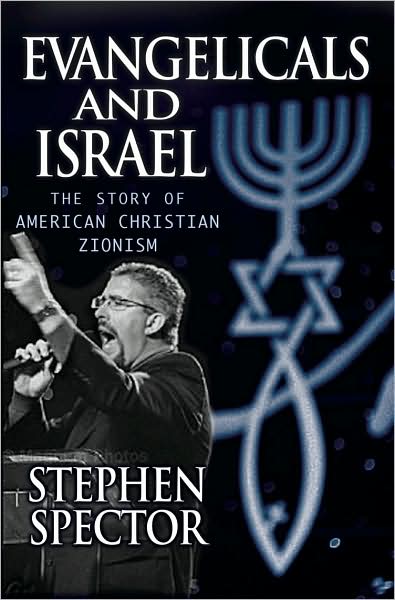
Evangelicals and Israel: A Review


Evangelicals and Israel: The Study of American Christian Zionism: Stephen Spector
Oxford University Press (2009)

After decades of reluctance to address this deeply controversial issue, in recent years there has been a veritable avalanche of books critical of the Christian Zionist movement. Authors include Grace Halsell, Don Wagner, Timothy Weber, Victoria Clark, Dan Cohen-Sherbok, Naim Ateek, Gary Burge, as well as two books of my own. It is perhaps therefore not surprising to find a growing reaction among Jewish Zionists who have begun to come to the defence of their Christian allies.

Stephen Spector’s work is representative of this genre of Jewish apologists, which includes Paul Merkley, David Brog, Shalom Goldman and Gerhard Falk. Their agenda appears to be to justify a strand within Christian Zionism that is neither popular nor representative of evangelicalism as a whole, but which nevertheless plays a strategic role within the Israel Lobby.

The book purports to be the story of American evangelical Christian Zionism. It is a good read, as one should expect for a Professor of English. It would be more accurate, however, to describe it as the story of political Christian Zionism as represented by organisations such as Eagles Wings, Bridges for Peace, Christian Friends of Israel, Christians United for Israel and the International Christian Embassy. These self appointed para-church organisations have publically disavowed both proselytism among Jews as well as apocalypticism, based on a reductionist interpretation of the Bible. They are primarily lobby organisations, advocating on behalf of a Zionism among churches and in Washington among politicians.

While critical of both evangelistic Christian Zionism (such as Jews for Jesus) as well as apocalyptic or dispensational Christian Zionism (such as Hal Lindsey and Tim LaHaye), Spector reserves his strongest criticisms for evangelicals who oppose Zionism on theological grounds.

So, although Spector interviewed over 70 Evangelical and Jewish Zionists in the course of his research, he relies on anecdotes and paraphrases to portray the views of those he deems ‘liberal’ or ‘modernist’ who regard biblical Zionism as an oxymoron. The chapter addressing criticisms of Christian Zionism is therefore one of the weakest and least convincing.

It is simply untrue to say that evangelicals who oppose Zionism “are closer to liberal mainline Protestants than to most conservative born-again Christians,” Academics at the bastions of evangelicalism in the USA, such as Fuller and Wheaton, repudiate Christian Zionism just as much as their counterparts in Europe. John Stott, the ‘father’ of evangelicalism, is not alone in describing ‘Christian Zionism’ as ‘biblical anathema’.

If evangelicalism is defined by the centrality of the gospel, the necessity of a personal faith in Jesus Christ, in the authority of the Scriptures and in the verbal proclamation of the gospel to all nations, it is actually Christian Zionists who, having reinterpreted the gospel and disavow proslytism, are closer in spirit to mainstream liberalism rather than conservative evangelicalism.

It is therefore not surprising that it is in assessment of the biblical and theological presuppositions of Christian Zionism that the book is probably at its weakest. While strong on dialogue with Jewish and Christian Zionists, there is little evidence that Spector understands the theological presuppositions and tenuous biblical basis for the various strands of Christian Zionism. He is reassured that none of those he interviewed tried to convert him and that evangelical Zionists can share the gospel in acts of kindness toward the Jews rather than through proselytism. This is not evidence of the orthodoxy of Christian Zionists, just the opposite.

While Old Testament Bible verses are occasionally quoted without context to demonstrate that Zionism is biblically rooted, it is the evangelical critics of Christian Zionism, according to Spector, who ‘unfairly’ quote ‘the biblical prophets to attack the modern state of Israel’.

The fundamental question Christian Zionists avoid is whether the coming of Jesus Christ was the fulfilment or the postponement of the promises God made to Abraham? Which is central to the New Testament – Jesus or Israel? Ironically, Christian Zionists are portrayed as the new Zealots. Like their 1st Century forebears, they are trying to impose a Jewish kingdom by force, something Jesus repudiated. Spector cites, for example and without comment, Jack Hayford as promising, “if the Israelis need soldiers, he and his Pentecostal congregants will fight side by side with them.” Portraying the modern state of Israel as God’s chosen people on earth, the role of the Church is therefore reduce to providing dubious justification for Israel’s colonization of Palestine.

While ostensibly a book about evangelicals, it soon becomes rather tiresome when, in any debate or disagreement posed, it is always Zionists who are given the last word. So, for example, in a dismissal of Walt and Mearsheimer’s definitive work on the Israel Lobby, Spector defers to Alan Dershowitz suggesting the author’s claims “are variations on old anti-Semitic themes of the kind found in the notorious czarist forgery The Protocols of the Elders of Zion and in Nazi literature.”

Conversely, Spector gives ample space to some of the worst examples of Islamaphobia. There is a deep paranoia regarding the motives of Arabs in general and Palestinians in particular. He refuses to see that Israel could be, in any way responsible, partly or otherwise, for the perpetuation of the Middle East conflict. They are always, in his words, “the victims of injustice, not the perpetrators.”

Disappointingly, for a book with 82 pages of notes and indexes, there is no conclusion or summary chapter. It is as if the publisher has left it out by mistake or needed to reduce the word count. Whatever the reason, the book is weaker for it.

Instead, the last chapter is given to an assessment of the influences on George W Bush’s Middle East policy. Here Spector tries to downplay the impact of the Israel Lobby. Without really explaining why, he would have us believe there is “broad and deep support” for Israel in America because “that position is politically sound and morally just, not because of political pressure or influence” from evangelicals. Ironically, he gives the last sentence in the book to Hal Lindsey.

If first impressions count, the eulogy on the back cover from Abraham Foxman, National Director of the Anti-Defamation League, must surely be the kiss of death to any work claiming to be balanced or objective. One surprised Cambridge academic did ask me rhetorically, who on earth could have possibly vetted the book for Oxford University Press? One wonders. But then it is worth remembering that it was the Oxford University Press who published (and still publishes) the first Christian defence of Zionism, namely the Scofield Reference Bible.
Evangelical Christians and Muslims Engage in “Bridges of Faith” Conversation

Evangelical Christian and Muslim scholars and religious leaders met May 13-15 in Toronto for the fourth in a series of “extended conversations” between the two faith traditions. The dialogue, titled “Foundations of Our Faith: Religion in the Public Square,” is part of an ongoing effort to “reach out across the religious boundaries despite the recognized differences in some of our essential religious beliefs,” according to organizers.

The conference was organized around the framework of the “five pillars” of Islam. Muslim scholars presented papers on each of the pillars and other key concepts, paired with a complementary paper by Evangelical Christian scholars. One panel, for instance, focused on “Hajj in Islam” and “Pilgrimage and Religious Geography in Evangelical Christianity.” Another panel addressed “The True Meaning of Jihad in Islam” and “Taking up the Cross in Evangelical Christianity.”

The invitation-only dialogue group, called “Bridges of Faith” (www.bridgesoffaith.org), has been sponsored by the World Islamic Call Society. The group first met in Chicago in 2007, followed by gatherings in Tripoli, Libya, and at Fuller Theological Seminary in Pasadena, California.

Participants in the Evangelical-Muslim dialogue came to Toronto from the Middle East, Europe, and from across North America, and from institutions including the Hartford Seminary MacDonald Center for the Study of Islam and Christian-Muslim Relations, the Islamic Society of North America, and the Arab Team for Muslim-Christian Dialogue, as well as from Fuller Seminary, Wheaton College, the Arab Baptist Theological seminary, North Park University, and other institutions.

Keynote speaker Dr. Richard Mouw, president of Fuller Seminary, affirmed the importance of Muslim-Evangelical Christian dialogue and commended the focus of the conference on the five pillars of Islam as a basis for conversation at this conference.

Mahmoud Ayoub said of the gathering, “As Muslims, we do this in response to the Quran’s call to all humanity to submit to the One true God.” Dr. Ayoub is professor of Islamic Studies and Christian-Muslim Relations at Hartford (Conn.) Seminary.

“As Evangelical Christians, we do this in emulation of Jesus, who through his teaching and life invited all of humanity into a relationship with God that transcends any single religious institution,” said co-convener Dr. Don Wagner, Executive Director of the Center for Middle Eastern Studies at North Park University in Chicago.

Jesus and God’s Gift of Grace: Ephesians 2:1-10

Ephesians 2: Jesus and the Gift of God’s Grace from Stephen Sizer on Vimeo.

Gentle natured Gregory, passed into eternity, aged 69, forgotten and alone in a cell of the women’s jail in Dade County, Miami. Married four times with six children he had once been a celebrity and successful paediatrician. But Gregory succumbed to alcoholism and his license to practice medicine was suspended. Haunted by self doubt and unable to live in the shadow of his father, he had died known as Gloria in a women’s jail, in high heels, a transvestite. When he was just 19, Gregory’s father blamed him for his mother’s death from cancer and did not speak to him for ten years before killing himself in precisely the same way Gregory’s grandfather had done before him.

In 1953, Gregory’s father wrote a short story about a Spanish father who tried to be reconciled to his son who had run away from the family home to Madrid. Now remorseful, the father took out an advert in a national newspaper “Paco meet me at Hotel Montana noon Tuesday, all is forgiven, Papa.” Paco is a common name in Spain, and when the father goes to the square he finds eight hundred young men names Paco waiting for their fathers. Gregory’s obituary even appeared in the Times Newspaper because he was the youngest son of Ernest Hemingway. Father and son, Ernest and Gregory knew all about the destructive power of what Philip Yancy calls “ungrace”.

Continue reading