Read the sermon here
Christ is Risen! He is Risen Indeed. Hallelujah!

I wonder how many little boys born this year will be called Francis. They say you never get a second chance to make a first impression. And if first impressions matter, Pope Francis created quite a stir on Maundy Thursday. He washed the feet of laity not just priests. He washed the feet of sinners and not just the righteous. He washed the feet of women and not just men. He washed the feet of a Muslim and not just Christians. Traditionalists angry? Good. They better get used to it. More importantly what impact will it have on church membership? We wait to see.
When you think of ‘membership’ what comes to mind? It probably depends on how exclusive or expensive the membership is, or how badly we want it. There are arts societies, sport associations, health clubs, university alumni and professional bodies. The list of ‘memberships’ is endless, and your wallet is probably full of plastic to prove it.
Some memberships are open to anyone who can pay the fee while others are exclusive and by ‘invitation only’. Locally, there is the Virginia Water Community Association, the Royal British Legion, Savill Gardens and of course Wentworth for those with a passion for golf, tennis or physical fitness. For many people, their membership provides a rich social life in which friendships and common interests can be pursued and shared. What may surprise you, however, is to discover that ‘membership’ is a Christian word. It appears in the Bible to describe how we become members of God’s family.
Why did Jesus die?
Read the sermon here
Why Did Jesus Die?

Good Friday : Why did Jesus die? (Mark 15)
Bertram Russell the philosopher and cynic once said, “most people would rather die than think… and most people do.” He went on to say, “When I die I rot”, which may have been true in his case, but not the whole truth. The reality is most people would rather not think about the one certainty in life. Recently I went to see the World Press Photo exhibition at the Royal Festival Hall. The annual competition takes entries from photojournalists, picture agencies, newspapers and magazines across the world. The winners whose photos are on display were selected from more than 100,000 entries.
I was struck by two things as I walked round: First, by how many of them portrayed people about to die, in the act of dying or afterwards. Second, by how those visiting the exhibition stood in silence, mesmerised by the photographs. Too much reality is hard to cope with, even in black and white. It’s the same with the biographies of famous people isn’t it? Biographies always dwell on their life achievements but invariably give little or no space to their deaths. That is why it is so striking to discover that in the biographies of Jesus dedicate about one third of their space to the last seven days in the life of Jesus and specifically to the subject of Jesus’ death. Clearly, Jesus was an amazing individual. But why spend so much time dwelling on his death? And further, why is it that the mode of his death—the cross—has become the universally-recognized symbol of Christianity?
The first Christians might have chosen something different to symbolize our faith. For example, they could have chosen:
A manger—to symbolize his birth, or
A scroll—to symbolize his teaching, or
A lamp—to symbolize the light of the world, or
An empty tomb—to symbolize his resurrection.
The Ultimate Example of Loving Service
Read the sermon here
The Ultimate Example of Loving Service
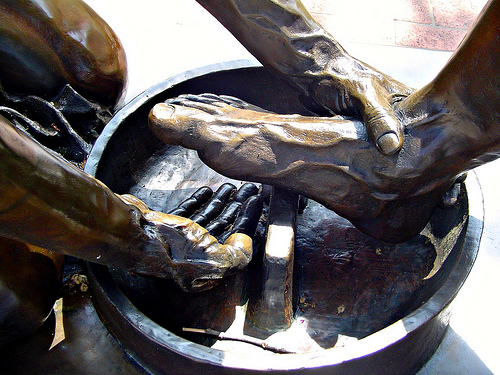 John Chapters 13-17 are known as the Upper Room Discourse. What is surprising is that in the first twelve chapters of John’s Gospel, Agape, God’s love is mentioned 8x. But in chapters 13-17, it is mentioned 31x. I want us to see the connection between love and service.
1. What Jesus Knew: The Extent of Loving Service
“It was just before the Passover Feast. Jesus knew that the time had come for him to leave this world and go to the Father. Having loved his own who were in the world, he now showed them the full extent of his love. The evening meal was being served, and the devil had already prompted Judas Iscariot, son of Simon, to betray Jesus. Jesus knew that the Father had put all things under his power, and that he had come from God & was returning to God.” (John 13:1-3)
Three things we are told Jesus ‘knew’. First, “Jesus knew that the time had come for him to leave this world and go to the Father.” (John 13:1) He knew he was rapidly approaching the most important moments of his life. His destiny from eternity past. He knew that the pain, the shame and the agony of the cross was before him. Here is the question: If you knew that you would die tomorrow, what would you do today? I would spend the time with my family,
I’d write some short letters to family members too far to visit and I’d make sure my will is in order. Not Jesus. John wants us to see something significant about Jesus. Fully God and fully man, Jesus is facing something we cannot imagine. He doesn’t say to the disciples, “Don’t you care about what I’m facing?” His focus is not on himself. He is concerned that they be prepared for what’s about to happen. Jesus is focused on them.
Jesus knew the time. Do you? Second, “Jesus knew that the Father had put all things under his power, and that he had come from God and was returning to God;” (John 13:2).
Yoel Ben David on Daniel’s Prophecy of Jesus
Yoel Ben David on Yeshua in Daniel from Stephen Sizer on Vimeo.
Yoel Ben David is the UK Director of Jews for Jesus. He preached at Christ Church, Virginia Water today, Palm Sunday on Jesus in Daniel.
Ladies Spring Hike: National Trust Devil’s Punchbowl

Date Saturday 20 April 2013
Time 10am to 4pm
Place National Trust Devils Punchbowl, Hindhead, Surrey
Meeting Point
Gather in the Christ Church Virginia Water car park for 10 am. We plan to car share and possibly use one Christ Church minibus. Please let us know if you want a lift from the Christ Church car park and back after the walk. We will be leaving the Church Church Virgina Water car park at about 10am with the aim of setting off on the first stage of the walk from the National Trust Devils Punchbowl car park at 1045am.
The Walk
A figure of eight walk. The first half is approximately 2.8 miles. A soup and roll lunch will be provided at the Cafe located at the National Trust Devils Punchbowl car park at approximately 1230pm. We will then aim to set off on the second and final part of the walk at 145pm. There will be an option to walk for 3.1 miles (for a slightly more challenging walk) or a 1 mile walk to Gibbet Hill. We will then return for tea and cake at the Cafe afterward the second leg of the walk for those that would like to (please bring a little money for tea and cake) before heading back to Virginia Water.

Donation
We would be delighted to receive what ever amount you feel you would like to give. All donations received will go directly towards The Harpswell Foundation and the costs which Rachel has incurred in getting to Phnom Penh. Suggested minimum of £25. The soup and roll lunch will be included. You may want a little money for the tea and cake later on.
We would be delighted to receive what ever amount you feel you would like to give. All donations received will go directly towards The Harpswell Foundation and the costs which Rachel has incurred in getting to Phnom Penh. Suggested minimum of £25. The soup and roll lunch will be included. You may want a little money for the tea and cake later on.
Practical considerations
Walk will suit all abilities and will have clear way markings. Individual maps will be provided on arrival. See map photo for detail. The terrain may be muddy and a little hilly so stout footwear is recommended and suitable clothing will be needed for all weathers! Maybe bring a drink and a small snack to share.

The reserved group lunch at the Café will give us a chance to hear from Rachel about her 3 month stay in Phnom Penh and her hopes and ideas as she prepares to go next month!
We are looking forward to the fun of walking together and at the same time helping young women in Cambodia with the chance to have a university education and develop the leadership skills necessary to have a positive impact on Cambodia’s future.
RSVP to Joanna Sizer (Spaces are limited so do hurry)
Christ Church Hosts Jews for Jesus

On Palm Sunday we are delighted to welcome Yoel Ben David again as our guest speaker. Yoel was raised by his Jewish Moroccan Mother and Scottish father in England and France. After school in England, Yoel moved to Israel where he met Adel. When they married, Adel and Yoel were Orthodox Jews. A year later, when he was serving in the Israel Defence Force, they became believers in Jesus in Jerusalem. Yoel joined Jews for Jesus staff in 2004 and since has led several outreaches in France, Israel and the USA and served in the UK during 2009. He returned to the London office of Jews for Jesus in July 2010 to assume his present responsibilities as Head of Evangelism.
See also Yoel on Y’Shua and the Harvest
How Can I Overcome Loneliness?
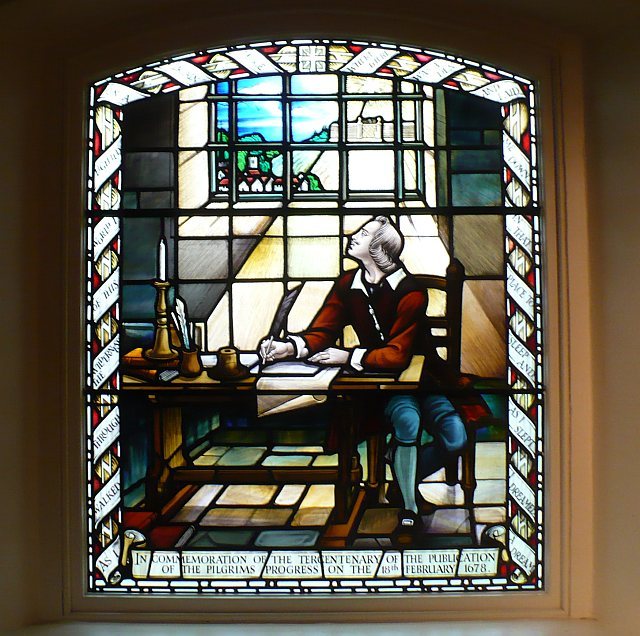
In my Sixth Form at school, there was one girl that stood out. Joy Lovely. While my friends were into scooters and beer, Joy was into Jesus – in a big way. She tried to convert me and my friends on numerous occasions. After I became a Christian at university I wrote and thanked Joy for her prayers.
Joy also played a role in the life of Terry Waite the hostage negotiator. As the Archbishop of Canterbury’s Special Envoy, Waite successfully negotiated the release of several hostages in Iran including John Coleman and Jean Waddell (the secretary to the Iranian Anglican Bishop) in 1980. Four years later he negotiated with Colonel Gaddafi for the release of British hostages held in Libya and again was successful. From 1985 Waite became involved in hostage negotiation in Lebanon, and secured the release of Lawrence Jenco and David Jacobsen. However, he was observed using an American military helicopter to travel between Cyprus and Lebanon. His appearance with Oliver North also meant that he became compromised when the Irangate scandal broke. Against advice, Waite felt a need to demonstrate his continuing trust in the other side.