The Passion of Jesus: The Son and Lord of David

When I was a child, I used to read the Daily Mail newspaper every day – well, the Peanuts cartoons, to be precise. I still remember when Lucy asked each of her friends whether she should have her ears pierced. The conversation went on for days. Schroeder was playing his piano. “Do you think I should have my ears pierced?” He replies, “I don’t mind, you pierced mine long ago.” She storms off. “Linus, Do you think I should have my ears pierced?” “I have a better idea…” he replies cheekily, “Why don’t you have your mouth boarded up?” Lucy wallops him. When he comes to, he reflects, “It was worth it!” How do you cope with people who just don’t seem to like you? No matter how hard you try to be nice to them, they will always twist your words, they question your motives, they gossip about you, they try and discredit you, they seem to undermine you at every opportunity.  Maybe you work with them, maybe they live next door, or maybe you are related. How do you deal with them? Blank them out? Retaliate? Stoop to their level? Do you go on the defensive? How do you react?

In our gospel reading today, we see how Jesus dealt with his enemies. We see his passion for them. When they ask what appear to be innocent questions, Jesus responds with a question of his own:  “What do you think about the Messiah?” – “who is he?” (Matthew 22:41). Implicit in that question are two more, “Why did Jesus come?” and What is his claim on our lives?” 

Continue reading

God’s Antidote to Dark Valleys (Psalm 23)

Life is a journey, with a beginning and end. We’re all travelers, somewhere on that journey, forever on the move, learning, growing, changing. The disruption caused by Covid-19, the daily news updates of casualties and the attempts to find a vaccine inevitably lead to a rollercoaster of emotions, highs and lows, hopes and fears.  Psalm 23 is probably the most widely known and best loved of them all. In part it is because it addresses the strong emotions we often feel at times such as this. There are two parts to Psalm 23:

23:1-3 “The Lord Is My Shepherd” – What I affirm about God.
23:5-6 “Your love will follow me” – What I experience of God.

Verse 4 links the two together.  The Lord is my Shepherd because I know Lord you are with me.

Continue reading

I have a friend who does not believe in God (Psalm 19)

I imagine you know quite a few people who do not believe in God. How do you answer them? Where do you begin?  The first thing I want to say is that when you encounter someone who doubts the existence of God realize that it is not your responsibility to convince them or win the argument. That is the work of the Holy Spirit.  Since God is not visible to the human eye, there can be no direct physical proof of him. However, God has provided ample evidence of his existence and character both in the created world and in the unique nature of human beings. Above all he has given a perfect and sufficient revelation of himself in the person of his Son, Jesus Christ. Besides these evidences, there is the witness of the Bible and the prophecies God placed in it which have come true. Finally there is the testimony of the Church. Today one quarter of the world’s population claim to follow Jesus Christ. Ironically, the Church is growing fastest where the persecution and opposition is the most intense. Let make some observations before we look at Psalm 19 our reading for today. First observation: Because of our fallen nature it is natural for people to doubt the existence of God. 

Continue reading

Philippians 2: A Conversation with Father Dave Smith

Each month I join Father Dave Smith for his Sunday Eucharist and provide a brief homily on the Epistle reading of the week. This week, Dave and wife Joy visited Southampton and so we recorded our discussion on Philippians 2 in the Titanic pub close to the port where the Titanic sailed on its ill-fated maiden voyage. The landlord even kindly turned the music down for us (a little).

Surrender or Else (Philippians 2)

Surrender is not a popular word, is it?  Almost disliked as much as the word submission. It implies losing, and no one wants to be a loser. Surrender evokes unpleasant images of admitting defeat in battle, forfeiting a game, or yielding to a stronger opponent. The word is almost always used in a negative context. In today’s competitive culture we are taught to never give up and never give in. So, we don’t hear much about surrendering. If winning is everything, to surrender is unthinkable. We would rather dwell on winning, succeeding, overcoming and conquering not yielding, submitting, obeying, or surrendering. It is ironic then that surrender is at the heart of the Christian faith.
 
On Palm Sunday Jesus rode on a donkey not a horse.  Jesus came in peace not war, to surrender not conquer. Jesus came to give his life as a ransom sacrifice, to be the Passover lamb, to make atonement with God. And when some in the crowd laid their coats on the ground, it was a sign of their surrender to him. Because surrender is the natural response to God’s grace and mercy. Our surrender is called many things in scripture: consecration, taking up your cross, dying to self, yielding to the Spirit, presenting ourselves as a living sacrifice. What matters is that we do it, not what we call it. 

Continue reading

Christian Zionism: Roadmap to Armageddon? (Arabic)

I am delighted to make available a digital copy of my book Christian Zionism: Roadmap to Armageddon? in Arabic – indeed two versions. The first was kindly translated by Nicholas Abou Mrad in Lebanon and published by the Arab Group for Christian Muslim Dialogue. The second was translated by Revd Jos Strengholt and published by the Anglican Publishing House in Cairo.

Click on one of the hyperlinks above or cover to download a copy.

The book is also available in English and published by Wipf & Stock

Continue reading

Greenbelt Festival 2023

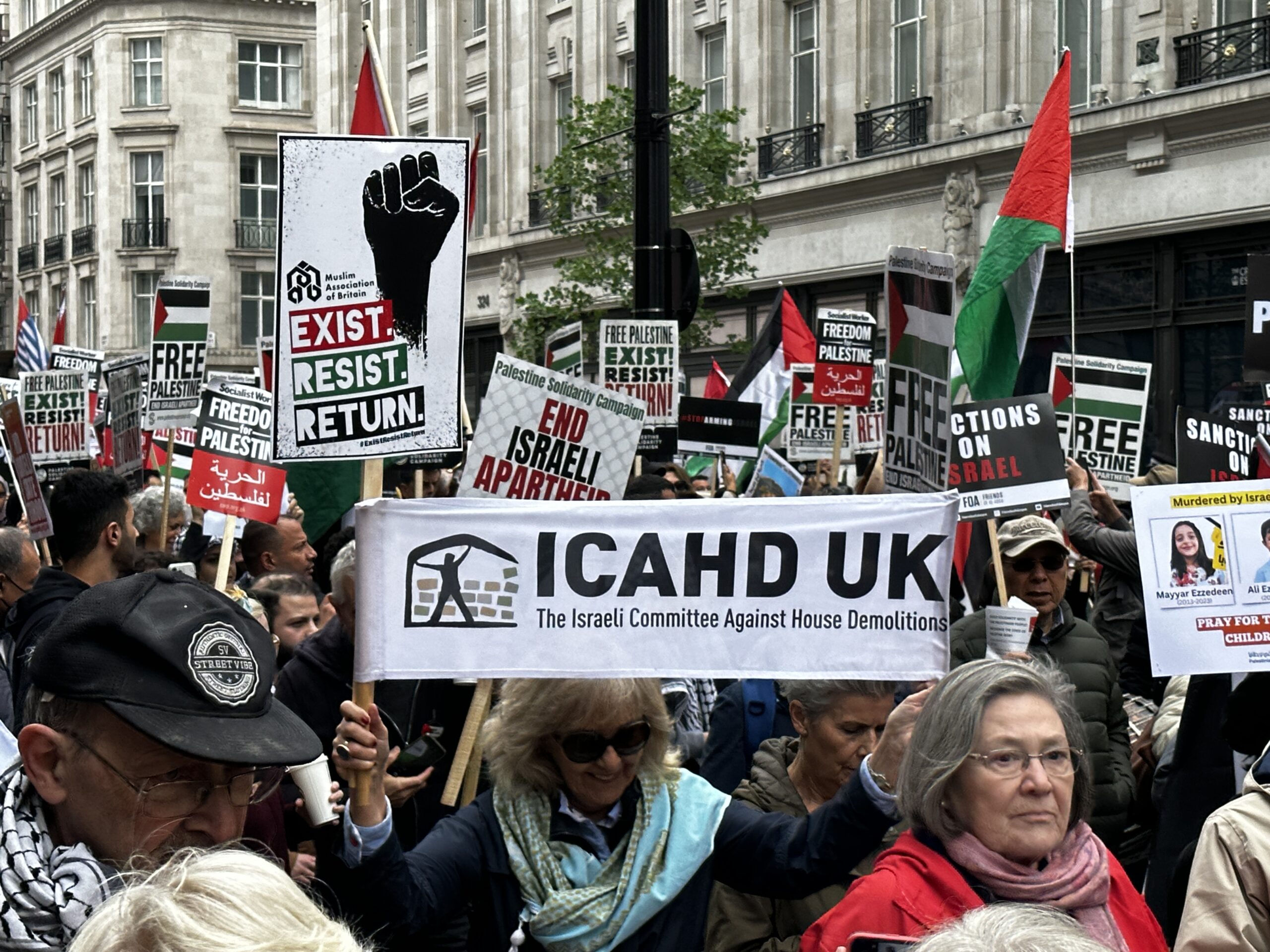
It was a delight to attend the 50th anniversary Greenbelt Festival held at Boughton House, near Kettering in August. I was part of the Israeli Committee Against House Demolitions (ICAHD) team sharing a marquee with the Action around Bethlehem Children with Disability (ABCD). During the Bank Holiday weekend, I interviewed several speakers and participants.

Daniel Munayer is the Executive Director of Musalaha, a faith-based organization that teaches, trains and facilitates reconciliation mainly between Israelis and Palestinians from diverse ethnic and religious backgrounds, and also international groups, based on biblical principles of reconciliation. Daniel spoke at Greenbelt sponsored by Embrace the Middle East. In this short interview he shares his vision for the future in Palestine. 

Linda Ramsden is the founder and director of the Israeli Committee Against House Demolitions(ICAHD UK) which is dedicated to resisting apartheid and building a shared democracy from the River Joran to the Mediterranean Sea. 

Continue reading

Zion’s Christian Soldiers: The Bible, Israel and the Church in Arabic

The Arabic edition of my book Zion’s Christian Soldiers: The Bible, Israel and the Church is now available as a pdf download

The print version of the Arabic edition of Zion’s Christian Soldiers was published by the Anglican Publishing House in Cairo and is also available and costs £8.95 plus £2.75 postage in the UK and £4.75 internationally. Order via PayPal.

Praise My Soul the King of Heaven (Psalm 103)

The “Pillars of Hercules,” which flank the entrance to the Straits of Gibraltar between Africa and Europe were from Roman times associated with the Latin phrase ne plus ultra, meaning “No More Beyond.” Certainly no one dared question the prevailing belief that there was nothing beyond the horizon. That was until 1492 when Christopher Columbus boldly sailed westward and discovered the New World. On his return, Spain celebrated with a new national logo. Coins were struck with two words: plus ultra meaning “More Beyond”. If you have experienced bereavement recently you know that ‘out of sight’ does not mean ‘out of mind’. But is there more beyond? More than simply the act of remembering the past? The Christian hope is that there is a new world beyond our horizon. Our Psalm this evening teaches us to look beyond our limited horizon, beyond what we can see, feel or touch. Psalm 103 inspires us to feel the heart beat of God’s love and realise there is indeed yet ‘more beyond’ our horizon to discover. More of God’s character to understand. More of his purposes to discover.

More of his love to experience. More of his commission to fulfil. More of his justice to proclaim. More of his love to share. More of his glory to praise.  Psalm 103 inspired Henry Francis Lyte to write one of the most opopular hymns in the English language “Praise my soul the King of heaven”. No wonder. We have here in Psalm 103 the authentic utterance of a redeemed child of God, who piles up words to express his gratitude to the God of grace.  There are three sections to the Psalm.  

God’s personal blessings (Psalm 103:1-5)
God’s Covenant Mercy (Psalm 103:8-18)
God’s Universal Dominion (Psalm 103:19-22)

Let us consider them in turn and discern whether there is indeed “more beyond”

Continue reading