Category Archives: Theology

Jesus on Marriage

The secret to newlywed bliss? Irrational optimism about your spouse. If marriage is about compromise, as they say, then happy marriage is about self-delusion. So found scientists at the University of Buffalo, who followed 222 newlyweds through their first three years together. The ones who went into marriage idealizing their partners ended up happier together than those who went in with clearer eyes. …

The study is published in the April issue of Psychological Science, Dr. Sandra Murray, a professor of psychology at the University at Buffalo, the State University of New York recruited 222 couples as they applied for their marriage licenses in Buffalo, N.Y. They were, on average, about 27 years old, with family incomes of about $40,000 to $70,000 a year. One hundred and ninety three couples “finished at least three of the seven waves of evaluation, she said. (Eleven separated or divorced.) Participants completed surveys about themselves, their partners and their marriages every six months for three years.”

A less-than-ideal partner can be seen as a reflection of one’s ideals predicted a certain level of immunity to the caustic effects of time. The couples who initially idealized their partner extremely experienced no declines in satisfaction in their partner. As long as both spouses have a positive attitude about their partner, they have likely to have a successful marriage and be very happy together.” (Source: Contracept.org)

Is there an alternative to irrational optimism and rational cynicism in relationships? I believe there is. In our series on the privileges of church membership the last sentence reads:

“To uphold the standard of marriage entrusted by Christ to his Church and to care that children are brought up to love and serve the Lord.”

Upholding the standard of marriage does not mean wearing rose tinted glasses any more than reinforcing Victorian stereotypes or giving in to more contemporary secular prejudices. When we address such a controversial subject as marriage, we have to acknowledge we bring a certain amount of excess baggage. In any church family there will be singles who are content and those who are not. Some will be happily married and others not. Some may be living together, some will be separated, some divorced and some widowed. We also bring with us the subconscious baggage of our parents marriage, happy or otherwise. And we may already have witnessed in the marriages of our our children or grandchildren, sadness and heartache for the same reasons. We each come to God with different needs, different hopes and longings, for ourselves and for those we love. So let us invite the Holy Spirit to speak to us, to teach us how, whatever our background, whatever our past experience, we can start again and live in right relationships as God intends. Please turn with me to Mark 10:6-9 and lets discover how Jesus speaks into our contemporary debate about marriage.

Jesus on Marriage from Stephen Sizer on Vimeo.

Continue reading

How to Receive Communion Faithfully

Receiving Holy Communion Faithfully from Stephen Sizer on Vimeo.

The Privilege of Church Membership: Receiving Communion Faithfully
(1 Corinthians 11:17-34)

Whenever I travel abroad I empty my wallet of all my extraneous plastic – there’s my Boots Advantage card, my Tesco Club card, Shell garage card and Nectar ‘you deserve it’ loyalty card, my Starbucks card, Costa Coffee Club card, my Caffe Nero card, my Halifax Ultimate Reward Card, Automobile Association card, Dry Cleaners loyalty card and of course, my Wentworth Club card.

Into my wallet  depending on who gave me the best flight deal, goes my British Airways Executive Card, my American Airlines, Delta or United Airline card, and of course my Passport.

We are probably all members of one or more club, trade union, professional association, community group, society or charity. Membership is important. It gives a sense of belonging.

What you may not realise however is that ‘Membership’ is actually a Christian word. In Paul’s letter to the Romans he writes, “in Christ we, though many, form one body, and each member belongs to all the others.” (Romans 12:5). That means ‘the Church’ is the oldest and largest club in Britain. Continue reading

Supporting the Church Abroad (Matthew 21:1-17)

Matthew 21 from Stephen Sizer on Vimeo.

The Road from Jericho to Jerusalem is just 14 miles long.  A day’s journey on foot, uphill all the way. Bethany is on one side of the Mount of Olives. A natural place to stop and rest before the final ascent and panoramic view of all Jerusalem.  But it is not the road that should capture our attention.   Dusty roads through dramatic scenery were as common then as now, indeed little has changed.  Israeli checkpoints, barbed wire, military settlements and the Separation Wall have replaced the Roman garrisons but it is still Occupied Territory.  It is ironic that if Jesus were born in Binfield he would have no problem getting from Jericho to Jerusalem today. But because he was born in Bethlehem he would not be able to make the journey to Jerusalem.   Like thousands of West Bank Christians he would be turned back at any one of the 400 military checkpoints that clog Palestine. Each one acts like plaque narrowing the arteries – constricting the flow of Palestinian life.

The Right Revd Suheil Dawani is the Anglican Bishop of Jerusalem. He was born in Nablus but serves at the Cathedral in Jerusalem. At least he did so until this week. He too has just had his Jerusalem residence permit revoked.  Under international law he has every right to live and work in his own country but the Israeli government is seeking to empty East Jerusalem of Palestinians and so under it is illegal for the Bishop to visit his Cathedral in Jerusalem.  Pray for your brothers and sisters today in the Holy Land who are denied the most basic of human rights – freedom of movement, freedom to worship, freedom to live in the land of their birth. Sadly they are haemorrhaging, as they are in Iraq and other Middle East countries.

Last week, for example, the most prominent Christian in Pakistan was murdered. Shahbaz Bhatti, 42, was shot outside his mother’s home in Islamabad Wednesday morning. He was the only Christian serving in Pakistan’s government. As Pakistan’s Federal Minister for Minorities Affairs, Shahbaz was well known for campaigning against the nation’s strict blasphemy law and lobbying for the rights of religious minorities. Last year Shahbaz made a video to be released in the event of his death. You can view it on my blog and also  Christianity Today. We need to do more than pray and give financially to mission.

That is why I travelled 7,000 miles to speak at Taylor University in Upland and Indiana University in Fort Wayne earlier this week. If we want to break the log jam in the Middle East we need to challenge the mindset in Middle America. Taylor maybe a small Christian University of only 3,500 students but everyone is challenged to go on mission trips, and boy were they fired up about the Middle East. So, on Tuesday night, when the University had invited Alvin Plantinga, described by Time magazine as the “leading philosopher of God,” to give a prestigious lecture, the students themselves organised a viewing of With God on our Side and at least 250 students showed up. We hope to have a recording of the Q&A online soon. On Thursday just before I flew home, I gave a 50 minute lecture on the Middle East to students at Indiana State University, that was also broadcast live by the local TV station. Continue reading

How to Read the Bible Carefully (2 Timothy 3:14-17)

How to Read the Bible Carefully from Stephen Sizer on Vimeo.

Do you remember your very first Bible? Mine was a gift from my grandfather. I must have been six or seven years old. It had a hard red cover. It was small, had very thin pages and tiny script. But that didn’t matter because it was unreadable anyway. On the occasions I tried, I had absolutely no idea what I was reading. It was a closed book. King James could keep his Bible. At senior school, I encountered the Revised Standard Version (RSV) in RE lessons, but I was more interested in the line drawings and maps than the text itself.

At University, when I became a Christian, the Bible really came to life. And I wanted a copy just like the guy who led me to Christ. It didn’t do much for my spelling because it was the New American Standard Bible (NASB) but at least it had a readable font, the sentences went right across the page like a real book and it had cross references that kept me occupied for hours. This was around the time of Woodstock and the fashion in Christian circles was to cut off the hard cover of your Bible and glue on a piece of off cut leather. So we could walk around campus, bare foot, carrying the kind of Bible John the Baptist must have had. I thought it would be cool to underline passages that spoke to me and I also used a highlight pen. The only problem was it bled through to the other side and pretty soon I was underlining most of the text.

Then I discovered my pastor had a wide margin, loose leaf Bible, so he could add his notes and make it look like he was preaching straight from the Bible. So I wanted one too. I bought my very own loose leaf Bible and added my notes in the margins and on extra pages. But I gave up because my writing wasn’t that good and there wasn’t enough room anyway.

Eventually I upgraded to an all leather New International Study Bible (NIV) and decided not to write anything in it. And that’s been my companion for the last 25 years. If you don’t own a Study Bible and you are serious about growing in Christ, I recommend you invest in one. I’d go for the TNIV or the ESV Study Bible. The Life Application Study Bible is also good. And if you want a Bible for daily devotions, go for the One Year Bible which provides you with an OT, NT, Psalm and Proverb for each day, and you can read the whole Bible in a year.

In this series on the Privileges of Church Membership, today we are thinking about how to read the Bible carefully. This morning I want us to answer 3 questions:

1. Why should I read the Bible carefully?

2. How can I read the Bible carefully?

3. What will reading the Bible carefully achieve?

[You can download a study outline here]

Continue reading

The First & Continuing Missionary Adventure (Acts 13)

Acts 13 from Stephen Sizer on Vimeo.

What comes to mind when you think of the word ‘missionary’? Pith helmets, savages, martyrs?  Ever think of yourself as a ‘missionary’? Or to use more contemporary language, a ‘mission partner’? Well that’s the theme of our Mission Sunday with special guest speaker Dick Dowsett on Sunday 27th March. We are going to see that the Lord has entrusted to each one of us, the good news of the gospel. He has given each one of us a ministry of reconciliation. On our Mission Sunday we are going to be challenged to get involved with one of more of our mission partner agencies – not just pray for them, not just give to them, but go with them. Our aim is that in years to come we will be sending mission teams out every year to work with churches in other parts of the Uk, Europe and the world. Tonight we are going to tag along with the Apostle Paul on his first missionary journey. I want us to see that it is in fact a continuing missionary adventure because it isn’t over yet. We usually identify the preaching of the Gospel with the quiet rural lakeside villages of Galilee where our Lord ministered. It can all sometimes seem rather remote and distant from our busy urban environment. The irony is however that the Church growth recorded in the Book of Acts was almost exclusively an urban expansion. Historian Wayne Meeks writes,

“within a decade of the crucifixion of Jesus, the village culture of Palestine had been left behind, and the Greco-Roman city had become the dominant environment of the Christian movement.”

Continue reading

Following the Example of Christ (John 13)

Follwing the Example of Christ (John 13)

“Then James and John, the sons of Zebedee, came to Jesus. “Teacher,” they said, “we want you to do for us whatever we ask.” “What do you want me to do for you?” he asked. They replied, “Let one of us sit at your right and the other at your left in your glory.” “You don’t know what you are asking,” Jesus said. … When the ten heard about this, they became indignant with James and John. Jesus called them together and said, “You know that those who are regarded as rulers of the Gentiles lord it over them, and their high officials exercise authority over them. Not so with you. Instead, whoever wants to become great among you must be your servant, and whoever wants to be first must be slave of all. For even the Son of Man did not come to be served, but to serve, and to give his life as a ransom for many.” (Mark 10:35-45)

“Not so among you. Instead, whoever wants to become great among you must be your servant.” Here is the DNA of the Church.

Back in the 1950’s, at the request of the Church Assembly, the Archbishops of Canterbury and York issued “A Short Guide to the Duties of Church Membership”.  A few years ago, we adopted this guide as the basis for our own Membership Covenant. You can pick up a copy from the information desk or website.[i] Between now and Easter we are exploring what it means to be a member of Christ Church. At Easter we will invite you to rededicate yourself to follow Jesus and serve in and through his Church.

churchmembership
Today we begin with the first of nine duties or privileges of church membership: “To follow the example of Christ at home and daily life, and to bear personal witness to him.”  How can we do that?

What does it mean? Please turn with me to John 13.  Chapters 13-17 are known as the Upper Room Discourse. What is surprising is that in the first twelve chapters of John’s Gospel, Agape, God’s love is mentioned 8x. But in chapters 13-17, it is mentioned 31x. I want us to see the connection between love and service by what Jesus knew, what Jesus did and what Jesus taught. Continue reading

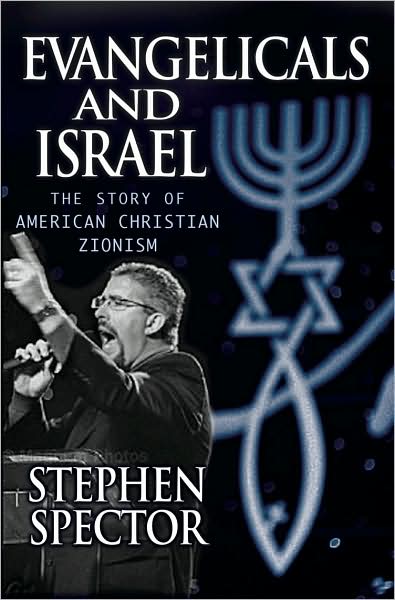
Evangelicals and Israel: The Story of American Christian Zionism

Evangelicals and Israel: Stephen Spector
Oxford University Press (2009) 338 pages.
Reviewed for American Studies Today, Issue 19, September 2010

After decades of reluctance to address this deeply controversial issue, in recent years there has been a veritable avalanche of books critical of the Christian Zionist movement. Authors include Grace Halsell, Don Wagner, Timothy Weber, Victoria Clark, Dan Cohen-Sherbok, Naim Ateek, Gary Burge, as well as two books of my own. It is perhaps therefore not surprising to find a growing reaction among Jewish Zionists who have begun to come to the defence of their Christian allies.

Stephen Spector’s work is representative of this genre of Jewish apologists, which includes Paul Merkley, David Brog, Shalom Goldman and Gerhard Falk.  Their agenda appears to be to justify a strand within Christian Zionism that is neither popular nor representative of evangelicalism as a whole, but which nevertheless plays a strategic role within the Israel Lobby.

The book purports to be the story of American evangelical Christian Zionism. It is a good read, as one should expect for a Professor of English. It would be more accurate, however, to describe it as the story of political Christian Zionism as represented by organisations such as Eagles Wings, Bridges for Peace, Christian Friends of Israel, Christians United for Israel and the International Christian Embassy. These self appointed para-church organisations have publically disavowed both proselytism among Jews as well as apocalypticism, based on a reductionist interpretation of the Bible. They are primarily lobby organisations, advocating on behalf of a Zionism among churches and in Washington among politicians.

While critical of both evangelistic Christian Zionism (such as Jews for Jesus) as well as apocalyptic or dispensational Christian Zionism (such as Hal Lindsey and Tim LaHaye), Spector reserves his strongest criticisms for evangelicals who oppose Zionism on theological grounds.

So, although Spector interviewed over 70 Evangelical and Jewish Zionists in the course of his research, he relies on anecdotes and paraphrases to portray the views of those he deems ‘liberal’ or ‘modernist’ who regard biblical Zionism as an oxymoron. The chapter addressing criticisms of Christian Zionism is therefore one of the weakest and least convincing.

It is simply untrue to say that evangelicals who oppose Zionism “are closer to liberal mainline Protestants than to most conservative born-again Christians,” Academics at the bastions of evangelicalism in the USA, such as Fuller and Wheaton, repudiate Christian Zionism just as much as their counterparts in Europe. John Stott, the ‘father’ of evangelicalism, is not alone in describing ‘Christian Zionism’ as ‘biblical anathema’.

If evangelicalism is defined by the centrality of the gospel, the necessity of a personal faith in Jesus Christ, in the authority of the Scriptures and in the verbal proclamation of the gospel to all nations, it is actually Christian Zionists who, having reinterpreted the gospel and disavow proslytism, are closer in spirit to mainstream liberalism rather than conservative evangelicalism.

It is therefore not surprising that it is in assessment of the biblical and theological presuppositions of Christian Zionism that the book is probably at its weakest. While strong on dialogue with Jewish and Christian Zionists, there is little evidence that Spector understands the theological presuppositions and tenuous biblical basis for the various strands of Christian Zionism. He is reassured that none of those he interviewed tried to convert him and that evangelical Zionists can share the gospel in acts of kindness toward the Jews rather than through proselytism. This is not evidence of the orthodoxy of Christian Zionists, just the opposite.

While Old Testament Bible verses are occasionally quoted without context to demonstrate that Zionism is biblically rooted, it is the evangelical critics of Christian Zionism, according to Spector, who ‘unfairly’ quote ‘the biblical prophets to attack the modern state of Israel’.

The fundamental question Christian Zionists avoid is whether the coming of Jesus Christ was the fulfilment or the postponement of the promises God made to Abraham? Which is central to the New Testament – Jesus or Israel? Ironically, Christian Zionists are portrayed as the new Zealots. Like their 1st Century forebears, they are trying to impose a Jewish kingdom by force, something Jesus repudiated. Spector cites, for example and without comment, Jack Hayford as promising, “if the Israelis need soldiers, he and his Pentecostal congregants will fight side by side with them.” Portraying the modern state of Israel as God’s chosen people on earth, the role of the Church is therefore reduce to providing dubious justification for Israel’s colonization of Palestine.

While ostensibly a book about evangelicals, it soon becomes rather tiresome when, in any debate or disagreement posed, it is always Zionists who are given the last word. So, for example, in a dismissal of Walt and Mearsheimer’s definitive work on the Israel Lobby, Spector defers to Alan Dershowitz suggesting the author’s claims  “are variations on old anti-Semitic themes of the kind found in the notorious czarist forgery The Protocols of the Elders of Zion and in Nazi literature.”

Conversely, Spector gives ample space to some of the worst examples of Islamaphobia. There is a deep paranoia regarding the motives of Arabs in general and Palestinians in particular. He refuses to see that Israel could be, in any way responsible, partly or otherwise, for the perpetuation of the Middle East conflict. They are always, in his words, “the victims of injustice, not the perpetrators.”

Disappointingly, for a book with 82 pages of notes and indexes, there is no conclusion or summary chapter. It is as if the publisher has left it out by mistake or needed to reduce the word count. Whatever the reason, the book is weaker for it.

Instead, the last chapter is given to an assessment of the influences on George W Bush’s Middle East policy. Here Spector tries to downplay the impact of the Israel Lobby. Without really explaining why, he would have us believe there is “broad and deep support” for Israel in America because “that position is politically sound and morally just, not because of political pressure or influence” from evangelicals. Ironically, he gives the last sentence in the book to Hal Lindsey.

If first impressions count, the eulogy on the back cover from Abraham Foxman, National Director of the Anti-Defamation League, must surely be the kiss of death to any work claiming to be balanced or objective. One surprised Cambridge academic did ask me rhetorically, who on earth could have possibly vetted the book for Oxford University Press? One wonders. But then it is worth remembering that it was the Oxford University Press who published (and still publishes) the first Christian defence of Zionism, namely the Scofield Reference Bible.

The Journey of a Lifetime

The Journey of a Lifetime (Matthew 2:1-12) from Stephen Sizer on Vimeo.

I wonder how long it took you to get here this morning? I wonder who has come the furthest? I wonder who has been on the longest journey this Christmas?

Life is a journey and we are all travelling on that journey. We sometimes use the word to describe the way we come to meet Jesus. Not everyone is brought up in a Christian home. Not everyone is fortunate enough to have been to a Sunday club like ours. You may be here for the first time or perhaps you don’t get to come very regularly. Perhaps you were not involved in the life of Christ Church a year ago, but you’re here now and you want to find out more. Then stick around. No matter where you are in your journey toward God, Jesus welcomes you too and delights in your desire to come and worship him. In our story today we learn about some other wise people looking for Jesus. They traveled a long way searching for Jesus.

We can learn several lessons from their journey of a lifetime that will help us in ours. Three in particular. Continue reading

A Lion in the Manger

“They were in Lucy’s room, sitting on the edge of her bed and looking at a picture on the opposite wall. It was a picture of a ship—a ship sailing straight towards you. Her prow was gilded and shaped like the head of a dragon with a wide-open mouth. She had only one mast and one large, square sail which was a rich purple. The sides of the ship—what you could see of them where the gilded wings of the dragon ended—were green. She had just run up to the top of one glorious blue wave, and the nearer slope of that wave came down towards you, with streaks and bubbles on it.…all three children were staring with open mouths. What they were seeing may be hard to believe when you read it in print, but it was almost as hard to believe when you saw it happening. The things in the picture were moving. It didn’t look at all like a cinema either; the colours were too real and clean and out-of-doors for that. Down went the prow of the ship into the wave and up went a great shock of spray. And then up went the wave behind her, and her stern and her deck became visible for the first time, and then disappeared as the next wave came to meet her and her bows went up again. At the same moment … Lucy felt all her hair whipping round her face as it does on a windy day. And this was a windy day; but the wind was blowing out of the picture towards them. And suddenly with the wind came the noises—the swishing of waves and the slap of water against the ship’s sides and the creaking and the overall high steady roar of air and water. But it was the smell, the wild, briny smell, which really convinced Lucy that she was not dreaming… a great cold, salt splash had broken right out of the frame and they were breathless from the smack of it, besides being wet through…”

So begins The Voyage of the Dawn Treader from The Chronicles of Narnia by C.S. Lewis. At face value it is a beautiful children’s story about a sea voyage. But Lewis intends us, young and old, to view it as a parable about life. More especially about discovering the purpose in life. And along the way, understanding the insidious power of evil, learning to resist temptation, and realising that rescue can only come from another realm. The realm of Aslan. Remember the first time you entered the world of Narnia? And came under the mesmerising spell of the evil White Witch who makes it “Always winter, never Christmas”… But the redemption of Narnia and the end of the White Witch’s reign has been prophesied and the arrival of “sons of Adam and daughters of Eve”, is a sign that the coming of Aslan as the rightful King is near. Clearly Aslan is a picture of the Lord Jesus. How do you feel about Jesus portrayed as a lion? Jesus is actually described as a lion in the first and the last books of the Bible. In Genesis, is this prophecy.

“You’re a lion’s cub, Judah, my son. Look at him, crouched like a lion, king of beasts; who dares mess with him? The sceptre shall not leave Judah; he’ll keep a firm grip on the command staff; Until the ultimate ruler comes and the nations obey him.” (Genesis 49: 9-10)

And in the Book of Revelation, the Apostle John, is told, “Do not weep! See, the Lion of the tribe of Judah, the Root of David, has triumphed.” (Revelation 5:5)

But why the name Aslan? Simple. Aslan is Turkish for ‘lion’. The abiding message of Narnia, so powerfully re-told in the new film, the Voyage of the Dawn Treader, is that God calls us to a grand adventure, an epic journey that will never end to know him and make him known. As Prince Caspian exclaims, “Think of the lost souls we are here to save”.

Continue reading

What’s in a Name? (Luke 1:1-25)

What’s in a Name? (Luke 1.1-25) from Stephen Sizer on Vimeo.

Do you know what your name means? My name, Stephen, means ‘crown’ or ‘garland’. As a noun Stephen first appears in Homer’s Iliad. So the name has been in use for at least 2,800 years. In the Acts of the Apostles, chapters 6-7, Stephen became the first Christian to give his life as a martyr for Jesus. That is very special to me, although I’m not sure that’s why my parents chose the name.

In many cultures, names are significant. They are chosen with care or handed down from father to son, from mother to daughter through the generations. In the West people often have no idea what their name means, more a novelty than necessity. Children’s names are often chosen for the sound or rhythm. Sometimes children are named after famous personalities.

Currently, the most popular boys name is Jack (third year running) followed by Oliver, Harry and Charlie. The most popular girl’s names are Olivia, Ruby and Grace. Olivia has been in the top three for three years also. Oliver and Olivia both in the top three? Is that due to  the subliminal influence of adverts for a healthy Mediterranean spread? Or the countries favourite pinup – sorry, chef. There may be some truth in that because Jamie’s latest cookbook, 30-Minute Meals, has sold 735,000 copies in the last two months alone- making it the fastest-selling non-fiction book of all time, outselling even the Bible.

In biblical times names were of incredible importance. A name carried more than your identity. It said something about who you are, what your God is like, or how you were expected to live. Names were not always given at birth. In fact it was common for a child to go for years without a permanent name. And sometimes God changed people’s names to better define who they are or whom they will become. Abram’s name was changed to Abraham; Jacob’s name became Israel.

On the other hand sometimes, people were given names that were never used. In Joseph’s dream, for example, the angel says Jesus will be given the name “Immanuel” which means “God with us”. This was predicted in Isaiah 7:14. And yet in the New Testament, Jesus is never called by that name. Maybe one day when every knee will bow.

In an hour or so we will have our Nativity Service and re-live the birth of the Lord Jesus. We’re very familiar with the Christmas story of Mary and Joseph and the baby Jesus. But we don’t often take time to get to know the people who had a role to play in God’s plan just before Jesus was born. Luke begins his gospel with the coming of the angel Gabriel to Zechariah and the promise that Elisabeth his wife will bear a son and they will name him John. This morning I want us to see how this family are not just the prelude to Christmas but testify by their names and by their actions that God is sovereign. That God is faithful to do what he has promised.

Continue reading