A “lame duck” Prime Minister had just lost a General Election. He was meeting with his successor in No. 10 Downing Street for an informal handover. Near the end of the orientation, he gave the incoming leader three numbered envelopes. He suggested they be opened, in order, on the anniversary of their meeting, or at times of national crisis. After the new Prime Minster had enjoyed his “honeymoon” year with the media and the public, the nation experienced something of an economic downturn. Curious, and beginning to feel lonely and isolated, he opened the first envelope. Inside was a card with two words: “Blame me.” So he did, criticizing the former Prime Minister for the countries woes. By the second anniversary, demonstrations and strikes had brought the country to a standstill. The Prime Minister eagerly opened the second envelope. Inside there were two words on the card: “Blame my administration.” So he did, blaming the unrest on the failed policies of the previous government now in opposition. About a year later, foreign policy blunders were leading to tensions in Europe and the Commonwealth and his popularity in the polls was plummeting. The Prime Minister reached for the third envelope desperate for a solution. Inside, the card read: “Prepare three envelopes.” Someone once said, “He who smiles in a crisis has found someone to blame.
Some enterprising businessperson will sooner or later register the domain name “Rent-a-Scapegoat.com” with the motto “Mea Culpa.” Here’s what the homepage might offer.
“In today’s society finding a solution to a problem is much less important than finding someone to blame. If you find yourself being blamed by the media, customers or politicians, for something you did not do, or even if you did, that’s where we come in. For a negotiable fee, one of our trained staff can be seconded to your company on a six month contract retrospectively backdated to before the controversy blew up. You mount an investigation, they will accept full responsibility, you fire them and they take the heat. You get a positive media story, and the “scapegoat” walks away. It’s clean, it’s tidy and it’s containable. It’s the new “go-to-fall-guy” concept brought to you by www.rent-a-scapegoat.com ”
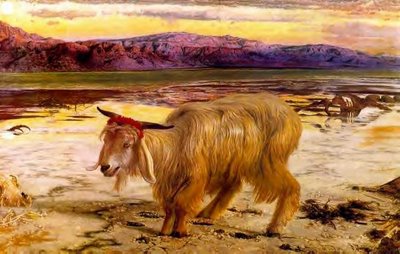
Let’s be honest. How many of us would be tempted to use that kind of service, if it existed? Especially, if they did house calls as well as business consulting? But seriously, is it not instinctive? When we come under the spotlight, we look for someone to blame, someone to pass the buck, someone to take the rap, a scapegoat? Where did this idea of the scapegoat come from? The term goes way, way back to Leviticus 16 when God introduced an annual festival called the Day of Atonement. Known as Yom Kippur (in September), it became the most solemn day in the Jewish calendar, a day of national mourning, of humiliation, of fasting, repentance and forgiveness. Yom Kippur is still observed today as a solemn Sabbath, but without the sacrifices because there is no Temple.
As a young Christian, one of the most influential people in my life was the Finnish evangelist Kalevi Lehtinen who died in July aged 75. At several Bible conferences I vividly remember him telling us to keep studying the Bible until you can see the smiling face of Jesus on every page. Keep reading the Bible until you can see the smiling face of Jesus on every page. “Christ in all the Scriptures” That is the theme for our morning sermon series this Autumn. We will only get from Genesis to Ruth, but we will come back and dip into every Old Testament book to discover what it can teach us about the Lord Jesus. We will see that every central character, every major event, every prophecy, every Festival reveals ever more brightly the person and work of the Messiah, God’s anointed Son. We will see conclusively that the coming of Jesus Christ was no accident but part of God’s redemptive plan from the very beginning and was revealed progressively through history and Scripture. And if you would like to read the book that inspired the series, it is called Christ in all the Scriptures. Written by A. M. Hodgkin in 1909, it has become a classic. Hodgkin observes, in his introduction,
“Abraham rejoiced to see My day.” ”Moses wrote of Me.” ”David called [Me] Lord.” (John 8:56; 5:46; Matthew 22:45). We have in these words of our Saviour abundant authority for seeking Him in the Old Testament … To those of us who believe in Christ as truly God, as well as truly Man, His word on these matters is authoritative.”
As we saw last week, Jesus refers to 20 Old Testament characters and quotes from 17 Old Testament books. In Genesis, for example, Jesus refers to creation, the institution of marriage, Noah, Abraham, Lot, to Sodom and Gomorrah. From Exodus, Jesus speaks of Moses, the burning bush, the Mannah in the wilderness and the Ten Commandments. From Leviticus, the ceremonial and moral law. From Numbers, the bronze serpent. From Deuteronomy, the law of Moses. Jesus refers to David, Solomon, Elijah and Zechariah. He confounds his critics not just by quoting Scripture but by identifying himself as the one the Scriptures are speaking about. In his very first sermon Jesus said, “Today this scripture is fulfilled in your hearing.” (Luke 4:21). To his opponents, Jesus replied.
“You diligently study the Scriptures because you think that by them you possess eternal life. These are the Scriptures that testify about me.” (John 5:39).
After his resurrection, on the road to Emmaus, to his doubting disciples Jesus said,
“How foolish you are, and how slow to believe all that the prophets have spoken! Did not the Messiah have to suffer these things and then enter his glory?” And beginning with Moses and all the Prophets, he explained to them what was said in all the Scriptures concerning himself… Everything must be fulfilled that is written about me in the Law of Moses, the Prophets and the Psalms.” Then he opened their minds so they could understand the Scriptures.” (Luke 24:25-27; 44-45)
May the Lord open our minds too, to understand everything written about Jesus in the Law of Moses, the Prophets and the Psalms, has indeed been fulfilled and accomplished for us. Continue reading →
What motivates you to get up in the morning? What excites you about the future? What drives you to realise your goals in life? What do you long to see our world become?
Here is the ultimate biblical vision of the future:
“ Then I saw “a new heaven and a new earth,” for the first heaven and the first earth had passed away, and there was no longer any sea. 2 I saw the Holy City, the new Jerusalem, coming down out of heaven from God, prepared as a bride beautifully dressed for her husband. 3 And I heard a loud voice from the throne saying, “Look! God’s dwelling place is now among the people, and he will dwell with them. They will be his people, and God himself will be with them and be their God. 4 ‘He will wipe every tear from their eyes. There will be no more death’ or mourning or crying or pain, for the old order of things has passed away…
Then the angel showed me the river of the water of life, as clear as crystal, flowing from the throne of God and of the Lamb down the middle of the great street of the city. On each side of the river stood the tree of life, bearing twelve crops of fruit, yielding its fruit every month. And the leaves of the tree are for the healing of the nations.” (Revelation 21:1-4; 22:1-2)
Jesus said to them, “How foolish you are, and how slow to believe all that the prophets have spoken! Did not the Messiah have to suffer these things and then enter his glory?” And beginning with Moses and all the Prophets, he explained to them what was said in all the Scriptures concerning himself… Everything must be fulfilled that is written about me in the Law of Moses, the Prophets and the Psalms.” Then he opened their minds so they could understand the Scriptures.” (Luke 24:25-27; 44-45)
“Christ in all the Scriptures” That is the theme and title for our morning sermon series this Autumn. Please pick up a programme card if you don’t yet have one to see what treasures are in store. This is going to be an exciting and revealing series. We won’t finish it this term – we will only get from Genesis to Ruth. But over the next few years we are going to dip into every book of the Old Testament to see what is said in all the Scriptures concerning the Lord Jesus Christ. We will see that every central character, every key event, every prophecy, every Feast and Festival reveals ever more brightly the person and work of the Messiah, God’s anointed Son. We will see conclusively that His coming was no accident but part of God’s redemptive plan, revealed from the very beginning and progressively through history and Scripture. And if you would like to read the book that inspired the series, it is appropriately called Christ in all the Scriptures. Written by A. M. Hodgkin, and first published in 1909, it has rightly become a classic. I would also commend Vaughan Robert’s book, God’s Big Picture. We are also commending the Home Group study guide Full of Promise
Hodgkin observes, in his introduction,
“Abraham rejoiced to see My day.” ”Moses wrote of Me.” ”David called [Me] Lord.” (John 8:56; 5:46; Matthew 22:45). We have in these words of our Saviour abundant authority for seeking Him in the Old Testament … To those of us who believe in Christ as truly God, as well as truly Man, His word on these matters is authoritative.”
In the Gospels, Jesus refers to 20 Old Testament characters and quotes from 17 Old Testament books. In Genesis, for example, Jesus refers to creation, the institution of marriage, to Noah, Abraham, Lot, to Sodom and Gomorrah. From Exodus, Jesus speaks of Moses, the burning bush, the Mannah in the wilderness and the Ten Commandments. From Leviticus, the ceremonial and moral law. From Numbers, the bronze serpent. From Deuteronomy, the law of Moses. Then there are references to David, Solomon, Elijah and Zechariah. He confounds his critics not just by quoting Scripture but by identifying himself as the one the Scriptures are speaking about.
“Today this scripture is fulfilled in your hearing.” (Luke 4:21).
“You diligently study the Scriptures because you think that by them you possess eternal life. These are the Scriptures that testify about me.” (John 5:39).
Finally three of his last seven sentences from the cross are quotations from the Old Testament. Hodgkin says,
“From a careful study of the Gospels, we cannot fail to see that the Old Testament Scriptures were continually upon Christ’s lips, because [they] were always hidden in His heart….”
Let us pray that the Lord will open our minds, as he did the Apostles, to understand how everything written about Jesus in the Law of Moses, the Prophets and the Psalms has indeed been fulfilled and accomplished for us. Then this good news will not only be hidden in our hearts but always on our lips.
Today we are beginning the next stage of an amazing historical journey. Back in January 2010, we began to read the Acts of the Apostles and learn about the birth of the early church to see how it fulfilled the Great Commission given by the Lord Jesus. As we join the journey again this Autumn in acts 18, the gospel has reached as far as Corinth. In the weeks to come, up to half term, we are going to journey with the Apostle Paul and his colleagues to discover some of the principles of ministry that will help us to share in that on-going mission in our generation.
The Purpose of Acts
Why did Luke write Acts? What purpose was the Spirit leading him to fulfil? The years have produced several different answers to those questions. The opening verses of Luke and Acts mention Theophilus as the recipient of Luke’s writings. Many think Theophilus was a Roman dignitary sympathetic to the Christian cause. Perhaps Luke was writing a defence of Christianity for this official during a time of persecution to show him there was nothing subversive or sinister about the followers of Jesus. The geographical framework of Acts, the spread of the gospel from Jerusalem to Rome, lends credibility to this idea.
In 1:3 of his Gospel, Luke clearly states he is trying to make “an orderly account” of the events surrounding Jesus’ ministry.
It’s easy to think Luke’s Gospel focuses on Jesus while Acts focuses on the followers of Jesus who continued their Master’s work. But Acts 1:1, says “In my former book … I wrote about all Jesus began to do and teach…” Luke implies that Jesus continued to do and teach more, and that His story was incomplete where the Gospel of Luke ended. A careful reading of Acts makes it clear that Jesus remained the active, living, focus of Luke’s story. In 9:4 (NIV), Jesus spoke directly to Saul and asked, “Why do you persecute me?” Later, in the same chapter, Peter could say directly to Aeneas, “Jesus Christ heals you” (9:34 NIV). In Acts 10, Christ made His will known to Peter concerning a ministry to the Gentiles. These are but three examples of Jesus’ vital involvement in the spread of the gospel in Acts. While Acts begins with the ascension of Jesus, there is no evidence anyone in the early church perceived Him as “gone” from their midst. Jesus healed, spoke, and directed the work of His disciples. Even when they preached, the disciples thought of Jesus as literally present in their preaching. They asked the listeners of those first sermons, not merely to believe facts about Jesus, but to encounter , the One who died, rose again, and lives forever. The ascension marked not Christ’s departure, but a transformation in the way Christ performs His ministry of salvation and grace. Acts is the continuing story of Jesus’ work but no longer bound by the limitations of time and space.
Before Jesus ascended to heaven he said, “you will receive power when the Holy Spirit comes on you; and you will be my witnesses in Jerusalem, and in all Judea and Samaria, and to the ends of the earth.” (Acts 1:8).
1. God promises to bless those who bless Israel and curses those who curse Israel
This popular if misguided assumption is based on Genesis 12:3. It shows how vital it is we allow Scripture to interpret Scripture. First, the original promise was made to Abram (that is Abraham) and no one else. Second, there is nothing in the promise to indicate God intended it be applied to Abraham’s physical descendants unconditionally, or in perpetuity. Third, in the New Testament we are told explicitly that the promises were fulfilled in Jesus Christ and in those who acknowledge Him as their Lord and Saviour. God’s blessings come by grace through faith, not by works or race (Ephesians 2:8-9).
Promise
Fulfilment
“I will make you into a great nation, and I will bless you; I will make your name great, and you will be a blessing. I will bless those who bless you, and whoever curses you I will curse; and all peoples on earth will be blessed through you” (Genesis 12:2-3).
The promises were spoken to Abraham and to his seed. Scripture does not say “and to seeds,” meaning many people, but “and to your seed,” meaning one person, who is Christ… There is neither Jew nor Gentile, neither slave nor free, neither male nor female, for you are all one in Christ Jesus. If you belong to Christ, then you are Abraham’s seed, and heirs according to the promise.” (Galatians 3:16, 28-29)
“I will surely bless you and make your descendants as numerous as the stars in the sky and as the sand on the seashore… and through your seed all nations on earth will be blessed…” (Genesis 22:17-18)
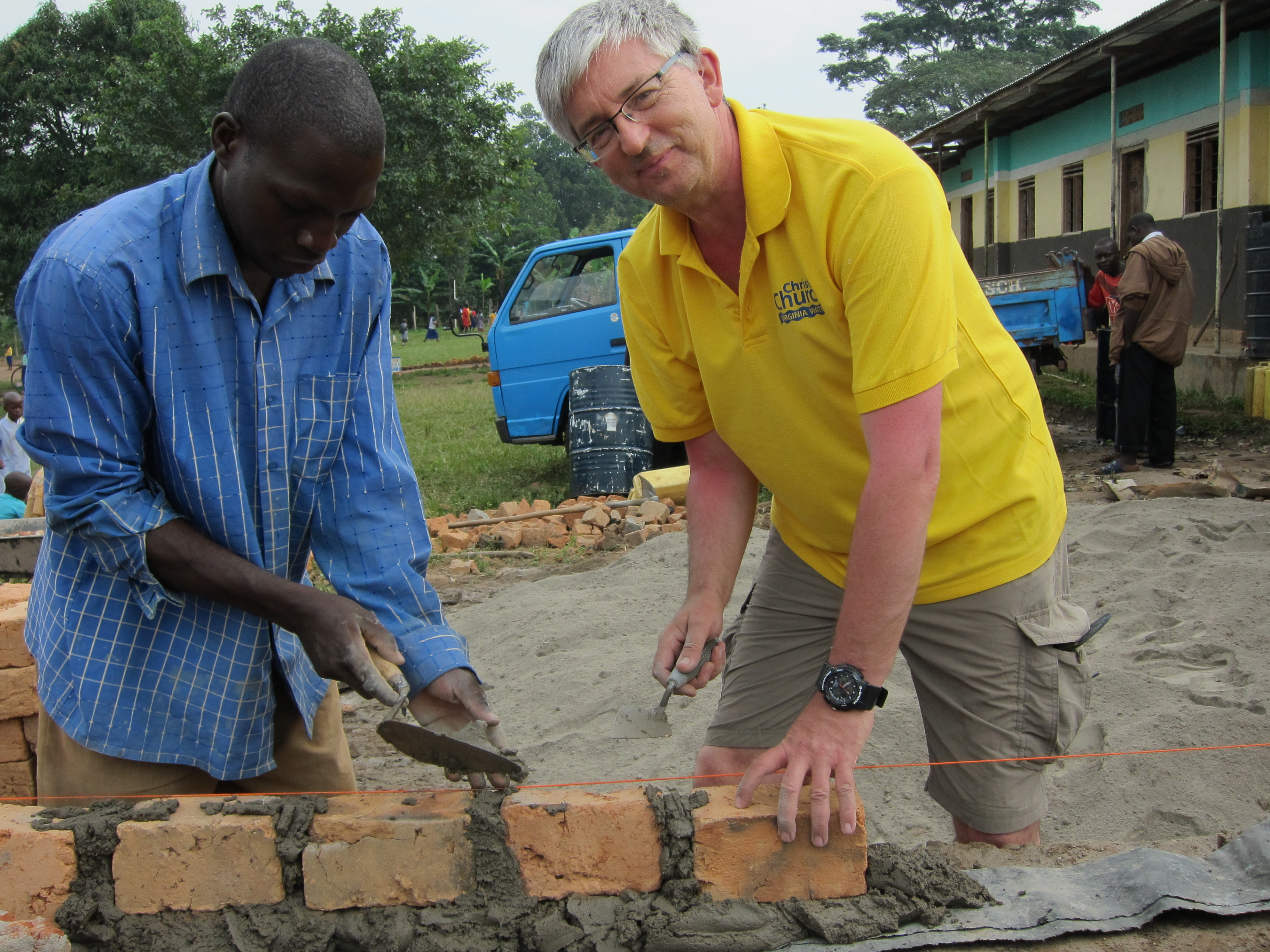
I know I shouldn’t but I am writing this on holiday – in Uganda. I haven’t come to stay in a safari park or lie on a sandy beach but to extend a school. With the help of people in Virginia Water, in July we raised enough to build four new classrooms at Goshen school in a village called Nkondo. You won’t find it on a map but its half an hour’s drive down a rough, bumpy track to the east of Luwero, about an hour and a half s drive north from Kampala. Several hundred thousand people were massacred in the infamous Luwero Triangle during the civil wars back in the 1970’s and 80’s and almost every family still bears the scars in some way. Malaria is endemic, orphans sadly too common and famine stalks much of East Africa. Kiwoko Hospital was built at the epicentre of the killings to help bring life and hope back to this war torn region It is also our base for the week.
That is why we also raised enough money to dig a well and provide a pump for the community. The 500 or so villagers, including the children, presently have to walk or cycle several kilometres every day to find safe clean water to drink. The villagers had tried to dig a well and got down 40 feet before they hit rock, so the new well is going to be dug by a specialist drilling team from the charity Fields of Life. This week, with the help of some local builders and even the school children, between their lessons, we managed to construct two classrooms up to the door lintels, got a third classroom up to waist height and laid the foundations for the fourth.
See more photos of Uganda here. Read more about the project here.
More used to writing, counselling and speaking, this week I have been discovering the therapy of manual labour, mixing concrete, erecting wooden scaffolding and brick laying. Instead of thinking about words-per-minute, this week I’ve been improving my bricks-per-hour rate. Today was the last day and the whole village turned out for the end of school term celebration, to dedicate the new buildings and mark the spot where, God willing, the new well will be dug.
The three of us from Virginia Water have received so much more than we have contributed. Yes, I miss not having electricity much of the week, or running water to flush, or hot water for a shower, but I would not trade these for the sense of fulfilment in having helped accomplish something, practical, constructive, meaningful and purposeful.
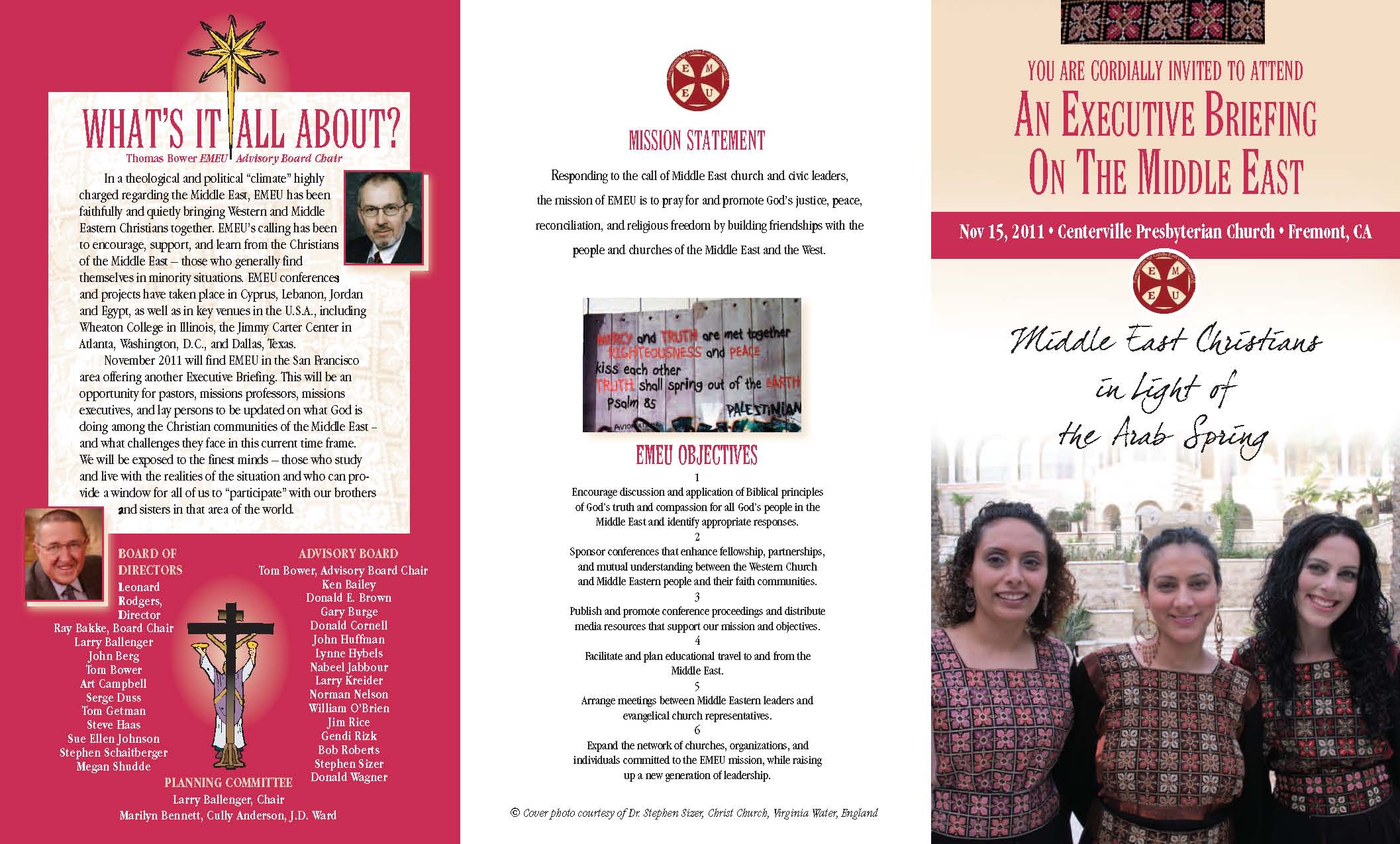
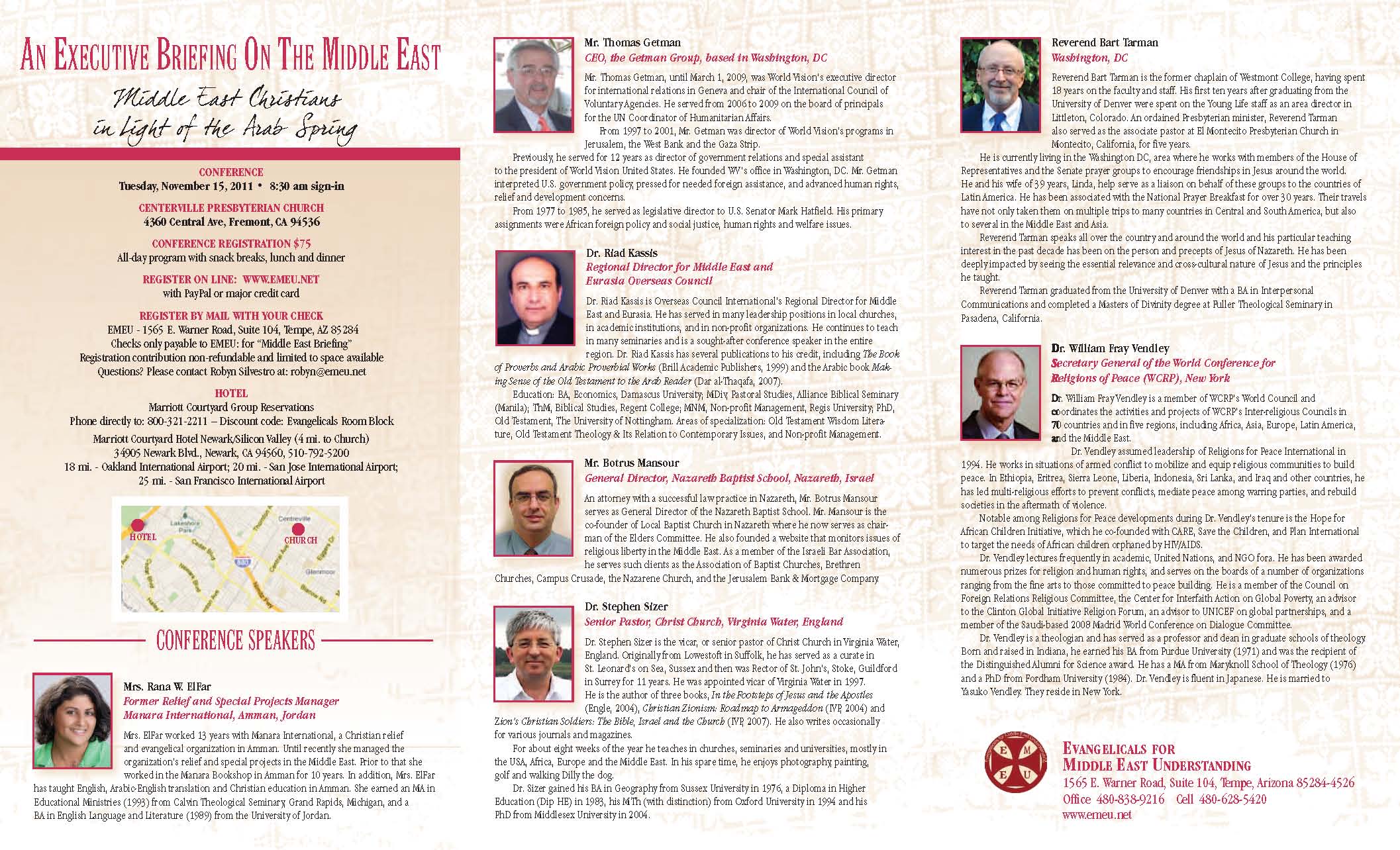
On Tuesday, November 15, 2011 EMEU will conduct a special Executive Briefing on the Middle East in the Bay area of San Francisco in the city of Fremont and held in the historic Centerville Presbyterian Church founded in 1853.
The purpose of this special one day briefing is to inform and gain insight into today’s Middle East. EMEU is inviting business and civic leaders, mission pastors, seminary and Bible college professors, and others for full day briefing ending with a banquet in the evening. Included in the briefing will be close interaction and round table discussions between Western and Middle Eastern leadership.
Since its start-up in 1985 EMEU has conducted strategic briefings and consultations on the Middle East. Our last meeting was in Dallas, Texas in November of 2010 when EMEU celebrated its 25th Anniversary. Prior to that, we met in Washington, D.C. at the Capitol Center in November 2009. Other EMEU events over the years have taken place in Jordan, Egypt, Lebanon, and Jerusalem plus one in 2006 at Wheaton College, Wheaton, Illinois jointly sponsored by EMEU and The Billy Graham Center.
Attendance is by invitation only.
If you are not on the EMEU mailing list or EMEU News list and would like to apply for an invitation to this briefing please click subscribe and type the acronym EBOME in the “why you wish to subscribe” block.
I recently heard a story about a guy who drove his car into a ditch accidentally. It was quite an isolated location and there was no mobile phone reception to call the rescue services. Thankfully, a local farmer saw it happen and brought his horse to help pull the car back on to the road. The farmer hitched Buddy up to the car and yelled, “Pull, Nellie, pull!” Buddy didn’t move. Once more the farmer hollered, “Pull, Nellie, pull!” Buddy didn’t respond. Then the farmer nonchalantly said, “Pull, Buddy, pull!” And the horse dragged the car out of the ditch. The motorist was very appreciative but he was also curious. He said “I am really grateful for your help. I just have one question: Why did you call your horse by the wrong name? The farmer said, “Oh, Buddy is blind – if he thought he was the only one pulling, he wouldn’t even try.” Like “Buddy” we find motivation difficult if we think we are the only ones pulling. That’s why Jesus sent his disciples out in teams of two by two. It iciples out in teams of two. It’ motivated the car bacrove his car into a ditch. s so much easier and more fulfilling to serve in teams isn’t it?
In this last sermon in the series, Jesus and Women, we meet Priscilla the wife of Aquila. In Acts 18, we’re introduced to the ultimate ministry team – Priscilla and Aquila. They’re a married couple who are always mentioned together – three times in Acts 18, then in Romans 16, 1 Corinthians 16 and 2 Timothy 4.
The Apostles had wives, and they took them with them when they preached (I Cor. 9:5), but their wives names are never mentioned in Scripture. Aquila’s wife, Priscilla, is.
Significantly their names only ever appear together which suggests they were a team. They were partners in ministry. Indeed Paul commends Aquila and Priscilla as his “fellow workers” who risked their lives for him. Even more significantly, in four of the five places where their names appear together, Priscilla is mentioned first. Let’s find out why. I want to introduce you to Priscilla the disciple, Priscilla the teacher and Priscilla the leader.
1. Priscilla the Disciple
“After this, Paul left Athens and went to Corinth. 2 There he met a Jew named Aquila, a native of Pontus, who had recently come from Italy with his wife Priscilla, because Claudius had ordered all Jews to leave Rome. Paul went to see them, 3 and because he was a tentmaker as they were, he stayed and worked with them. 4 Every Sabbath he reasoned in the synagogue, trying to persuade Jews and Greeks… 18 Paul stayed on in Corinth for some time. Then he left the brothers and sisters and sailed for Syria, accompanied by Priscilla and Aquila. Before he sailed, he had his hair cut off at Cenchreae because of a vow he had taken. 19 They arrived at Ephesus, where Paul left Priscilla and Aquila. He himself went into the synagogue and reasoned with the Jews.” (Acts 18:1-4, 18-19)
In the year 52 A.D. the Roman emperor Claudius issued an edict expelling all Jews from the city of Rome. Suetonius, the Roman historian, says, some within the Jewish community were persecuting their Christian neighbours and causing considerable disturbance in the city. Claudius cared little about the reason for the trouble, and even less about who the guilty parties were. He knew they were Jews, and that was enough; so all Jews were uprooted from their homes and banished from Rome, the innocent along with the guilty.
This included a Jew named Aquila, who had migrated to Rome from the province of Pontus on the Black Sea, and he decided to migrate to the city of Corinth. By his side was his faithful wife, Priscilla. We do not know for certain whether she was Jewish or Roman, nor are we sure whether or not they were both Christians at the time. God in his providence uses their profession to connect Priscilla and Aquila with Paul. When Paul arrives from Athens, he makes contact with fellow tent makers, possibly to work with them to provide an income for himself as well. Paul worked so that he was not dependent on the churches he founded. Priscilla and Aquila were hospitable and invited Paul into their home and let him stay with them. Paul had confidence in them and invested his life in them. A lasting friendship was born between them. If Priscilla and Aquila did not know the Lord before, Paul’s stay would have left them in no doubt. No one could be anywhere near Paul for very long and not be affected by his passion for Jesus. Paul stayed with them for 18 months, no doubt instructing them in the gospel. Priscilla the disciple.
2. Priscilla the Teacher
“Meanwhile a Jew named Apollos, a native of Alexandria, came to Ephesus. He was a learned man, with a thorough knowledge of the Scriptures. 25 He had been instructed in the way of the Lord, and he spoke with great fervourand taught about Jesus accurately, though he knew only the baptism of John. 26 He began to speak boldly in the synagogue. When Priscilla and Aquila heard him, they invited him to their home and explained to him the way of God more adequately.” (Acts 18:24-26)
Apollos sounds quite an impressive speaker. Aquila and Priscilla were deeply impressed with him, but they detected a serious flaw in his preaching. Tactfully they made no attempt to correct him in front of everyone at the synagogue. Nor did they try and put him straight over coffee after the service. They had a better way. They invited him home for lunch. I remember vividly one of the first evangelistic conversations I had as a young Christian. After it was over my friend, an older Christian, who’d been with me, took me to one side and said, “Well done, but actually the Holy Spirit is a person, not an ‘it’.” I never forgot. Perhaps it was at the kitchen table that Pricilla and Aquila led the conversation round to the mornings sermon, told Apollos what a blessing his ministry had been, asked him how he had become a believer, and then gently introduced the question of baptism.
Gently and lovingly, they explained how the gospel of the Lord Jesus was the fulfilment of the Hebrew scriptures he knew so well; That John’s baptism was a preparation for receiving Christ; and that Christian baptism was a natural consequence of receiving Christ. What Priscilla and Aquila did would not have been possible had they not been discipled by Paul for 18 months. What they learnt from Paul they passed on to Apollos. They multiplied themselves, just as Paul has done. The purpose of discipleship is not the accumulation of knowledge but multiplication. Disciples are meant to become disciplers. We were born to reproduce. That is why our mission comprises three words – win – build – send. We seek to win people to Christ, build them in the faith and send them to do what? Win people to Christ and build them in the faith in order to… It is only because Priscilla was a disciple that she could become a discipler of others. What Priscilla and Aquila did for Apollos is the norm. Every Christian teacher, whether it be the Apostle Paul or one of our pastors here, is accountable to the plain teaching of Scripture. If you are not sure about something you hear in a sermon, don’t just accept it. Check it out from the Word of God, and if you are still not sure, ask the preacher. The Berean Christians mentioned in Acts give us our model.
“Now the Berean Jews were of more noble character than those in Thessalonica, for they received the message with great eagerness and examined the Scriptures every day to see if what Paul said was true.” (Acts 17:11)
Priscilla the disciple became Priscilla the teacher. There is one more dimension to her ministry:
3. Priscilla the House Church Leader
“The churches in the province of Asia send you greetings. Aquila and Priscilla greet you warmly in the Lord, and so does the church that meets at their house.” (1 Corinthians 16:19)
Given the nature of their trade, Priscilla and Aquila could be flexible where and when they earned their income from making tents. So they left their home in Corinth and followed Paul to Ephesus. He continued travelling while they settled down and opened their home, not only to Apollos but to other believers. In both Corinth and then in Ephesus, their home became a church, a house church. It seems at some point they decided to move back to Rome. Claudius was dead. Once again, their home became a meeting place for Christ followers.
“Greet Priscilla and Aquila, my co-workers in Christ Jesus. 4 They risked their lives for me. Not only I but all the churches of the Gentiles are grateful to them. 5 Greet also the church that meets at their house.” (Romans 16:3-5)
Given the way Paul affirms them by name, and mentions their role “co-workers” and specifically their bravery “they risked their lives for me” we may assume they became leaders within those churches. Priscilla and Aquila are mentioned one more time in the New Testament, in the last chapter of the last book the Apostle Paul wrote.
Their stay in Rome was short, probably because of the gruesome persecution of the Christians under Nero. They returned to Ephesus one final time. It had been sixteen years since Paul first met them at Corinth, and now he was in a Roman prison for the second time. His death at the hands of the emperor Nero was imminent, and he was writing the last paragraph of his long and fruitful life. “Greet Priscilla and Aquila, and the household of Onesiphorus” (2 Timothy 4:19). Paul is thinking of his dear friends who were then back in Ephesus where Timothy was ministering. It was just a brief and simple greeting. But Paul wanted to be remembered to them in the last hours of his life. Imagine the impression that Priscilla and Aquila left in the mind of the apostle Paul. Their legacy was not the churches they founded in their homes but the model of ministry they demonstrated consistently – evangelism, discipleship and multiplication – winning, building and sending. We have seen Priscilla and Aquila the disciples, the teachers and the leaders. Tradition has it they eventually died in Ephesus as martyrs like Paul. Their blood was indeed the seed of the church. “For me to live is Christ, to die is gain.”
Lets pray.
With thanks to Jeff Strite and Timothy Henning for ideas and inspiration. Read their sermons on Priscilla at www.sermoncentral.com
This week saw the birth of the newest nation in the world – The Republic of South Sudan. After centuries of slavery and colonialism, 55 years ago, Sudan finally won independence from British rule. But the suffering was only just beginning. In our life time, Sudan has endured two major, protracted, civil wars. Estimates suggest at least two and a half million people died. Quite a price for self determination.
In September, the Palestinian government will also seek UN approval to be recognised as an independent sovereign state, based on the June 1967 borders with Israel. The aspirations of the Palestinian people go back even further than Sudan, at least to the UN Partition Plan of 1947, 63 years ago, another legacy of failed British imperialism. Unlike South Sudan, however, the United States will veto the declaration in the UN Security Council. Israel is presently buying votes in the UN General Assembly to avoid a 2/3 majority endorsing the declaration.
But will that end Palestinian aspirations for independence? Is the Freedom Flotilla, presently detained by the Greek authorities, a humanitarian attempt to relieve suffering in Gaza or is it an existential threat to Israel’s existence? The Israel ambassador to Spain, Raphael Schutz, said this on Friday. There is “no humanitarian crisis” or shortage of food and medicine in Gaza. The Freedom Flotilla should be seen “for what it is: a propaganda event intended to build solidarity with a terrorist group that wants to wipe Israel off the map and kill the greatest possible number of Jews and Israelis.”
Many Jewish people fear there will be further attempts to annihilate them. Unfortunately there has been plenty of historical precedents. Comparisons between Ahmadinejad and Hitler are common, even among the wiki-leaked US diplomatic cables. So how should we respond? Clearly anti-Semitism is evil. Racism is unacceptable and must not be tolerated.
But how should we respond to those who threaten Israel’s existence? Pastor John Hagee is the leader of the 20,000 member, Cornerstone Church in San Antonio in Texas.
His views are broadcast weekly to around 100 million homes through TV and radio. He will also be speaking in Birmingham at a Bible Prophecy conference in August unless the Home Secretary banns his visit. He offers one novel solution. He said recently,
“The United States must join Israel in a pre-emptive military strike against Iran to fulfill God’s plan for both Israel and the West… a biblically prophesied end-time confrontation with Iran, which will lead to the Rapture, Tribulation, and Second Coming of Christ.”
So what is the difference between the pre-emptive military strike advocated by Pastor Hagee and the pre-emptive military strike advocated by Esther 2,500 years ago? Well lets find out. According to the United Nations there are currently over 32 armed conflicts in the world, causing more than 1,000 deaths per year. Although the term ‘ethnic cleansing’ was only coined in 1992, during the Bosnian-Serb civil war, it has clearly been practised for thousands of years. So when we turn to this final episode in the story of Esther, are we not witnessing the same kind of barbaric, tribal, ethnic cleansing we see in places like Iraq, Burma, Ossetia, Kashmir, Indonesia and Botswana?
There is, I think superficially, an element of truth in this. Human nature has not improved over time. I do not imagine the Jews and the Iranians of Esther’s day were anymore righteous than their contemporaries. Certainly we are no more righteous than they. But why does this story of Esther have to end in this way? Why do we recoil from the slaughter? More importantly, why is it recorded here in the Scriptures? We shall find an explanation. It may not be palatable, but it is given. As we reach the penultimate episode in the story of Esther, observe:
The Means of Israel’s Deliverance (Esther 9:1-4)
The Completeness of Israel’s Deliverance (9:5-17)
The Purpose of Israel’s Deliverance (9:18-10:3)
Websites store cookies to enhance functionality and personalise your experience. You can manage your preferences, but blocking some cookies may impact site performance and services.
Essential cookies enable basic functions and are necessary for the proper function of the website.
Name
Description
Duration
Cookie Preferences
This cookie is used to store the user's cookie consent preferences.

 Seven Biblical Answers to Popular Zionist Assumptions