
Jesus is Risen from Stephen Sizer on Vimeo.
Author Archives: Stephen Sizer
The Passion of Jesus the Messiah
 Frans van der Lugt, a 75 year old Jesuit priest, was a well-known figure in the Old City of Homs, respected by many for his solidarity with residents of the rebel-held area under a government siege for nearly two years. He refused to leave insisting that Syria was his home and he wanted to be with its citizens in their time of need. “If you stay, you stay for the struggle” he told the Independent in February. Last Sunday he was abducted and then murdered in his monastery garden. Another clergyman Ziad Hilal, described Frans as “a ray of joy and hope to all those trapped in the Old City.”
If you want to know someone’s heart, observe their final journey. The scale of the devastation in Syria is apocalyptic. The UN estimates there are 9 million refugees. If you want to help, see Embrace the Middle East, Tearfund or World Vision. I was in Tehran this week to publicize a Peace Pilgrimage to Syria taking medical supplies. I hope to welcome one or more of the participants on their way home next Sunday. If you want to know someone’s heart, observe their final journey. In the verses before us today we learn three things about Jesus’ final journey.
The Passion of Jesus the Messiah from Stephen Sizer on Vimeo.
In Jesus Christ I am Secure
 On January 6th 1941, the American President, Franklin Delano Roosevelt addressed the US Congress on the state of the war in Europe. Much of what he said that day has been long forgotten. But at the close of his address, he said something memorable, that he looked forward “to a world founded upon four essential human freedoms.” He named them: freedom of speech, freedom of worship, freedom from want, and freedom from fear. He died in 1945, just three weeks before the Nazi’s surrendered on April 12th 1945. He never lived to enjoy the peace he had laboured to secure. Yet Roosevelt was a man of vision and he dreamed of what the world could be, indeed should be, even in its darkest hour. We remember his vision because 60 years ago on 10th December 1948, just three years after the allies had defeated Nazism and peace declared, those four freedoms became incorporated into the Universal Declaration of Human Rights. Universally, people aspire to and endorse these four freedoms, even though, as we see in places like China, Iran and Zimbabwe, for example, they have not been realised for all on earth. Yet without them people give up hope.
In Jesus Christ I am Secure from Stephen Sizer on Vimeo.
This evening I want us to consider four of our throne rights as children of God. The rights the Lord Jesus Christ has won for you because he has defeated the source of evil in our universe, and brought peace between God and humanity. Luther called Romans “the clearest Gospel of all”. “If a person understands it”, wrote Calvin, “he has a sure road opened for him to the understanding of the whole Scripture.” John Chrysostom had the Book of Romans read aloud to him once a week. You and I could do a lot worse than that. If Romans is like the Himalayas of the Bible, chapter 8 is the Everest, the highest peak of all. You will not appreciate the view attained from Romans 8, unless you have walked along the path of Romans 1-7, and discovered there that apart from Jesus Christ, you are a lost and helpless sinner. Just as there would have been no Declaration of Human Rights without VE Day, so there would be no comfort, no Romans 8 without the victory of the cross and the realisation of the futility of all other paths to God. Because of the victory Christ has won, described in Romans 1-7, we are able to celebrate and appropriate our “Declaration of Throne Rights”, found in Romans 8.
Christians Zionists at War with Syria
 Why has Israel been the subject of more UN Resolutions than any other country in the world? And why has the USA vetoed virtually every single one of them? Why is Israel allowed to develop chemical, biological and nuclear weapons while other Middle East countries denied access to peaceful nuclear technology? Why such a close relationship between Israel and the United States of America? What is the fascination with Israel among Evangelical Christians in America?
There is a simple explanation. At least one in four American Christians surveyed recently by Christianity Today magazine said that they believe it is their biblical responsibility to support the nation of Israel. This view is known as Christian Zionism.
The Pew Research Center put the figure at 63 per cent among white evangelicals. Christian Zionism is therefore pervasive within American evangelical, charismatic and independent denominations including the Assemblies of God, Pentecostals and Southern Baptists, as well as many of the independent mega-churches and among television evangelists.
Christian Zionism is much less prevalent within the historic denominations (Roman Catholic, Episcopal, Methodist, Presbyterian), which show a greater respect for the work of the United Nations, support human rights, the rule of international law, empathize with the Palestinians and cooperate with the indigenous Middle East churches.
Imagine Life on Earth from a Heavenly Perspective

On 25th May 1961, President John F. Kennedy delivered a speech before a joint session of Congress entitled, “Special Message to the Congress on Urgent National Needs,”. Facing growing tension with Russia, JFK insisted the United States should set as a goal the “landing a man on the moon and returning him safely to the earth” by the end of the decade. Kennedy urged the U.S. to work diligently to lead the achievements of space travel because “in many ways [it] may hold the key to our future on earth.”
As the 1960s wore on scientists struggled with the enormity and complexity of delivering on that promise. But someone suggested they imagine they had already achieved their goal, and were standing on the moon looking back at earth. Then ask ‘how did we do it?’ And work backward instead of forward to achieve their goal. On 21st July 1969 Neil Armstrong became the first man to walk on the Moon.
Our aim is not the moon but heaven. How are we going to get there? One of the Bible passages that has driven me in my ministry for 35 years is Ephesians 4:11-16. But yesterday for the first time the Lord challenged me to imagine we had already attained that goal and change the tense from future to past.
“It was he who gave some to be apostles, some to be prophets, some to be evangelists, and some to be pastors and teachers, to prepare God’s people for works of service, so… the body of Christ has been built up. We have all reached unity in the faith and in the knowledge of the Son of God and we have become mature, attaining to the whole measure of the fulness of Christ. Now we are no longer infants… instead, speaking the truth in love, we have in all things grown up into him who is the Head, that is, Christ. From him the whole body, joined and held together by every supporting ligament, has grown and built itself up in love, as each part did its work.” (Ephesians 4:11-16).
What difference does the tense make to the passage? Everything. You know, when we get to heaven it will be past tense. So what does being mature look like? Feel like? That simple change from future aspiration to past achievement changes everything. Instead of seeing our 2020 Vision and Five Year Plan as aspirational, let us meditate on what it will be like, God willing, to have achieved the goals God has for us. Then lets look back from the vantage point of heaven with a renewed determination to help one another become what we already are in Christ.
As we look back and give thanks for what the Lord has achieved among us last year, I can look forward to the exciting adventures God has in store for the year ahead and above all, look up to my Lord and Saviour who equips us with everything we need to do his will.
“For we are God’s handiwork, created in Christ Jesus to do good works, which God prepared in advance for us to do.” (Ephesians 2:10)
Our ultimate vision is, that “we all reach unity in the faith and in the knowledge of the Son of God and become mature.” (Ephesians 4:13)
In 2014, my prayer for you is that you will indeed become mature, serving one another willingly, joyfully and wholeheartedly, investing all the gifts and talents God has entrusted to you, to build up his church in and beyond Virginia Water, to his praise and glory.
Let us never forget, the Church is the only hope for the world. This Easter I invite you to renew your commitment to Jesus Christ and to his church family here and be part of this exciting adventure in the coming year. May the Lord bless you and those you love.
Jesus and His Sheep and Goats
 Do you know why dogs and cats are so different? A dog looks at you with those big brown eyes, cocks its head to one side and says to itself, “You love me, you feed me, you care for me, you take me for walks… you must be God”. A cat looks at you with those piercing green eyes and thinks to itself “You love me, you feed me, you care for me, you stroke me … I must be God”.
There are cat people and there are dog people. There are tennis people and there are golf people. Some people like to sleep with the windows open and some people prefer to sleep with the windows closed – and they are usually married to each other. Some people keep a pen and notepad by the telephone while other people just have children. There are breakfast people and there are people who don’t remember what breakfast is. There are A type people and there are the rest of you. There are Tigger people and there are Eyore people. There are blue sky optimist people and there are chicken little – sky falling in people. And every team has at least one of each. When it comes to finances, some are cheque book people and some are cash people. There are Harrods people and there are T.K. Maxx people. There are Waitrose shoppers and Aldi shoppers. There are carefully balanced every month cheque book people and there are shut the cheque account down every two years and start over people. There are people with stock brokers and there are people perfectly capable of going broke without them. And you know who you are.
Jesus says that ultimately, there are only two kinds of people – the sheep people and the goat people. Do you know which you are?
“When the Son of Man comes in his glory, and all the angels with him, he will sit on his throne in heavenly glory. All the nations will be gathered before him, and he will separate the people one from another as a shepherd separates the sheep from the goats. He will put the sheep on his right and the goats on his left.” (Matthew 25:31-33)
Jesus the King and the Sheep and the Goats from Stephen Sizer on Vimeo.
Jesus the Master is Returning

I suspect Russell Crowe and the producers of his latest film, in cinemas from next week, had wished they had released Noah in January at the height of the wettest winter on record. The film has inevitably aroused controversy. On the one hand for being creative with the Scriptures, but on the other for assuming that the Flood really happened.
It has certainly divided my Facebook friends. When challenged as to whether I really believed in the story of Noah. I simply replied, “Jesus clearly did, and that is good enough for me.” In our series the Passion of Jesus, as we prepare for Easter, we are listening to Jesus explain the meaning of his death, the significance of his resurrection, the implications of his ascension and the signs of his return. In the first half of Matthew 24, last week, we saw how Jesus answered his disciples’ question.
“What will be the sign of your coming and of the end of the age?” (Matthew 24:3).
I recommended viewing these verses through varifocal lenses. For Jesus describes: The Beginning of the Last Days. The Signs of the Last Days and the End of the Last Days. And all are in perfect focus.
In the verses before us today, Jesus elaborates on the events immediately preceding his return. I want to draw out three implications for us:
1. Jesus will return to an unsuspecting world
2. Jesus will rebuke unfaithful hypocrites
3. Jesus will reward his diligent servants
Jesus and the Torah
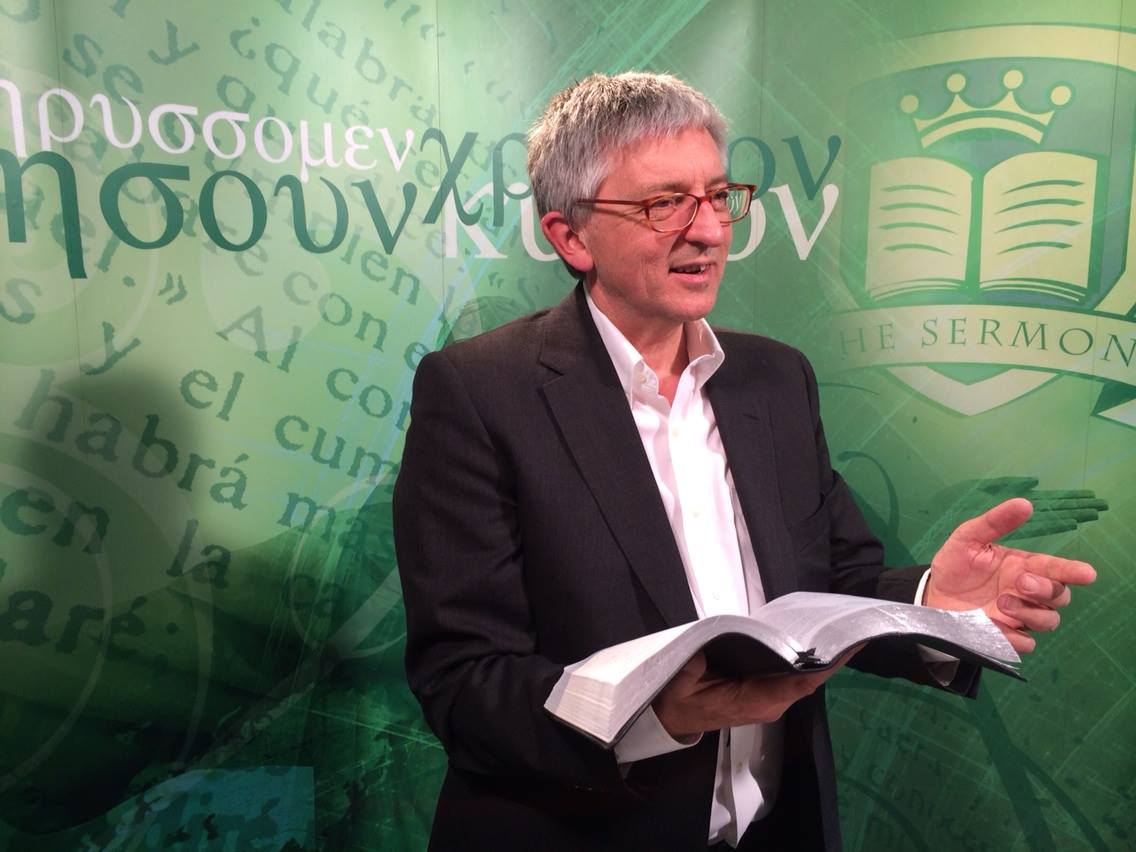
I was recently with Vivid Broadcast, Broadbridge Heath, Sussex, to record six of my sermons on ‘Christ in all the Scriptures’ for ‘The Sermon‘ a ministry of Richard Bewes.
Genesis: Jesus and Abraham’s Sacrifice
Exodus: Jesus and the Passover Lamb
Leviticus: Jesus and the Atonement Sacrifice
Numbers: Jesus and the Bronze Snake
Deuteronomy: Jesus and the Prophet
Joshua: Jesus and the Commander of the Lord’s Army
View the whole series so far here
Vivid have recently won the contract to record the Antique Roadshow.

Jesus is Coming Soon

In July 2006, at the launch of Christians United for Israel, after recorded greetings from President George W. Bush, and in the presence of US Senators and the Israeli Ambassador, Pastor John Hagee from Texas suggested,
“The United States must join Israel in a pre-emptive military strike against Iran to fulfill God’s plan for both Israel and the West … a biblically prophesied end-time confrontation with Iran, which will lead to the Rapture, Tribulation, and Second Coming of Christ.” [i]
Is that what the Apostle Peter had in mind when he said we should “look forward to the day of God and speed its coming”? (2 Peter 3:12). Is this how we “speed Christ’s coming”? Well what did Jesus say? In our series The Passion of Jesus, we have come to Matthew 24. The chapter begins with Jesus’ disciples asking him a question.
“What will be the sign of your coming and of the end of the age?” (Matthew 24:3).
They were dying to know when Jesus would return. And Christians have been speculating ever since. In verse 34, Jesus answers,
“Truly I tell you, this generation will certainly not pass away until all these things have happened.” (Matthew 24:34).
Jesus is Coming Soon from Stephen Sizer on Vimeo.
The problem has been that Christians in every generation since have believed Jesus was referring to their generation. Were they wrong? Well, yes and no. As a young Christian growing up in the 1970s, I was addicted to books on Bible prophecy like Hal Lindsey’s, Late Great Planet Earth. Lindsey insisted the signs of Jesus return were coming true in our generation. Lindsey figured that the return of the Jewish people back to the land after 2000 years, the founding of the State of Israel in 1948, and the capture of Jerusalem in 1967, were signs that Jesus predicted. Since a biblical generation is 40 years, Lindsey speculated that Jesus would therefore return in 1988.
Christianity Explored in Arabic
 Would you like to help make history? South Sudanese Christians have asked for our help to fund the translation of the Christianity Explored course into Arabic.
One of our partners I have worked with in Juba writes,
“there is urgent need to translate the CE material to Arabic to benefit mainly those South Sudanese Christians who came from Arabic background. They are taking their discipleship seriously and they have great impact on other believers in South Sudan.”
We need to raise $1,000 US Dollars to facilitate the translation of the course material by this Summer. In August we hope to return to South Sudan and continue to train church leaders to use the course. If you would like to help make this possible, we would be pleased to hear from you. We are working with the charity Fields of Life to make this happen.
 Here are photos of some of our adventures introducing Christianity Explored in Uganda, Kenya, Burundi and South Sudan.