Category Archives: Sermons

Becoming a Contagious Christian: Motivation

Have you ever wondered how God might start a conversation to get someone’s attention? How about these for starters?

“Please don’t drink and drive. You’re not quite ready to meet me yet.” God

“When you’re weary, feeling small. When tears are in your eyes, I will dry them all.” God

“Can you imagine the price of air if you had to buy it from another supplier?” God

“I was thinking of making the world in black and white . Then I thought naaaah.” God

“If you think the Mona Lisa is stunning, you should look at my own masterpiece, in the mirror.” God

“Don’t’ forget your umbrella. I might water the plants today.” God

“If you missed the sunrise I made for you today, never mind. I’ll make you another one tomorrow.” God

“How can you possibly be a self-made man? I specifically recall making you.” God

“I think you are the most beautiful person in the world. Okay, so I’m biased.” God

If that is how God might start a conversation to get someone’s attention, how might you? How do we become fruitful in sharing our faith? How can we become contagious Christians? That is our theme for the next five Sundays.

It is ironic that the word ‘evangel’ means good news but the word evangelism or evangelist is so often associated with negative connotations. Why is that? We sometimes equate evangelists with men in dark suits with loud voices standing on soap boxes on street corners haranguing passers by.

You may have experienced the kind of teaching that suggests your spiritual maturity depends on how often you witness to others. And like me you may have felt a failure or guilty. That is why I am really excited about this series Becoming a Contagious Christian because we are going to learn an entirely different way of sharing Jesus. No matter what your background, your personality or temperament. It doesn’t matter whether you are an extrovert or an introvert. God has wired us uniquely. In Scripture we find many different examples and approaches to evangelism and I’m confident there is at least one that is natural for you.

By the end of this five week series, my prayer is that every member of Christ Church will:

1. Be sure that they are a Christian.
2. Be able to share their faith naturally using a simple tool.
3. Have discovered their preferred evangelism style.
4. Be able to tell the story of their personal faith journey.
5. Become a contagious Christian among friends & family.

Continue reading

Christ is Risen! He is Risen Indeed. Hallelujah!

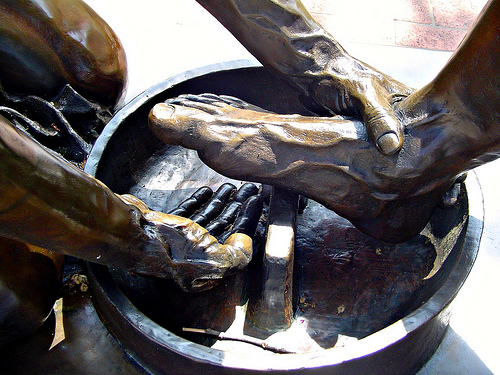
I wonder how many little boys born this year will be called Francis. They say you never get a second chance to make a first impression. And if first impressions matter, Pope Francis created quite a stir on Maundy Thursday.  He washed the feet of laity not just priests. He washed the feet of sinners and not just the righteous. He washed the feet of women and not just men. He washed the feet of a Muslim and not just Christians. Traditionalists angry? Good. They better get used to it. More importantly what impact will it have on church membership? We wait to see.

When you think of ‘membership’ what comes to mind? It probably depends on how exclusive or expensive the membership is, or how badly we want it. There are arts societies, sport associations, health clubs, university alumni and professional bodies. The list of ‘memberships’ is endless, and your wallet is probably full of plastic to prove it.

Some memberships are open to anyone who can pay the fee while others are exclusive and by ‘invitation only’. Locally, there is the Virginia Water Community Association, the Royal British Legion, Savill Gardens and of course Wentworth for those with a passion for golf, tennis or physical fitness. For many people, their membership provides a rich social life in which friendships and common interests can be pursued and shared. What may surprise you, however, is to discover that ‘membership’ is a Christian word. It appears in the Bible to describe how we become members of God’s family.

Continue reading

Why Did Jesus Die?

Good Friday : Why did Jesus die? (Mark 15)

Bertram Russell the philosopher and cynic once said, “most people would rather die than think… and most people do.” He went on to say, “When I die I rot”, which may have been true in his case, but not the whole truth. The reality is most people would rather not think about the one certainty in life. Recently I went to see the World Press Photo exhibition at the Royal Festival Hall. The annual competition takes entries from photojournalists, picture agencies, newspapers and magazines across the world. The winners whose photos are on display were selected from more than 100,000 entries.

I was struck by two things as I walked round: First, by how many of them portrayed people about to die, in the act of dying or afterwards. Second, by how those visiting the exhibition stood in silence, mesmerised by the photographs.  Too much reality is hard to cope with, even in black and white. It’s the same with the biographies of famous people isn’t it? Biographies always dwell on their life achievements but invariably give little or no space to their deaths. That is why it is so striking to discover that in the biographies of Jesus dedicate about one third of their space to the last seven days in the life of Jesus and specifically to the subject of Jesus’ death. Clearly, Jesus was an amazing individual. But why spend so much time dwelling on his death? And further, why is it that the mode of his death—the cross—has become the universally-recognized symbol of Christianity?

The first Christians might have chosen something different to symbolize our faith. For example, they could have chosen:

A manger—to symbolize his birth, or
A scroll—to symbolize his teaching, or
A lamp—to symbolize the light of the world, or
An empty tomb—to symbolize his resurrection.

Continue reading

The Ultimate Example of Loving Service

John Chapters 13-17 are known as the Upper Room Discourse. What is surprising is that in the first twelve chapters of John’s Gospel, Agape, God’s love is mentioned 8x. But in chapters 13-17, it is mentioned 31x. I want us to see the connection between love and service.

1. What Jesus Knew: The Extent of Loving Service

“It was just before the Passover Feast. Jesus knew that the time had come for him to leave this world and go to the Father. Having loved his own who were in the world, he now showed them the full extent of his love. The evening meal was being served, and the devil had already prompted Judas Iscariot, son of Simon, to betray Jesus. Jesus knew that the Father had put all things under his power, and that he had come from God & was returning to God.” (John 13:1-3)

Three things we are told Jesus ‘knew’. First, “Jesus knew that the time had come for him to leave this world and go to the Father.” (John 13:1)  He knew he was rapidly approaching the most important moments of his life. His destiny from eternity past. He knew that the pain, the shame and the agony of the cross was before him.  Here is the question: If you knew that you would die tomorrow, what would you do today? I would spend the time with my family,

I’d write some short letters to family members too far to visit and I’d make sure my will is in order. Not Jesus.  John wants us to see something significant about Jesus. Fully God and fully man, Jesus is facing something we cannot imagine. He doesn’t say to the disciples, “Don’t you care about what I’m facing?”  His focus is not on himself. He is concerned that they be prepared for what’s about to happen. Jesus is focused on them.

Jesus knew the time. Do you? Second, “Jesus knew that the Father had put all things under his power, and that he had come from God and was returning to God;” (John 13:2).

Continue reading

How Can I Overcome Loneliness?

In my Sixth Form at school, there was one girl that stood out. Joy Lovely. While my friends were into scooters and beer, Joy was into Jesus – in a big way. She tried to convert me and my friends on numerous occasions. After I became a Christian at university I wrote and thanked Joy for her prayers.

Joy also played a role in the life of Terry Waite the hostage negotiator. As the Archbishop of Canterbury’s Special Envoy, Waite successfully negotiated the release of several hostages in Iran including John Coleman and Jean Waddell (the secretary to the Iranian Anglican Bishop) in 1980. Four years later he negotiated with Colonel Gaddafi for the release of British hostages held in Libya and again was successful. From 1985 Waite became involved in hostage negotiation in Lebanon, and secured the release of Lawrence Jenco and David Jacobsen. However, he was observed using an American military helicopter to travel between Cyprus and Lebanon. His appearance with Oliver North also meant that he became compromised when the Irangate scandal broke. Against advice, Waite felt a need to demonstrate his continuing trust in the other side.

Continue reading