 Gary Burge has written not one but two short and very readable books for Zondervan – The Bible and the Land and Jesus, The Middle Eastern Storyteller. Both are about 110 pages long, easy to read and bursting with glorious photos and simple maps.
Jesus, the Middle Eastern Storyteller
In Jesus, the Middle Eastern Storyteller, the parables of Jesus come alive as never before when Gary uncovers the culture that gives them their deepest meaning. His expert, illustrated guide shows in everyday terms how the customs, literature and values of the ancient world can inform and grow your faith in today’s digital age.
Storytellers made history, and Jesus was the greatest of them all. But how can modern readers know what he actually meant in such iconic parables as the Prodigal Son and the Good Samaritan? Jesus, the Middle Eastern Storyteller combines the readability of a popular novel and the authority of scholarship to uncover the hidden meaning of references too often misinterpreted or left shrouded in mystery. The first volume in the Ancient Context, Ancient Faith series drives to the heart of readers’ desire to know the culture behind the Scriptures. Colorful maps, photos, and illustrations enhance the context of the times that shaped Jesus’ vivid communication of core truths. This expert guide is an invaluable resource for study groups, teachers, leaders, and inquiring Christians who want to dig deeper and enrich their spiritual life.
The Bible and the Land
In The Bible and the Land Gary offers a rare exploration into the world of the Bible and how its land, culture, and traditions contribute to a unique understanding of a life with God. Insights into numerous biblical passages reveal how cultural assumptions lie behind countless biblical stories.
As the early church moved away from the original cultural setting of the Bible and found its home in the west, Christians lost touch with the ancient world of the Bible. Cultural habits, the particulars of landscape, even the biblical languages soon were unknown. And the cost was enormous: Christians began reading the Bible as foreigners and missing the original images and ideas that shaped a biblical worldview.
This new book by New Testament scholar Gary Burge launches a multivolume series that explores how the culture of the biblical world is presupposed in story after story of the Bible. Using cultural anthropology, ancient literary sources, and a selective use of modern Middle Eastern culture, Burge reopens the ancient biblical story and urges us to look at them through new lenses. Here he explores primary motifs from the biblical landscape—geography, water, rock, bread, etc.—and applies them to vital stories from the Bible.
Listen in on a Q & A with Gary over these two new books:
Q: Does culture always affect one’s understanding of spiritual life?
A: Every community of Christians throughout history has framed its understanding of spiritual life within the context of its own culture. Byzantine Christians living in the fifth century and Puritan Christians living over a thousand years later used the world in which they lived to work out the principles of Christian faith, life, and identity. The reflex to build house churches, monastic communities, medieval cathedrals, steeple-graced and village-centered churches, or auditoriums with theater seating will always spring from the dominant cultural forces around us.
If it is true that every culture provides a framework in which the spiritual life is understood, the same must be said about the ancient world. The setting of Jesus and Paul in the Roman Empire was likewise shaped by cultural forces quite different from our own. If we fail to understand these cultural forces, we will fail to understand many of the things Jesus and Paul taught.
Q: If we fail to consider cultural context, are we in danger of misinterpreting scripture?
A: We must be cautious interpreters of the Bible. We must be careful lest we presuppose that our cultural instincts are the same as those represented in the Bible. We must be culturally aware of our own place in time-and we must work to comprehend the cultural context of the Scriptures that we wish to understand. Too often interpreters have lacked cultural awareness when reading the Scriptures. We have failed to recognize the gulf that exists between who we are today and the context of the Bible. We have forgotten that we read the Bible as foreigners, as visitors who have traveled not only to a new geography but a new century. We are literary tourists who are deeply in need of a guide.
Q: Why did you write the Ancient Context, Ancient Faith series?
A: The goal of this series is to be a guide-to explore themes from the biblical world which are often misunderstood. In what sense, for instance, did the physical geography of Israel shape its people’s sense of spirituality? How did the story-telling of Jesus presuppose cultural themes now lost to us? What celebrations did Jesus know intimately (such as a child’s birth, a wedding, or a burial)? What agricultural or religious festivals did he attend? How did he use common images of labor or village life or social hierarchy when he taught? Did he use humor or allude to politics? In many cases-just as in our world-the more delicate matters are handled indirectly, and it takes expert guidance to revisit their correct meaning.
In a word, this series employs cultural anthropology, archaeology, and contextual backgrounds to open up new vistas for the Christian reader. I wrote the first two volumes of the Ancient Context, Ancient Faith series to connect modern readers with ancient life. If the average reader suddenly sees a story or an idea in a new way, if a familiar passage is suddenly opened for new meaning and application, this effort has succeeded.
Q: Do I really need to understand ancient Middle Eastern culture in order to understand the Bible?
The stories we read in the Bible sometimes presuppose themes that are completely obscure to us (e.g. the scarcity of water; see next question). Moreover, when we read the Bible, we may misrepresent its message because we simply do not understand the cultural instincts of the first century. We live two thousand years distant; we live in the West and the ancient Middle East is not native territory for us.
Q: How does water highlight the simple yet profound differences between ancient Middle Eastern life and ours today?
A: Those of us who live in North America or Europe think little about water. Rainfall averages are generally ample; if anything, we may experience flooding. This is the opposite of life in the Holy Land. The people of the Middle East think about water constantly: it is the “oil” of the Holy Land. And if you control it, you have power. Glimpses of this reality are hidden behind many political struggles. When the rains failed to come during biblical times, the springs dried up and the wells went dry, drought and famine became a reality.
Judaism also distinguished between “living” water (which came from the hand of God via rain, a spring, a river) and common water (held in a cistern or “lifted” by human hand). Many Jewish purification rituals had to take place in such living water; living water had the power to cleanse and purify. So when Jesus offers “living water” to the Samaritan woman at the well, he is offering an inner life-giving spring for cleansing. This significance would not have been lost on a woman who had probably been barred from her community’s ritual baths of purification.
Q: How is an understanding of the Holy Land’s geography, topography, and agriculture vital to interpretation of scripture?
A: The Holy Land itself gives us a window into God’s purposes for life. The Promised Land is not an easy land-it is not paradise, neither today nor in biblical times. The land has a spiritual architecture that incorporates elements we desire (good cities with ample rainfall and rich soil) and things we would prefer to avoid (wilderness). But this is life. And when God brought his people to this land, he built into it those elements that would provide a framework for his people to understand life with him.
The land is itself the cultural stage-setting of the Bible. Biblical stories assume we know something about altars, sheepfolds, cistern water, and the significance if the wind blows west out of the desert. To project European or American notions of farming (seed distribution) or fishing (cast and trammel nets) or travel (at night or day) onto the Bible is to immediately distance oneself from what the Bible may have intended to say.
Q: How did Jesus’ storytelling fit the context of his culture?
A: Jesus lived in a storytelling world and he was well known for his ability as a storyteller. Jesus himself was theatrical, and this was feature of his teaching strategy. Rather than giving a speech about a corrupt temple, he ransacked it. His culture valued the clever image, the crisp story. Jesus himself was clever and in this brilliance, people intuited his sophistication. However, Jesus’ best figurative stories contain a surprise. They are like a box that contains a spring-and when it is opened, the unexpected happens. They are like a trap that lures you into its world and then closes on you.
Q: Do we need to become more like the ancient world in order to live biblically?
A: No, we do not need to imitate the biblical world in order to live a more biblical life. This was a culture that had its own preferences for dress, speech, diet, music, intellectual thought, religious expression, and personal identity. And its cultural values were no more significant than are our own. Modesty in antiquity was expressed in a way we may not understand. The arrangement of marriage partners is foreign to our world of personal dating. Even how one prays (seated or standing, arms upraised or folded, aloud or silent) has norms dictated by culture. There is no ideal cultural standard; we must each learn how to live biblically within the context of our own culture.
Gary M. Burge (PhD, King’s College, Aberdeen University) is a professor of New Testament in the Department of Biblical & Theological Studies at Wheaton College and Graduate School.

 You either love it or hate it but The Office is one of the most successful TV Comedy series of the 21st Century. Called a ‘mockumentary’, its filmed as a ‘fly-on-the-wall’ documentary and set in the offices of Wernham Hogg, a paper merchant in Slough, ironically not far from here. The faster paced US spin-off follows the mundane daily interactions of a group of idiosyncratic office employees at another paper company this time in Scranton, Pennsylvania. Written by Ricky Gervais and Stephen Merchant, and starring Gervais, The Office catapulted him to stardom in 2001, winning two Golden Globes, one for his acting and one for the show itself.
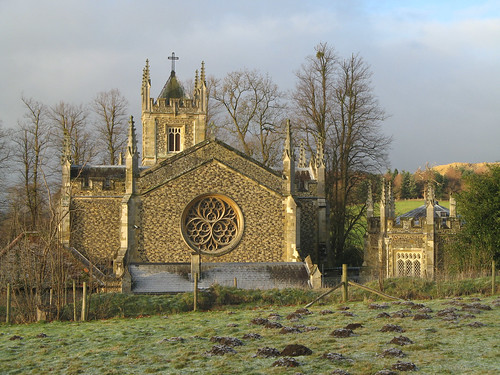 Last night I spoke at the Albury History Society. The subject was “Edward Irving, the Albury Circle and the Origins of the Middle East Conflict”. I explained how the Arab-Israeli conflict could be traced right back to the eccentric views of Edward Irving and his colleagues, who met in the home of Henry Drummond in Albury, Surrey, during Advent 1826. Irving was largely responsible for popularising the notion that God had a separate purpose for the Jewish people apart from the Church and restored to Palestine. John Darby took these ideas further and fashioned them into what became known as Dispensationalism which is now the domnant theological framework of Evangelicals, Fundamentalists and Pentecostals in the USA. It is this constiuency that is underwriting financial and political support for the agenda of the Zionist Lobby, and hence a major obstacle to peace in the Middle East.