Author Archives: Stephen Sizer

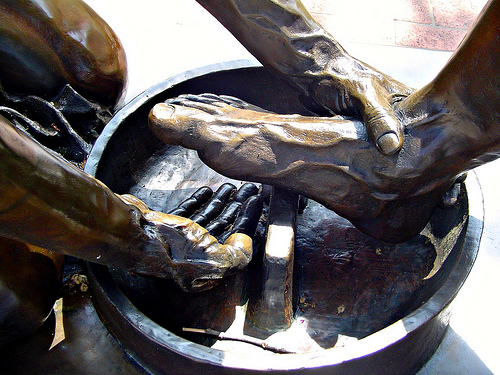
The Ultimate Example of Loving Service

John Chapters 13-17 are known as the Upper Room Discourse. What is surprising is that in the first twelve chapters of John’s Gospel, Agape, God’s love is mentioned 8x. But in chapters 13-17, it is mentioned 31x. I want us to see the connection between love and service.

1. What Jesus Knew: The Extent of Loving Service

“It was just before the Passover Feast. Jesus knew that the time had come for him to leave this world and go to the Father. Having loved his own who were in the world, he now showed them the full extent of his love. The evening meal was being served, and the devil had already prompted Judas Iscariot, son of Simon, to betray Jesus. Jesus knew that the Father had put all things under his power, and that he had come from God & was returning to God.” (John 13:1-3)

Three things we are told Jesus ‘knew’. First, “Jesus knew that the time had come for him to leave this world and go to the Father.” (John 13:1)  He knew he was rapidly approaching the most important moments of his life. His destiny from eternity past. He knew that the pain, the shame and the agony of the cross was before him.  Here is the question: If you knew that you would die tomorrow, what would you do today? I would spend the time with my family,

I’d write some short letters to family members too far to visit and I’d make sure my will is in order. Not Jesus.  John wants us to see something significant about Jesus. Fully God and fully man, Jesus is facing something we cannot imagine. He doesn’t say to the disciples, “Don’t you care about what I’m facing?”  His focus is not on himself. He is concerned that they be prepared for what’s about to happen. Jesus is focused on them.

Jesus knew the time. Do you? Second, “Jesus knew that the Father had put all things under his power, and that he had come from God and was returning to God;” (John 13:2).

Continue reading

Ladies Spring Hike: National Trust Devil’s Punchbowl

Date Saturday 20 April 2013
Time
10am to 4pm
Place
National Trust Devils Punchbowl, Hindhead, Surrey

Meeting Point
Gather in the Christ Church Virginia Water car park for 10 am. We plan to car share and possibly use one Christ Church minibus. Please let us know if you want a lift from the Christ Church car park and back after the walk. We will be leaving the Church Church Virgina Water car park at about 10am with the aim of setting off on the first stage of the walk from the National Trust Devils Punchbowl car park at 1045am.

The Walk
A figure of eight walk. The first half is approximately 2.8 miles. A soup and roll lunch will be provided at the Cafe located at the National Trust Devils Punchbowl car park at approximately 1230pm. We will then aim to set off on the second and final part of the walk at 145pm. There will be an option to walk for 3.1 miles (for a slightly more challenging walk) or a 1 mile walk to Gibbet Hill. We will then return for tea and cake at the Cafe afterward the second leg of the walk for those that would like to (please bring a little money for tea and cake) before heading back to Virginia Water.

 Donation
We would be delighted to receive what ever amount you feel you would like to give. All donations received will go directly towards The Harpswell Foundation and the costs which Rachel has incurred in getting to Phnom Penh. Suggested minimum of £25. The soup and roll lunch will be included. You may want a little money for the tea and cake later on.

Practical considerations
Walk will suit all abilities and will have clear way markings. Individual maps will be provided on arrival. See map photo for detail. The terrain may be muddy and a little hilly so stout footwear is recommended and suitable clothing will be needed for all weathers! Maybe bring a drink and a small snack to share.

The reserved group lunch at the Café will give us a chance to hear from Rachel about her 3 month stay in Phnom Penh and her hopes and ideas as she prepares to go next month!

We are looking forward to the fun of walking together and at the same time helping young women in Cambodia with the chance to have a university education and develop the leadership skills necessary to have a positive impact on Cambodia’s future.

RSVP to Joanna Sizer (Spaces are limited so do hurry)

National Trust Devil’s Punchbowl 

Harpswell Foundation Cambodia

Christ Church Hosts Jews for Jesus

On Palm Sunday we are delighted to welcome Yoel Ben David again as our guest speaker. Yoel was raised by his Jewish Moroccan Mother and Scottish father in England and France. After school in England, Yoel moved to Israel where he met Adel. When they married, Adel and Yoel were Orthodox Jews. A year later, when he was serving in the Israel Defence Force, they became believers in Jesus in Jerusalem.  Yoel joined Jews for Jesus staff in 2004 and since has led several outreaches in France, Israel and the USA and served in the UK during 2009. He returned to the London office of Jews for Jesus in July 2010 to assume his present responsibilities as Head of Evangelism.

See also Yoel on Y’Shua and the Harvest

How Can I Overcome Loneliness?

In my Sixth Form at school, there was one girl that stood out. Joy Lovely. While my friends were into scooters and beer, Joy was into Jesus – in a big way. She tried to convert me and my friends on numerous occasions. After I became a Christian at university I wrote and thanked Joy for her prayers.

Joy also played a role in the life of Terry Waite the hostage negotiator. As the Archbishop of Canterbury’s Special Envoy, Waite successfully negotiated the release of several hostages in Iran including John Coleman and Jean Waddell (the secretary to the Iranian Anglican Bishop) in 1980. Four years later he negotiated with Colonel Gaddafi for the release of British hostages held in Libya and again was successful. From 1985 Waite became involved in hostage negotiation in Lebanon, and secured the release of Lawrence Jenco and David Jacobsen. However, he was observed using an American military helicopter to travel between Cyprus and Lebanon. His appearance with Oliver North also meant that he became compromised when the Irangate scandal broke. Against advice, Waite felt a need to demonstrate his continuing trust in the other side.

Continue reading

The Parable of the Lost Sheep

The Parable of the Lost Sheep from Stephen Sizer on Vimeo.

Why did Jesus tell the story about the lost sheep? Three reasons:

1. To show us how much God loves us
To show how much God cares for us. What does a good shepherd do for his sheep? He feeds them when they are hungry. He protects them when they are afraid. Jesus told the story about a shepherd and his sheep to show us how much God loves us. He also told the story,

2. To remind us that we are like sheep
Sheep easily get lost. And we can too. We go astray. We get into trouble. We get into all kinds of mess and we need someone to help us. Jesus says, a good shepherd searches for his sheep until he finds them. He celebrates with his friends when he finds them. Who has God sent to look after us? Every one of us has one. A mummy! Today we thank God for our Mummies for all they do for us. What are some of the things you want to thank your Mummy for?

They love us even when we are naughty.
They feed us when we are hungry.
They teach us to read and write.
They help us when we get into trouble.
They put us to bed when were tired.

So today we thank God for our Mummies. We all have a Mummy! Whether she lives near or far away, whether she is with us, or now lives with Jesus. God gave them the strong love they have for us, and the wisdom and the strength they need to look after us. Often it is our Mummies lead us to God, by their example, by bringing us to Sunday Clubs, and by their prayers. Today we thank God for our Mummies. So why did Jesus tell this story?

1. To show us how much God loves us!
2. To remind us that we are like sheep.

3. To reveal Jesus is our Good Shepherd
Jesus said, “I am the good shepherd; I know my sheep and my sheep know me… and I lay down my life for the sheep. I have other sheep that are not of this sheep pen. I must bring them also. They too will listen to my voice, and there shall be one flock and one shepherd.” (John 10:14-16).

So where are you in the story? Is Jesus your shepherd? Are you listening to his voice or not? Are you following Jesus or going your own way? Are you lost or found? If you want to know Jesus and be known by Jesus, say this prayer with me…

Dear Lord Jesus, thank you for loving me so much that you came to save me. I am sorry that I have gone astray. Thank you for laying down your life for me. Help me to know you, by listening to your voice and following your lead, for the rest of my life. Amen

How can I live above average?

What are your early memories of school? Most of mine are of annual reports saying I needed to try harder or was pretty average at most things. But at age eleven, all that changed, forever. In the last week of term, for the first time ever, I came first at something. I won the first race of my life – the 800 yard, walking race. Do you know the difference between walking and running? Walking becomes running when both feet are off the ground at the same. In a walking race, one foot has to be on the ground at any time. And although it may be hard to imagine it now, at age 11, I had the natural skinny hip movement necessary to walk with speed.

For the next few days before term ended I bathed in the glory of being a winner. At last I was the best in my year at something and it had been recognised. And I kept the certificate to prove it. I still remember the surge of adrenaline that lasted days. The desire for recognition and affirmation are deep, deep needs. The need is universal. Everyone longs to be recognized for something. Recognition is good for our emotional health.

As young children we say instinctively, “Watch me, Daddy, watch me!” We need to be recognized. We need to be affirmed from an early age. That doesn’t change when we grow up. We just get more subtle in fishing for recognition. We do it with our cars, with our clothing and our homes. All the time we’re saying, “Watch me, accept me, affirm me, appreciate me.” That’s because we have a deep need to be valued and recognised. A healthy self esteem develops, however, when we find an equilibrium between our own emotional needs and those of others. We will however, ultimately only find peace with ourselves when we find our security in a right relationship with God. Because ultimately what he thinks about us is more important than what other people think. If we rely solely on others for our emotional stability, we will never be secure or truly fulfilled. Instead we will remain immature and self centred. When we are secure in our relationship with our God, we can grow up healthily into the unique people He intends us to become. We can then excel. We can thrive. Our short Old Testament reading have probably sold more books per verse than any other in history.

How can I live above average? from Stephen Sizer on Vimeo.

Continue reading

Jesus and Other Faiths

Introduction:

We live in a world in which uncertainty and agnosticism are more valuable than conviction and commitment. People can make their own way to God if they are sincere and determined.  And that everyone should find their own way to God. So my way is just as good as yours.

Sincerity and Truth
Many people think all religions lead to God because they assume that all religions are essentially the same when you reduce them to their core beliefs. They liken the religions to different paths up a mountain, believing that as we approach the summit we realise how much we have in common. But this just isn’t true and only shows they have not looked deeply enough at what the various religions teach. If you let each religion speak for itself, you find they differ greatly on the basic concepts-God, truth, reality, the basic human dilemma and the solution to that dilemma. They differ so much that many of their statements contradict one another. For example, God cannot be both personal, as Christians, Jews and Muslims believe, and impersonal, as Buddhists and Hindus believe. Jesus cannot be a false Messiah as Judaism teaches, a prophet as Islam teaches and the Son of God as Christians believe. Those are contradictory statements. According to the rules of logic, contradictory statements cannot all be true. Therefore, all religions cannot possibly be true. It is a logical impossibility. And if they are not all true, and if they lead us in different directions, then not all of them can lead to God. The Sincerity of adherents of other religions is not in question. You can be sincere but sincerely wrong.

Persuasion and Respect
Some people make this assertion for another reason. They think that it is intolerant to believe only one religion has things right. But this response shows a misunderstanding of what intolerance really is. Intolerance comes from the word “tolerate.” To tolerate means to allow something, such as a belief, to exist even though we don’t like it or agree with it. Tolerance does not mean never disagreeing with anybody. The word implies disagreement. True tolerance means allowing differing views to coexist without necessarily agreeing with them or claiming that all views are true. Therefore, we can hold that one view is true or better than other views without being intolerant or disrespectful. If we were truly intolerant, we would silence other points of view. But merely engaging in persuasive conversation with someone you disagree with is not intolerance. We show more respect for each other when we take our religious claims seriously than when we clothe them in a patronizing cloak of relativism. Continue reading

How Can I Handle Discouragement?

Are you into ‘motivational posters’? I am in a big way. Here are some of my favourites.

  • Ambition: The journey of a thousand miles sometimes ends very, very badly.
  • Pain: Pain is just weakness leaving the body. Sometimes your spirit tags along with it.
  • Distinction: Looking sharp is easy when you haven’t done any work.
  • Mistakes: It could be that the purpose of your life is only to serve as a warning to others.
  • Achievement: You can do anything you set your mind to when you have vision, determination, and an endless supply of expendable labour.
  • Idiocy: Never underestimate the power of stupid people in large groups.
  • Teamwork: A few harmless flakes working together can unleash an avalanche of destruction.
  • Acquisition: The discovery that you’re no longer a big fish in a small pond, or even a small fish in a big pond, but a small fish in a big fish.
  • Madness: Madness does not always howl. Sometimes, it is the quiet voice at the end of the day saying, “Hey, is there room in your head for one more?”

You know what the world’s most deadly but preventable disease is? No, its not cancer. Its not malaria or even AIDS. There is something much more debilitating. It is discouragement. And if you want a quick fix visit www.despair.com

There are three things which make discouragement a deadly disease:

It’s universal. One in four of us will suffer from depression this year. But everyone of us gets discouraged sooner or later. I know I do. I am sure you do. We all do. Its universal.

It’s recurring. You get multiple opportunities to become  discouraged every day. It’s universal. It’s recurring. Thirdly,

It’s contagious. In fact it is highly contagious. My discouragement will infect you and vice versa. It rubs off.

But there is good news. Discouragement is curable. The story of Nehemiah illustrates the causes and cures for discouragement. We are going to see that together, when we join hands, when we work together, when we watch one another’s back, when we encourage one another, we can banish discouragement. We can make a difference.

I invite you to turn to Nehemiah 4 with me. Nehemiah was a leader of the Jewish people. They had returned to Israel from exile in Babylon. They needed to rebuild the walls around Jerusalem to be secure from their enemies. When they first started on the wall, they had fervour, excitement, and zeal.  But after working for a while they got discouraged. Notice the change of heart from verse 6 to 12.

So we rebuilt the wall till all of it reached half its height, for the people worked with all their heart…. Then the Jews who lived near them came and told us ten times over, “Wherever you turn, they will attack us.” (Nehemiah 4:6,12)

Continue reading