Monthly Archives: February 2016

Where do we Worship? The Church Defined

Worship_0A few weeks ago I visited Cairo to preach at St Michael’s and All Angels and to give some teaching on the reliability of the Bible.  It is a very special church family. Their building hosts several congregations including an Egyptian community, two separate expat church families (one Anglican and one non conformist) and two Sudanese congregations one all age and one in their teens and twenties. To accommodate everyone in their heart language, they hold numerous mid-week and weekend services in English, Arabic and Sudanese. The music ranges from the exuberant and informal African, via Egyptian Arabic music to the more laid back Anglican Hymns Ancient and Modern.  And the Anglican priest is called Jos who just happens to be a fluent Arabic speaking Dutchman. Cosmopolitan, international, multi-ethnic.

Not that dissimilar to the picture of the international church of Jesus Christ, the Bride of Christ we find described in Peter’s first epistle. In 1 Peter 2:1-10 we discover how God would have us live in community. We were designed to live in community – to know and be known, to love and be loved, to serve and be served, to celebrate and be celebrated. Peter uses four vivid pictures to describe our relationship to one another in the Church.

Continue reading

The Riches of Poverty

james-c-christensen-the-widows-mite1“Do you not know that God entrusted you with that money (all above what buys necessities for your families) to feed the hungry, to clothe the naked, to help the stranger, the widow, the fatherless; and, indeed, as far as it will go, to relieve the wants of all mankind? How can you, how dare you, defraud the Lord, by applying it to any other purpose?” I wonder if you can guess who said that? John Wesley.

He went on to say ““When a man becomes a Christian, he becomes industrious, trustworthy and prosperous. Now, if that man when he gets all he can and saves all he can, does not give all he can, I have more hope for Judas Iscariot than for that man!” This morning, in our series on Jesus, Mean and Wild, we meet the lady who knew how to handle money. I want us to observe how impressed Jesus is with her rather than her contemporaries. We don’t know her name but we do learn:

True Giving is Unpretentious: Observed by God’s Son
True Giving is Sacrificial: Prized in God’s Economy
True Giving is Reckless: Trusting in God’s Provision

The Riches of Poverty (Mark 12) from Stephen Sizer on Vimeo.

Continue reading

The Prosperity Gospel


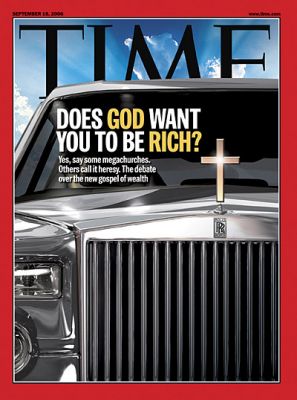
God’s Will is Prosperity, insists Gloria Copeland. “Give $10 and receive $1,000; give $1,000 and receive $100,000. . . . In short, Mark 10:30 is a very good deal.” “Scripture clearly establishes how intensely God desires to display His goodness and His love toward man by pouring out His prosperity and abundance… If you’re a believer, you have a covenant right to prosperity. And not just prosperity but True Prosperity. Now, with Gloria’s detailed study, you can “… discover for yourself that God’s Will is Prosperity.”  And if following Gloria’s advice doesn’t maketime-prosperity-gospel you sufficiently wealthy, Amazon recommends, you also read her husband, Kenneth Copeland’s books, The Laws of Prosperity, and Prosperity, the Choice is Yours.

If the Copeland lifestyle is anything to go by, they are blessed indeed. A recent survey claims Copeland is the richest pastor in the world.[i] Their net worth is estimated at $760 million though he already claims to be a billionaire. Their 1,500-acre ministry campus near Fort Worth includes a church, a private airstrip, a hangar for the ministry’s $17 million jet aircraft, and a $6 million lakefront mansion. Maybe there is something in the prosperity gospel. Gloria quotes from Mark 10 where we meet a very religious and very prosperous young man who wants to follow Jesus. Lets read the story and see what it has to say about the prosperity gospel. Continue reading

Submission: The Heart of Worship

According to the BBC, since the Middle Ages, 14 February is the date we’re encouraged to show our partners even more affection than the other 364 days of the year. Not in some parts of the world though. In places like Pakistan, Malaysia and Saudi Arabia, celebrating Valentine’s Day with flowers, chocolates or a glass of wine could result in severe punishment. In Malaysia, last year, 80 Muslims were arrested by the Islamic morality police for celebrating Valentine’s Day. Officers raided budget hotels in the central state of Selangor and capital, Kuala Lumpur, detaining unmarried Muslim couples who were sharing rooms. The anti-Valentine’s Day campaign by the country’s Islamic authorities goes back to a fatwa (religious ruling) issued in 2005. However, many Malaysians still celebrate the day and other faiths are not affected by the Valentine’s Day boycott in the country. In Pakistan last year, there were clashes at a university in Peshawar over Valentine’s Day. Liberal students were celebrating with red balloons and cake while another group felt such a show was un-Islamic.

Dozens of students threw rocks in the scuffle, leading to gunshots being fired by both sides and rooms in a student dormitory being set on fire. Three students were injured and stones were thrown at police. In Saudi Arabia, Valentine’s Day is banned by the kingdom’s religious police. Women and men sit separately in restaurants and public displays of affection are taboo. However, some shops continue to sell red roses and other traditional Valentine’s presents. One shop owner described how Valentine’s Day orders are placed over the telephone to avoid detection and flowers are hidden in the back of the store. Last August, the decision to sentence five Saudis to a total of 39 years in prison, as well as 4,500 lashes between them, was upheld. The men had been found dancing with six women they were unrelated to on Valentine’s Day. Alcohol and red roses were also seized.[i]

Continue reading

The Real Jesus I Never Knew

20110726p1_01The first event I ever came to at Christ Church, 18 years ago, was an Alpha taster evening. I sat next to a lady and we got talking. Then she asked me “What do you do for a living?” I replied “Guess”. Without batting an eyelid she said, “Well, you are either an estate agent, a vicar or an undertaker.” I replied, “How did you guess?”, She replied “Because I am married to one”. She was in fact a local vicar’s wife.

J. John the evangelist has a better answer. “It’s difficult to know what to say. Because if I say to you that I’m a Reverend, which I am, that conjures up certain images in people’s minds as to what I might be. I like to be a bit creative in telling people what I do. I sat next to this lady on an airplane at Heathrow airport and I said, ‘Hello’, and she said, ‘Hello’. Then I said to her, ‘Where are you going?’ and she said, ‘I’m going to Singapore’. And she said to me, ‘Where are you going?’ and I said, ‘I’m going to Australia’.  I said, ‘What do you do?’ and she told me; then she said to me, ‘What do you do?’ and I said, ‘Well….’ ‘… I work for a global enterprise.’ She said, ‘Do you?’ I said, ‘Yes I do.’ I said, ‘We’ve got outlets in nearly every country of the world.’ She said, ‘Have you?’ I said, ‘Yes we have.’ I said, ‘We’ve got hospitals and hospices and homeless shelters,’ I said, ‘We do marriage work, we’ve got orphanages, we’ve got feeding programmes, educational programmes.’ I said, ‘We do all sorts of justice and reconciliation things’. I said, ‘Basically, we look after people from birth to death, and we deal in the area of behavioural alteration.’ She went, ‘Wow!’ And it was so loud, her ‘Wow!’, loads of people turned round and looked at us. She said, ‘What’s it called?’ I said, ‘It’s called the church … have you not heard of it?’ And that’s it, really, isn’t it – if we are a follower of Jesus then we are part of a global enterprise. But not only is it global, it’s intergalactic, because it includes everyone that’s gone before us.’[i]

The Real Jesus I Never Knew from Stephen Sizer on Vimeo.

Continue reading

What is True Worship?

10497-woman-worship-group-lsIf you have travelled abroad on holiday or for work, you will no doubt have observed a variety of places of worship. Synagogues, mosques, temples, shrines, churches, chapels, cathedrals. Some permanent, some temporary. Some very ancient, some modern. Some ornate and some very simple. And within them, if you have ventured inside, you might have seen Muslims prostrating, Shia’s lamenting, Buddhists meditating, Voodoos dancing, Shintos chanting, Hindus sacrificing, Zoroastrians lighting fires, Jews rocking, Sufis whirling, Shakers… shaking, Catholics kneeling, Mystics contemplating, Pentecostals slaying, and Anglicans doing everything, decently and in order. Colourful, vibrant, diverse. Worship is universal.

Continue reading

Jesus Christ Foretold In All the Scriptures

names-of-jesusYou are invited to discover what the Hebrew scriptures reveal concerning the Lord Jesus Christ. Amazingly, every central character, every key event, every prophecy, every Feast and Festival reveals ever more brightly the person and work of the Messiah, God’s anointed Son.  You will see conclusively that His coming was no accident but part of God’s redemptive plan, revealed from the very beginning and progressively through history and Scripture.

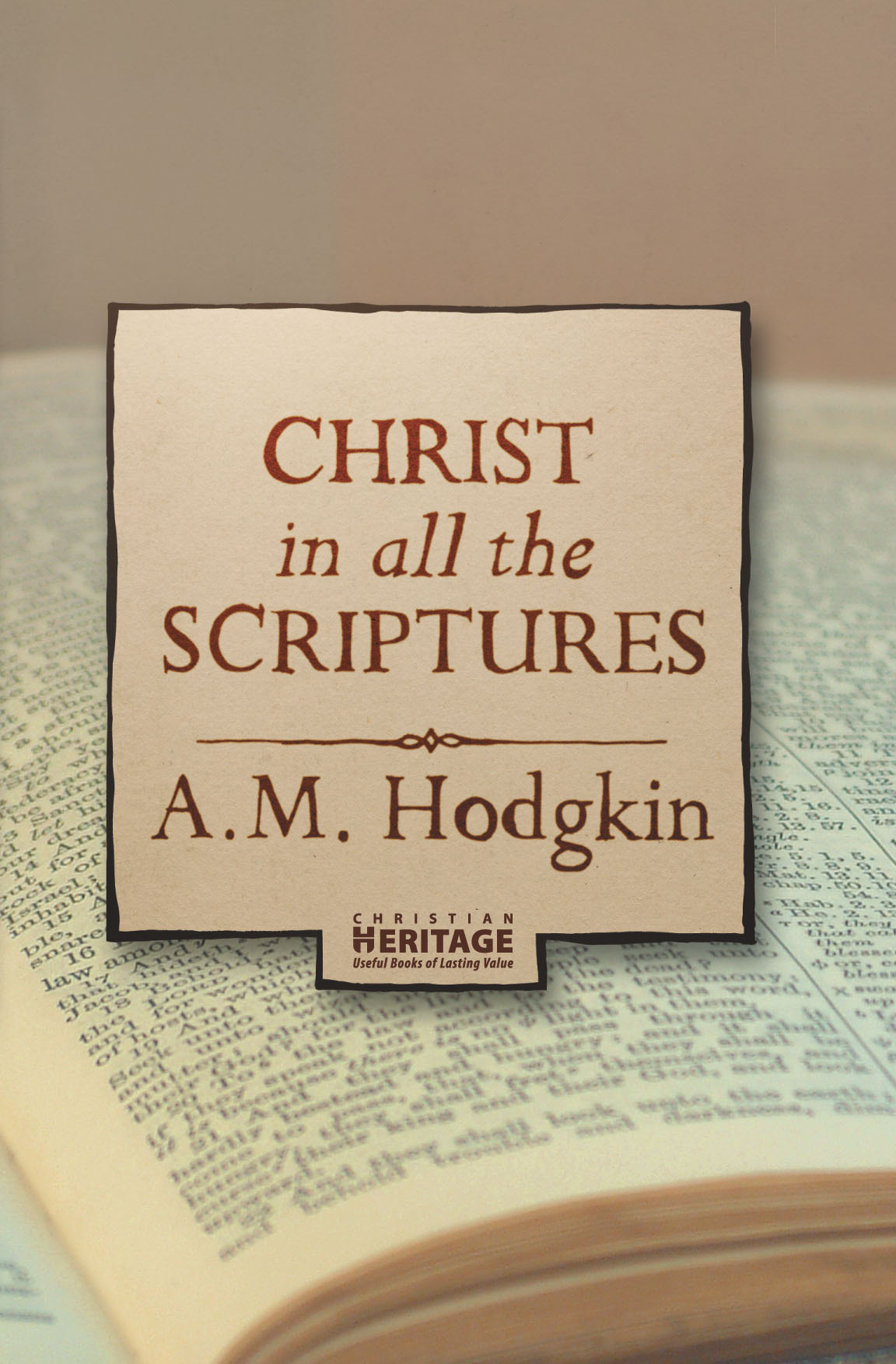
And if you would like to read the book that inspired the series, it is appropriately called Christ in All the Scriptures. Written by A. M. Hodgkin, and first published in 1909, it has rightly become a classic. You can also read the entire book digitally here.

Hodgkin observes, in his introduction “Abraham rejoiced to see My day.” ”Moses wrote of Me.” ”David called [Me] Lord.” (John 8:56; 5:46; Matthew 22:45). We have in these words of our Saviour abundant authority for seeking Him in the Old Testament … To those of us who believe in Christ as truly God, as well as truly Man, His word on these matters is authoritative.”

Christ in all the ScripturesIn the Gospels, Jesus refers to 20 Old Testament characters and quotes from 17 Old Testament books. In Genesis, for example, Jesus refers to creation, the institution of marriage, to Noah, Abraham, Lot, to Sodom and Gomorrah. From Exodus, Jesus speaks of Moses, the burning bush, the Mannah in the wilderness and the Ten Commandments. From Leviticus, the ceremonial and moral law. From Numbers, the bronze serpent. From Deuteronomy, the law of Moses. Then there are references to David, Solomon, Elijah and Zechariah. He confounds his critics not just by quoting Scripture but by identifying himself as the one the Scriptures are speaking about.

“How foolish you are, and how slow to believe all that the prophets have spoken! Did not the Messiah have to suffer these things and then enter his glory?” And beginning with Moses and all the Prophets, he explained to them what was said in all the Scriptures concerning himself… Everything must be fulfilled that is written about me in the Law of Moses, the Prophets and the Psalms.” Then he opened their minds so they could understand the Scriptures.” (Luke 24:25-27; 44-45)

“Today this scripture is fulfilled in your hearing.” (Luke 4:21).

“You diligently study the Scriptures because you think that by them you possess eternal life. These are the Scriptures that testify about me.” (John 5:39).

Continue reading