Category Archives: Bible

Welcome to Babylon

“In the third year of the reign of Jehoiakim king of Judah, Nebuchadnezzar king of Babylon came to Jerusalem and besieged it. And the Lord delivered Jehoiakim king of Judah into his hand, along with some of the articles from the temple of God. These he carried off to the temple of his god in Babylonia and put in the treasure house of his god. Then the king ordered Ashpenaz, chief of his court officials, to bring into the king’s service some of the Israelites from the royal family and the nobility—young men without any physical defect, handsome, showing aptitude for every kind of learning, well informed, quick to understand, and qualified to serve in the king’s palace. He was to teach them the language and literature of the Babylonians.” (Daniel 1:1-4)

Daniel never expected to end up in Babylon any more than you did. Picture Daniel. One of the brightest and best of Israel. Daniel is from a family of high social status. He is physically flawless. He is a strikingly handsome man.  If Joanna were giving this message, she might tell you to picture Daniel Craig. Apparently Daniel is actually much shorter than he appears on screen. So picture someone who looks like Daniel Craig only more handsome and less dumpy. Daniel is bright. He is quick to understand. He is qualified to serve in the king’s palace, which means he has a high level of what we would call ‘emotional intelligence’. He is also devoted to God and God’s people. And he has all the dreams that young men like that have. Back in Judah his future would have been predictable. The whole world is at his feet. He would go to a good university and then on to success in whatever field he chose. He would have a great marriage, live in an enviable home with the right postcode, raise a wonderful family, occupy a prominent place in the community. But life did not turn out the way he planned.

Continue reading

Our Mandate for Creation Care

creation-care-and-the-gospel-reconsidering-the-mission-of-the-churchMark Carney, the Bank of England governor, issued a warning recently that climate change poses a huge risk to global stability. At a gathering of leading insurers at Lloyd’s of London, Mr Carney pointed out that the rapid increase in weather-related catastrophes was causing a spike in financial costs. But he also warned that the challenges currently posed by climate change “pale in significance compared with what might come”. He said our generation has little incentive to avert future problems. Ironically, insurers are among those with the biggest interest in climate change as the syndicates operating at Lloyd’s, the world’s oldest insurance market, are the most exposed to disasters such as hurricanes and floods. Mr Carney said the after-effects of such disasters were likely to grow worse: “The challenges currently posed by climate change pale in significance compared with what might come. “The far-sighted amongst you are anticipating broader global impacts on property, migration and political stability, as well as food and water security.” Who is responsible? We can blame politicians for failing to act sooner. We can criticize multinational corporations for exacerbating climate change through the exploitation of oil, gas and other natural resources. Or we can acknowledge that the Christian Church, which is the largest religious movement in the world, has largely failed to fulfil its responsibility to care for creation. Church leaders have not, until relatively recently, acknowledged that creation care is integral to the gospel.

Continue reading

How to Become an Eco Church

761841There are many different kinds of Church. You can be a member of an Anglican, Baptist, Brethren, Charismatic, Coptic, Episcopal, Methodist, Orthodox, Pentecostal, Presbyterian, Reformed, Roman Catholic or one of hundreds of other denominations including the Strict and Particular.

Some prefer a High Church, a Low Church, a Broad Church, Mega Church or a House Church. In remote places you may have to attend a Virtual Church. In some countries people belong to the Underground Church because they are a Persecuted Church. Many long to have a Junior Church, and aspire to be a Messy Church. But no one wants to belong to a Dead Church. We need to belong to a Bible Church, a Local Church, a Community Church, an International Church, a Gospel Church and a welcoming, friendly, caring, Christ–centred, Holy Spirit filled Church.

And some are realising that God also wants us to be an Eco Church as well. What is an Eco Church? An Eco Church demonstrates by their actions that they care for God’s earth. That is why on Harvest Sunday at Christ Church we are committing ourselves to become an Eco Church.

Increasing numbers of Christians are realising that caring for God’s creation is central to the Christian faith. We may have neglected creation care in the past but we are rediscovering that creation care is one of our God given responsibilities. A’Roche together with Tearfund and the Church of England are teaming up to help us become an Eco Church. This is a talk I gave at the September Family Service.

Continue reading

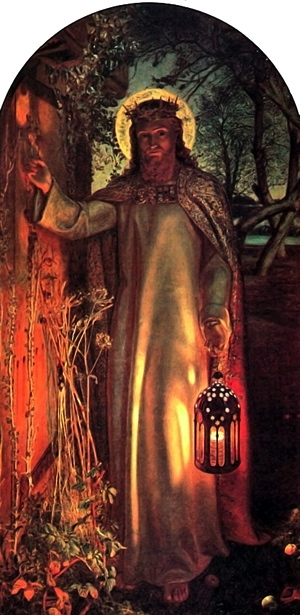
Here I am! I stand at the door and knock

william_holman_hunt_light_of_the_world_300-2Water is pretty amazing stuff isn’t it?  In its natural state we take it for granted. But when its cooled to 0 degrees centigrade it can bring an entire country to a stand still. When heated to boiling point water changes from a liquid to a gas. That is when water takes on a whole new dimension and becomes very, very powerful. Thomas Savery, the British military engineer, was the first to patent a steam engine in 1679. James Watt refined the engine and gave his name to the unit of power generated by the steam engine. A watt is apparently 1/746th of a horse power. For much of the 20th century, our entire rail transportation system was powered by steam.  As a young boy I used to collect the names of the different steam trains that ran between Lowestoft and Liverpool Street, delivering fresh fish to Billingsgate Market and bringing Londoners to the sandy beaches of the Suffolk coast. Steam is still used to catapult jet aircraft from aircraft carriers. The steam catapult with pistons the length of a football pitch, can hurl a 45,000-pound plane from 0 to 165 miles per hour in two seconds.

Great power is realized when water is heated to high temperatures.  But even greater power is released when Christians are on fire for Jesus.  In our concluding study of the seven letters to the Churches of Revelation, the church in Laodicea has the unenviable distinction of being the only one about of which Jesus had nothing good to say. This is the sternest of the seven letters. Unlike the other churches, there is much censure and no praise.

Continue reading

What Life is Really All About

Slide1‘This is the place of my song-dream, the place the music played to me,’ whispered the Rat, as if in a trance. ‘Here, in this holy place, here if anywhere, surely we shall find Him!’ Then suddenly the Mole felt a great Awe fall upon him, an awe that turned his muscles to water, bowed his head, and rooted his feet to the ground. It was no panic terror— indeed he felt wonderfully at peace and happy— but it was an awe that smote and held him and, without seeing, he knew it could only mean that some august Presence was very, very near. With difficulty he turned to look for his friend. and saw him at his side cowed, stricken, and trembling violently. And still there was utter silence in the populous bird-haunted branches around them; and still the light grew and grew.

Kenneth Grahame’s Wind in the Willows is one of my favourite children’s stories. Rat and Mole’s encounter with the Piper at the Gates of Dawn sums up what happens when we recognise the Almighty God as our Creator, as our Shepherd and Lord.

During the Summer we have been exploring Ecclesiastes together. Solomon has encouraged us to identify with those whose world view is secular, whether of an atheist or agnostic. Solomon describes their world view 27x as “under the sun.”

Continue reading

Contentment and Where to Find it

lord-of-the-rings-ring-wallpaper-3Hugh Grosvenor, aged 25, became the most eligible bachelor in the country this week. That is because, on the death of his father, the Duke of Westminster, Hugh inherited a fortune estimated by Forbes to be worth £9 billion. This makes the young Hugh, the third wealthiest landowner in Britain and the 68th wealthiest person in the world. His estate includes 190 acres in Belgravia and thousands of acres in Scotland and Spain. Contented? Wouldn’t you be? 
What price contentment? A fraction of £9 billion you might think.

Well think again. Although the word doesn’t actually appear in our passage this morning, the theme of Ecclesiastes 5 is contentment. In verses 5:8-17, the Lord looks at the world and observes how we buy into a number of myths about money. In verse 17, we are reminded of the consequences: “All their days they eat in darkness, with great frustration, affliction and anger.” (Ecclesiastes 5:17).

Continue reading

Christ the Controversialist: Bringing Division Not Peace

img_FireForGodWhat is your image of Jesus? Where does it come from? Is it the Jesus ‘meek and mild’ of childhood Sunday school? If you read Luke’s gospels from beginning to end in one go, it will take you less than an hour. But you will discover something very profound. Following Jesus in the First Century, any more than now, was not for the faint hearted. It was an uncomfortable, unsettling and hazardous experience. Mark Galli, in his book, Jesus Mean and Wild, observes,

“Nearly everywhere we turn, in the gospel of Mark … we find a Jesus who storms in and out of people’s lives, making implicit or explicit demands and, in general, making people feel mighty uncomfortable.” For example, Jesus “sternly charges” or “strictly orders” people he heals (Mark 1:43; 3:12; 5:43; 8:30); he looks upon religious leaders with “anger” and “grief” (Mark 3:5). He destroys a herd of swine while showing no regret, providing no compensation to the owner (Mark 5:1-20); He overturns the money tables in the Temple in a moment of rage (Mark 11:15-17); He rebukes Peter as demonic (Mark 8:33). He is “indignant” with the disciples (Mark 10:13-14). He says the Sadducees are biblically and spiritually ignorant (Mark 12:24), He describes his entire generation as “faithless” (Mark 9:19). Jesus makes it clear that following him will entail suffering and death (Mark 9:35-37, 43-50). On one occasion, his ‘gospel appeal’ to the crowds included this promise, “Whoever wants to be my disciple must deny themselves and take up their cross and follow me. For whoever wants to save their life will lose it, but whoever loses their life for me and for the gospel will save it.” (Mark 8: 34-35).”

Continue reading

Satisfaction and where to find it

landscape-1431447892-rollingstonessatisfaction“I can’t get no satisfaction
I can’t get no satisfaction
‘Cause I try and I try and I try and I try
I can’t get no, I can’t get no

When I’m ridin’ in my car
And that man comes on the radio
And he’s tellin’ me more and more
About some useless information
Supposed to fire my imagination

I can’t get no, oh no no no
Hey hey hey, that’s what I say
I can’t get no, I can’t get no
I can’t get no satisfaction
No satisfaction, no satisfaction, no satisfaction.”

There are other lyrics but I thought I’d spare you. I think you get the point. “Can’t get no satisfaction” became a hit, way back in 1965, for the Rolling Stones. Co-written by Mick Jagger and Keith Richards, it makes a perfect title for the Book of Ecclesiastes. Aged 72, Mick Jagger appeared in the news again this week, still it seems, seeking satisfaction. He is not alone. I am sure we’ve all had plenty of first hand experience that confirms that satisfaction is temporary.

Continue reading

Humility: The Prerequisite for Service

Humility-CS-Lewis1I have a confession to make. I am a junky. I have a serious addiction problem. I have had it since childhood.  I have not talked about it before. Today I am coming clean.  It has nothing to do with chemical dependency or substance abuse.

But there are no “twelve-step” therapy groups or treatment centres to help me fight it.  Many people are addicted and don’t even know they are. At least I do. And now you do too.

Do you feel any less of me? Because what you think matters to me. And that’s the problem.  Do you know what it is called? “Approval addiction”. It is living in bondage to what other people think about you. When your identity is wrapped up in whether you are perceived to be successful, likable, or acceptable, you are predisposed to this addiction also. Then you too are an approval addict.  John Ortberg says, “no matter how much of this drug you get, you can never have enough. Just like all other junkies, you need more and more.” Henri Nouwen put it like this, “Who am I? I am the one who is liked, praised, admired, disliked, hated or despised.” In other words, I am what other people think I am. If being busy is important , then I must be seen to be busy.  If having money is a sign of success, then I will invest my life in making as much as I can and flaunting it.

Continue reading

Generosity: The Cost of Service

generosity-3One day, a rich dad took his son on a trip to a village. He wanted to show him how poor somebody could be. They spent the day on the farm of a poor family. At the end of the day, the dad asked, “Did you see how poor they are? What did you learn?”  The son replied, “We have a dog, they have four. We have a swimming pool, they have a river. We have lanterns at night, they have stars. We buy our food, they grow theirs. We have mobile phones, they have friends. We have computers, they have the Bible. As they headed back, the son said, “Thanks, dad, for showing me how poor we actually are.” In our sermon series on serving our theme is generosity. From 2 Corinthians 8, we are going to see that:

Christian giving is an expression of the grace of God (2 Cor. 8:1-7)
Christian giving is inspired by the cross of Christ. (2 Cor. 8:8-9)
Christian giving reflects our unity in the Spirit (2 Cor. 8:10-15) Continue reading