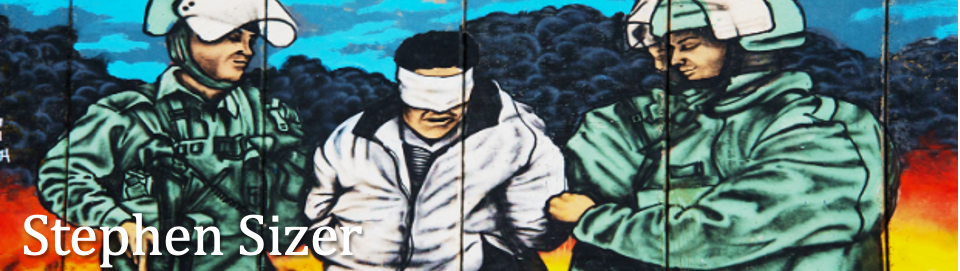
The Road from Jericho to Jerusalem is just 14 miles. A half-day’s journey, uphill all the way. Bethany is just on the other side of the Mount of Olives. A natural place to stop and rest before the final ascent and panoramic view of all Jerusalem. But it is not the road that should capture our attention. Dusty roads through dramatic scenery were as common then as now, indeed little has changed. Israeli checkpoints, barbed wire, military settlements and the Separation Barrier have replaced the Roman garrisons but it is still Occupied Territory. It is ironic that if Jesus were born in Blackpool he would have no problem getting from Jericho to Jerusalem today. But because he was born in Bethlehem he would not be able to make the journey to the Mount of Olives, let alone join the Palm Sunday procession into the Old City. Like thousands of West Bank Christians he would be unable to visit Jerusalem today. He would be turned back at a military checkpoint – because he was born in Bethlehem. Pray for your brothers and sisters today in the Holy Land who are denied the most basic of human rights – freedom of movement, freedom to worship, freedom to live in the land of their birth. In March, Bethlehem Bible College is hosting an international conference called “Christ at the Checkpoint” with Lynn Hybels, Tony Campolo and many other evangelicals. Come and meet Christ’s family living at the checkpoints.
Richard Bewes, former Rector of All Soul’s, Langham Place, London, spoke at Christ Church, Virginia Water on Mission Sunday, 10th January 2010. In this sermon he draws out four principles of mission from the Apostle Paul’s encounter in Athens recorded in Acts 17.
In this sermon, he considers the mission lessons learnt from the story of Caleb in Joshua, and in particular, Caleb’s drive and energy, even as an 85 year old, to claim the promises of God.
I wonder whether you saw the New Year in at a party? When people have had a glass or two you often find out what they really think. I heard of a guest at a rather noisy party, who approached his hostess to complain, “I find the whole situation absurd,” he shouted rather loudly over the din, “no-one here seems to realise how silly they look all dressed up, how pathetic their little lives really are, their behaviour is so grotesque…their small talk is so…so superficial…” “Ah,” said the hostess, smiling sweetly, “you must join the sociologists in the far corner. The rest of us realised all that a long time ago but we decided to ignore it and just enjoy the party….” Ecclesiastes was written by a man who decided not to ignore reality any longer but joined the deviants in the corner who are confronting the absurdity of life. And he invites us to listen in on their conversation. The first verse suggests this is the work of King Solomon but most commentators doubt it. The writer gives himself the name qoheleth which is translated teacher (TNIV) or preacher (ESV). For convenience, I am going to assume it is Solomon. What matters is that we read this as an autobiographical journey by someone in search of meaning in life. In the opening chapter, Solomon introduces us to three people, a scientist, an historian and a philosopher, who each help him to answer the ultimate question, “Is life worth living?”
And Solomon gives us his answer in verse 2, even before asking the question. “Meaningless! Meaningless!” says the Teacher.
“Utterly meaningless! Everything is meaningless.” (Eccl.1:2)
This is like a detective novel in which the writer begins by telling you who did it then proceeds to reveal how they did it and how the clues fit together. While popular in fiction, few people are really comfortable with this “Sherlock Holmes” style of ruthless elementary deduction when applied to real life.
During the Spring when we explore Ecclesiastes together, we are going to unmask some of our fantasies and take off our rose tinted spectacles. Ecclesiastes does not allow us to escape back into our Disney make-believe world where the blood is only tomato ketchup, and everyone rides off into the sunset, living happily ever after.
A hard look at life can be very disconcerting. Have you noticed the way the TV news typically ends? The news will move from a story about army casualties through a road side bomb in Afghanistan, to a suicide bombing of a mosque in Pakistan, to the latest revelations of Iran’s clandestine nuclear programme to a devastating cyclone in the Philippines, then, almost without a pause, we move to the latest cricket and rugby scores, and then with a smile and a shuffle of papers we end “on a lighter note” with a trivial or eccentric story with a happy ending… and in a millisecond it’s straight into the make-believe world of the adverts. T.S. Eliot rightly warned that “humankind cannot bear very much reality.”
But bear it we must if people are to realise that the message of Jesus Christ is good news. You cannot save a drowning man if he does not realise his predicament. Francis Schaeffer, the most influential 20th Century Christian philosopher, once wrote,
“There is a time, and ours is such a time, when a negative message is needed before anything positive can begin…People often say to me, “What would you do if you met a really modern man on a train and you had just an hour to talk to him about the gospel?” I would spend forty-five or fifty minutes on the negative, to show him his real dilemma-to show him that he is more dead than even he thinks he is…Then I would take ten or fifteen minutes to tell him the gospel…Unless he understands what is wrong, he will not be ready to listen, and understand the positive.”
This is the stance that Ecclesiastes takes. Solomon drags us through the pointlessness of life without God, often with great humour. We greatly misunderstand this book if we imagine that Solomon is merely a cynic. He never lets us forget that the posture he is taking is not a divine viewpoint. Rather it is the rationale of a secular person looking at the world with all its problems, horizontally. Or, as Solomon puts it 27x from “under the sun.” He does not accept these secular assumptions. He is deliberately putting on the mantle of the secular mind to force us to think the way the world thinks, and takes us to the logical end of such a world view.
It may be uncomfortable, even disconcerting, to deliberately try and imagine the world without God, but this we need to do if we are to identify with our family and friends who avoid God.
Who think the Church irrelevant. We are going to find that Ecclesiastes will help us a great deal to get into the mind of the unchurched Harry and Mary. There are some amazing similarities between cultures separated by thousands of years and thousands of miles. Human nature does not change with the colour of the skin. Solomon, would have concurred with the view of Black Elk, the great Sioux religious leader, “Everything an Indian does is in a circle”,
he said, “Even the seasons form a great circle in their changing and always come back again to where they were. The life of a man is a circle from childhood to childhood.” For centuries, wise people in different cultures have been pondering the mysteries of the “circles” of human life. Whenever you use phrases like “life cycle“, or “the wheel of fortune,” or “come full circle,” you are taking a cyclical view of life and nature. If life is only part of a great cycle over which we have no control, what’s the point? Why carry on? “Eat, drink and be merry…” (Eccl. 8:15). While much of the world, for most of the time ignores such questions, pretending life is one long party, lets return to the corner of the room and overhear the conversation between Solomon and his friends, a scientist, an historian and a philosopher, debating the ultimate question. Solomon looked at the cycle of life “under the sun” and he came to three bleak conclusions.
From the view point of the scientist, nothing in life is changed (1:4-7); in the opinion of the historian nothing is new (1:8-11), and in the experience of the philosopher, nothing is understood (1:12-18).
Websites store cookies to enhance functionality and personalise your experience. You can manage your preferences, but blocking some cookies may impact site performance and services.
Essential cookies enable basic functions and are necessary for the proper function of the website.
Name
Description
Duration
Cookie Preferences
This cookie is used to store the user's cookie consent preferences.