Monthly Archives: January 2009

The Welcoming Committee in the Kingdom of Heaven

I defy you to watch this video without tears coming to your eyes. As BabyBlue put it on her blog, “the Lord doesn’t leave us where He finds us, but lifts us up and transforms our lives – therefore is anyone is in Christ they are a new creation, the old has passed away, behold, all things become new (II Cor. 5:17).

She writes, “If we were to write a cardboard testimony, what would it say? What do we want it to say? Do you believe God can do it? Through you? In you? Yes, He can. Yes, He will. All we need to do is ask – that’s all. We simply ask Him to come into our life and make us new. “Come into my life, Lord Jesus, and make me new.” No matter how long, or how short we’ve been following Jesus – or even if we haven’t followed Jesus at all – that prayer changes everything.” I can’t better that so I won’t.

Grace and Peace: An Introduction to Philippians

“Why is it that we rejoice at a birth and grieve at a funeral? It is because we are not the person involved.” That was Mark Twain. Here is another of his ditties on grief and joy.
“Grief can take care of itself, but to get full value of a joy you must have somebody to divide it with.” Mark Twain was a professional humorist. His lectures and writings have made people laugh all over the world. He had that rare gift of enabling people to forget their troubles, at least for a time. Yet Mark Twain was himself, in private a man whose life was broken by sorrow.  When his daughter Jean died suddenly of an epileptic seizure, Twain, too distressed even to go to the funeral.

He said to a friend, “I have never greatly envied anyone but the dead. I always envy the dead.”  Many of the people who have brought the most happiness to the world have been people who have suffered deeply.  Isaiah the prophet described Jesus Christ as “A Man of sorrows acquainted with grief” (Isaiah 53:3). Yet we know from the Gospels that Jesus possessed a deep and lasting joy. As He faced the cruel death of Calvary, Jesus said to His followers, “I have told you this so that my joy may be in you and that your joy may be complete.” (John 15:11).  Hebrews tells us “For the joy set before him he endured the cross, scorning its shame.” (Hebrews 12:2). Indeed, Jesus explained that while his friends would grieve when he died, his resurrection would bring them lasting joy,

“Very truly I tell you, you will weep and mourn while the world rejoices. You will grieve, but your grief will turn to joy…I will see you again and you will rejoice, and no one will take away your joy… Ask and you will receive, and your joy will be complete.” (John 16:20-22, 24).

So, one of the consequences of coming to know God as our loving Heavenly Father through the Lord Jesus Christ, of having the assurance of sins forgiven, of eternal life, of the indwelling, empowering, equipping, baptising, filling of the Holy Spirit – is the joy, the joy of Jesus. After love, the second fruit of the Spirit. Joy. Yet it seems we don’t always take advantage of this privilege. We live under a cloud of discouragement, of disappointment, even of despair, dependant on our circumstances, on the newspaper headlines, on the weather, on other people, when we could and we should be experiencing deep seated joy of Jesus.  What robs us of this joy?

The answer to this important question is found in Paul’s intensely personal letter to the Philippians. In just 104 verses Paul uses the personal pronoun no less than 100 times. Not because he is being boastful or having to defend his apostleship. No, he is writing to friends who have been loyal and generous and he cares passionately about their welfare in a hostile and increasingly menacing world.

With the prospect of a very challenging year ahead, when pundits are comparing this recession to the Great Depression of the 20s and 30s, there is good reason for studying Philippians together on Sunday mornings in the Spring.

Read more here

A Prayer for Gaza

O God our prayer today is more like an inarticulate cry and our hearts ache. We saw a man in Gaza weeping beside his three little dead children – innocent beauty now bloodied in death

A massacre that started on the eve of Holy Innocents Day claims more and more women and children’s lives.

UN schools bombed, where families had sought refuge.

The people of Gaza with nowhere to run.

They are imprisoned under a harsh siege, bombed by the most sophisticated new weapons and then attacked in their own streets and houses.

O God where can they find refuge. No one has listened to their suffering for over 60 years.

O God of the oppressed and suffering we see you in the wounded of Gaza – we hear your cries of pain – we share your tears. May we never be silent in the face of such pain.

O God may world leaders at last hear the cries of the children and the suffering of Gaza.

May the siege be removed. The gates be opened. May they be allowed to have food, water, medicine, human rights, dignity, justice, democracy.

O God hear the cry of Gaza.

May freedom come – may healing come – may hope come.

May they be treated as we would like to be treated.

And we pray for the people of Israel because there will be no peace for them until the occupation ends and the siege is over – no peace for them until justice comes to Palestine.

And we pray that peace will come soon and that each person will recognise the value of the other and Israel and Palestine become a Holy Land once more.

Amen.

Garth Hewitt
Director, Amos Trust
Canon, Jerusalem Cathedral

January 2009, www.amostrust.org

Christian Zionism: Christian Bookshops Directory Book of the Month

A review by Phil Groom

Israel’s crimes against humanity must always be seen against the backdrop of the equally terrible crimes of humanity against Israel. But does this make those crimes — its ongoing abuse of the Palestinians and, as I revisit this review at the beginning of 2009, its current assault on the Gaza Strip — any less offensive? Personally, I think not: I originally wrote this review for Evangelical Quarterly in August 2006, during Israel’s war of vengeance against Hezbollah in Lebanon. More than two years later, have any lessons been learned? Has anything changed? It seems not. Apart from these introductory paragraphs, then, this review also remains unchanged, and Sizer’s book remains as relevant and necessary today as it was when originally published.

James warns us (James 3:1) that those who teach will be judged all the more harshly; and similarly, those who represent God to the world will surely be held to even greater account than those who do not know him. This, if it applies to any nation, must surely apply to Israel if they are indeed God’s chosen people.

Hamas’ and Hezbollah’s crimes not withstanding, the State of Israel’s ongoing abuse of the Palestinian people and its neighbours in Lebanon is without a shadow of doubt both a crime against humanity and an offence against God. And the tendency of many Christians to give uncritical support — or even open endorsement — to Israel’s apartheid and wholly disproportionate policies is an aberration that compounds that offence.

If you’re a Christian Zionist you’ll find those opening paragraphs extremely troubling. Are we not, as Christians, required to support the State of Israel? Are not the Jews God’s chosen people? Surely those who bless Israel will be blessed and those who curse Israel will be cursed (Genesis 12:3) — and aren’t statements like these anti-semitic anyway?

Yet as I read this book and observe the current situation it’s difficult to draw any other conclusion. I was brought up in a Brethren assembly, taught to read the Bible from within a dispensationalist framework, and although (as far as I remember) the term “Christian Zionist” was never used, its essence informed my thinking. It took a trip to Israel and time spent with Palestinian Christians, seeing the oppression first-hand, to bring home to me how distorted my thinking was.

Sizer’s experience, it seems, has been similar, describing himself in his introduction as a young Christian ‘devouring Hal Lindsey’s best-selling book, The Late Great Planet Earth, and hearing in person his lectures on eschatology’, then, after a pilgrimage to the Holy Land — ironically, organised by some ‘Christian Zionist friends’ — experiencing a ‘radical change in perspective.’ (p.9-10).

Many Christians will never have an opportunity to visit Israel in person, but Sizer has done a magnificent job in this book, presenting us with a comprehensive overview of Christian Zionism’s variant streams, historical developments and theologies which allows anyone willing to approach the subject with an open mind to make their own assessment. This is supported by a number of helpful charts comparing, for example, the historical development of Christian Zionism since 1800 (p.105) and the different types of Christian Zionism (p.256-257). His analysis is careful, detailed and meticulous, a distillation of his doctoral thesis, which takes his readers through the movement’s history (chapter 1), examining its theological emphases (chapter 2) and exposing its political implications (chapter 3) to finally emerge (chapter 4) with “Biblical Zionism: a covenantal alternative”, an approach that does justice to both the old covenant under Abraham and the new covenant under Christ and offers hope to Jew and Palestinian alike, eschewing violence and leaving no room for anti-semitism.

Each chapter is broken down into manageable subsections and ends with a concise summary of the arguments presented therein, allowing even an impatient reader to benefit and a more patient reader time to pause and take stock.

Sizer’s final conclusions are — for this reader at least — inescapable:

…the choice is between two theologies: one based primarily on the shadows of the old covenant; the other on the reality of the new covenant. In identifying with the former, Christian Zionism is an exclusive theology that focuses on the Jews in the land rather than an inclusive theology that centres on Jesus Christ, the Saviour of the world. It consequently provides a theological endorsement for racial segregation, apartheid and war. This is diametrically opposed to the inclusive theology of justice, peace and reconciliation which lie at the heart of the new covenant. (p.260).

A glossary of terms, appendix (‘Challenging Christian Zionism’, a statement from Sabeel, the Palestinian Liberation Theology Centre in Jerusalem), eleven pages of bibliography and three indices (people, subjects and biblical references) round the book off, whilst footnotes throughout, rather than endnotes, help to keep the entire volume as reader-friendly as possible. This is a book that deserves the widest possible readership. No one who has a concern for the Middle East should ignore the issues raised; to do so is — returning to Sizer’s introduction — ‘nothing less than to perpetuate the evil of the Levite in the Parable of the Good Samaritan who walked by on the other side.’ (p.13).

The time for silence is over: those who are Israel’s true friends must speak out against Israel’s behaviour before this nation pushes itself over the brink and into Armageddon.

Phil Groom, January 2009

Phil Groom is this site’s Webmaster and Reviews Editor. He’s a regular contributor to Christian Marketplace magazine and is the manager of London School of Theology Books & Resources. Any opinions expressed here are personal and should not be taken as representing the views of London School of Theology or of any other group or organisation.

Statement by the Patriarchs and Heads of the Churches in Jerusalem on the current devastating situation in Gaza


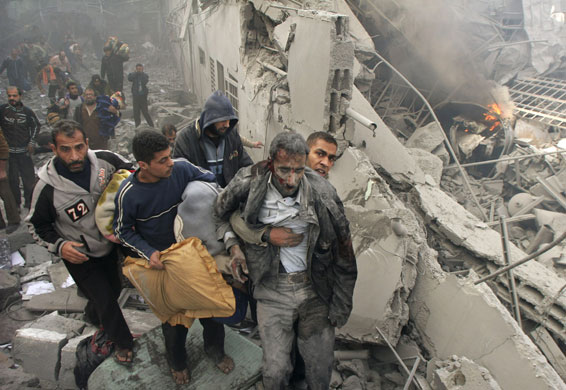
Photograph: Adel Hana/AP

We, the Patriarchs, Bishops and the Heads of Christian Churches in Jerusalem, follow with deep concern, regret, and shock the war currently raging in the Gaza Strip and the subsequent destruction, murder and bloodshed, especially at a time when we celebrate Christmas, the birth of the King of love and peace. As we express our deep sorrow at the renewed cycle of violence between Israelis and Palestinians and the continued absence of peace in our Holy Land, we denounce the ongoing hostilities in the Gaza Strip and all forms of violence and killings from all parties. We believe that the continuation of this bloodshed and violence will not lead to peace and justice but breed more hatred and hostility – and thus continued confrontation between the two peoples.

Accordingly, we call upon all officials of both parties to the conflict to return to their senses and refrain from all violent acts, which only bring destruction and tragedy, and urge them instead to work to resolve their differences through peaceful and non-violent means.

We also call upon the international community to fulfill its responsibilities and intervene immediately and actively stop the bloodshed and end all forms of confrontation; to work hard and strong to put an end to the current confrontation and remove the causes of conflict between the two peoples; and to finally resolve the Israeli-Palestinian conflict with a just and comprehensive solution based on international resolutions.

To the various Palestinian factions we say: It is time to end your division and settle your differences. We call on all factions at this particular time to put the interests of the Palestinian people above personal and factional interests and to move immediately toward national comprehensive reconciliation and use all non-violent means to achieve a just and comprehensive peace in the region.

Finally, we raise our prayers to the Child in the manger to inspire the authorities and decision makers on both sides, the Israelis and Palestinians, for immediate action to end the current tragic situation in the Gaza Strip. We pray for the victims, the wounded and the broken-hearted. May the Lord God Almighty grant all those who have lost loved ones consolation and patience. We pray for all those living in panic and fear, that God may bless them with calm, tranquility and true peace.

We call on all to observe next Sunday, January 4, as a day for justice and peace in the land of peace.

+ Patriarch Theophilos III, Greek Orthodox Patriarchate
+ Patriarch Fuad Twal, Latin Patriarchate.
+ Patriarch Torkom II, Armenian Apostolic Orthodox Patriarchate.
Fr. Pier Battista Pizzaballa, ofm, Custody of the Holy Land
+ Anba Abraham, Coptic Orthodox Patriarchate.
+ Archbishop Swerios Malki Mourad, Syrian Orthodox Patriarchate.
+ Abune Matthias, Ethiopian Orthodox Patriarchate
+ Archbishop Paul Nabil Sayyah, Maronite Patriarchal Exarchate.
+ Bishop Suheil Dawani, Episcopal Church of Jerusalem & the Middle East.
+ Bishop Munib Younan, Evangelical Lutheran Church in Jordan & the Holy Land.
+ Bishop Pierre Malki, Syrian Catholic Patriarchal Exarchate
+ Bishop Youssef Zre’i, Greek Catholic Patriarchal Exarchate.
Fr. Raphael Minassian, Armenian Catholic Patriarchal Exarchate

Read John McArthy If it were your home, what hope restraint? and Ilan Pappe Israel’s Righteous Fury and its Victims in Gaza

The Narrow Gate of Justice: Sabeel Statement
Pirates of the Mediterranean: Gaza Update
Photos of Gaza

The Christians of Gaza

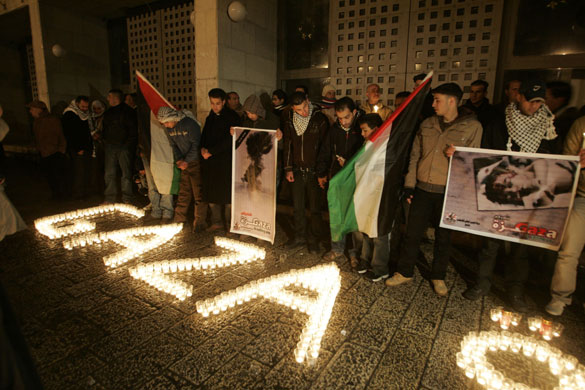
Photograph: Musa Al-shaer/AFP/Getty Images

A little known fact is the presence of a small but significant Christian Palestinian presence in Gaza. Gerald Butt wrote about them in Life at the Crossroads: History of Gaza. Read a review here.

Carl Moeller of Open Doors has just sent this news and prayer update on their plight.

“As an estimated 10,000 Israeli ground troops invaded Gaza today, the small community of Christians are drawing strength from their faith in God. Last week’s attacks left over 400 dead and 2,000 injured and the numbers are expected to dramatically increase.

According to reliable reports, the Gaza Baptist Church building was still standing this morning but has had some of its windows shattered by the bombings. Some Christian families left Gaza for Bethlehem over the holidays and are now separated from their loved ones with the border sealed. Many of the hospitals, already lacking basic medicines and medical equipment, are overwhelmed with the casualties and often are without power.

This is serious trouble for Christians in Gaza. Even before the recent end to the ceasefire (December 19) and the bombings, the estimated 3,000 Christians in Gaza have been living in fear from threats from Islamic militants.

Please join me in prayer for these brave Christians in Gaza in the wake of this new outbreak of violence. Pray that the war between Israel and Palestine is shorter and less devastating than what military and political speculators around the world are predicting. Pray that Christian families will be reunited. Pray that the Gaza Baptist Church building will be spared from the bombs.

Earlier this year one believer in Gaza stated: “Seventy percent of the Christians want to leave Gaza because they are very afraid. But we love Gaza. It’s our country, we have roots here, our homes are here. We will not know anyone if we go somewhere else.”

Pray that the seeds Brother Andrew sowed with Hamas and other prominent militant groups and the Gazan Christians sowed throughout the years when the Palestinian Bible Society actively shared God’s love with Muslim friends and neighbors will bear fruit. May their offerings of Christ’s love result in peace and God’s glory. Please check our website at http://www.opendoorsusa.org/ for updates.

In Christ our hope,
Carl Moeller

Dr. Carl A. Moeller
Open Doors USA President/CEO

x

Read John McArthy’s excellent piece in the Independent If it were your home, what hope restraint?

Also:

The Narrow Gate of Justice: Sabeel’s Statement
Statement by the Patriarchs and Heads of the Churches

Pirates of the Mediterranean: Gaza Update

More photos of Gaza

Building Community to Defeat Extremism

Remember that phrase in the film Miss Congeniality when all the beauty contestants are asked what is the one most important thing our society needs? They all reply “world peace” and the crowd cheers ecstatically. What is your wish for Virginia Water in 2009? Sounds a little more specific than your hopes for the entire world doesn’t it?

Focussing on Virginia Water moves us from generalities to responsibilities, from what we hope others will do to what we can do. And sometimes it only takes one person’s initiative. I hope you too were inspired by PC Elaine Bryant’s initiative to get the first ever Virginia Water community Christmas trees up. I kept thinking two things – first, why hadn’t we done it before and second, see what a person with vision and determination can achieve in a few weeks to bring us together.

OK, we are only talking about two Christmas trees with lights for heaven’s sake but that is not the point. Judging by the hundreds of people who turned out on a cold wet evening, including families with small children and senior citizens, to sing carols, drink mulled wine and eat mince pies and ginger bread men, perhaps PC Bryant’s initiative struck a chord in a lot of us. We certainly had more police officers in Virginia Water than I have ever seen before.

So what is my hope for Virginia Water in 2009? To see you and everyone else in the community come to know Jesus as your friend and leader. That is my first hope and prayer. If you want to know more, come along any Sunday at 9:30, 11:00 or 6:30.

My second hope is to see us as a community grow closer together in the year ahead. With the recession beginning to bite harder and forecast to last at least a year, with the steady rise in radical political and religious extremism, anti-social behaviour and the threat of terrorism ever before us, the temptation in 2009 will be to retreat into our shells or begin to blame others for our woes.

Remember Oswald Mosley and his Black Shirts that fed off the back of the Great Depression? How do we avoid it ever happening again? If we are tempted to think it could never happen here, we need to think again. I was pleased to see that the Holocaust Research Centre of Royal Holloway University are collaborating with German educational institutions in a conference this month in Berlin on holocaust perpetrators. The conference will address how and why ‘normal’ people become genocide perpetrators.

With the leaking in November of the names, addresses and occupations of the 12,000 members of the British National Party (BNP), media attention, has focussed on the handful of police officers, teachers and soldiers so identified. While membership of the political party is entirely legal, certain occupations are banned from being members of the BNP.

I was encouraged by two aspects of the incident. First, membership of such parties is still perceived to be an embarrassment to the majority of people in Britain. Second, given legitimate concerns over evidence of institutional racism and anti-semitism I was relieved that so few Christian leaders were listed.

Ben Wilson, a spokesman for the Church of England, said in November. “The church’s General Synod passed a motion in 2004 stating that any political movement that seeks to divide our communities on the basis of ethnicity is an affront to the nature of God revealed in creation and scripture and is a grave danger to harmonious community relationships; consequently voting for and/or supporting a political party that offers racist policies is incompatible with Christian discipleship.”

So how do we combat religious and political extremism and build community here in Virginia Water? Here are three ideas:

1. Support the Virginia Water Community Association; the Royal British Legion; our three local schools PTA’s and governing bodies at Trumps Green, Christ Church and St Ann’s Heath; the Scouts, Cubs, Guides and Brownies; the Library; the Help the Aged charity shop; and further afield, White Lodge and St Peters Hospital. There’s also the lobby against the incinerator at Trumps Farm. I am sure you can think of others.

2. Volunteer to serve in the community. At Christ Church, we encourage every member to volunteer at least an hour a week in the church and community – with things like a monthly senior citizen’s lunch club and Scallywags and Cherubs toddler groups. If everyone in Virginia Water volunteered an hour a week to the community, it would be the equivalent of employing 18 people. Two hours each and it would be the equivalent of employing 36 people. A sign of a healthy community is how well it cares for the most vulnerable – whether in terms of gender, health, age or race. How do you think we are doing?

3. Support community based events in 2009. There will hopefully be the VWCA Carnival Capers, the open air Summer art exhibition, the school productions and Fayres, the Polo Championship, the Wentworth bonfire, the Remembrance Sunday wreath laying, and now the Christmas tree lighting. At Christ Church we have added annual events like Mothering Sunday, the Bank Holiday Rogation Walk around Virginia Water, a Summer Picnic in the Park and of course the Church festivals of Easter, Harvest and Christmas to help build community.

So, how about it? What is your hope for Virginia Water in 2009? What are you prepared to do to turn it into a reality? If you have other ideas on how to strengthen our community write a letter to the editor. May the Lord bless you and those you love throughout the year ahead.

Article published in the January edition of Connection, the community magazine of Virginia Water, and delivered at the 2008 Wentworth Christmas Carol Concert